


Ovulation is induced with oral agents, letrozole or clomiphene citrate, or with injectable gonadotropins, and a trigger injection of hCG or a GnRH agonist times the release of a mature egg. Oral courses typically start early in the cycle, while injectable protocols usually run 7 to 12 days, with ovulation occurring about 36 to 48 hours after the trigger. All of these medications require specialist monitoring with ultrasound and blood tests to work safely.
TL;DR:
- People with PCOS often start with letrozole, while hypothalamic amenorrhea usually requires gonadotropins because oral drugs depend on brain hormone signals.
- Gonadotropins commonly begin at 37.5 to 75 IU daily, with increases delayed at least 7 days and aimed at producing one mature follicle.
- If more than two follicles reach 16 millimeters, clinicians consider canceling the cycle; a GnRH agonist trigger may lower the risk of ovarian hyperstimulation syndrome.
- When several cycles fail, clinicians review dose, ovarian response, and timing before switching to gonadotropins, adding IUI, or moving to IVF.
Table of Contents
- Which medications are used for ovulation induction: oral drugs, injectables, and triggers
- How these medications are taken: dosing windows and treatment schedules
- Who is a candidate for different ovulation induction meds
- What to expect during a treatment cycle: monitoring and timeline
- Risks, side effects, and safety steps clinicians take
- Our clinical approach to ovulation induction at Barbados Fertility Centre
- Potential side effects and management beyond OHSS and multiples
- Cost overview of ovulation induction medications and related monitoring
- Preparation before starting ovulation induction treatment
- Aftercare and next steps if ovulation induction fails or does not result in pregnancy
- A note on individualized care during ovulation induction
- How we support ovulation induction patients at Barbados Fertility Centre
- FAQ
- Sources
Which medications are used for ovulation induction: oral drugs, injectables, and triggers
Letrozole is an aromatase inhibitor. It lowers estrogen production temporarily, which prompts the pituitary gland to release more follicle-stimulating hormone (FSH) and encourages a follicle to mature. Clomiphene citrate works differently: as a selective estrogen receptor modulator, it blocks estrogen receptors in the brain, tricking the body into thinking estrogen is low, which also drives up FSH and humanizing hormone (LH) output. Both are FDA-approved oral ovulatory stimulants, though letrozole is prescribed for this purpose based on clinical evidence rather than its original indication.
When oral agents don’t produce ovulation, or when a patient’s diagnosis calls for a more direct approach, injectable gonadotropins step in. These include recombinant FSH and urinary preparations such as human menopausal gonadotropin (hMG), and they stimulate the ovaries directly rather than working through the brain’s hormone signals. We typically reserve gonadotropins for patients who haven’t responded to oral agents or who have hypothalamic causes of anovulation.
Once monitoring shows a follicle has reached maturity, a trigger injection finalizes the process:
- hCG trigger: mimics the natural LH surge and reliably completes follicle maturation, with ovulation expected 36 to 48 hours later, per ASRM guidance.
- GnRH agonist trigger: an alternative used in higher-risk patients, since it produces a shorter hormonal surge that can lower the chance of ovarian hyperstimulation.
The choice between the two depends on a patient’s ovarian response and overall risk profile, something your fertility specialist assesses cycle by cycle.
How these medications are taken: dosing windows and treatment schedules
Each medication class follows its own rhythm, and knowing the general pattern helps you understand what a treatment calendar looks like.
- Oral agents (letrozole or clomiphene): treatment usually begins on day 3 to 5 of the cycle and continues for 5 days. Ovulation most often occurs 5 to 10 days after finishing the course, according to clomiphene’s prescribing information.
- Gonadotropin protocols: dosing commonly starts low, at 37.5 to 75 IU per day, with cautious step-up increases only after at least 7 days if follicle growth hasn’t progressed. Total stimulation generally runs 7 to 12 days, with frequent monitoring guiding each adjustment.
- Trigger timing: once a follicle reaches maturity on ultrasound, the hCG or GnRH agonist trigger is given as a single injection. Ovulation is expected roughly 36 to 48 hours later, which is when intercourse or intrauterine insemination (IUI) is timed.
This step-up approach to gonadotropins exists specifically to find the lowest dose that produces one mature follicle, reducing the odds of an overly strong ovarian response.
Who is a candidate for different ovulation induction meds
Medication choice depends heavily on the underlying reason for anovulation, and clinicians weigh diagnosis, prior response, and personal history before recommending a path.
- PCOS: letrozole is often considered first-line therapy, since randomized trials and meta-analyses show it produces higher live-birth and pregnancy rates than clomiphene in women with polycystic ovary syndrome. Clomiphene remains a reasonable alternative where letrozole isn’t suitable.
- Hypothalamic amenorrhea: because the signal to the ovaries is weak or absent, oral agents that work through the brain usually aren’t effective. These patients typically need gonadotropin therapy, sometimes combining FSH and LH, a point ASRM’s committee opinion reinforces.
- Clomiphene-resistant cases: options include switching to letrozole, if it hasn’t already been tried, or moving to low-dose gonadotropin protocols under close supervision.
- Insulin-resistant PCOS: metformin is sometimes added alongside ovulation induction medication, depending on individual clinical judgment.
Our fertility healthcheck evaluations, and resources on managing PCOS, help map these decisions to each patient’s specific test results before treatment begins.
What to expect during a treatment cycle: monitoring and timeline
A typical ovulation induction cycle follows a predictable rhythm of scans and blood draws, even though the exact dates shift based on how your body responds.
- Transvaginal ultrasound tracks follicle growth and endometrial thickness, while serum estradiol measurements show how the ovaries are responding to the medication.
- These results guide whether a dose stays the same, increases, or whether the cycle should proceed to trigger.
- From the start of oral medication to ovulation typically spans 10 to 15 days; gonadotropin cycles run on a similar overall timeline once the 7 to 12 day stimulation phase and the 36 to 48 hour post-trigger window are added together.
- Early success is measured by confirming ovulation actually occurred, since pregnancy and live-birth rates vary considerably depending on the underlying diagnosis and the medication used.
Severe OHSS can involve ascites, electrolyte imbalance, and thromboembolic risk, which is why clinicians sometimes cancel a cycle or withhold the trigger entirely rather than proceed when the ovarian response looks excessive. Converting to IVF, where excess eggs can be safely retrieved instead of released, is another option clinicians use to protect patient safety while not wasting a stimulated cycle.
Risks, side effects, and safety steps clinicians take
Ovarian hyperstimulation syndrome (OHSS) is the main safety concern with ovulation induction, and it ranges widely in severity. Mild cases cause bloating and abdominal discomfort; severe OHSS can bring intractable nausea, severe abdominal pain, and dyspnea, and requires prompt medical attention.
Careful monitoring exists specifically to prevent this outcome:
- Follicle counts and sizes are tracked closely, and a cycle with more than two follicles reaching 16 millimeters or larger often prompts consideration of cancellation to limit the chance of multiple pregnancy.
- Clomiphene’s common side effects include hot flashes and, less often, visual disturbances, which should be reported to your clinician right away.
- Injectable gonadotropins can cause mild local reactions at the injection site, usually manageable without stopping treatment.
- Any sudden weight gain, severe pelvic pain, or difficulty breathing during treatment warrants an immediate call to your fertility team.
Pro Tip: In patients at higher risk of OHSS, choosing a GnRH agonist trigger instead of hCG, combined with a conservative low-dose step-up gonadotropin protocol, meaningfully lowers the chance of a severe reaction.
Our clinical approach to ovulation induction at Barbados Fertility Centre
Barbados Fertility Centre has held JCI accreditation for the sixth time, reflecting medical standards reviewed against international benchmarks since the clinic’s founding in 2002. We built our ovulation induction protocols around the same monitoring principles used across evidence-based fertility care: frequent ultrasound and hormone checks, conservative dosing, and open communication at every step.
- We track follicle development and estradiol levels throughout each cycle to adjust medication safely.
- Our luteal-phase support protocols help maintain the uterine lining after ovulation is confirmed.
- We keep patients informed of findings at each visit, so decisions about dose changes or trigger timing are never a surprise.
Patients weighing next steps often start with our IVF cost calculator to understand pricing before committing to a plan.
Potential side effects and management beyond OHSS and multiples
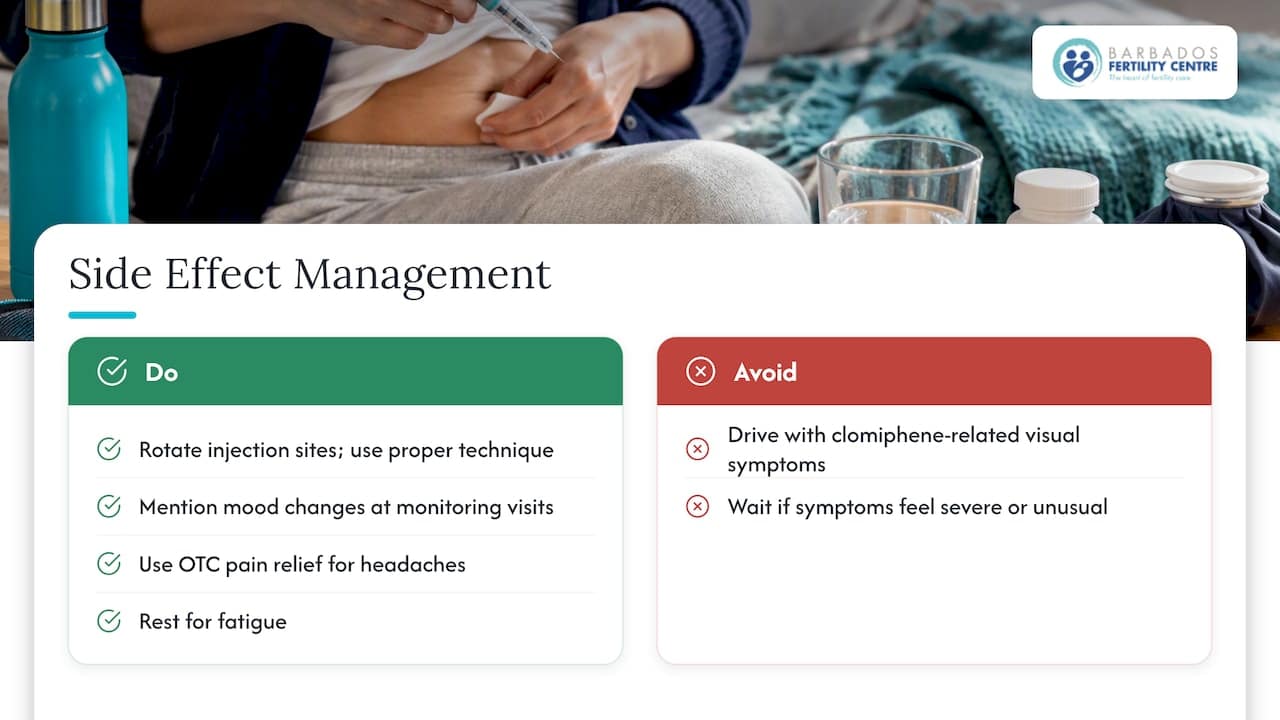
Beyond OHSS and multiple pregnancy, ovulation induction medications carry a set of milder, more common side effects worth knowing about. Clomiphene is frequently associated with hot flashes, mood changes, and occasionally blurred vision or light sensitivity, symptoms that prescribing information notes typically resolve once the medication course ends. Letrozole’s side effect profile tends to be milder for most patients, though fatigue, headache, and mild dizziness can occur during the days immediately following the course.
Gonadotropin injections can cause soreness, redness, or mild swelling at the injection site, along with occasional bloating as the ovaries respond to stimulation. Rotating injection sites and using proper technique reduces local discomfort considerably.
Mood fluctuations are common across all ovulation induction medications, since the hormonal shifts involved can affect emotional well-being temporarily. We encourage patients to mention any mood changes at monitoring visits, since adjusting the medication or dose sometimes helps.
Most side effects are manageable with simple measures: over-the-counter pain relief for headaches, rest for fatigue, and avoiding driving if visual symptoms occur with clomiphene. Any symptom that feels severe or unusual, rather than a mild nuisance, should prompt a call to your clinical team rather than waiting for the next scheduled visit.
Cost overview of ovulation induction medications and related monitoring
Costs for ovulation induction vary by medication class, dose, and how many monitoring visits a cycle requires. Oral agents like letrozole and clomiphene are generally the least expensive option, since they require fewer injections and a shorter monitoring schedule than gonadotropin cycles. Injectable gonadotropins cost more, both because of the medication itself and because these cycles typically need more frequent ultrasound and blood estradiol checks to adjust dosing safely.
Monitoring visits, the ultrasounds and bloodwork that guide every cycle, add up across the treatment window and are a necessary part of the total cost rather than an optional extra. We’ve found that U.S. patients researching IVF stimulation drugs alone often see costs in the thousands of dollars, which is part of why transparent, itemized pricing matters before treatment starts.
If ovulation induction alone doesn’t lead to pregnancy after several cycles, or if a patient’s diagnosis points toward IVF as the better next step, our IUI services and IVF options are priced separately and listed clearly so patients can weigh the full range of paths forward rather than being surprised mid-treatment. We always recommend discussing medication costs and monitoring fees together with your clinic before a cycle begins, since the two are inseparable parts of the same treatment.
Preparation before starting ovulation induction treatment
Before any medication is prescribed, baseline testing establishes a clear picture of what’s driving anovulation and whether oral agents or injectables make more sense. This usually includes hormone panels (FSH, LH, estradiol, and thyroid function), an assessment of ovarian reserve, and a pelvic ultrasound to check for structural issues such as fibroids or cysts. Our fertility healthcheck evaluations cover these baseline tests as a starting point for treatment planning.
Lifestyle factors matter too. Maintaining a healthy body weight improves response to both oral and injectable medications, and smoking cessation is consistently recommended before any fertility treatment begins, since smoking affects ovarian response and pregnancy outcomes. Limiting alcohol and caffeine, while not always a strict requirement, is commonly advised as part of general preparation.
Partners are often tested as well, since male-factor infertility can coexist with ovulation disorders and affect which treatment path, induction alone, IUI, or IVF, makes the most sense. We recommend discussing current medications and supplements with your clinician beforehand, since some can interact with ovulation induction drugs or mask early monitoring results. Taking these preparatory steps seriously shortens the path to an effective, personalized treatment plan rather than a trial-and-error approach.
Aftercare and next steps if ovulation induction fails or does not result in pregnancy
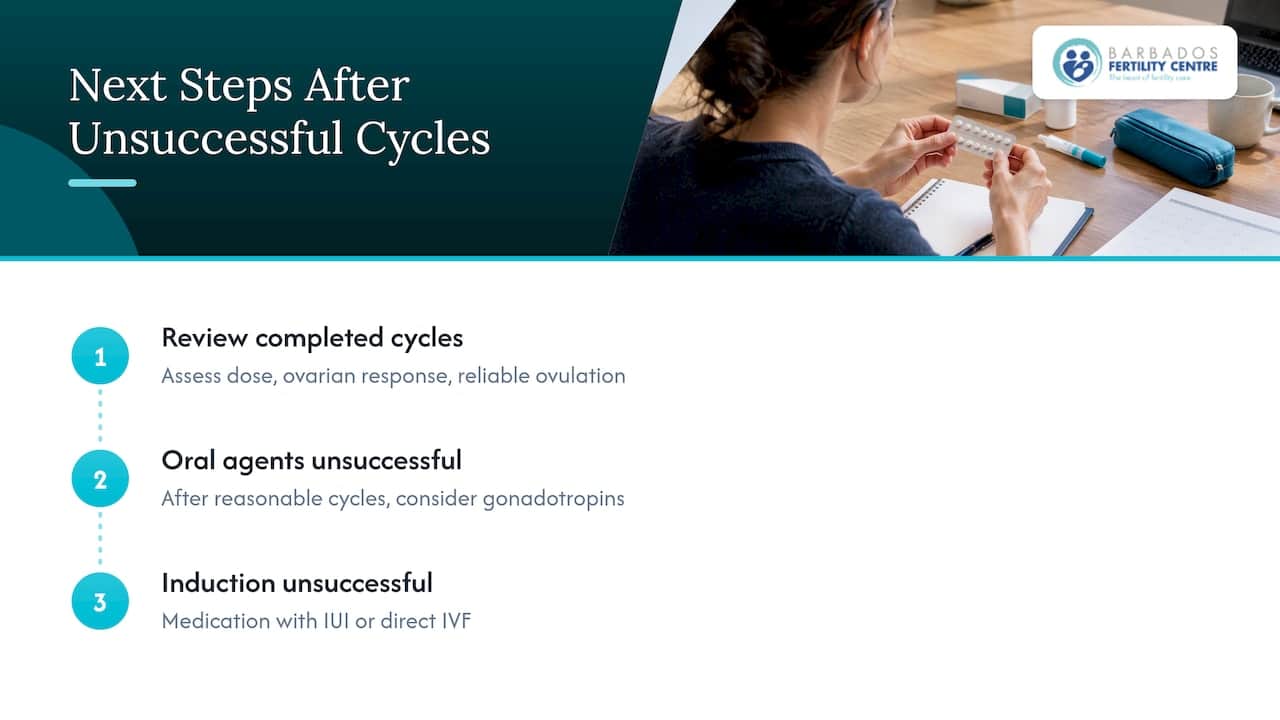
Not every cycle of ovulation induction results in pregnancy, even when ovulation itself is confirmed, and that’s a normal part of fertility treatment rather than a sign that something has gone wrong. Clinicians typically review several completed cycles, the dose used, how the ovaries responded, and whether ovulation occurred reliably, before deciding on next steps.
If oral agents haven’t worked after a reasonable number of cycles, moving to gonadotropin injections is a common next step, particularly for patients who haven’t yet tried that option. For patients who have exhausted ovulation induction alone without success, combining medication with IUI, or moving directly to IVF, are both well-established paths forward. Our guidance on what to ask before starting IVF can help frame that conversation with your clinical team.
Emotional support matters as much as the medical plan at this stage. Repeated unsuccessful cycles can be discouraging, and we encourage patients to lean on their care team for honest conversations about realistic next steps rather than continuing the same protocol indefinitely. A thoughtful review of what did and didn’t work, dosing response, follicle development, timing accuracy, often reveals a clearer path toward the treatment most likely to succeed.
A note on individualized care during ovulation induction
Every patient responds differently to the same starting dose, which is why we treat ovulation induction as a process of careful, ongoing adjustment rather than a fixed formula. The right medication and monitoring plan comes from a conversation with a fertility specialist who knows your specific history and test results.
— Barbados
How we support ovulation induction patients at Barbados Fertility Centre
We offer ovulation induction alongside IUI and IVF, so if oral agents or injectables alone don’t lead to pregnancy, your treatment plan can progress without starting over at a new clinic. Our pricing stays transparent from the first consultation: IUI cycles, including scans, start from $500, and IVF pricing is listed in full detail on the same page.
- We monitor every cycle with ultrasound and hormone testing to keep dosing safe and effective.
- We offer a free fertility healthcheck to help identify the right starting point for treatment.
- We provide full cost transparency through our IVF cost calculator.
If you’re ready to talk through your options, visit our IVF treatment abroad page to see how we can help plan your next cycle.
This article is general information, not a substitute for advice from a qualified doctor. Consult a qualified healthcare professional about your own circumstances before acting on anything here.
FAQ
What can I take to trigger ovulation?
A trigger injection of hCG or a GnRH agonist is used to complete follicle maturation once monitoring shows a follicle is ready. Ovulation typically occurs 36 to 48 hours after the trigger is given.
What is the role of clomiphene?
Clomiphene citrate is an FDA-approved oral medication that blocks estrogen receptors in the brain, prompting the body to release more FSH and LH to stimulate ovulation. The standard starting dose is 50 mg daily for 5 days, and it remains a common alternative to letrozole for certain patients.
How many days after taking letrozole will I ovulate?
Ovulation after a letrozole course most commonly follows the same general window seen with oral ovulation induction agents, typically 5 to 10 days after finishing the 5-day course. Monitoring with ultrasound confirms the exact timing for each patient.
Is ovulation induction the same as IVF?
No, ovulation induction and IVF are different treatments with different goals. Ovulation induction aims to produce one mature egg released naturally or timed for intercourse or IUI, while IVF involves retrieving multiple eggs for fertilization outside the body before transferring an embryo.
Sources
- Exogenous gonadotropins and ovulation induction (PMC6046677)
- Ovarian hyperstimulation syndrome clinical review (PubMed 27678032)
- ASRM committee opinion: use of exogenous gonadotropins for ovulation induction (2020)
- Letrozole versus clomiphene citrate in PCOS: review/meta-analysis (PubMed 26479460)
- CLOMID (clomiphene citrate) prescribing information (FDA)
Recommended
- IVF Patients: Evidence First Luteal Phase Support and JCI Clinic Plan
- Cut U.S. IVF Medication Costs: Stimulation Drugs Often $3,000–$7,000
- Making the Most of a Fertility Treatment Timeline: IVF Abroad
- IVF – What You Should Be Asking