


A standard travel insurance policy will usually not pay for a planned IVF cycle abroad, and it may not pay for complications that come from it either. To be protected, you need a specialist medical-travel policy that names IVF or your exact procedure, and you need its exclusions and limits in writing before you pay for flights. This guide shows how to tell the products apart, which questions to ask, and how to plan cover if you are a U.S. patient traveling to Barbados.
TL;DR
- Trip-cancellation cover and medical cover are different products. The U.S. State Department notes that trip-cancellation insurance usually does not pay foreign medical costs.
- Planned IVF is not an “unexpected illness.” Ask the insurer whether the policy accepts planned fertility treatment, and get the answer in writing.
- Check separately for complications (such as OHSS), medical evacuation, extended accommodation, and pregnancy-related care after transfer.
- Medicare and Medicaid generally do not pay for care outside the U.S., so confirm what your private health plan does abroad.
- Ask your clinic to document your protocol and dates before you buy. Insurers price and approve against those details.
Table of Contents
- Why IVF abroad needs its own insurance plan
- What ordinary travel insurance usually leaves out
- The complications you are actually insuring against
- Does your U.S. health plan or Medicare help abroad?
- Questions to put to any insurer, in writing
- A coverage checklist you can print
- What insurance costs, and how to budget
- Timing your trip and your cover
- If you become pregnant
- Our perspective: insurance is part of the plan, not an afterthought
- Pricing the treatment side of your trip
- Who needs to be most careful
- A step-by-step way to get covered
- FAQ
- Sources
Why IVF abroad needs its own insurance plan
Most people buy travel insurance to protect a vacation: a canceled flight, lost luggage, a sudden illness. IVF abroad is different. You are traveling on purpose to receive medical care, on known dates, with known medications and known risks. Insurers tend to treat that as a planned procedure rather than an accident of travel, and many standard policies are written to exclude it.
The CDC’s Yellow Book describes travel insurance, travel health insurance, and medical evacuation insurance as separate products. That matters here, because each one answers a different question:
| Product | What it is meant to do | Does it help with IVF? |
|---|---|---|
| Trip cancellation or interruption | Reimburses prepaid, nonrefundable trip costs for listed reasons | Only if your reason for canceling is a listed one. A failed or canceled cycle is rarely a listed reason |
| Travel medical (health) | Pays for emergency illness or injury abroad | Possibly for complications, but only if the policy does not exclude fertility treatment and its complications |
| Medical evacuation and repatriation | Moves you to appropriate care or home when medically necessary | Useful as a safety net. Check the trigger conditions |
| Specialist medical-travel policy | Written for people traveling for treatment | The only type likely to name IVF, ICSI, IUI, or egg freezing |
The point is not to scare you. Most IVF trips go as planned. The point is that the policies people reach for by default were not designed for this trip, and finding that out after a complication is expensive.
What ordinary travel insurance usually leaves out
Policy wording varies by insurer, so read yours. In general, expect these gaps:
- The planned treatment itself. The consultation, stimulation medication, egg retrieval, fertilization, and embryo transfer are scheduled care. They are typically not covered as emergencies.
- A failed cycle. No insurance product makes IVF succeed, and a negative result is not an insured event.
- Pre-existing conditions. The CDC’s guidance on what to do when sick abroad notes that policies vary widely and that pre-existing conditions are often excluded. Infertility diagnoses, PCOS, endometriosis, and clotting disorders can all raise questions.
- Pregnancy. Many policies exclude pregnancy complications or neonatal care abroad. This becomes relevant the moment a transfer works.
- Travel against medical advice. Some policies void cover if you travel when your doctor has advised otherwise.
Specialist insurers do exist for this niche. For example, one U.K.-based medical travel insurer for IVF abroad says it covers life-threatening complications during a procedure, while listing exclusions such as pre-existing conditions unrelated to the treatment. Product availability, eligibility for U.S. residents, and terms differ by insurer and change over time, so treat any example as a prompt for your own questions, not a recommendation.
The complications you are actually insuring against
It helps to know what the realistic risks are, because that tells you which benefits matter. The American Society for Reproductive Medicine (ASRM) identifies ovarian hyperstimulation syndrome (OHSS), deep-vein thrombosis, and pulmonary embolism among the risks of fertility treatment, with higher risk in some patients, including those with obesity, polycystic ovary syndrome, or thrombophilias.
For most patients these are uncommon, and a good clinic screens for them and adjusts the protocol. But the practical window to think about runs from the start of ovarian stimulation through egg retrieval and into early pregnancy. If you develop symptoms such as severe abdominal pain, rapid weight gain, shortness of breath, or a swollen painful leg, you need urgent medical care, and your clinic should tell you in advance who to call and where to go.
What that means for your policy:
- Hospitalization. Does the policy pay a local hospital directly, or do you pay and claim back?
- Evacuation. The CDC says medical evacuation can cost from USD 25,000 within North America to more than USD 250,000 from distant or remote locations. Ask how the insurer decides that evacuation is “medically necessary.”
- Extended stay. If you cannot fly home on schedule, does the policy pay for extra nights and rebooked flights?
- Complications after you return. Ask whether complications that begin after you are back in the United States are covered, and for how many days after treatment.
Does your U.S. health plan or Medicare help abroad?
Do not assume it does. The State Department states plainly that the U.S. government does not pay medical costs for U.S. citizens abroad, and Medicare says it usually does not cover health care outside the U.S., with a few narrow exceptions. Medicaid follows a similar pattern.
Private employer or marketplace plans vary. Some cover emergencies abroad, many apply out-of-network rules, and almost none treat elective treatment in another country as an in-network benefit. If your plan does cover fertility care at home, that does not mean it reimburses a clinic in another country. Call the member services number and ask three things: whether emergency care abroad is covered, whether complications of fertility treatment received abroad are covered, and what documentation a claim would need.
Questions to put to any insurer, in writing
Phone answers are not worth much if a claim is later denied. Send an email or use the insurer’s chat and save the transcript. Ask:
- Does this policy accept a planned fertility procedure (name it: IVF, ICSI, IUI, egg freezing, or donor cycle) at a named clinic in Barbados?
- Are complications of that procedure covered, including OHSS, bleeding, infection, and blood clots? Is there a sub-limit?
- How are pre-existing conditions defined, and is there a look-back period?
- Is medical evacuation and repatriation included, and what is the maximum benefit?
- Is extended accommodation covered if I cannot travel home on the planned date?
- If I become pregnant, are pregnancy-related and newborn complications covered abroad, and until what week?
- Does the insurer pay the hospital directly, or must I pay first and submit receipts?
- Is there a 24-hour assistance line, and does it arrange care at the destination?
- What happens if my doctor changes my dates?
- Is there a deductible, and is prior authorization required?
If a policy will not name your procedure, assume it is not covered.
A coverage checklist you can print
The CDC recommends carrying medical records, identifying appropriate care at your destination, and confirming a policy’s limitations before you travel, particularly for pregnant travelers. Adapted for an IVF trip:
- Planned procedure, protocol, and dates (from your clinic)
- Emergency treatment for complications
- OHSS and thromboembolism specifically named or not excluded
- Hospitalization benefit and limit
- Medical evacuation and repatriation limit
- Extended accommodation and rebooked flights
- Trip interruption terms
- Pregnancy and neonatal benefits, if relevant
- Pre-existing condition rules
- Deductible and prior authorization
- 24-hour assistance number saved in your phone
- Claims documentation: receipts, medical reports, and prescriptions
What insurance costs, and how to budget
There is no reliable public price for IVF-specific cover, because it depends on your age, medical history, the procedure, the destination, and the limits you choose. What the CDC does give is a general benchmark: comprehensive travel policies can cost up to 8% of the trip cost when cancellation is limited to listed reasons, and up to 15% for cancellation for any reason. That figure is for comprehensive trip policies, not a quote for fertility cover, so use it only to size a line in your budget and get real quotes.
When you compare the total cost of IVF abroad against treatment at home, include insurance, flights, accommodation, and medication alongside clinic fees. Our guide to breaking down IVF costs walks through each category, and our IVF cost calculator helps you build an estimate.
Timing your trip and your cover
Travel during IVF is often possible, but timing should be individualized with your reproductive endocrinologist and the clinic abroad. Practical points:
- Buy early, but read cancellation terms. Some benefits, especially for pre-existing conditions, depend on buying soon after your first trip deposit. Ask the insurer.
- Get dates from the clinic first. Cover bought against vague dates may not match what happens. Many protocols can be coordinated remotely, with monitoring at home and a shorter stay abroad. See how to make the most of an IVF abroad timeline.
- Plan the flight home. Many patients ask whether flying soon after transfer affects results. Our review of 2,135 transfers found no clear difference related to flying. Your own doctor should still decide what is right for you.
- Carry records and medication. Keep your protocol, medication list, and clinic contact details with you, and confirm airline rules for carrying injectables.
Barbados also requires visitors to complete an online immigration and customs form ahead of arrival. Check current entry requirements before you book, since rules can change.
If you become pregnant
A positive result is the outcome everyone hopes for, and it is also when insurance gaps matter most. The CDC says travel is rarely contraindicated in a normal pregnancy, while pregnancies that need frequent monitoring may warrant avoiding travel. It also advises pregnant travelers to consider insurance that covers pregnancy-related problems and neonatal care.
A policy that covers an emergency appendectomy may still exclude a threatened miscarriage or a premature delivery abroad. If you plan to stay in Barbados past the pregnancy test, check whether pregnancy benefits are explicit and for how many weeks they apply. Most patients fly home before this stage and continue care with their own doctor, so also confirm your U.S. health plan covers prenatal care that begins after treatment abroad.
Our perspective: insurance is part of the plan, not an afterthought
We have treated patients from around the world since 2002, and the question we hear from U.S. patients is rarely “is the medicine good?” It is “what happens if something goes wrong a thousand miles from home?” That is a fair question, and it deserves a straight answer.
Our view is simple. First, no policy replaces a well-run cycle. The best protection is a clinic that screens your risk before stimulation, adjusts your protocol to your history, and monitors you closely. Barbados Fertility Centre operates under JCI accreditation, an international standard for healthcare quality, and personalizing the protocol is how we approach every patient.
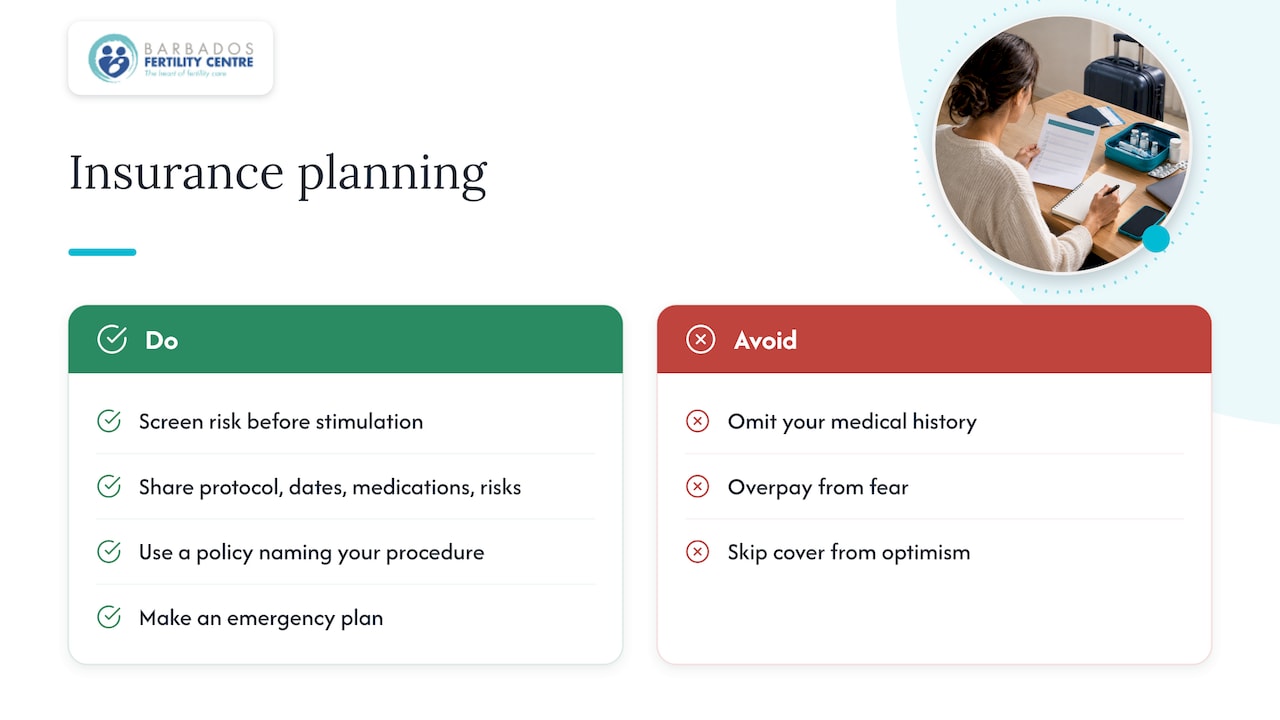
Second, insurance works best when the clinic and the insurer have the same facts. Ask us for your documented protocol, expected dates, medications, and known risks before you buy. Give that to the insurer exactly as written, and do not leave out your history. An omission is the easiest reason for a claim to fail.
Third, do not let fear of the unlikely drive you to overpay, and do not let optimism lead you to skip cover. A written checklist, a specialist policy that names your procedure, and a clear emergency plan take a few hours and remove most of the uncertainty. Our coordination team works with international patients remotely, so you can ask these questions before you commit to any dates.
— Barbados
Pricing the treatment side of your trip
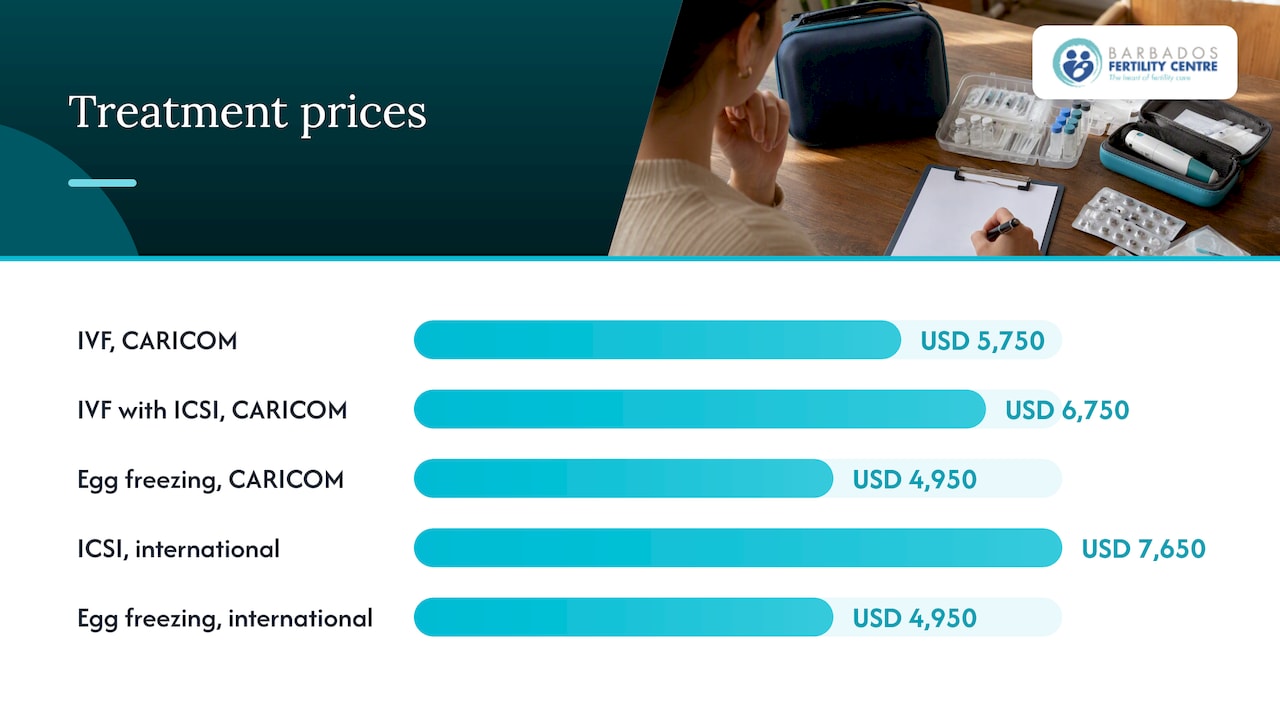
Insurance is only one line in the budget. Our published prices are in US dollars: IVF from 5,750 USD, IVF with ICSI from 6,750 USD, and egg freezing from 4,950 USD on the CARICOM price list, while the international price list shows ICSI at 7,650 USD and egg freezing at 4,950 USD. IUI starts from 500 USD per cycle, including scans. Which list applies depends on your residency, and medications and travel are additional. For a U.S. patient, the IVF abroad overview explains how a cycle is organized and what a typical stay looks like.
Seeing the numbers in advance lets you size your insurance budget against the full cost, and compare it honestly with quotes you may have received at home. Some patients tell their story in our U.S. patient testimonial if you want to hear how the decision felt from the other side.
Who needs to be most careful
ASRM says fertility treatment is not governed by one universal eligibility rule: clinicians should assess each patient’s risk, counsel them on benefits and alternatives, and may decline treatment when the risk is unacceptably high. Be especially thorough with your insurer if any of the following apply:
- A history of OHSS in a previous cycle
- PCOS or a high number of antral follicles
- A known clotting disorder or a family history of thrombosis
- Obesity or other conditions your doctor flags as raising risk
- A pregnancy that already needs close monitoring
These are not automatic barriers to treatment. They are reasons to speak with your own doctor and our medical team early, and to disclose them accurately when you apply for cover. Age also shapes the plan, and our guide on how old is too old for IVF covers what doctors say about age and success rates.
A step-by-step way to get covered
- Talk to your own doctor about whether travel is appropriate for your history, then book a consultation with the clinic.
- Request your written protocol and expected dates from the clinic.
- Call your health plan and ask what it covers abroad, in writing.
- Request quotes from at least two specialist medical-travel insurers and one standard travel insurer so you can see the differences.
- Send the 10 questions above and keep every reply.
- Choose the policy that names your procedure, covers complications and evacuation, and states its pregnancy terms.
- Buy it at the point the terms recommend, then save the policy number, assistance line, and claim forms on your phone.
- Carry copies of your records, prescriptions, and the clinic’s emergency contact.
FAQ
Does travel insurance cover IVF abroad?
Usually not under a standard policy. Planned fertility treatment is typically treated as elective care, and failed cycles are not insured events. Look for a specialist medical-travel policy that names your procedure, and get its exclusions in writing.
Does travel insurance cover you if you are pregnant?
It depends on the policy. The CDC notes that many policies exclude pregnancy-related or newborn complications abroad, so pregnancy benefits should be explicit. Ask what weeks of pregnancy are covered and whether it applies after an embryo transfer.
Will Medicare or my U.S. health plan pay for care in Barbados?
Medicare and Medicaid generally do not cover care outside the United States. Private plans vary, so call your insurer and ask specifically about emergencies and fertility-treatment complications abroad.
Can you travel while undergoing IVF?
Often yes, but timing should be agreed with your reproductive endocrinologist and the treating clinic. The windows that need the most care are ovarian stimulation, the days after egg retrieval, and early pregnancy.
Is IVF 100% successful?
No. No clinic and no insurance policy can guarantee a pregnancy, and outcomes depend on age, diagnosis, and individual response. A consultation with your doctor and ours will give you a realistic view of your own chances.
Sources
- CDC Yellow Book: Travel Insurance, Travel Health Insurance, and Medical Evacuation Insurance
- U.S. Department of State: Travel Insurance
- CDC Yellow Book: What To Do When Sick Abroad
- CDC Yellow Book: Pregnant Travelers
- ASRM Ethics Committee opinion (2022): fertility services for women at increased risk of complications
- Medicare: Travel outside the U.S.
- Medical Travel Shield: IVF travel insurance
- Barbados travel documents and entry requirements
Recommended
- Making the Most of a Fertility Treatment Timeline: IVF Abroad
- Top 10 Myths of Doing IVF Abroad
- Flying After Embryo Transfer: 2,135 Transfers, No Clear Difference