


A freeze-all IVF cycle means every viable embryo from your egg retrieval is frozen, and none is transferred fresh. The transfer happens later, in a separate frozen embryo transfer (FET) cycle. For some patients this is the safest and most effective route. For others it adds time and cost without a proven gain. This guide explains which group you may fall into, so you can have a more useful conversation with your doctor.
TL;DR
- Freeze-all (also called deferred or elective frozen transfer) means freezing all embryos after stimulation and transferring in a later cycle.
- It is well supported when there is a high risk of ovarian hyperstimulation syndrome (OHSS), when progesterone is elevated at the end of stimulation, or when you are doing PGT-A testing.
- For the general IVF population with none of those reasons, there is no high-quality evidence that routine freeze-all raises cumulative live birth rates.
- It lengthens the time between retrieval and a pregnancy test, and it adds a FET cycle and storage to your budget.
- Ask your clinic why it is recommended for you specifically, not as a default.
Table of Contents
- What “freeze-all” means in IVF
- When freeze-all has a clear medical reason
- When freeze-all may not add value
- How freeze-all changes your timeline
- What freeze-all does to your costs
- Our perspective on freeze-all
- Treatment with us
- Questions to ask your doctor before agreeing to freeze-all
- FAQ
- Sources
What “freeze-all” means in IVF
In a conventional IVF cycle, one or two fresh embryos are transferred a few days after egg collection, and any remaining good embryos are frozen. In a freeze-all cycle, the freeze-all practice is to cryopreserve all mature oocytes or viable embryos after ovarian stimulation. Your uterus gets a rest, and the transfer is scheduled in a later, usually non-stimulated or hormone-prepared cycle.
The approach became practical because of vitrification, an ultra-fast freezing technique that largely avoids damaging ice crystals. The same PMC review notes that vitrification was crucial to making freeze-all a reality. Today, most embryos survive thawing, which is why the strategy moved from a niche tool to a routine option in many clinics.
You will see several names for the same thing: freeze-only, deferred embryo transfer, elective frozen embryo transfer, or a “segmented” cycle. The word “elective” matters. It describes freeze-all chosen by preference or protocol, not because a medical problem forces it.
When freeze-all has a clear medical reason
Three situations come up again and again in the clinical literature.
You are at high risk of OHSS
OHSS is a reaction in which fertility drugs make the ovaries overrespond. A pregnancy can make it worse, which is why avoiding a fresh transfer matters. A 2019 Cochrane review found lower OHSS rates after a freeze-all strategy than after fresh transfer, with a reduction from a 4% baseline to roughly 1% to 2% described in the PMC review. Patients who produce many follicles, such as those with polycystic ovary syndrome or a high egg count, are the ones most often offered this route. For high-risk patients, freeze-all is considered the preferred medical management.
Progesterone is elevated at the end of stimulation
Sometimes progesterone rises before the trigger shot. That can affect how receptive the uterine lining is to a fresh embryo. By waiting, the body’s hormones return to baseline, and the lining can be prepared on a schedule for FET. This is also described in the PMC review of freeze-all.
You plan to test embryos with PGT-A
Preimplantation genetic testing for aneuploidy (PGT-A) checks embryos for the wrong number of chromosomes. Results take time, and the ASRM notes that most clinics do not process the biopsied cells in-house, and that blastocysts can be biopsied on day 5, 6 or 7. A fresh transfer would not wait for results, so the embryos are frozen and the best one is transferred later. This is why freeze-all and PGT-A often travel together.
When freeze-all may not add value
Here is the part many clinic pages skip. If you have none of the reasons above, the evidence for routine freeze-all is weaker than the marketing suggests.
The UK regulator, the HFEA, rates elective freeze-all cycles as a treatment add-on and states that, for people without a specific indication, there is no high-quality evidence that it improves cumulative live birth rates. The HFEA is a UK body, so its rating is not US guidance, but the underlying trial evidence is international.
That evidence includes a multicentre randomized trial in women with regular menstrual cycles published in The BMJ, which compared ongoing pregnancy rates between freeze-all and fresh transfer. The Cochrane evidence summary on fresh versus frozen transfers asks the same safety and effectiveness question. The Lancet commentary on elective frozen transfer for all describes how quickly the practice was adopted after vitrification arrived. Adoption ran ahead of proof.
A Canadian guideline captures the trend. Freeze-all cycles in Canada rose from 24% to 78% over a decade, and experts link this mainly to the spread of PGT-A, not only to medical need. The authors of the Canadian Fertility and Andrology Society guideline say the strategy should be personalized to patient characteristics, not applied to everyone.
The practical reading: freeze-all is a tool, not an upgrade. If your doctor recommends it, you should hear a specific reason.
How freeze-all changes your timeline
The biggest everyday difference is time. Because the transfer is delayed until a later cycle, the time to pregnancy is longer than with a fresh transfer. Plan for it emotionally and logistically.
A typical sequence looks like this:
- Stimulation and monitoring. Injectable medication and scans over roughly two weeks, tailored to you.
- Egg retrieval. A short procedure under sedation.
- Fertilization and culture. Eggs are fertilized by standard IVF or ICSI, and embryos grow in the lab.
- Vitrification. All suitable embryos are frozen, with or without a biopsy for PGT-A.
- Recovery. Your body returns to baseline, often for a menstrual cycle or more.
- FET preparation. The lining is prepared with medication or tracked in a natural cycle.
- Embryo transfer and pregnancy test.
If you are traveling for treatment, this matters twice. You might complete steps 1 to 4 on one trip and return for the transfer later, or arrange the transfer around your own calendar. Embryos can wait in storage, so scheduling is flexible, but you need a clear plan before you book flights.
What freeze-all does to your costs
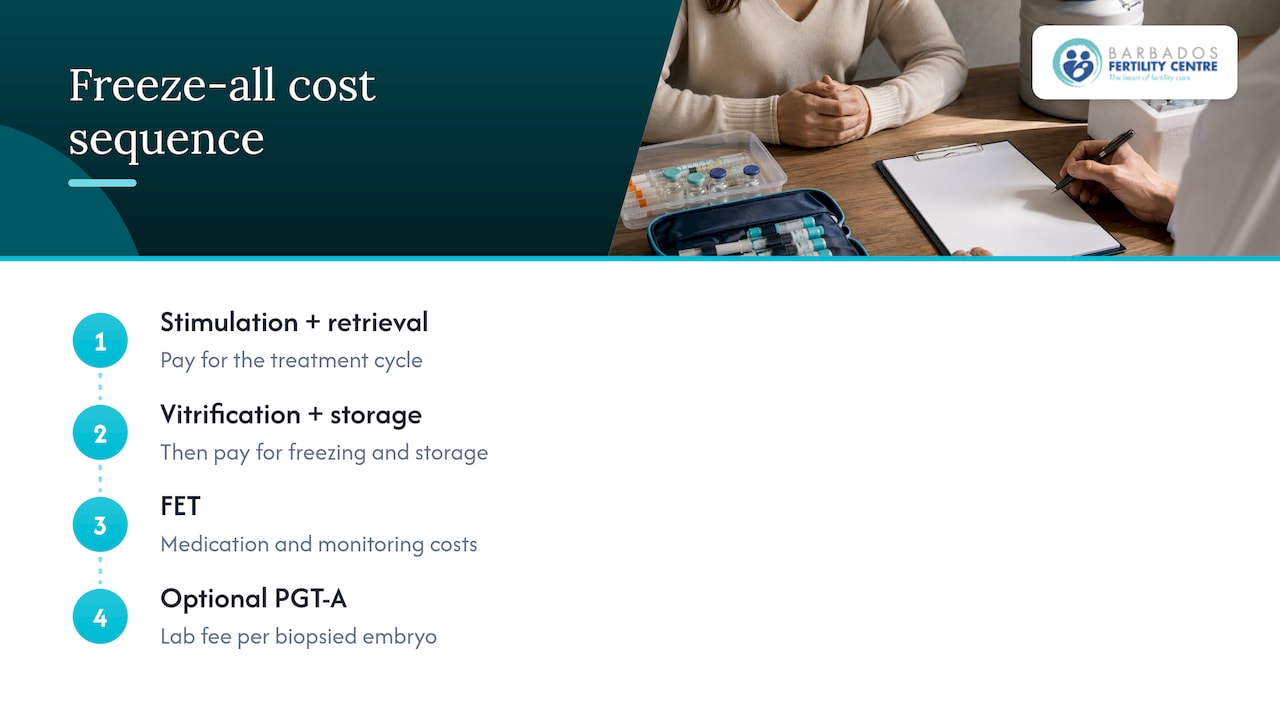
Freeze-all splits one fresh-transfer cycle into two procedures. You pay for the stimulation and retrieval cycle, then for vitrification, storage and a FET with its own medication and monitoring. If you add PGT-A, there is a lab fee per biopsied embryo on top. The HFEA advises patients paying out of pocket to weigh a single cycle with unproven add-ons against funding more cycles of standard, proven treatment.
That is a fair way to think about it. If freeze-all is medically needed, it is simply part of the treatment. If it is optional, it deserves the same cost-benefit scrutiny as any add-on.
For a US budget view, our itemized guide to embryo freezing costs in the US breaks down each line item. Medication is often the largest surprise, and we cover it in IVF medication costs. To estimate your own total, use the IVF cost calculator.
Published treatment prices at our clinic
We publish our prices so you can compare them with a US quote. These are our listed amounts:
| Treatment | Price |
|---|---|
| IVF | from 5750 USD |
| IVF with ICSI | from 6750 USD |
| ICSI | 7650 USD |
| Embryo donation cycle | 5000 USD |
| Egg freezing | 4950 USD |
Prices differ between our CARICOM price list and our international price list, so check the list that applies to you. A treatment plan can vary with your medical situation, so confirm what your quote includes.
Our perspective on freeze-all
We see freeze-all as a clinical decision, not a sales feature. When a patient is at risk of OHSS, or when progesterone is high on the day of the trigger, we are comfortable saying that waiting is the better medicine. When a patient has a good response and no complicating factor, we think the honest conversation is about trade-offs: a longer wait and an extra cycle against a benefit that trials have not shown for the average patient.
Our approach is personalized care. Every patient responds differently to stimulation, so the decision about fresh or frozen transfer is best made with your own scan results and hormone levels in front of you, ideally before stimulation begins and again before the trigger. We also know that cost is a stress of its own. That is why we publish prices, and why we would rather help you fund a proven plan than add steps that may not change your odds.
If you are comparing options from outside the US, we coordinate treatment remotely before you travel, so most of the planning is done from home.
— Barbados
Treatment with us
Barbados Fertility Centre has treated patients since 2002, holds JCI accreditation, and offers IVF, ICSI, IUI, egg freezing, egg donation and embryo freezing in a private, calm setting. If you want a freeze-all cycle quoted against a US estimate, start with our IVF treatment abroad page, or review our IVF treatment overview. If egg freezing rather than embryo freezing is your goal, see egg freezing at our clinic.
Questions to ask your doctor before agreeing to freeze-all
Bring these to your consultation. They work at any clinic.
- What is my specific reason? OHSS risk, progesterone level, PGT-A, or a uterine lining concern are all legitimate answers.
- What would you do if I did a fresh transfer instead? A good doctor can explain the difference for your case.
- How many embryos do you expect to freeze, and what is the thaw survival rate in your lab?
- What will the FET cycle cost in total, including medication, monitoring and storage?
- If I plan PGT-A, who processes the biopsy, and how long do results take?
- How long until the first transfer?
Our guide IVF: what you should be asking covers more questions for your first appointment.
FAQ
What does “freeze all” mean in IVF?
It means all viable embryos from one stimulation cycle are frozen by vitrification and none are transferred fresh. The transfer takes place in a later frozen embryo transfer cycle. It is chosen either for a medical reason or by clinic or patient preference.
What are the downsides of freezing all embryos?
The main downsides are a longer wait before a pregnancy test, an extra FET cycle with its medication and monitoring, and storage fees. For patients without a specific indication, the HFEA says there is no high-quality evidence that routine freeze-all improves cumulative live birth rates. Ask your doctor whether the benefit applies to you.
Does freeze-all reduce the risk of OHSS?
Yes. A Cochrane review found lower OHSS rates after freeze-all than after fresh transfer, with figures falling from about 4% to between 1% and 2%, as summarized in the PMC review. If you have many follicles or a history of OHSS, ask your doctor about it before stimulation starts.
Is freeze-all necessary if I am doing PGT-A?
In most cases, yes, or very nearly. Biopsy results take time, and the ASRM notes that most clinics send the cells to an outside lab, so embryos are usually frozen while you wait. The best embryo is then transferred in a later cycle.
Can I do freeze-all abroad and transfer later?
Often you can, because frozen embryos can be stored and transferred when you are ready. The details depend on the clinic and your medical plan, so ask for a written schedule and cost estimate. Our team can explain how we coordinate treatment for international patients.
Sources
- Freeze-all, for whom, when, and how (PMC)
- Elective freeze all cycles (HFEA)
- Approaches to frozen embryo transfer: a Canadian Fertility and Andrology Society guideline
- The use of preimplantation genetic testing for aneuploidy: a committee opinion (ASRM, 2024)
- Freeze-all versus fresh blastocyst transfer in women with regular menstrual cycles (The BMJ)
- Fresh versus frozen embryo transfers for assisted reproduction (Cochrane)
- Elective frozen embryo transfer for all? (The Lancet)
Recommended
- $10,000–$20,000 to Freeze Embryos in the US: An Itemized Cost Breakdown
- Egg Freezing Info
- Cut U.S. IVF Medication Costs: Stimulation Drugs Often $3,000–$7,000
- Freeze Your Eggs Before 35? What the Evidence and AMH Say