


A single IUI cycle typically runs from a few hundred dollars for a natural, unmedicated cycle up to several thousand when stimulation medication and frequent monitoring are added. The biggest swing factors are medication choice (oral versus injectable), how many ultrasounds and blood draws your clinic requires, whether you need donor sperm, and how much your insurance plan actually covers. Check your policy early, then read on for a line-by-line breakdown.
TL;DR:
- Clinics usually bill sperm washing separately from insemination, so request an itemized quote specifying procedure, lab work, medication, and included monitoring visits.
- Injectable gonadotropins can cost substantially more than oral drugs, while offering only modest outcome gains for many patients with unexplained subfertility.
- Before treatment, get written confirmation of coverage, deductible, lifetime caps, prior authorization, and exclusions; plans may cover procedures but not medication or donor sperm.
- Three IUI cycles could cost $1,800 with natural cycles and minimal monitoring, or $9,000 with injections, intensive monitoring, and donor sperm.
- IUI succeeds in roughly 10% to 15% of cycles, and blocked tubes or severe male factor can make repeated attempts less worthwhile.
Table of Contents
- What drives the base clinic and lab fees
- How your medication and monitoring choices change the bill
- Checking insurance and financing a cycle
- What multiple cycles really cost over time
- Building your own cost estimate
- What a single cycle looks like day to day
- Indirect costs for patients traveling to Barbados
- Who is a good candidate for IUI, and how that affects value
- Getting clear answers on your invoice before you start
- Our approach to transparent pricing
- Get a personalized IUI quote
- FAQ
- Sources
What drives the base clinic and lab fees
The procedure itself is only one piece of the invoice. Clinics typically charge a base fee for the insemination visit, then add separate charges for sperm processing, lab work, and any donor sperm purchase. Procedure-only pricing varies widely between clinics and regions, which is why two patients can describe very different “IUI costs” and both be accurate.
Sperm needs to be washed and concentrated before insemination, a process billed as its own line item in most clinics. The ASRM coding resources for sperm preparation show that CPT 58322 covers the insemination procedure while sperm wash and preparation are billed separately under distinct codes, which is why a single “IUI” line on your invoice rarely reflects the full charge.
Your invoice will likely include these components:
- Clinic or procedure fee for the insemination appointment itself.
- Sperm wash and preparation charge, billed separately from the procedure in most practices.
- Donor sperm purchase fee if partner sperm is not being used.
- Baseline lab work, such as infectious disease screening required before treatment.
Some clinics advertise an all-in “IUI package” that bundles the procedure, a basic medication protocol, and a set number of monitoring visits into one price. Others bill à la carte, where each ultrasound, blood draw, and medication refill appears as its own charge. Neither approach is inherently cheaper, but package pricing is easier to budget against, while à la carte billing rewards patients who need fewer monitoring visits. Ask for a written, itemized quote before you commit, so you know which model you’re paying for.
How your medication and monitoring choices change the bill
Medication is where IUI budgets diverge the most. Oral agents like clomiphene citrate and letrozole cost a fraction of injectable gonadotropins, and that gap compounds fast once you factor in multiple cycles.
A peer-reviewed cost-effectiveness analysis found that average medication costs across four cycles vary significantly, with oral agents costing much less than injectable gonadotropins, according to research published in PMC. That same analysis concluded that injectable gonadotropins raise cumulative medication spending substantially compared with oral agents, while delivering only modest gains in outcomes for many patients with unexplained subfertility.
Monitoring adds its own layer of cost. A typical stimulated cycle involves:
- A baseline ultrasound and bloodwork before starting medication.
- Two to four follow-up visits combining ultrasound and blood draws to track follicle growth.
- A trigger-shot visit and the insemination appointment itself.
Each monitoring visit carries its own ultrasound and lab fee, so a cycle needing four visits costs meaningfully more in monitoring alone than one needing two. Clinics manage this tradeoff by setting cancellation thresholds: if too many follicles develop, some cycles are converted to IVF or canceled outright to avoid a high-order multiple pregnancy, which protects patient safety but also means the medication cost for that cycle may not translate into an insemination attempt. We recommend reviewing medication cost-saving strategies before choosing a stimulation protocol.
Checking insurance and financing a cycle
Fertility coverage varies enormously by employer and by state, and the only way to know your real out-of-pocket number is to get it in writing. RESOLVE’s insurance guidance notes that many employer plans still exclude infertility treatment entirely, and coverage depends heavily on state mandates and individual plan design.
Before your first appointment, request:
- A copy of the plan’s infertility or fertility treatment coverage pages, not just a summary.
- The deductible amount and whether it has already been met this year.
- Any dollar caps or lifetime maximums specific to fertility treatment.
- Whether prior authorization is required for medication or the procedure.
- Whether donor sperm costs are excluded, since many plans cover the procedure but not donor materials.
Medication is the line item insurers most often leave to the patient, even on plans that cover the procedure and monitoring. RESOLVE’s guidance on navigating insurance recommends contacting HR and your clinic’s billing office together, since billing staff can translate plan language into real-world cost estimates and flag coverage gaps before treatment starts.
Pro Tip: Ask your clinic whether a specialty pharmacy or manufacturer coupon program applies to your stimulation medication: these programs can meaningfully lower out-of-pocket drug costs.
When insurance falls short, payment plans and fertility-specific loans are worth asking about directly. Confirm the interest rate, whether payment is due per cycle or upfront for a multi-cycle package, and what happens to unused funds if you conceive earlier than planned.
What multiple cycles really cost over time
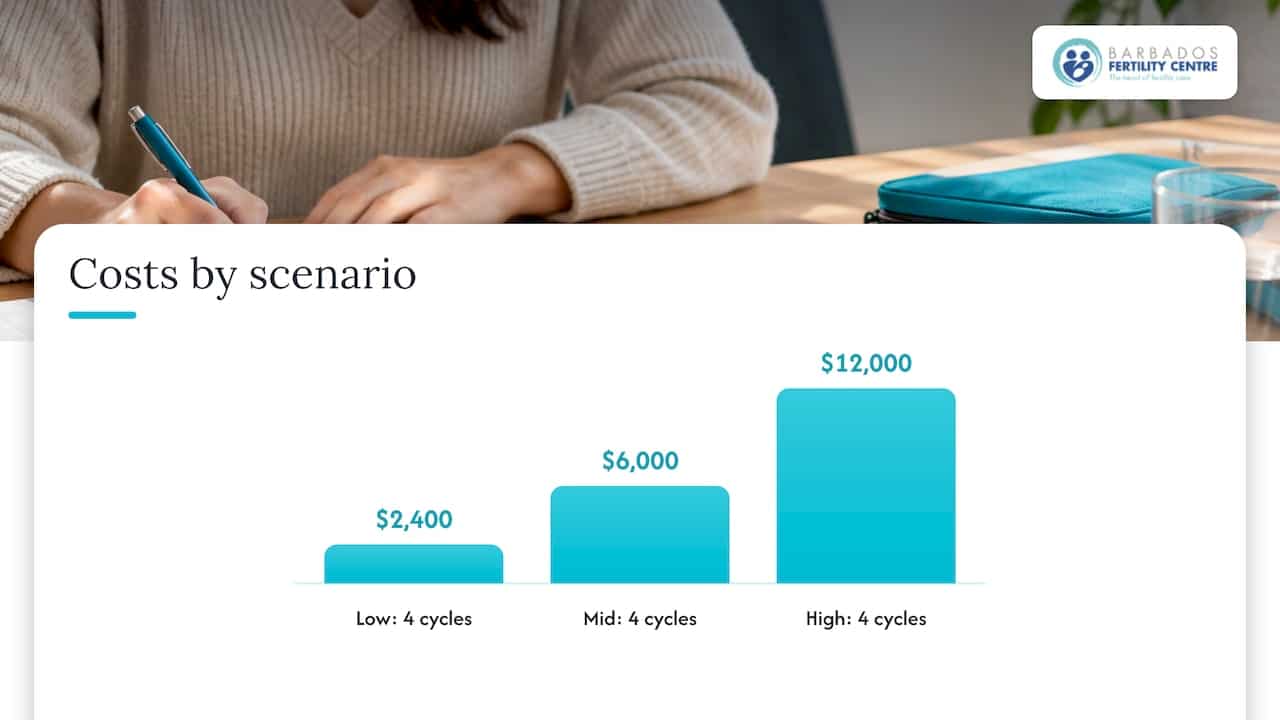
Because IUI succeeds in roughly 10 to 15% of cycles, according to the Hugh Wynter Fertility Centre at UWI, most patients should budget for more than one attempt rather than treating a single cycle’s price as the full picture.
Consider three illustrative scenarios based on per-cycle cost, low, mid, and high:
- Low scenario ($600/cycle, natural cycle, minimal monitoring): 1 cycle = $600; 3 cycles = $1,800; 4 cycles = $2,400.
- Mid scenario ($1,500/cycle, oral medication plus standard monitoring): 1 cycle = $1,500; 3 cycles = $4,500; 4 cycles = $6,000.
- High scenario ($3,000/cycle, gonadotropins plus intensive monitoring and donor sperm): 1 cycle = $3,000; 3 cycles = $9,000; 4 cycles = $12,000.
These figures are illustrative math built on round per-cycle inputs, not published averages, and your own clinic’s quote should replace them. The pattern matters more than the exact numbers: choosing injectable medication over an oral agent can push a four-cycle budget from the low thousands into five figures, which is exactly the tradeoff the PMC cost-effectiveness study weighs against the modest success-rate gains gonadotropins sometimes provide. Donor sperm adds a recurring per-cycle purchase cost on top of whichever medication path you choose, so factor that into every cycle of your projection, not just the first.
Building your own cost estimate
A simple worksheet keeps the moving pieces organized before you commit to a cycle:
- Write down the clinic’s base procedure fee and sperm processing charge.
- Add your chosen medication plan’s exact pharmacy quote, not a general price range.
- Add the estimated number of monitoring visits multiplied by your clinic’s per-visit fee.
- Include donor sperm costs if applicable, plus travel and lodging if you’re treating away from home.
- Add a contingency line of 10 to 15% for extra monitoring visits or a repeated test.
Get your insurer’s deductible, exclusions, and prior authorization rules in writing first, then take that document to your clinic’s billing office to fill in the procedure and medication numbers they control. Our cost calculator and procedure price list are built for exactly this exercise.
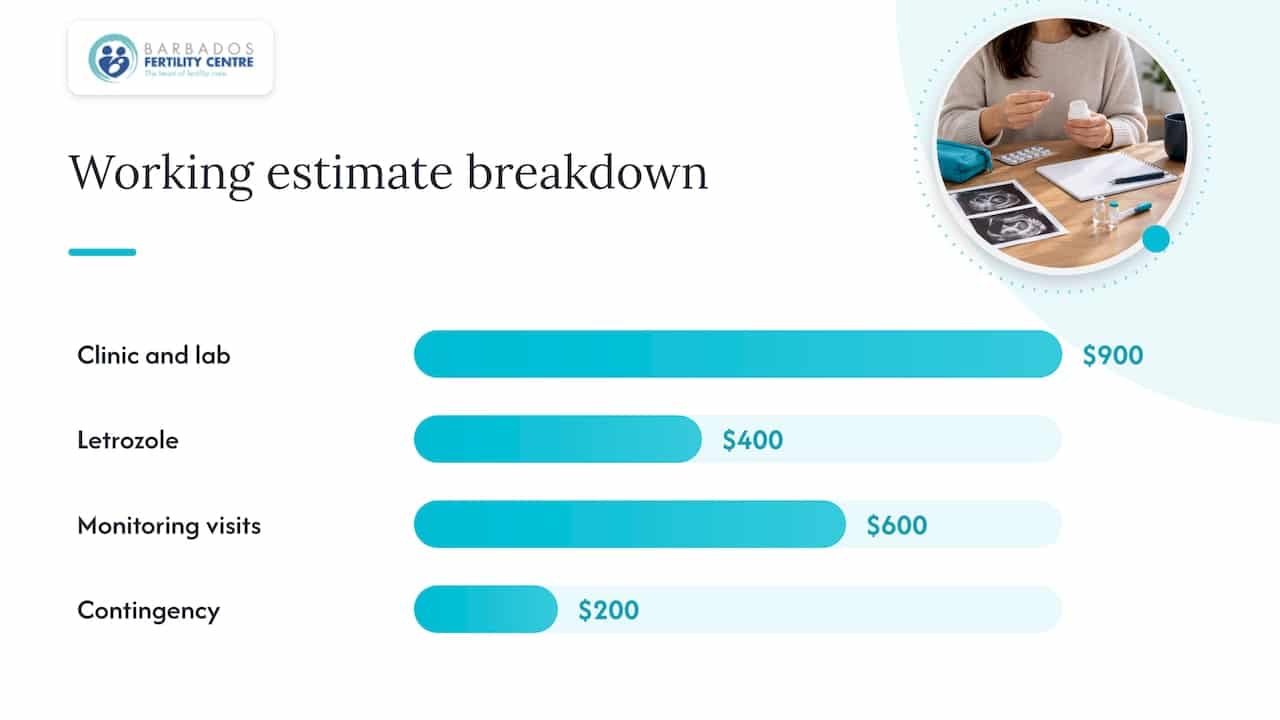
Pro Tip: Say your worksheet totals a $900 clinic and lab fee, a $400 letrozole prescription, $600 in monitoring visits, and a $200 contingency: that’s a $2,100 working estimate before travel, which you can then compare line-by-line against any clinic’s written quote.
What a single cycle looks like day to day
A stimulated IUI cycle typically spans two to three weeks from the first monitoring appointment to the insemination itself. Oral medications like letrozole or clomiphene are usually taken for five days early in the cycle, followed by two to four monitoring visits spaced a few days apart as follicles develop. The insemination appointment itself is brief, often done in under 15 minutes, but it falls on a specific day determined by your trigger shot or natural ovulation timing, which means it cannot always be scheduled around your calendar.
This timing has real budget implications. Each monitoring visit is a separate trip to the clinic, which adds up in gas, parking, or time away from your desk even before you count the visit’s own fee. Patients working outside standard flexible-hours jobs often need to request partial days off repeatedly across a single cycle rather than one block of leave. For those traveling to a clinic from out of town, the unpredictable timing of the trigger shot and insemination day means travel plans sometimes need to stay flexible until late in the cycle, which can affect flight change fees or lodging costs. Building a few days of schedule flexibility into your plan, on both ends of a cycle, tends to reduce last-minute costs more than any single line item on the clinic invoice.
Indirect costs for patients traveling to Barbados
For patients traveling to our clinic, the indirect costs around a cycle deserve their own line in the budget alongside the clinic fees themselves. Round-trip flights, several nights of accommodation, and local transportation all factor into total spend, and these costs vary by home country, season, and how far in advance you book.
Because monitoring visits are spread across one to two weeks before the insemination appointment, patients coming from abroad generally plan to stay on-island for the full monitoring window rather than flying back and forth. Remote coordination options can allow early monitoring with a local provider and final visits at the clinic, reducing travel days. Time off work follows a similar pattern to the timeline above, but with the added consideration of travel days on each end of the trip. Our IVF Treatment Abroad page outlines how this logistics planning works in practice, and reviewing it alongside your procedure quote gives a fuller picture of the total trip cost, not just the clinical fees.
Who is a good candidate for IUI, and how that affects value
IUI tends to work best for patients with open fallopian tubes, a reasonable ovarian reserve, and mild male-factor infertility or unexplained subfertility, since the procedure relies on sperm reaching the egg largely on its own. Patients with both tubes blocked, severe male-factor infertility, or advanced age with diminished ovarian reserve typically see lower success per cycle, which changes the cost-effectiveness equation even when the per-cycle price looks identical.
This matters directly for budgeting: a treatment with strong per-cycle odds for one patient can be a poor value for another at the same price point. The UWI fertility center’s overview of IUI frames IUI as appropriate for a defined set of diagnoses, which is why a thorough workup before your first cycle, rather than after a few unsuccessful ones, tends to produce a more cost-effective treatment path. Discussing your specific diagnosis with your care team before committing to a cycle count helps align your budget with your actual odds, rather than a generic success-rate figure.
Getting clear answers on your invoice before you start
Billing confusion is one of the most common sources of frustration in fertility care, and most of it is preventable with the right questions asked early. Request an itemized quote that separates the procedure fee, sperm processing, medication, and each monitoring visit, rather than a single bundled number, so you can see exactly what changes if your protocol changes mid-cycle.
Ask specifically whether the quote assumes a set number of monitoring visits, and what happens to the price if you need more. Confirm whether donor sperm, if applicable, is purchased through the clinic or a separate sperm bank, since that changes which invoice the charge appears on. Finally, ask whether unused medication or a canceled cycle carries any partial refund or credit toward a future attempt, since policies on this vary significantly between clinics and are rarely volunteered upfront.
Our approach to transparent pricing
A transparent approach to fertility budgeting involves providing itemized, written quotes separating procedure, medications, and monitoring costs so patients know where each dollar goes before committing.
Patients are encouraged to request written determinations from insurers and to compare itemized quotes against clinic pricing; guidance on medication sourcing and remote monitoring logistics can help reflect the full budget picture.
— Barbados
Get a personalized IUI quote
The fastest way to know your real number is to run it through our IVF Cost Calculator or review our itemized price list, where I.U.I. with partner or donor sperm starts from $500 per cycle including scans. Reach out for a personalized, written quote built around your own protocol and monitoring plan.

This article is general information, not a substitute for advice from a qualified doctor. Consult a qualified healthcare professional about your own circumstances before acting on anything here.
FAQ
Is IUI painful?
Most patients describe IUI as mild cramping similar to a Pap smear, lasting only a few minutes during the procedure itself. Discomfort typically fades quickly afterward, and no anesthesia is needed for the insemination itself.
How much do three rounds of IUI cost?
Three cycles can range from roughly $1,800 in a low-cost natural cycle scenario to $9,000 or more with injectable medication and donor sperm, based on illustrative per-cycle math in this guide. Your actual total depends heavily on which medication protocol and monitoring schedule your clinic recommends.
How much does IVF cost?
Our IVF pricing starts from 5750 USD one-off, while IVF with ICSI starts from 6750 USD one-off, according to our price list. IVF involves a more intensive stimulation and lab process than IUI, which is reflected in the higher base price.
How does insemination work?
A sperm sample is washed and concentrated in the lab to isolate the most motile sperm, then placed directly into the uterus using a thin catheter around the time of ovulation. The procedure itself takes only a few minutes and does not require sedation.
What should I ask for to make sure an IUI quote is complete?
Request an itemized breakdown covering the procedure fee, sperm processing, medication, and each monitoring visit separately, rather than one bundled number. Ask what happens to the price if you need additional monitoring visits or if the cycle is canceled partway through.
Sources
- Health Insurance 101 | RESOLVE: The National Infertility Association
- Cost-effectiveness of ovarian stimulation agents for IUI in couples with unexplained subfertility (PMC8366296)
- Sperm Preparation IUI and IVF | ASRM coding resources
- Intrauterine insemination | Hugh Wynter Fertility Centre, UWI
Recommended
- Cut U.S. IVF Medication Costs: Stimulation Drugs Often $3,000–$7,000
- IVF Cycles Per Year: How Many Is Safe? Expert Fertility Guide
- Breaking Down IVF Costs: Clinic Fees, Medications, & Travel