


Tubal repair works best for younger patients with proximal or mild distal blockage and no other fertility problems; severe distal disease, hydrosalpinx, or age past 35 usually point straight to IVF. If a hydrosalpinx is present, removing or sealing the affected tube before IVF raises the odds of pregnancy. The right path depends on exactly where the blockage sits, how bad it is, and how much time you have.
TL;DR:
- Tubal repair is most successful for younger patients with proximal or mild distal blockage and no other fertility issues, but severe disease or age over 35 favors IVF.
- Hydrosalpinx significantly lowers pregnancy chances if untreated before IVF, and removal or sealing of the affected tube increases the likelihood of implantation.
- Diagnostic accuracy varies: HSG and HyCoSy often produce false positives, so laparoscopy remains the gold standard for confirming tubal patency.
- Surgery offers options like tubal cannulation, salpingostomy, or reversal but has variable success rates and increased risks, often leading to IVF if unsuccessful.
- The most predictable and quicker pathway for severe cases or older patients is direct IVF, with cycle timing typically around 4 to 6 weeks, while repair attempts may take over a year to attempt conception naturally.
Table of Contents
- What Blocked Fallopian Tubes Mean for Fertility
- Causes and Signs of Blocked Tubes
- Diagnosing Blocked Tubes: HSG, HyCoSy, and Laparoscopy
- Surgical Options Beyond IVF: Cannulation, Repair, and Reversal
- IVF and Hydrosalpinx: Bypassing the Problem Tube
- How to Decide: Age, Severity, and Timeline
- Setting Realistic Expectations on Risk and Success
- Post-Treatment Care and Monitoring
- Emotional and Psychological Support During Treatment
- What Blocked Tubes Treatment Actually Costs
- Timeline: How Long Each Pathway Actually Takes
- Non-Surgical Alternatives and Where They Fall Short
- Our Perspective on Choosing the Right Path
- Get a Clear Plan for Your Tubal Diagnosis
- Key Clinical Guidance and Reviews
- Sources
- FAQ
What Blocked Fallopian Tubes Mean for Fertility
Your fallopian tubes aren’t passive pipes. The fimbriae at the tube’s end sweep the egg inward, and tiny hair-like cilia lining the tube push it toward the uterus while carrying sperm the other way. Fertilization normally happens inside the tube itself, so a blockage anywhere along that path can stop conception before it starts.
A few distinctions matter for treatment planning:
- Partial vs. complete blockage — partial obstruction may still allow sperm through while trapping the egg or embryo.
- Proximal vs. distal location — proximal blockage sits near the uterus; distal blockage sits near the ovary, closer to the fimbriae.
- Hydrosalpinx — a distally blocked tube fills with fluid that can leak into the uterus and interfere with embryo implantation, which is why it gets treated before IVF rather than left alone.
Causes and Signs of Blocked Tubes
Most tubal blockage traces back to infection, scarring, or prior surgery. Pelvic inflammatory disease from chlamydia or gonorrhea is a leading cause, but endometriosis, abdominal surgery, ectopic pregnancy, and prior tubal ligation all leave scar tissue capable of sealing a tube shut. Hydrosalpinx often develops as the long-term result of one of these injuries, sometimes years after the original infection cleared.
Here’s the part that surprises most patients:
- Blocked tubes rarely cause pain, bleeding changes, or any noticeable symptom.
- Periods, ovulation, and libido usually stay completely normal.
- The blockage is typically discovered only once a couple starts an infertility workup.
That absence of warning signs is exactly why diagnostic testing, not symptom-watching, drives the diagnosis.
Diagnosing Blocked Tubes: HSG, HyCoSy, and Laparoscopy
The workup usually moves through three stages, each with a specific purpose:
- Hysterosalpingogram (HSG) or HyCoSy — a dye or saline contrast study, done first-line, that shows whether the tubes are open.
- Diagnostic laparoscopy with chromopertubation — a minimally invasive surgical look, considered the gold-standard test for tubal patency, since it can also spot adhesions or endometriosis that imaging misses.
- Selective salpingography or tubal cannulation — used to confirm and sometimes immediately treat a proximal blockage found on HSG.
Diagnostic accuracy matters more than most patients realize. HSG and HyCoSy are excellent screening tools, but they routinely generate false positives at the proximal tube, because a muscle spasm or a mucus plug can look identical to true scarring on the images. When laparoscopy later shows the same tube is actually open, that mismatch is called discordant tubal blockage, and it isn’t a benign coincidence. Patients with this discordant finding conceive at lower rates than patients whose tubes are consistently patent on every test, which is one reason a single ambiguous HSG shouldn’t be the last word on your fertility plan.
Surgical Options Beyond IVF: Cannulation, Repair, and Reversal
Surgery still has a real place in blocked tubes treatment, but candidacy depends heavily on where the blockage sits.
Selective tubal cannulation threads a thin catheter through the cervix and uterus to clear a proximal blockage, often under fluoroscopic or hysteroscopic guidance. It’s the least invasive repair option and works best when the obstruction is a mucus plug or mild scarring rather than dense fibrosis. Pooled data put clinical pregnancy rates in the low-to-mid 20 percent range within 6 to 12 months after the procedure, with live-birth rates running close behind. Perforation is a rare procedural risk, and reocclusion can happen months later.
Laparoscopic salpingostomy and fimbrioplasty address distal blockage, opening a sealed tube end or reconstructing damaged fimbriae. Adhesiolysis clears scar tissue wrapped around the tube or ovary. These procedures suit younger patients with mild hydrosalpinx or limited adhesions, but success varies widely depending on how much scarring is present, and reocclusion remains a real possibility even after a technically successful repair.
Microsurgical anastomosis, better known as tubal ligation reversal, reconnects a tube that was previously cut for sterilization. It works well when enough healthy tube length remains on both sides and the partner’s semen analysis is normal, but it demands genuine microsurgical skill, and outcomes drop sharply in patients over 40 or with damaged tube segments.
Every surgical repair carries the same underlying tradeoff:
- Ectopic pregnancy risk rises after tubal surgery, since a partially functional tube can let sperm reach an egg without moving the embryo along fast enough.
- Reconstructed anatomy doesn’t guarantee restored function — the tube may look open again without its cilia working normally, which keeps ectopic risk elevated even after a successful-looking repair.
- A failed or partial repair often still leads to IVF, so the surgery becomes an added step rather than a final answer.
Pro Tip: Ask your surgeon for the Hull and Rutherford grading of your tubal damage before scheduling any repair procedure. That grading, based on adhesion severity and tube appearance at laparoscopy, predicts success rates far better than the diagnosis “blocked tubes” alone.
IVF and Hydrosalpinx: Bypassing the Problem Tube
IVF sidesteps the tube entirely. Eggs are retrieved directly from the ovary and fertilized in the lab, so a scarred or blocked tube never has to carry the egg or embryo anywhere. That’s why IVF is the default recommendation for severe distal disease, older patients, or anyone whose repair attempt already failed.
Hydrosalpinx changes the equation before IVF even starts. Fluid trapped in a hydrosalpinx can leak backward into the uterus and interfere with embryo implantation, and the WHO recommends salpingectomy or tubal occlusion before IVF for exactly this reason: clinical trial data show the intervention raises clinical pregnancy rates compared with leaving the hydrosalpinx untreated. Removing the tube also tends to lower ectopic risk during the IVF cycle that follows.
Ultrasound-guided aspiration of the hydrosalpinx fluid is sometimes offered as a less invasive alternative, but the fluid usually reaccumulates within weeks, making it a short-term fix rather than a reliable substitute for surgery. Most fertility specialists still reach for salpingectomy or occlusion as the more dependable step before an IVF cycle.
How to Decide: Age, Severity, and Timeline
A workable decision framework runs on three inputs: age, blockage severity, and how much time you can spend on a repair attempt before switching strategies.
- Under 35 with mild-to-moderate disease and no other fertility factors — repair is a reasonable first move, with 6 to 12 months allowed to attempt natural conception afterward.
- Severe distal disease, hydrosalpinx, age 35 or older, or a significant male-factor issue — IVF is usually the faster, more reliable route, often without attempting repair first.
- No pregnancy within the expected window after a successful repair — most guidance points toward transitioning to IVF once 6 to 12 months pass without conception, since prolonging the attempt mainly costs time that matters more as age advances.
Discordant test results deserve their own line in this framework. If HSG showed blockage but laparoscopy later showed patency, don’t assume the tube is fine. That discordant pattern still predicts lower fecundity than a clean, consistent result, and it may argue for moving to IVF sooner rather than waiting out a natural-conception window.
Setting Realistic Expectations on Risk and Success
Numbers help more than optimism here. Pregnancy rates after tubal cannulation or laparoscopic repair cluster in the low-to-mid 20 percent range over 6 to 12 months, and most successful pregnancies after repair happen between 11 and 21 months post-procedure, not immediately.
Two risks deserve equal weight. Ectopic pregnancy runs higher after any tubal surgery, generally in the 3 to 5 percent range following cannulation, compared with a lower baseline risk for IVF pregnancies. Reocclusion is the other catch: roughly a third of successfully recanalized tubes can close again over time, which is worth factoring into any decision to attempt repair rather than moving directly to IVF.
Post-Treatment Care and Monitoring
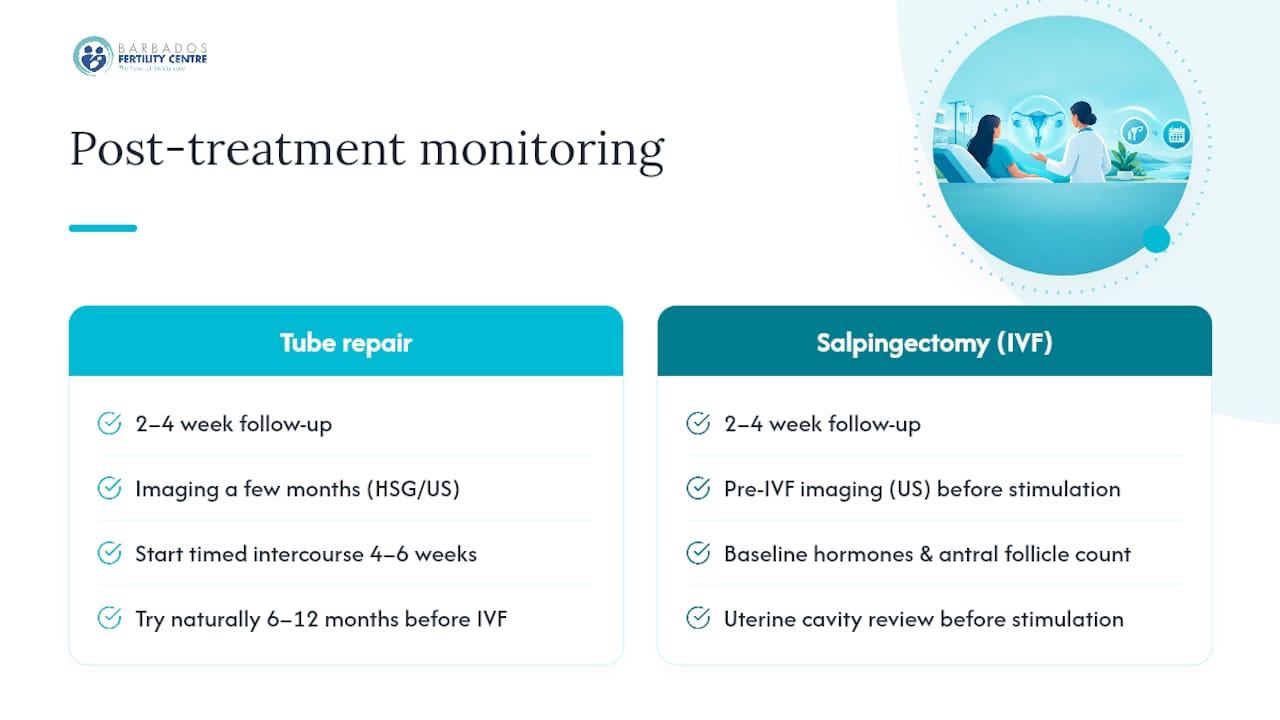
Whichever pathway you choose, the weeks that follow treatment matter as much as the procedure itself. After tubal cannulation or laparoscopic repair, expect a follow-up appointment within 2 to 4 weeks to check healing and confirm there’s no infection or unusual bleeding. Many clinics repeat an HSG or ultrasound a few months later to verify the tube is still open, since reocclusion can happen silently.
Timed intercourse or ovulation tracking usually starts once you’re cleared for normal activity, often within 4 to 6 weeks of a laparoscopic procedure. If you’re trying naturally after repair, monitoring your cycle with ovulation predictor kits or basal body temperature charting helps you make the most of the fertile window during the 6 to 12 month trial period most clinicians recommend before reconsidering IVF.
For patients who had a salpingectomy specifically to prepare for IVF, monitoring shifts toward the IVF cycle itself: baseline hormone levels, an antral follicle count, and a review of uterine cavity health before stimulation begins. Because hydrosalpinx fluid can sometimes redevelop in a tube stump if the removal wasn’t complete, a follow-up ultrasound before starting IVF stimulation is a reasonable safeguard.
Whatever the procedure, don’t skip the follow-up imaging. A tube that looked open on the operating table can narrow again within months, and finding that out before you spend another cycle trying naturally saves real time.
Emotional and Psychological Support During Treatment
A tubal blockage diagnosis often lands harder than patients expect, partly because there are usually no symptoms leading up to it. One day you’re simply trying to conceive; the next, you’re weighing surgery against IVF with numbers and grading systems you’ve never heard of.
That emotional weight is worth naming directly. Anxiety around surgical risk, grief over a delayed timeline, and frustration with reocclusion after a “successful” repair are all common reactions, not signs you’re handling things poorly. Couples going through tubal repair or IVF benefit from having a clear source of information they trust, someone who explains what each result actually means rather than leaving them to interpret scan reports alone.
Practical support helps as much as emotional support. Ask your care team, whichever clinic you choose, what happens at each step, what the realistic odds are for your specific grade of blockage, and what the backup plan looks like if the first approach doesn’t work. Couples who go in with a clear decision framework, like the age and severity checklist above, tend to feel more in control even when outcomes don’t go their way. Connecting with a counselor experienced in fertility care, or a support group of others navigating the same repair-versus-IVF decision, can also ease the isolation many patients feel during this process.
What Blocked Tubes Treatment Actually Costs
Cost varies enormously by pathway, and it’s worth comparing the full picture rather than just the sticker price of one procedure.
Diagnostic testing is usually the smallest expense: HSG or HyCoSy runs a few hundred dollars in most settings, while diagnostic laparoscopy costs considerably more because it involves anesthesia and an operating room. Surgical repair, whether cannulation, salpingostomy, fimbrioplasty, or tubal reversal, typically costs more than the diagnostic workup alone, and that figure often doesn’t include the months of monitoring and attempted conception that follow.
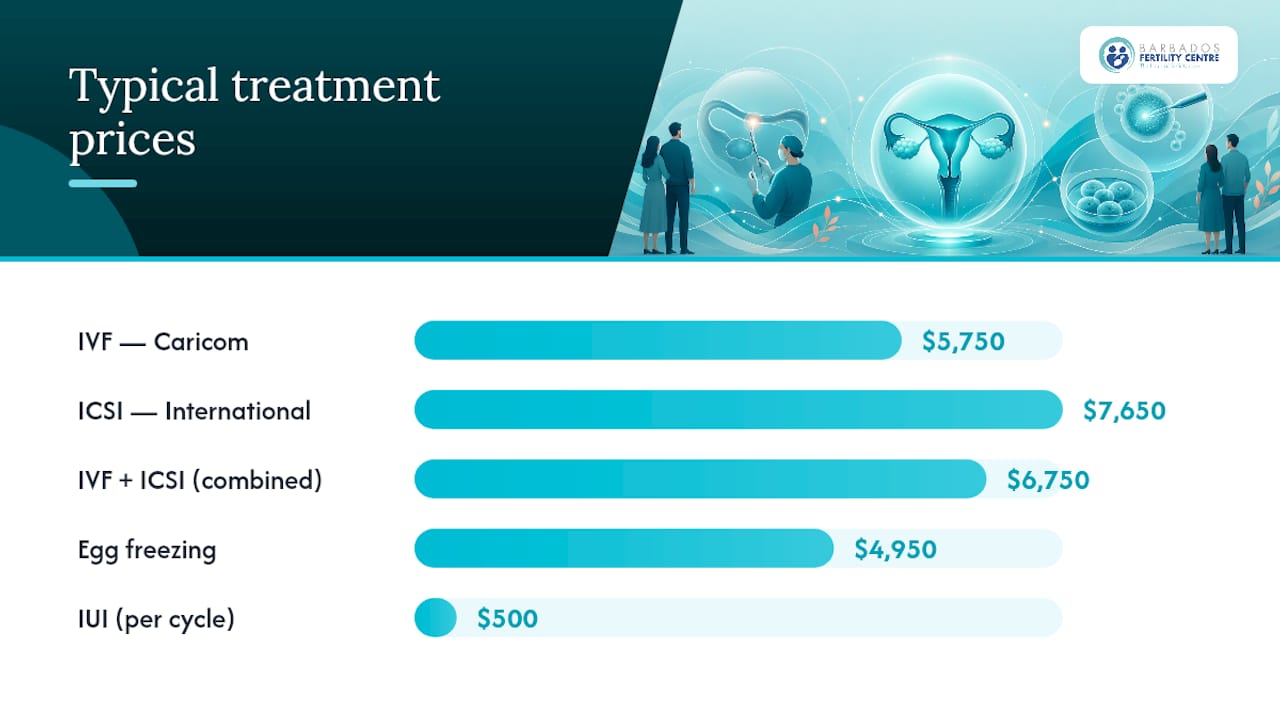
IVF carries its own separate cost structure, but it comes with a defined endpoint rather than an open-ended trial period. At Barbados Fertility Centre, IVF is priced from $5,750 for Caricom patients, while ICSI is priced at $7,650 for international patients. Combined IVF with ICSI starts from $6,750, and an egg freezing cycle starts from $4,950 for Caricom patients, with straight egg freezing listed at $4,950 for international patients. IUI, whether using a partner’s or donor sperm, starts from $500 per cycle including scans.
The financial comparison that matters most isn’t repair versus IVF as a single upfront number. It’s the cost of a repair attempt that doesn’t lead to pregnancy within a year, plus the IVF cycle that likely follows, versus the cost of moving to IVF directly when severity or age already points that way.
Timeline: How Long Each Pathway Actually Takes
Tubal cannulation is the fastest procedure itself, often done as a day case with recovery measured in days rather than weeks. But the meaningful timeline isn’t the procedure. It’s the 6 to 12 month window clinicians typically recommend for attempting natural conception afterward, since most successful pregnancies after repair occur between 11 and 21 months post-procedure.
Laparoscopic salpingostomy, fimbrioplasty, and adhesiolysis involve general anesthesia, so recovery runs 1 to 2 weeks before resuming normal activity, with full internal healing taking a bit longer. Add the same 6 to 12 month conception window used for cannulation, and the full pathway from surgery to a natural pregnancy attempt, if successful, spans roughly a year.
Microsurgical tubal reversal has the longest surgical recovery among the repair options, often 2 to 4 weeks before returning to normal activity, given the more extensive incision and reconstruction involved.
IVF, by contrast, runs on a tighter and more predictable clock. A single cycle, from ovarian stimulation through egg retrieval, fertilization, and embryo transfer, typically takes 4 to 6 weeks start to finish, with a pregnancy test roughly two weeks after transfer. If salpingectomy is needed first to address a hydrosalpinx, that adds a separate short surgical recovery, usually 1 to 2 weeks, before the IVF cycle itself begins.
Non-Surgical Alternatives and Where They Fall Short
Patients often ask whether medication, physical therapy, or other non-surgical approaches can unblock fallopian tubes without surgery. The honest answer is that no medication dissolves scar tissue or reopens a truly blocked tube.
Antibiotics can treat active infection and prevent further tubal damage, but they don’t reverse scarring that has already formed. Physical therapies aimed at pelvic mobility, sometimes marketed as fertility massage or tubal flushing, have no clinical trial evidence behind them for reopening a genuinely blocked tube, and relying on them in place of a real diagnostic workup can waste valuable time, especially for patients already past 35.
Where non-surgical care does have a legitimate role is in cases where imaging shows a spasm or mucus plug rather than true scarring. Selective salpingography, which combines contrast imaging with a directed flush of the tube, can clear a mucus plug or minor debris without full surgery, and it’s genuinely less invasive than laparoscopy. That’s different from vague “tubal flushing” remedies sold without any imaging confirmation of what’s actually causing the blockage in the first place.
Our Perspective on Choosing the Right Path
Barbados Fertility Centre has coordinated fertility care since 2002, and the pattern we see most often is patients arriving with a tubal diagnosis that’s less clear-cut than their referral letter suggests. We start every tubal case with a fresh look at the imaging and, where warranted, coordinate laparoscopic assessment before recommending repair or moving straight to IVF. Our team has supported thousands of successful pregnancies across a JCI-accredited facility, and we’d rather talk through your specific scan results than guess at a generic recommendation. If you’re weighing repair against IVF, an individualized assessment is the fastest way to get a real answer.
— Barbados
Get a Clear Plan for Your Tubal Diagnosis
Barbados Fertility Centre gives international patients a direct route to IVF pricing that’s a fraction of comparable US clinic costs, without cutting corners on accreditation or oversight. If your HSG or laparoscopy report already points toward hydrosalpinx or severe distal disease, you don’t need to spend months attempting a repair that the evidence suggests is unlikely to work.
Getting started is straightforward: a remote consultation reviews your existing scans, lab work, and surgical history, and our team lets you know within that first conversation whether repair, IVF, or a combination of both fits your situation. For international patients, ICSI and egg freezing pricing is listed in full detail, while Caricom patients can review IVF, IUI, and combined ICSI packages on our dedicated pricing page. Our services span IVF, ICSI, IUI, and egg freezing, all coordinated remotely before you travel. Reach out through Barbados Fertility Centre to request an assessment and find out which pathway actually fits your diagnosis, not just a general one.
Key Clinical Guidance and Reviews
For readers who want the primary evidence behind these recommendations, the ASRM committee opinion on tubal surgery covers surgical indications in depth, while the WHO/NCBI summary on tubal disease and hydrosalpinx lays out the evidence for pre-IVF salpingectomy. The Cleveland Clinic’s patient-facing hydrosalpinx overview is a clear starting point for anyone newly diagnosed, and the PMC review on discordant tubal blockage explains why conflicting test results deserve extra scrutiny.
This article is general information, not a substitute for advice from a qualified doctor. Consult a qualified healthcare professional about your own circumstances before acting on anything here.
Sources
- Management of tubal disease and hydrosalpinx — WHO/NCBI summary
- Hydrosalpinx: Causes, Symptoms, Diagnosis & Treatment | Cleveland Clinic
- Discordant tubal blockage and its effect on pregnancy rates (PMC article)
FAQ
What Is the Best Treatment for Blocked Fallopian Tubes?
There’s no single best treatment. Selected proximal or mild distal blockage in younger patients often responds to tubal cannulation or laparoscopic repair, while severe distal disease, hydrosalpinx, or age past 35 usually make IVF the more reliable option. The right choice depends on the exact location and severity of the blockage.
How Do You Flush Blocked Fallopian Tubes?
Tubal flushing, more precisely called selective salpingography, uses contrast dye under imaging guidance to clear minor blockages like mucus plugs, and it can double as a diagnostic and treatment step for proximal occlusion. It isn’t effective for dense scar tissue or true structural blockage, which typically requires surgical repair or IVF instead.
What Are the First Signs of a Blocked Tube?
Most blocked tubes cause no noticeable symptoms at all. Periods, ovulation, and pain levels usually stay normal, which is why the blockage is almost always found during an infertility workup rather than from symptoms prompting the visit in the first place.
Is It Possible to Unblock Fallopian Tubes Without Surgery?
Selective tubal cannulation can clear certain proximal blockages, like mucus plugs, using a catheter guided through the cervix without full surgery. True scarring from infection, endometriosis, or prior surgery generally doesn’t respond to non-surgical methods and requires either laparoscopic repair or bypassing the tube entirely with IVF.