


Luteal phase support, typically progesterone supplementation, is routinely recommended in stimulated IVF cycles and most frozen embryo transfer protocols because it improves implantation and clinical pregnancy rates. Vaginal, intramuscular, subcutaneous, and oral dydrogesterone are the main routes, with hCG, estradiol, and GnRH agonist sometimes added. The right route, dose, and duration still depend on your cycle type and how your clinic monitors your response.
TL;DR:
- Progesterone support is essential in IVF, with the route and timing tailored to your cycle type and clinic protocols, especially in frozen transfers without natural corpus luteum.
- Vaginal progesterone is the most common choice for fresh and medicated FET cycles due to ease of use and effective local delivery, while injections and oral options are used based on individual tolerance and response.
- In programmed frozen embryo transfer cycles, full external progesterone support starts early because no natural corpus luteum compensates, whereas natural cycle FET may require minimal additional support.
- Monitoring serum progesterone levels around transfer can guide personalized rescue strategies, including adding systemic hormones or increasing dosage, though these practices lack definitive large-trial evidence.
- Common side effects include local irritation, injection site discomfort, or nausea, but serious adverse effects are rare, and proper technique and reporting symptoms help ensure safety.
Table of Contents
- What Is Luteal Phase Support and Why Does It Matter?
- How Does Luteal Support Differ in a Fresh Embryo Transfer?
- Natural vs. Medicated Frozen Embryo Transfer: Why Luteal Support Differs
- Progesterone Delivery Methods: Vaginal, Injection, or Oral?
- What Are hCG, Estradiol, and GnRH Agonist Adjuncts For?
- When Should You Start and Stop Progesterone Support?
- What Side Effects Should You Expect, and How Do You Manage Them?
- How Barbados Fertility Centre Approaches Luteal Phase Support
- Practical Next Steps Before Your Transfer
- Considering Treatment? How Barbados Fertility Centre Handles Your Luteal Support Plan
- Sources
- FAQ
What Is Luteal Phase Support and Why Does It Matter?
The luteal phase is the roughly two-week window after ovulation when the corpus luteum, a temporary gland left behind on the ovary after an egg is released, produces the progesterone that prepares your uterine lining for a fertilized embryo. Progesterone thickens the endometrium, opens what fertility specialists call the “window of implantation,” and helps prevent the uterus from contracting an embryo loose before it can attach.
In a natural cycle, this system runs itself. In vitro fertilization changes the biology in ways that make outside progesterone support necessary for most patients.
Controlled ovarian stimulation, the hormone protocol that produces multiple mature eggs for retrieval, floods your system with supraphysiologic estrogen and progesterone levels that suppress the pituitary signals normally needed to sustain the corpus luteum afterward. Egg retrieval itself removes granulosa cells that would otherwise help produce luteal progesterone. And the choice of trigger shot matters enormously here: an hCG trigger keeps some luteal function alive, while a GnRH agonist trigger, often chosen to lower the risk of ovarian hyperstimulation syndrome, tends to suppress the corpus luteum more sharply and usually calls for more assertive supplementation.
This is why specialists describe luteal insufficiency in IVF as largely a man-made problem rather than a hormonal defect a patient started with, as Nature Reviews Endocrinology frames it. Progesterone support bridges a predictable gap between ovarian production shutting down and the placenta taking over hormone production around eight to ten weeks of pregnancy.
The clinical evidence backing this practice is substantial, if not perfectly uniform. Multiple systematic reviews confirm that luteal phase support raises clinical pregnancy rates compared with no support at all, and it has become standard of care across fertility clinics globally, per the same Nature Reviews Endocrinology analysis. Cochrane’s own review of the topic is more measured: progesterone appears to increase clinical pregnancy rates in several settings, but the certainty of evidence for live birth and miscarriage outcomes ranges from low to moderate depending on the trial quality and population studied, according to the Cochrane review on luteal phase support.
What does this mean in practice for you? A few things are settled, and a few are still being worked out:
- Progesterone supplementation is not optional in most protocols. It is the default, evidence-supported approach.
- The exact route, starting dose, and stopping point vary by clinic and by your specific cycle type.
- Fresh and frozen transfers need different luteal strategies, because a frozen cycle may or may not involve a corpus luteum at all.
That last point deserves its own explanation, since it shapes almost every decision your care team makes about your medication schedule.
How Does Luteal Support Differ in a Fresh Embryo Transfer?
In a fresh cycle, your ovaries have just been stimulated and retrieved, so some luteal tissue exists, but it is working under stress from the stimulation protocol and needs backup almost immediately.
Most clinics begin progesterone the evening of or the day after egg retrieval, before the embryo transfer even happens. The rationale is straightforward: the endometrium needs adequate progesterone exposure timed correctly relative to embryo age at transfer, so starting early rather than waiting for a positive pregnancy test gives the lining time to synchronize. Waiting too long risks a mismatch between embryo developmental stage and endometrial receptivity.
Three regimens dominate clinical practice in fresh transfers:
- Vaginal progesterone as the default first-line choice for most patients, delivered as gel, suppository, or insert, because it achieves high local endometrial concentration with a relatively simple dosing schedule.
- Intramuscular progesterone in oil, used by some clinicians either as a primary choice or as an add-on when vaginal absorption seems inadequate, valued for delivering steady, measurable systemic hormone levels.
- Estradiol or hCG supplementation, added selectively rather than universally, often when a clinic’s protocol calls for additional estrogen support or when trigger choice suggests a weaker natural luteal contribution.
The comparative evidence between these options is where things get interesting, and a little contested. Vaginal progesterone and intramuscular progesterone in oil produce broadly similar clinical pregnancy rates in most trial comparisons, which is why many programs default to vaginal delivery purely on convenience and tolerability grounds rather than superior efficacy. Where the debate persists is in edge cases: patients with malabsorption concerns, prior cycles with unexpectedly low progesterone readings, or those who simply cannot tolerate vaginal administration for personal or medical reasons.
hCG as luteal support in fresh cycles carries a caveat worth flagging early: it can support the corpus luteum effectively, but it also raises the risk of ovarian hyperstimulation syndrome, particularly in patients who already produced a high egg count during stimulation. Most clinics reserve hCG-based luteal support for lower-risk patients or skip it altogether in favor of progesterone-only regimens when OHSS risk is a concern.
The practical trade-offs boil down to this: vaginal progesterone wins on convenience and avoids needles, intramuscular injections offer predictable systemic levels at the cost of daily injection discomfort, and add-on agents like hCG or estradiol get reserved for specific clinical pictures rather than applied across the board. Your clinic’s choice usually reflects both the research evidence and a pragmatic read of your individual cycle, prior response, and tolerance for injections versus vaginal medication.
Natural vs. Medicated Frozen Embryo Transfer: Why Luteal Support Differs
Frozen embryo transfer splits into three distinct protocol types, and the presence or absence of a corpus luteum in each one changes the luteal support conversation completely.
Natural cycle FET (NC-FET) relies on your own ovulation. You develop a follicle, ovulate, and the resulting corpus luteum produces progesterone on its own timeline, with the embryo transferred at the appropriate window afterward. Because a functioning corpus luteum exists, some clinics use minimal or no additional progesterone, monitoring closely instead and adding support only if levels run low.
Modified natural cycle FET follows the same ovulation-driven logic but adds a trigger shot to control timing precisely, plus a course of luteal progesterone as a safety net, since the trigger itself can subtly alter corpus luteum function compared with a fully spontaneous cycle.
Artificial or programmed FET (AC-FET) suppresses your natural cycle entirely and builds the endometrium with externally administered estrogen, then progesterone, on a fixed calendar. No corpus luteum forms at all in this protocol, which means every bit of progesterone your body has during early pregnancy comes from the medication schedule. This is the scenario where luteal phase support is not just recommended, it is essential, with no biological backup if doses are skipped or absorption is poor.
That distinction matters beyond the transfer cycle itself. AC-FET’s complete reliance on exogenous progesterone, with no corpus luteum contributing the broader range of hormones and signaling molecules a natural luteal phase provides, has been linked in some analyses to differences in obstetric outcomes compared with natural cycle FET, according to the Nature Reviews Endocrinology review. This doesn’t mean programmed cycles are unsafe. It means clinicians increasingly weigh cycle type as a factor in counseling, not just a scheduling convenience.
Recommended regimens differ accordingly:
- NC-FET: minimal to no supplementation in low-risk patients with confirmed ovulation and adequate luteal progesterone, verified through blood monitoring.
- Modified natural FET: trigger shot plus a standard vaginal or combined progesterone course starting after confirmed ovulation.
- AC-FET: full-dose vaginal progesterone (often combined with intramuscular backup if levels run low) starting several days before transfer and continued without interruption, since there is no natural production to fall back on.
One of the more clinically useful developments in recent FET research involves adjunct therapy. A 2025 network meta-analysis covering 4,688 participants found that adding a small subcutaneous dose of GnRH agonist, 0.1 mg given once or twice after transfer, to standard vaginal progesterone improved clinical pregnancy rates in FET cycles, with a relative risk of 1.86 compared with placebo, according to the network meta-analysis on luteal support protocols. The live birth benefit from this addition remains statistically inconclusive, which is an important caveat: a higher clinical pregnancy rate is encouraging, but it is not the same outcome as a baby brought home. Clinicians reviewing this data tend to treat the GnRHa add-on as a promising option to discuss rather than a settled new standard.
Progesterone Delivery Methods: Vaginal, Injection, or Oral?
Every route of progesterone administration gets the hormone into your system, but how it gets there, how steady the levels stay, and how much daily burden it places on you differ meaningfully.
Vaginal progesterone (gels, suppositories, or inserts) delivers medication directly to the uterine environment through what researchers call a “first uterine pass effect,” achieving high local endometrial tissue concentration even when blood serum levels look modest on a lab test. This is why a low serum progesterone reading on vaginal-only support does not automatically mean the endometrium itself is under-supported, though clinicians still use serum levels as one signal among several. Tolerability is generally good, though local irritation and a persistent discharge are common complaints.
Intramuscular progesterone in oil delivers the hormone straight into muscle tissue, typically the hip, producing dependable, easily measured serum levels day after day. It has decades of use behind it and remains a common choice, especially as a backup when vaginal absorption is uncertain. The trade-off is daily injections, which many patients describe as the least pleasant part of an already demanding treatment schedule.
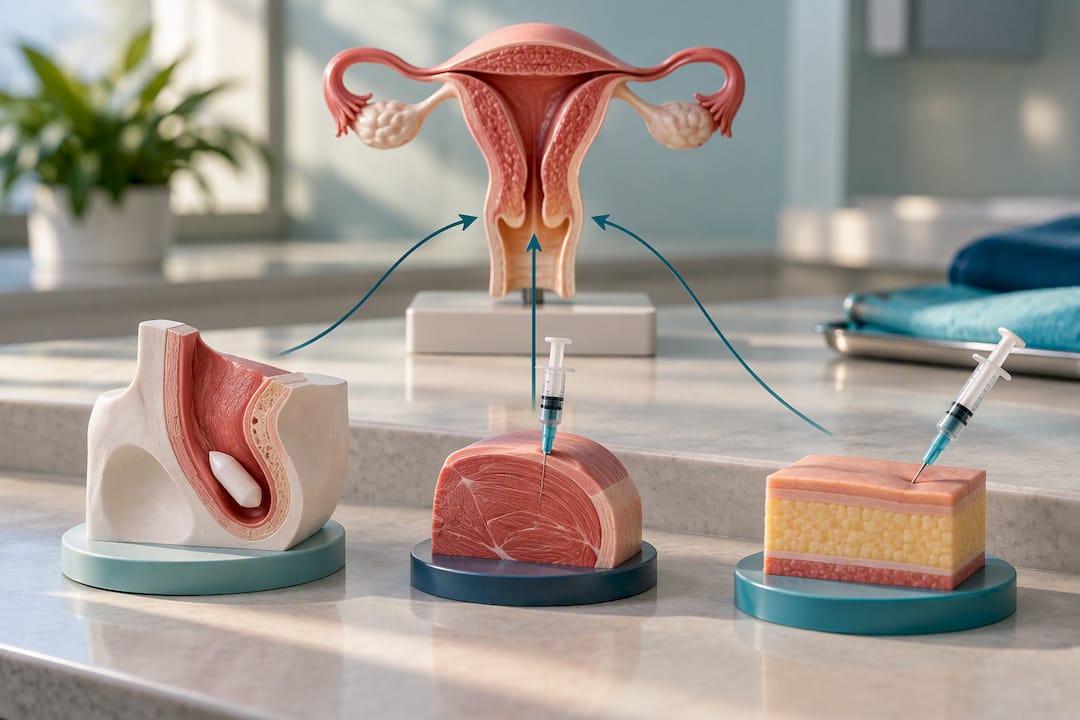
Subcutaneous progesterone injects into fatty tissue rather than deep muscle, using a much smaller needle. It is a newer option compared with intramuscular dosing and appeals to patients who want steady systemic levels without the discomfort of deeper injections.
Oral dydrogesterone, a synthetic progestogen taken as a tablet, offers by far the simplest logistics: no needles, no vaginal application, no refrigeration in most formulations. Randomized trials and pooled analyses suggest dydrogesterone can produce ongoing pregnancy and live birth outcomes comparable to micronized vaginal progesterone in some fresh cycle contexts, according to a review on luteal-phase support in assisted reproductive technology. It has become an appealing first-line option in clinics that prioritize convenience without sacrificing outcomes.
Here is where the decision usually lands in practice:
- Vaginal progesterone remains the default first-line choice for most fresh and medicated FET cycles, largely on convenience and strong local endometrial effect.
- Intramuscular or subcutaneous progesterone gets added or substituted when a patient has documented low serum progesterone, suspected poor vaginal absorption, or a history of a cycle that underperformed on vaginal-only support.
- Oral dydrogesterone works well for patients who want to avoid needles and vaginal medication altogether, particularly where local guidelines and clinic experience support its use.
- Adherence problems (missed doses, difficulty following a vaginal application schedule, needle anxiety) are themselves a clinical factor. A route you will actually use consistently may outperform a theoretically superior one you keep skipping.
Pro Tip: If you are struggling with vaginal progesterone’s messiness or an injection site is getting sore and hard, tell your clinic before you simply stop or reduce a dose on your own. A route switch or timing adjustment is usually simple; an unreported gap in coverage during the implantation window is not something you want to discover later.
What Are hCG, Estradiol, and GnRH Agonist Adjuncts For?
Progesterone is the backbone of luteal phase support, but three adjunct agents come up often enough in patient conversations to deserve a straight answer on when and why they get added.
hCG (human chorionic gonadotropin) stimulates the corpus luteum directly, essentially telling it to keep producing hormones the way early pregnancy naturally would. It can be effective luteal support in the right patient. The catch is real: hCG raises the risk of ovarian hyperstimulation syndrome, a potentially serious complication involving fluid shifts and swollen, painful ovaries, particularly in patients who developed a high number of follicles during stimulation. Most clinics reserve hCG-based support for lower OHSS-risk patients and lean on progesterone-only regimens for everyone else.
Estradiol supplementation rests on a simple idea: estrogen and progesterone work together to prepare the endometrium, so adding estradiol alongside progesterone might improve receptivity, especially in cycles where suppression from stimulation or a GnRH agonist trigger has knocked out normal estrogen production too. The evidence for estradiol as a routine add-on is mixed. Some trials show a modest benefit, others show none, which is why it tends to be used selectively rather than universally, often guided by a clinic’s own protocol and a patient’s hormone monitoring results.
Subcutaneous GnRH agonist, added at a low dose after transfer alongside standard vaginal progesterone in FET cycles, is the newest of these three to gain real research traction. The 2025 network meta-analysis referenced earlier found this combination associated with meaningfully higher clinical pregnancy rates compared with vaginal progesterone alone, though the live birth data remained inconclusive. Researchers reviewing this evidence describe it as a genuinely promising direction that still needs larger, longer-term trials before it becomes a default recommendation rather than a discussion point, an assessment echoed in commentary from the Nature Reviews Endocrinology analysis on luteal support strategy.
The practical takeaway across all three adjuncts: none of them replace progesterone as your foundation. They are supplementary tools your clinic may layer on based on your trigger type, your OHSS risk, prior cycle outcomes, and how your specific protocol calls for it, not universal add-ons every patient should expect or request by default.
When Should You Start and Stop Progesterone Support?
Timing questions come up constantly, and the honest answer is that the “when” depends heavily on which protocol you’re in.
In fresh IVF cycles, progesterone usually begins the evening of egg retrieval or the following morning, ahead of the embryo transfer itself, so the endometrium has time to synchronize with embryo developmental stage. In FET cycles, timing depends on protocol type: natural cycle FET starts progesterone after confirmed ovulation, while programmed (AC-FET) cycles start it on a fixed calendar day calculated backward from the planned transfer date, since there’s no ovulation event to anchor the schedule to.
Duration is the other question every patient eventually asks, usually somewhere around week six when the injections or vaginal medication start feeling endless. Most protocols continue progesterone at minimum through the first pregnancy test, and if that test is positive, support typically continues for several more weeks, commonly cited as running through roughly seven to twelve weeks of pregnancy, by which point the placenta has generally taken over adequate hormone production on its own.
Monitoring adds a layer of precision to this timeline that pure calendar-based dosing misses. Research has proposed that a serum progesterone level below roughly 8.8 to 9.2 ng/mL on the day of embryo transfer, measured in patients using vaginal progesterone, correlates with lower ongoing pregnancy rates, according to a review of luteal phase support protocols. This threshold isn’t a hard cutoff that guarantees failure below it or success above it, and lab-to-lab assay variability means the same blood sample can produce meaningfully different numbers depending on where it’s tested. Clinicians treat it as one useful data point among several, not a verdict.
When a progesterone check comes back low, clinics generally have a few rescue options available:
- Add intramuscular or subcutaneous progesterone on top of existing vaginal medication, aiming to raise serum levels while keeping the strong local endometrial effect vaginal delivery already provides.
- Increase the vaginal dosing frequency or dose strength, particularly if absorption rather than production seems to be the underlying issue.
- Add oral dydrogesterone as a supplementary agent, leaning on its systemic bioavailability to shore up levels the vaginal route alone hasn’t reached.
The evidence behind these rescue strategies is described by researchers as an emerging practice rather than an established protocol backed by large randomized trials. Personalizing luteal support this way, checking blood progesterone and adjusting rather than applying one fixed dose to every patient, is gaining traction clinically even though the trial evidence supporting exactly which rescue method works best is still developing.
What Side Effects Should You Expect, and How Do You Manage Them?
Every route of progesterone delivery comes with its own predictable set of complaints, and knowing what’s normal versus what warrants a call to your clinic makes the whole process considerably less stressful.
Vaginal progesterone most commonly causes local irritation, a thick discharge, and general messiness that many patients describe as the most annoying, if not medically serious, part of treatment.
Intramuscular injections cause injection site pain, and with daily dosing over weeks, some patients develop hard, tender knots of tissue at rotation sites that can ache for days.
Subcutaneous injections tend to cause milder site reactions than intramuscular dosing, given the smaller needle and shallower injection depth, though bruising is still common.
Oral dydrogesterone avoids injection and vaginal side effects entirely but can occasionally cause nausea, headache, or breast tenderness, the same general category of symptoms associated with progesterone exposure through any route.
None of this data suggests these medications are unsafe for you or a developing pregnancy. Reassuringly, research has found no evidence that first-trimester progesterone use for luteal support increases the risk of fetal malformation, based on pooled analyses across multiple large studies, according to a review on progesterone protocols in embryo transfer cycles. The side effects are real and worth managing, but they are not a signal that something has gone medically wrong.
A few practical steps make a genuine difference in day-to-day tolerability:
- Rotate intramuscular injection sites systematically and apply gentle heat beforehand to ease muscle tension and reduce soreness.
- Ask your nurse for hands-on injection training rather than relying only on a printed instruction sheet. Technique errors are a common, fixable cause of unnecessary pain.
- If oral dydrogesterone causes nausea, taking it with food or splitting the dose as your clinic advises often helps.
- Keep a simple daily log of doses taken and any symptoms, since it makes a phone call to your care team faster and more useful if something feels off.
Pro Tip: Report any injection site that becomes increasingly red, hot, or swollen rather than just tender, especially if it comes with fever. That combination can signal infection, which is uncommon but worth ruling out quickly rather than waiting it out.
How Barbados Fertility Centre Approaches Luteal Phase Support
Translating research findings into a real patient’s medication calendar takes more than reading the trial data. It requires a clinical team that adjusts protocol choices to each patient’s cycle type, prior response, and practical circumstances, including the reality that many patients traveling for treatment are managing medication schedules far from home.
At Barbados Fertility Centre, luteal support decisions follow the same evidence base covered throughout this guide: vaginal progesterone as a common first-line approach in most fresh and FET protocols, with intramuscular or subcutaneous backup available when monitoring suggests it’s needed, and oral dydrogesterone offered as an option where clinically appropriate. Patients undergoing programmed frozen transfers receive full progesterone support from the start, since no corpus luteum exists to provide a natural safety net.
Operating as a JCI-accredited facility, an internationally recognized benchmark for patient safety and clinical quality, since opening in 2002, the clinic has built its luteal support counseling around a few practical priorities that show up consistently in how it works with patients:
- Clear explanation of why the specific route and timing were chosen for that individual patient’s protocol, not a generic handout.
- Hands-on injection training before patients leave the clinic, reducing the technique errors that make intramuscular dosing more painful than it needs to be.
- Coordinated medication logistics for international patients, since traveling with refrigerated or controlled medications adds a layer of complexity domestic patients don’t face.
- Remote monitoring support after patients return home, allowing progesterone level checks and dosage adjustments without requiring a return trip to Barbados.
The clinic’s broader track record, spanning thousands of documented successful pregnancies across two decades of IVF, ICSI, IUI, and egg freezing cases, reflects an operational philosophy built around minimizing treatment stress while keeping medical standards aligned with major international benchmarks.
Practical Next Steps Before Your Transfer
Three conversations are worth having with your care team before your protocol locks in. Ask directly which progesterone route they recommend for your specific cycle type and why, since fresh, natural FET, and programmed FET genuinely call for different approaches. Confirm your exact start date relative to trigger or ovulation, and ask whether a serum progesterone check is planned around the time of transfer. Before you begin, review medication storage instructions carefully. Some formulations need refrigeration and injectable progesterone in oil can be uncomfortable if it’s too cold when administered.
A few symptoms deserve an urgent call, not a wait-and-see approach: severe abdominal pain or rapid bloating, especially after an hCG trigger or hCG-based luteal support, can signal ovarian hyperstimulation syndrome. Heavy bleeding, fever with an injection site that looks infected, or a progesterone result that comes back well below your clinic’s threshold all warrant a same-day conversation with your team rather than waiting for your next scheduled check-in.
Evidence in this field keeps evolving, and reasonable clinics sometimes make different but equally defensible choices for the same patient profile. That’s not a sign anyone is guessing. It reflects genuine uncertainty in parts of the research, which is exactly why individualized monitoring matters more than following a fixed protocol on autopilot.
— Barbados
Considering Treatment? How Barbados Fertility Centre Handles Your Luteal Support Plan
If you’ve made it this far, you already understand that luteal phase support is not a footnote in IVF treatment. It’s a clinical decision with real evidence behind it, and it deserves a clinic that treats your protocol as individualized rather than boilerplate. Barbados Fertility Centre offers accredited IVF and FET care with the medication logistics, injection training, and monitoring support built directly into the patient experience, at a cost structure that runs meaningfully below equivalent US clinics.

As a JCI-accredited facility with services spanning IVF, ICSI, IUI, and FET monitoring, the clinic pairs internationally benchmarked medical standards with a calmer, less clinical environment than many patients are used to during treatment. Luteal phase management here includes hands-on training for injectable progesterone, clear guidance on vaginal versus systemic options, and remote progesterone monitoring so international patients aren’t left guessing about dosage adjustments once they’re home.
Pricing is transparent from the outset. IVF starts from $5,750 for regional patients on the CARICOM price list, while international patients can review full treatment costs, including ICSI at $7,650, on the international pricing page. If you’re ready to discuss your specific cycle type and luteal support plan, reach out to the clinic directly to schedule a consultation and get a personalized quote.
This article is general information, not a substitute for advice from a qualified doctor. Consult a qualified healthcare professional about your own circumstances before acting on anything here.
Sources
- Luteal phase support in assisted reproductive technology | Nature Reviews Endocrinology
- Comparison of Luteal Support Protocols in Frozen IVF / ICSI Cycles: A Network Meta‐Analysis
- Luteal phase support for assisted reproduction — Cochrane
FAQ
How Do I Support My Body During the Luteal Phase in IVF?
Supporting the luteal phase in IVF mainly means taking the progesterone your clinic prescribes exactly on schedule, whether that’s vaginal, intramuscular, subcutaneous, or oral dydrogesterone. Beyond medication adherence, avoiding strenuous exercise, staying hydrated, and attending every scheduled monitoring appointment help your care team catch and correct low progesterone before it affects implantation.
What Does Luteal Phase Support Mean in Fertility Treatment?
Luteal phase support means using progesterone, sometimes combined with estradiol, hCG, or GnRH agonist, to replace hormone production that ovarian stimulation and egg retrieval disrupt. It’s standard practice in IVF and most FET cycles because it improves implantation conditions and clinical pregnancy rates.
What Should Be Avoided During the Luteal Phase After Embryo Transfer?
Avoid skipping or delaying progesterone doses, since consistent hormone levels matter more during this window than almost any other factor you can control. Also avoid strenuous exercise, hot tubs, and stopping medication early without your clinic’s explicit guidance, even if a home pregnancy test looks negative before your scheduled blood test.
How Can I Improve a Weak Luteal Phase Before or During IVF?
If monitoring shows a serum progesterone level below the range associated with lower pregnancy rates (roughly 8.8 to 9.2 ng/mL in some studies), your clinic can add intramuscular or subcutaneous progesterone, raise your vaginal dose, or add oral dydrogesterone. This kind of monitored, individualized adjustment tends to work better than switching medications on your own without a blood test to confirm the problem.
Is Luteal Phase Support Different for Frozen vs. Fresh Embryo Transfers?
Yes. Fresh cycles have some existing corpus luteum function to build on, while programmed frozen cycles have no corpus luteum at all and rely entirely on external progesterone from the start. Natural cycle FET falls in between, often needing minimal support since ovulation provides a functioning corpus luteum on its own.
Recommended