

Micro-TESE is the guideline-recommended approach for men with non-obstructive azoospermia, while percutaneous or epididymal techniques like PESA and TESA usually work well for obstructive causes. Whichever path applies, the retrieval must be coordinated with the partner’s IVF cycle or a sperm cryopreservation plan well before the procedure date, and every patient should go in with realistic expectations about yield and risk.
TL;DR:
- Percutaneous methods like PESA and TESA are best suited for obstructive azoospermia cases and have high success rates, but they may miss sperm in non-obstructive cases.
- MicroTESE is the preferred approach for non-obstructive azoospermia because it offers significantly higher sperm retrieval success by visually targeting productive testicular tissue.
- The choice of retrieval technique depends on diagnosis, testicular size, prior surgeries, urgency, and lab capabilities, with staged strategies often maximizing success and minimizing tissue damage.
- Fresh sperm are generally preferred for NOA when counts are very limited, while cryopreservation is suitable for OA cases with ample sperm, with outcomes more heavily influenced by female factors and embryology expertise.
- Recovery involves minor risks like hematoma and swelling, and the procedure’s success depends on proper planning, timing, and coordination with IVF, with microTESE requiring specialized surgical skills.
Table of Contents
- What Determines Which Sperm Retrieval Method You Need?
- Percutaneous vs. Open Surgical Approaches: An Overview
- How Do PESA and TESA Work, and Who Are They For?
- Why Microsurgical TESE Is the Standard for NOA
- How Should You Choose Between Retrieval Methods?
- What Happens After Retrieval: ICSI, Fresh vs. Frozen Sperm, and Outcomes
- What Are the Risks and Recovery Timeline After Surgical Sperm Retrieval?
- Barbados Fertility Centre: A Clinical Option for Coordinated Retrieval and IVF
- A Clinician’s View on Staging Retrieval Decisions
- Planning Your Retrieval and IVF Cycle With Barbadosivf
- Sources
- FAQ
What Determines Which Sperm Retrieval Method You Need?
The choice between retrieval methods starts with one question: is the azoospermia obstructive or non-obstructive? Obstructive azoospermia (OA) means sperm production is normal, but a blockage, from a prior vasectomy, congenital absence of the vas deferens, or scarring, prevents sperm from reaching the ejaculate. Non-obstructive azoospermia (NOA) means the testicles themselves are producing little or no sperm, often due to hormonal failure, genetic causes, or prior chemotherapy.
That distinction changes almost everything about the surgical sperm retrieval plan, including anesthesia, setting, and the odds of success. Before any procedure, a urologist typically orders a diagnostic workup to confirm the diagnosis and estimate expected yield:
- Repeat semen analysis to confirm azoospermia rather than a lab error or a temporary factor.
- FSH and testosterone levels, since a high FSH with small testes usually points to NOA.
- Scrotal ultrasound to check testicular volume and rule out obstruction or varicocele.
- Karyotype and Y-chromosome microdeletion testing when NOA is suspected, since some genetic findings affect prognosis and counseling.
Timing matters just as much as diagnosis. When NOA is likely, many centers recommend attempting sperm retrieval and cryopreservation before the partner starts ovarian stimulation, so a failed retrieval doesn’t waste an egg retrieval cycle. For OA, where retrieval succeeds in nearly every case, same-day fresh retrieval synchronized with egg collection is common and often preferred. Either way, the first attempt is usually the best shot at finding sperm. Scar tissue from a prior biopsy can make a second attempt harder, which is why staged strategies, discussed below, are worth planning from the start.
Percutaneous vs. Open Surgical Approaches: An Overview
Surgical sperm retrieval methods fall into two broad families, and understanding the split helps make sense of everything that follows.
- Percutaneous techniques use a needle inserted through the scrotal skin without an open incision. This category includes PESA (percutaneous epididymal sperm aspiration) and TESA (testicular sperm aspiration), both of which can often be done in an office setting under local anesthesia.
- Open and microsurgical techniques require a scrotal incision and direct visualization of testicular tissue. This category includes conventional TESE (testicular sperm extraction), microdissection TESE (microTESE), MESA (microsurgical epididymal sperm aspiration), and mapping approaches sometimes called SST (sperm sampling by testicular biopsy) or fine-needle mapping.
The trade-offs track predictably with invasiveness. Percutaneous methods are faster, need less anesthesia, and cause less tissue disruption, but they sample blindly and can miss sperm-containing pockets, particularly in NOA, where sperm production is patchy rather than uniform. Open and microsurgical methods take longer, usually require an operating room and general or regional anesthesia, and carry more recovery downtime, but they let the surgeon see what’s being sampled, which matters enormously when sperm production is unpredictable.
A growing number of surgeons now favor staged, single-session strategies: starting with a less invasive sampling or mapping technique and escalating to microTESE within the same operative session only if needed. This approach, described in reviews of office-based and operative retrieval strategies, aims to maximize the odds of finding sperm on the first attempt while avoiding unnecessary microdissection of healthy tissue. It’s a practical compromise between “do the least invasive thing” and “don’t waste the only good shot you get.”
How Do PESA and TESA Work, and Who Are They For?
PESA and TESA are the workhorses of obstructive azoospermia treatment, and for good reason: when the problem is a blockage rather than a production failure, sperm are usually sitting right there waiting to be collected.
PESA involves inserting a fine needle into the epididymis, the coiled tube where sperm mature and are stored, and gently aspirating fluid. TESA instead targets the testicle directly, drawing a small tissue and fluid sample through a needle without an open incision. Both are typically performed under local anesthesia, sometimes with mild sedation, and both can often be completed in an office or outpatient setting in under 30 minutes.
Here’s how the two methods generally compare in practice:
- Best candidates: Men with confirmed OA, especially post-vasectomy or with congenital absence of the vas deferens.
- Setting: Office-based or outpatient, usually without general anesthesia.
- Success rate: Near-total in OA cases, since sperm production itself is normal and the blockage is the only barrier.
- When to avoid: NOA, where blind needle sampling is unlikely to find the scattered pockets of sperm production that do exist.
The evidence on which technique performs better is more nuanced than “just pick one.” A systematic review and meta-analysis comparing TESA and PESA in obstructive azoospermia found no significant difference in overall pregnancy or miscarriage rates between the two. But pooled data showed TESA produced a meaningfully higher implantation rate (odds ratio 1.58, P = 0.02), suggesting that testicular sperm may sometimes outperform epididymal sperm once fertilized eggs are transferred, even when live birth outcomes end up similar. Fertility specialists weigh this alongside embryology lab preferences and the individual case.
Pro Tip: Ask your surgeon in advance whether they plan PESA, TESA, or both in sequence. Many clinics will attempt PESA first and move to TESA only if the epididymal sample comes up empty, which spares you a second appointment.
The practical caveats matter too. Needle aspiration can cause a small hematoma (blood collection under the skin), and repeat procedures are sometimes necessary if the first sample is inadequate or contaminated with blood, which can interfere with sperm assessment in the lab. None of this is usually dangerous, but patients should know a second attempt is a real possibility, not a sign that something went wrong.
Why Microsurgical TESE Is the Standard for NOA
Non-obstructive azoospermia is a fundamentally harder problem, and it demands a fundamentally different tool. When the testicles aren’t reliably producing sperm, the challenge shifts from “get the sperm out” to “find where sperm production, if any, is happening.”
Conventional TESE removes one or more small tissue samples through an open scrotal incision, without magnification, and checks them for sperm. MESA applies microsurgical technique specifically to the epididymis, useful mainly in select OA or reconstructive cases. Microdissection TESE (microTESE) takes the concept further: the surgeon opens the tunica of the testicle widely and uses an operating microscope, typically at 15 to 25 times magnification, to identify and selectively sample the larger, more opaque seminiferous tubules that are more likely to contain active sperm production. That selectivity is the whole point. Rather than blindly removing tissue across the testicle, the surgeon targets the tubules that visually look most likely to be productive, which improves yield while limiting damage to surrounding parenchyma.
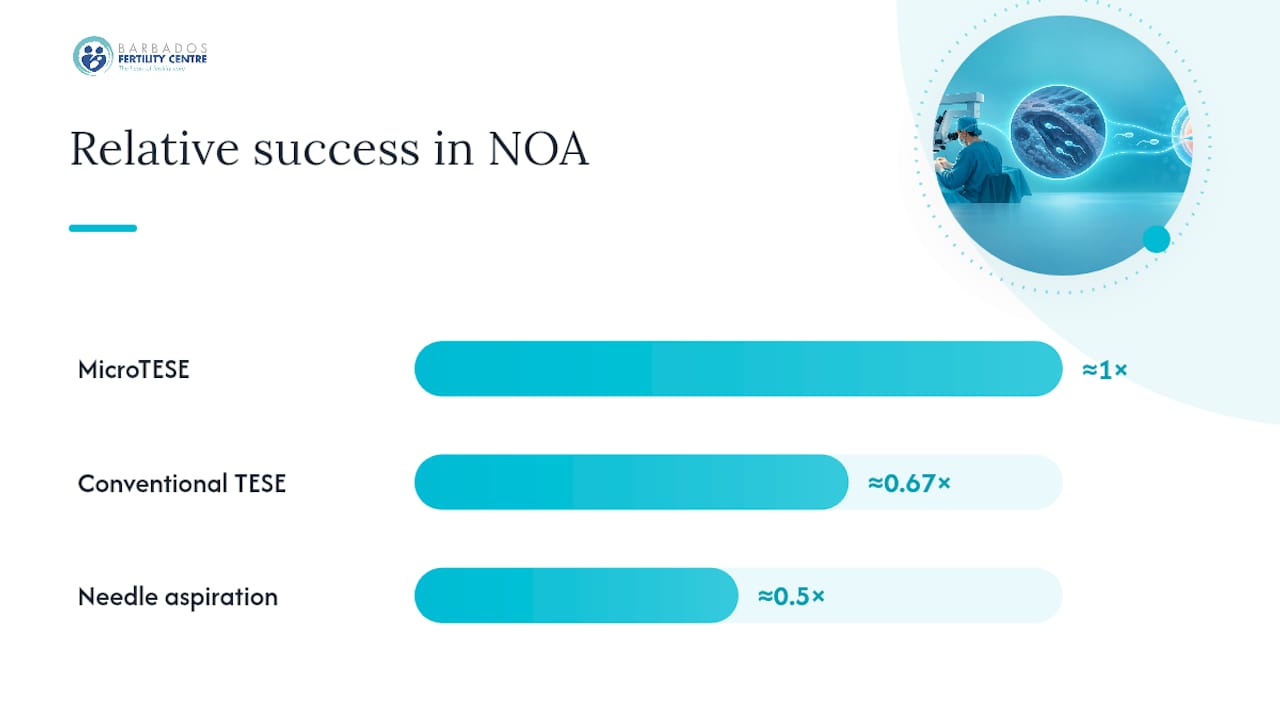
The evidence behind this preference is substantial. The 2024 AUA/ASRM guideline update recommends microTESE specifically for men with NOA, and the data behind that recommendation is hard to argue with:
MicroTESE succeeds roughly 1.5 times more often than conventional TESE, and roughly twice as often as simple needle aspiration, in men with non-obstructive azoospermia, according to meta-analyses cited in the guideline.
That gap exists because NOA testicles often have sperm production scattered in isolated microscopic islands rather than distributed evenly. A blind biopsy or needle pass can easily miss those islands entirely; a microscope lets the surgeon see subtle differences in tubule size and opacity that correlate with active sperm production.
Some surgeons combine mapping techniques, sometimes done as an office-based fine-needle biopsy across multiple testicular sites before the main procedure, with a staged approach to microTESE. The goal is to gather intelligence about where sperm exist before committing to extensive microdissection, which reduces unnecessary tissue sampling while still allowing escalation to full microTESE in the same session if the mapping result is ambiguous.
A few operational realities matter here that patients rarely hear about upfront:
- MicroTESE requires genuine microsurgical training and volume; not every urology practice performs enough cases to maintain proficiency.
- The embryology lab needs to be on standby for immediate specimen processing, since sperm found during microTESE are often scarce and time-sensitive.
- General or regional anesthesia is standard, and the procedure typically runs longer than percutaneous alternatives, often one to three hours depending on findings.
How Should You Choose Between Retrieval Methods?
The right method isn’t a matter of personal preference. It comes down to a short list of clinical and logistical factors that a fertility specialist should walk through with you before scheduling anything.
- OA or NOA? This is the single biggest fork in the decision tree, and it should be confirmed with hormone testing and imaging before any procedure is booked.
- History of prior biopsies or surgery? Scar tissue changes the surgical approach and can lower expected yield on a repeat attempt.
- Testis size and consistency? Smaller, softer testicles on exam or ultrasound often correlate with lower NOA yield and may push toward microTESE over conventional TESE from the outset.
- Timing urgency? Whether retrieval happens fresh alongside a partner’s egg retrieval, or in advance with cryopreservation as a safety net, depends heavily on how confident the team is in finding sperm.
- Lab capability? Not every IVF lab has equal experience processing surgically retrieved sperm; ask directly about the center’s track record with these specimens.
- Cost and insurance coverage? Surgical retrieval, anesthesia, and cryostorage fees add up differently depending on the method chosen and the clinic’s fee structure.
Before consenting to a procedure, it helps to walk through a short checklist with your surgeon: expected sperm retrieval rate for your specific diagnosis, whether testosterone monitoring will be needed afterward, whether donor sperm backup is arranged in case retrieval fails, and what the cryostorage fees look like if sperm are frozen rather than used fresh.
Pro Tip: Ask your surgeon directly how many microTESE cases they perform annually and what their center’s sperm retrieval rate has been for NOA patients specifically. Caseload volume correlates with outcomes in microsurgical procedures, and a confident specialist will have that number ready.
It’s also worth asking what the embryology lab’s ICSI success rate looks like and what the contingency plan is, mapping first, then microTESE, or a second attempt weeks later, if the initial procedure comes up empty.
What Happens After Retrieval: ICSI, Fresh vs. Frozen Sperm, and Outcomes
Surgically retrieved sperm almost always require intracytoplasmic sperm injection (ICSI) rather than conventional IVF, because the sperm counts recovered this way are typically far too low, and often too immature or immotile, for sperm to fertilize an egg on their own. A single embryologist manually injects one sperm into each mature egg, which makes even a handful of retrieved sperm potentially enough for a treatment cycle.
Whether to use fresh or frozen sperm depends heavily on the underlying diagnosis. For OA, guideline sources note little meaningful difference in pregnancy or miscarriage rates between fresh and cryopreserved sperm, since retrieval reliably yields adequate numbers either way. For NOA, the calculation shifts: when sperm counts recovered are very limited, some centers prefer to use fresh sperm on the same day as egg retrieval rather than risk losing viability through the freeze-thaw process, though a good freezing protocol usually preserves sperm adequately for later use.
Outcome ranges reported in the literature vary by clinic, sperm source, and, most heavily, the female partner’s age and ovarian reserve. Fertilization rates with ICSI using surgically retrieved sperm are generally comparable to ICSI using ejaculated sperm once fertilization occurs, though clinical pregnancy and live birth rates depend far more on egg quality and embryology lab experience than on which retrieval method was used.
A few points worth underscoring for patients weighing their odds:
- ICSI is standard practice for surgically retrieved sperm; conventional insemination in the lab dish is not typically an option.
- Fresh sperm may be favored for NOA cycles with very limited counts, while frozen sperm work well for OA cases with ample yield.
- Female age and ovarian reserve influence outcomes more than the sperm retrieval method itself in most cycles.
- A lab’s specific experience handling surgically retrieved, low-motility specimens is a real modifier of success, and it’s a fair question to ask any clinic directly.
What Are the Risks and Recovery Timeline After Surgical Sperm Retrieval?
Surgical sperm retrieval is generally safe, but it isn’t risk-free, and patients deserve a straightforward accounting of what can go wrong and how recovery usually unfolds.
The most common complications are scrotal pain, swelling, and hematoma, a collection of blood under the skin that can cause bruising and discomfort but usually resolves on its own within a couple of weeks. Infection is uncommon but possible at the incision or needle site. More significant, though rarer, risks include testicular atrophy from disrupted blood supply, and a decline in testosterone production, particularly after microTESE, since even careful microsurgical technique can affect some of the testosterone-producing cells surrounding the sampled tubules. Guideline sources specifically flag this testosterone risk as something patients should be counseled on and monitored for after the procedure, regardless of how meticulous the surgical technique was.
Recovery guidance from clinical centers is fairly consistent:
- Ice the area for the first 24 hours to limit swelling.
- Wear a supportive jock strap or snug underwear for several days to weeks.
- Manage pain with scheduled NSAIDs like ibuprofen and acetaminophen as needed, following standard outpatient dosing guidance, unless a medical condition rules out NSAID use.
- Expect light activity to resume within 48 to 72 hours, but avoid heavy lifting or strenuous exercise for 2 to 4 weeks depending on the extent of surgery.
Follow-up matters just as much as the procedure itself. Semen or andrology results from any retrieved and frozen sperm are usually available within days, while hormone levels, especially testosterone, are typically rechecked at follow-up visits over the following weeks to months to catch any decline early. Patients should seek urgent review for worsening pain, fever, significant swelling, or any sign of infection rather than waiting for a scheduled follow-up.
Barbados Fertility Centre: A Clinical Option for Coordinated Retrieval and IVF
A JCI-accredited fertility clinic offers facility and process standards that meet international medical benchmarks used to evaluate care across borders. For men navigating surgical sperm retrieval alongside a partner’s IVF cycle, that accreditation matters because it signals the same rigor applied to embryology and lab handling that a retrieval procedure depends on to succeed.
Some fertility clinics offer services including IVF, ICSI, and sperm and embryo cryopreservation, which can be coordinated when a retrieval procedure is banked ahead of an egg retrieval cycle rather than timed same-day. For international patients, remote coordination is a practical necessity: travel logistics, cycle synchronization with a partner’s ovarian stimulation, and cryopreservation scheduling all need to line up before either partner arrives on the island. In some clinics, teams work through the treatment timeline in advance so the surgical and IVF components of a cycle are planned together rather than pieced together at the last minute.
A Clinician’s View on Staging Retrieval Decisions
The instinct to jump straight to the most aggressive procedure is understandable, but it’s not always the right call. A staged approach, starting with the least invasive method that plausibly fits the diagnosis and escalating only when needed, respects both the tissue and the patient’s emotional bandwidth for repeat procedures.
What gets underweighted in most conversations is the emotional toll of an uncertain retrieval, especially for men facing NOA. Counseling should include real talk about donor sperm as a backup plan, not as a failure, but as a contingency that protects the couple’s IVF cycle from being derailed entirely if retrieval comes up empty. Shared decision-making, where the patient understands the odds and has a say in how aggressive the surgical plan is, tends to produce better-adjusted outcomes than a purely surgeon-driven protocol.
— Barbados
Planning Your Retrieval and IVF Cycle With Barbadosivf
Coordinating surgical sperm retrieval with a partner’s egg retrieval can be facilitated by some fertility clinics offering in-house IVF and ICSI programs aligned with the retrieval timeline, plus options for sperm cryopreservation to bank results ahead of the cycle if needed.

That combination matters because a successful sperm retrieval only pays off if the embryology lab is ready to inject and fertilize immediately, or freeze reliably for later use. Barbadosivf’s IVF with ICSI service is priced from $6,750 for CARICOM patients, while international patients can review ICSI pricing at $7,650 one-off. Some clinics coordinate remotely with patients ahead of travel to align retrieval timing, cryopreservation logistics, and cycle scheduling.
If you’re weighing surgical sperm retrieval alongside an upcoming IVF or ICSI cycle, the next step is a consultation to review your diagnosis, expected timeline, and which pricing plan fits your situation. Visit Barbadosivf to request one.
Sources
For readers who want to go deeper into the clinical evidence behind this guide, a few primary sources stand out. The 2024 AUA/ASRM guideline update on male infertility remains the authoritative reference for microTESE recommendations in NOA. The systematic review and meta-analysis comparing TESA and PESA offers the clearest data on outcome differences in obstructive azoospermia. For procedural detail and staged retrieval strategy, the review of operative and office-based retrieval techniques is a strong clinical resource, and the Cleveland Clinic’s microTESE overview provides an accessible patient-facing explanation of the technique itself.
This article is general information, not a substitute for advice from a qualified doctor. Consult a qualified healthcare professional about your own circumstances before acting on anything here.
- Diagnosis and treatment of infertility in men: AUA/ASRM guideline updates (2024)
- Operative techniques and office-based sperm retrieval strategies (review/chapter)
- microTESE overview — Cleveland Clinic
FAQ
How painful is sperm retrieval?
Most percutaneous procedures like PESA and TESA involve mild to moderate discomfort managed with local anesthesia, similar to a needle biopsy. Open procedures like microTESE involve more post-operative soreness for several days, typically managed with NSAIDs and acetaminophen alongside ice and scrotal support.
What are the downsides of surgical sperm retrieval?
The main downsides are hematoma, temporary swelling, and a small risk of infection, along with rarer risks like testicular atrophy or a decline in testosterone production, particularly after microTESE. There’s also no guarantee sperm will be found, especially in non-obstructive azoospermia, which is why cryopreserved backup planning matters.
Does insurance cover the TESE procedure?
Coverage varies widely by insurer, plan, and country, and many fertility-related procedures are only partially covered or excluded entirely. Patients should confirm coverage directly with their insurer and ask their clinic about transparent pricing; Barbadosivf publishes its IVF with ICSI and ICSI pricing directly on its site for patients comparing costs.
How long does a TESE procedure typically last?
Conventional TESE and PESA/TESA are usually completed within 30 minutes to an hour, while microTESE typically takes one to three hours depending on how extensively the surgeon needs to search testicular tissue. Recovery from anesthesia and immediate post-op observation can add time to the total visit, especially for open microsurgical cases.
What is the difference between TESE and microTESE for NOA?
Conventional TESE removes tissue samples without magnification, while microTESE uses an operating microscope to selectively target tubules more likely to contain sperm. MicroTESE succeeds roughly 1.5 times more often than conventional TESE in men with non-obstructive azoospermia, which is why it’s the guideline-preferred method for this diagnosis.