


Ovarian hyperstimulation syndrome (OHSS) is an exaggerated response of the ovaries to fertility medication. No single method removes the risk completely, but a plan built around your risk profile lowers it a great deal. That plan has four parts: an individualized medication dose, a protocol that suits your ovarian reserve, a trigger shot chosen with OHSS in mind, and the option of freezing all embryos for a later transfer. This guide explains each part, who is more likely to need them, and which symptoms after egg retrieval should send you to a doctor.
TL;DR
- Mild OHSS is common in IVF, while moderate or severe OHSS affects just over 1 in 100 women, according to RCOG patient information.
- Higher risk goes with polycystic ovaries, a previous OHSS episode, a high antral follicle count, a high AMH and a strong response to stimulation.
- The most effective strategies in the evidence are an antagonist protocol, a GnRH agonist trigger, milder stimulation and dopamine agonists such as cabergoline.
- Freezing all embryos and transferring later is the usual option when the ovaries respond very strongly.
- Call your clinic or seek medical help if pain keeps getting worse, or if you vomit, have urinary problems, chest pain or trouble breathing.
Table of Contents
- What OHSS is and why it happens
- Who is more likely to develop OHSS
- Step 1: Testing and an individualized plan
- Step 2: Choosing the protocol
- Step 3: Trigger shot choice
- Step 4: Cabergoline after the trigger
- Step 5: Freezing all embryos
- How much risk can be removed
- Symptoms after retrieval that need prompt attention
- Our perspective on OHSS prevention
- Planning treatment with us
- Questions to bring to your consultation
- FAQ
- Sources
What OHSS is and why it happens
During IVF, medication stimulates the ovaries to grow several follicles instead of the single one that develops in a natural cycle. In some patients the ovaries respond more strongly than intended. They swell, and fluid can shift out of the blood vessels into other parts of the body. That is OHSS.
Most cases are mild. RCOG reports that mild OHSS affects as many as 33 in 100 women having IVF, and just over 1 in 100 develop the moderate or severe form. Those numbers explain why prevention starts before the first injection. The aim is not to avoid stimulation, which is what makes IVF work. The aim is to match the stimulation to the ovaries in front of us.
Who is more likely to develop OHSS
Risk is not equal for every patient, and much of it can be read from tests done before treatment starts. The American Society for Reproductive Medicine (ASRM) guideline on OHSS prevention lists baseline risk factors: polycystic ovary syndrome, previous OHSS, an antral follicle count above 24, and AMH above 3.4 ng/mL. The same guideline reports higher risk with younger age, Black race, and infertility caused by ovulation disorders, tubal factor or unexplained infertility.
Some risk signals only appear once stimulation is under way. The ASRM names more than 17 follicles over 10 mm at trigger, estradiol above 3,500 pg/mL at trigger, and more than 15 eggs retrieved as stimulation-related markers.
RCOG adds a timing factor. Risk is higher for women under 30 and for those who become pregnant in the same IVF cycle in which symptoms appear, particularly with a multiple pregnancy.
| Risk marker | When it is known | Why it matters |
|---|---|---|
| PCOS, previous OHSS | Before treatment | Calls for a gentler plan from day one |
| High AFC or AMH | Before treatment | Predicts a strong response, so dosing starts lower |
| Many follicles, high estradiol | During monitoring | Can change the trigger or the transfer plan |
| Many eggs retrieved | At retrieval | Can lead to a freeze-all decision |
If you want to understand the testing side, our guide to ovarian reserve testing explains what AFC and AMH results mean.
Step 1: Testing and an individualized plan
Prevention begins with knowing how your ovaries are likely to respond. A 2012 review in Reproductive Biology and Endocrinology argues that high-risk patients can be identified from their risk and biomarker profile, and that the stimulation protocol can then be tailored. The same review notes that when individualization is not applied correctly, patients are more likely to experience OHSS.
There is a useful nuance in the research. A 2019 paper in Frontiers in Endocrinology notes that dose individualization by ovarian reserve does not generally improve live birth rates, but the reduction in OHSS risk may be substantial. In practical terms, tailoring the dose protects you without costing you a chance of success.
The ASRM guideline recommends dosing gonadotropins based on individualized ovarian reserve testing. It also suggests considering a lower starting dose, or oral ovulation-inducing medications such as clomiphene citrate or letrozole, when OHSS is a concern. Our overview of the IVF medications explains what each drug in a cycle does.
Step 2: Choosing the protocol
The protocol is the schedule of medications that controls your cycle. For patients where OHSS is a concern, the ASRM recommends a GnRH antagonist protocol. An umbrella review by Palomba and colleagues in 2023 supports this: GnRH antagonist co-treatment (36 randomized trials, OR 0.61) was among the most effective interventions, with moderate certainty of evidence.
The same review found that mild ovarian stimulation (9 trials) and dopamine agonists (10 trials) were effective and safe in reducing OHSS, also with moderate certainty. Mild stimulation means lower doses and fewer follicles. It suits patients who respond strongly, because the goal is a healthy number of good eggs, not the largest number possible.
Step 3: Trigger shot choice
The trigger shot completes egg maturation before retrieval, and it is one of the most influential decisions for OHSS risk. Standard hCG triggers act for a long time in the body, which keeps the ovaries stimulated after retrieval. A GnRH agonist trigger works differently and is much shorter-acting.
The ASRM recommends a GnRH agonist trigger as a first-line strategy to reduce moderate-to-severe OHSS. The Palomba review found agonist triggering (8 trials, OR 0.15) to be among the most effective interventions. A 2014 review found that in the largest trial in a high-risk population, with 15 to 25 follicles, no OHSS cases were reported even with a fresh embryo transfer, when low-dose hCG rescue was used.
Two points from the ASRM guideline are worth knowing:
- A lower-dose hCG-only trigger is not recommended as a way to reduce OHSS risk.
- If an agonist trigger is used with a planned fresh transfer, adequate luteal support is recommended.
Timing matters as much as the drug. Our guide to trigger shot timing covers how clinicians decide the right moment and what happens afterward.
Step 4: Cabergoline after the trigger
For patients at risk of moderate-to-severe OHSS, the ASRM guideline gives a strong recommendation to start a dopamine agonist such as cabergoline on the day of the hCG trigger or soon after, and continue it for several days. This is prescribed medication, so the dose and duration come from your physician.
Step 5: Freezing all embryos
OHSS often worsens when pregnancy occurs in the same cycle, because the body produces its own hCG. Freezing embryos and transferring them in a later cycle removes that overlap.
The ASRM recommends considering a freeze-only cycle followed by a frozen embryo transfer for patients at risk because of a high ovarian response or elevated estradiol. It reports that multiple high-quality studies found significant reductions in moderate or severe OHSS. A 2025 article on women with PCOS also lists cryopreservation of all embryos with deferred transfer among strategies that reduce risk.
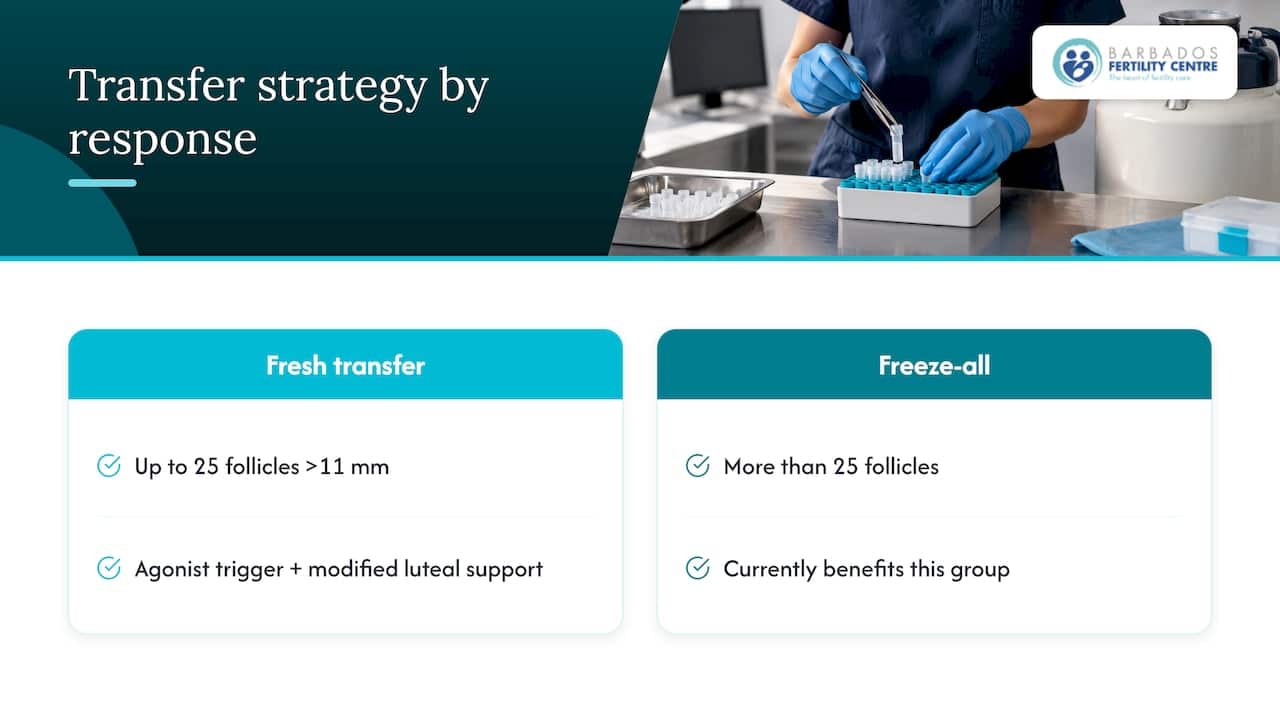
How far to rely on it depends on the patient. The 2014 review suggests that patients with up to 25 follicles over 11 mm may be able to proceed to a fresh transfer after an agonist trigger with modified luteal support, while those with more than 25 follicles currently benefit from freeze-all. Your own numbers at monitoring decide which route fits.
If you have PCOS and are weighing treatment options, our page on PCOS and IUI explains when IVF becomes the better route.
How much risk can be removed
Be realistic about what prevention does. A 2015 review concluded that no single method completely prevents OHSS, and that sorting women by risk and individualizing treatment helps reduce their chances of developing it. The best results come from combining measures: a careful starting dose, close monitoring, a suitable trigger, medication after the trigger when indicated, and a freeze-all decision when the response is high.
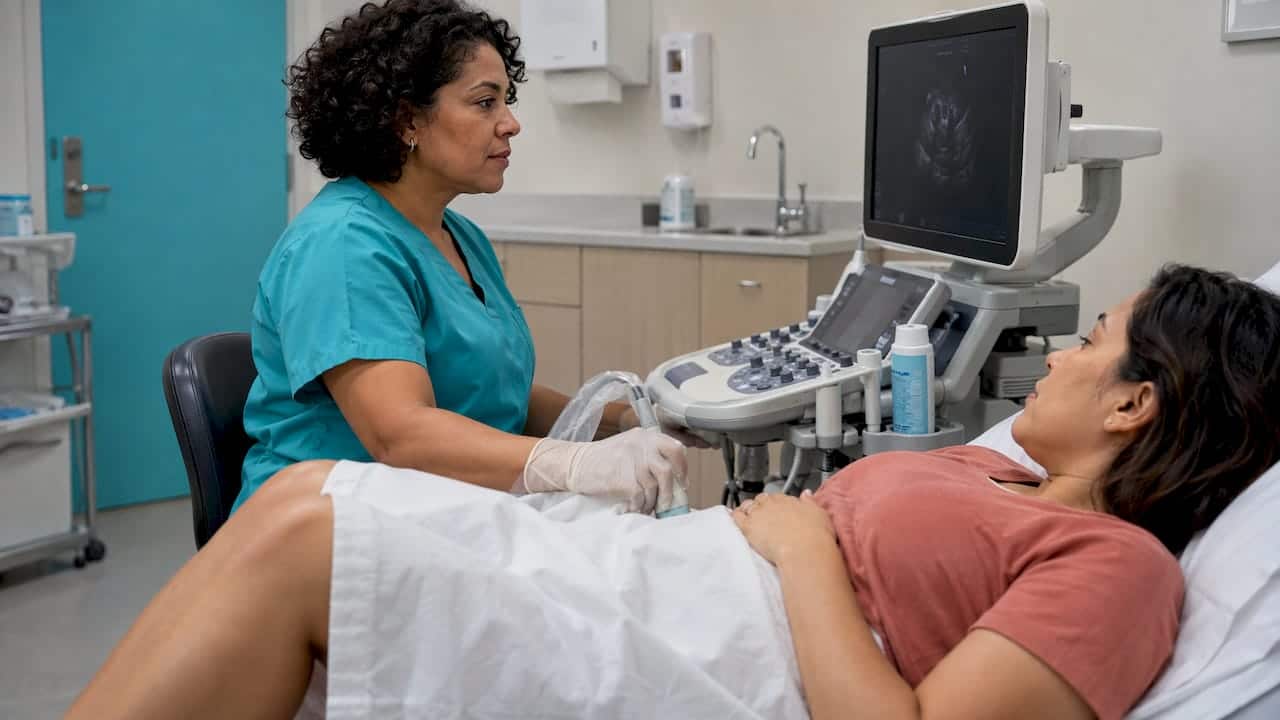
This is why monitoring visits matter. Ultrasound scans and blood tests during stimulation give your doctor the information to adjust the plan before problems build.
Symptoms after retrieval that need prompt attention
Some bloating and tenderness can follow egg retrieval. What matters is the direction of travel. RCOG advises calling for medical help if you develop symptoms of OHSS, particularly if pain is not getting any better or you start to vomit, have urinary problems, chest pain or difficulty breathing.
If you are treated away from home, plan for this in advance:
- Ask your care team who to contact after retrieval and how to reach them out of hours.
- Know where the nearest hospital is for the days after your procedure.
- Do not wait for a scheduled appointment if symptoms are getting worse. Chest pain or breathing difficulty needs urgent medical care.
Our perspective on OHSS prevention
At Barbados Fertility Centre, we see OHSS prevention as part of personalized care, not an add-on to it. Every patient starts from different ovaries, a different history and a different goal, so a single standard dose for everyone makes little sense.
We believe the safest cycle is one planned around you: your test results, your history and the way you respond as monitoring progresses. The research points the same way, with risk categorization and individualized treatment as the foundation of prevention.
We also know that fear of complications is part of what makes IVF feel overwhelming. Our aim is to reduce that stress with clear explanations, open communication and a calm setting. If you have PCOS, a high AMH, or a previous OHSS episode, tell us at the start, and we will build your plan with that in mind.
Barbados
Planning treatment with us
If you are considering IVF and want a plan that takes your OHSS risk seriously, we can review your history and test results with you before you commit to a cycle. We are a JCI-accredited fertility centre, and we coordinate treatment remotely for international patients before you travel.
Our published IVF pricing starts from $5,750, and IVF with ICSI starts from $6,750. International patients can see ICSI at $7,650 and egg freezing at $4,950 on our international price list. You can estimate your own total with the IVF cost calculator, or read more about IVF treatment in Barbados.
Egg freezing patients also respond strongly to stimulation at times, so the same risk review applies. Our egg freezing page explains how a cycle works.
Questions to bring to your consultation
A good consultation turns the research above into a plan for you. Consider asking:
- What do my AFC and AMH suggest about how I will respond?
- What starting dose are you proposing, and why?
- Which trigger will you use if I respond strongly?
- Under what circumstances would you recommend freezing all embryos?
- What symptoms should make me call you, and who do I call?
These questions also help you feel in control, which matters during a treatment that can otherwise feel like things are happening to you.
FAQ
Can OHSS be prevented completely?
No. A 2015 review states that no single method completely prevents it. Risk can, however, be reduced substantially by sorting patients by risk, individualizing the dose and protocol, and choosing the trigger and transfer plan carefully.
Which risk factors matter most?
The ASRM lists PCOS, previous OHSS, a high antral follicle count and a high AMH as baseline factors. During treatment, many follicles at trigger, high estradiol and a large number of eggs retrieved add to the risk. Younger age is also associated with higher risk.
Does a freeze-all cycle lower the chance of pregnancy?
Freeze-all delays the embryo transfer to a later cycle rather than cancelling it. The ASRM recommends considering it for patients at risk because of high ovarian response or elevated estradiol. Your doctor can explain how it fits your situation and timeline.
Which symptoms mean I should call a doctor after egg retrieval?
RCOG advises seeking medical help for OHSS symptoms, especially pain that is not improving, vomiting, urinary problems, chest pain or difficulty breathing. Do not wait for your next scheduled visit if any of these appear.
Sources
- ASRM: Prevention of moderate and severe ovarian hyperstimulation syndrome, guideline 2023
- RCOG: Ovarian hyperstimulation syndrome (OHSS)
- Fiedler and Ezcurra: Predicting and preventing ovarian hyperstimulation syndrome
- Broekmans: Individualization of FSH doses in assisted reproduction
- Palomba et al.: Interventions to prevent or reduce the incidence and severity of OHSS
- Castillo, Humaidan and Bernabéu: Pharmaceutical options for triggering of final oocyte maturation
- Minimising OHSS in women with PCOS
- Prevention of ovarian hyperstimulation syndrome: a review
Recommended
- IVF Medications List: What Each Drug Does and What to Expect
- Endometrial Scratch Before IVF: What the Evidence Shows
- IVF – What You Should Be Asking
- Can I Still Do IVF With a Low Egg Count?