


A frozen embryo transfer (FET) thaws an embryo created in an earlier IVF cycle and places it in your uterus when your lining is ready. The cycle usually takes about 4 to 8 weeks from your first monitoring visit to a pregnancy test. The transfer itself takes minutes and needs no anesthesia. Most of the work is preparing the uterus so the timing matches the embryo’s stage.
This guide walks through each step in order, explains natural versus medicated cycles, covers what to do and avoid afterward, and gives national success figures by age.
TL;DR
- An FET uses embryos frozen in a previous IVF cycle. Your clinic prepares your uterine lining with your natural cycle or with hormones, then thaws and transfers the embryo.
- Plan on roughly 4 to 8 weeks from the start of a cycle to a pregnancy test. The transfer visit is short and usually comfortable.
- Aftercare is mostly ordinary life: take your progesterone as prescribed, skip strenuous exertion if your clinic advises it, and do not stay on bed rest. Guidelines find no benefit from it.
- In US national data, live birth rates per thaw run from about 47% under age 35 to about 20% over age 42. Embryo quality and age drive the result.
- We coordinate FET and IVF cycles for international patients at Barbados Fertility Centre, with published pricing.
Table of Contents
- What a frozen embryo transfer is and when it is used
- The FET timeline, step by step
- Natural versus medicated FET
- Fresh versus frozen transfer
- What to expect on transfer day
- Care after embryo transfer
- Can you travel or fly after an embryo transfer?
- When can you test, and what are early signs?
- Frozen embryo transfer success rates
- Our perspective
- Start with a plan and a price
- FAQ
- Sources
What a frozen embryo transfer is and when it is used
During IVF, eggs are retrieved and fertilized, and the resulting embryos are grown in the laboratory for several days. Embryos that are not transferred right away can be frozen by vitrification, a rapid cooling method, and stored. An FET is the later cycle in which one of those embryos is thawed and transferred.
People end up with an FET for several reasons:
- Embryos left over from a fresh cycle. Some of the embryos from a retrieval are frozen for later attempts or future siblings.
- A freeze-all cycle. The clinic freezes every embryo and transfers later, so the uterus is not exposed to the hormones of ovarian stimulation. We cover when this helps in our guide to freeze-all IVF.
- Genetic testing. If embryos are biopsied for preimplantation genetic testing (PGT-A), they are frozen while results come back.
- Donor or donated embryos. Embryo donation always uses frozen embryos, and you can read about the characteristics of donated embryos we describe to recipients.
- Timing. Illness, travel, or a need to rest between cycles can all make a delay sensible.
If you are still weighing the bigger picture, our page on what IVF involves explains the stages before the transfer.
The FET timeline, step by step
Exact schedules vary by clinic and by protocol, so treat this as a typical pattern and not a promise.
Step 1: Planning and baseline checks
Your doctor reviews your embryo count and quality, your history, and any earlier transfers. A baseline ultrasound early in your menstrual cycle checks the uterus and ovaries. Some patients also have a uterine evaluation, such as a saline sonogram, if the cavity has not been assessed recently.
Step 2: Preparing the uterine lining
This is the longest stage, usually one to three weeks. The goal is a lining that is thick enough and receptive at the moment the embryo is placed. There are two main routes, compared in the next section.
Step 3: Monitoring
You have one or more ultrasounds, sometimes with blood tests, to measure lining thickness and hormone levels. The scans decide the date of your transfer.
Step 4: Progesterone and scheduling the thaw
Progesterone tells the lining to become receptive. The day it starts is counted as day zero for the embryo. A day 5 blastocyst is transferred after about five days of progesterone exposure, an earlier-stage embryo after fewer. Your clinic times the thaw so the embryo and lining are in step.
Step 5: Thawing and transfer
The embryology team thaws the embryo on the day and confirms it has survived and is developing normally. You then have the transfer, described below.
Step 6: The wait and the pregnancy test
Progesterone continues. A blood test for hCG is usually scheduled roughly one to two weeks after transfer, and your clinic will give you an exact date. If it is positive, you continue medication and have early ultrasounds.
| Stage | Typical length | What happens |
|---|---|---|
| Planning and baseline scan | A few days | Review of embryos, history and uterus |
| Lining preparation | 1 to 3 weeks | Natural cycle tracking or estrogen |
| Monitoring | Several visits | Ultrasound, sometimes bloodwork |
| Progesterone, then transfer | About 5 days for a day 5 blastocyst | Embryo thawed and transferred |
| Waiting period | Roughly 1 to 2 weeks | Progesterone continues, then hCG blood test |
Natural versus medicated FET
Both routes are well established. The choice depends on how regularly you ovulate, your history, and what your doctor prefers.
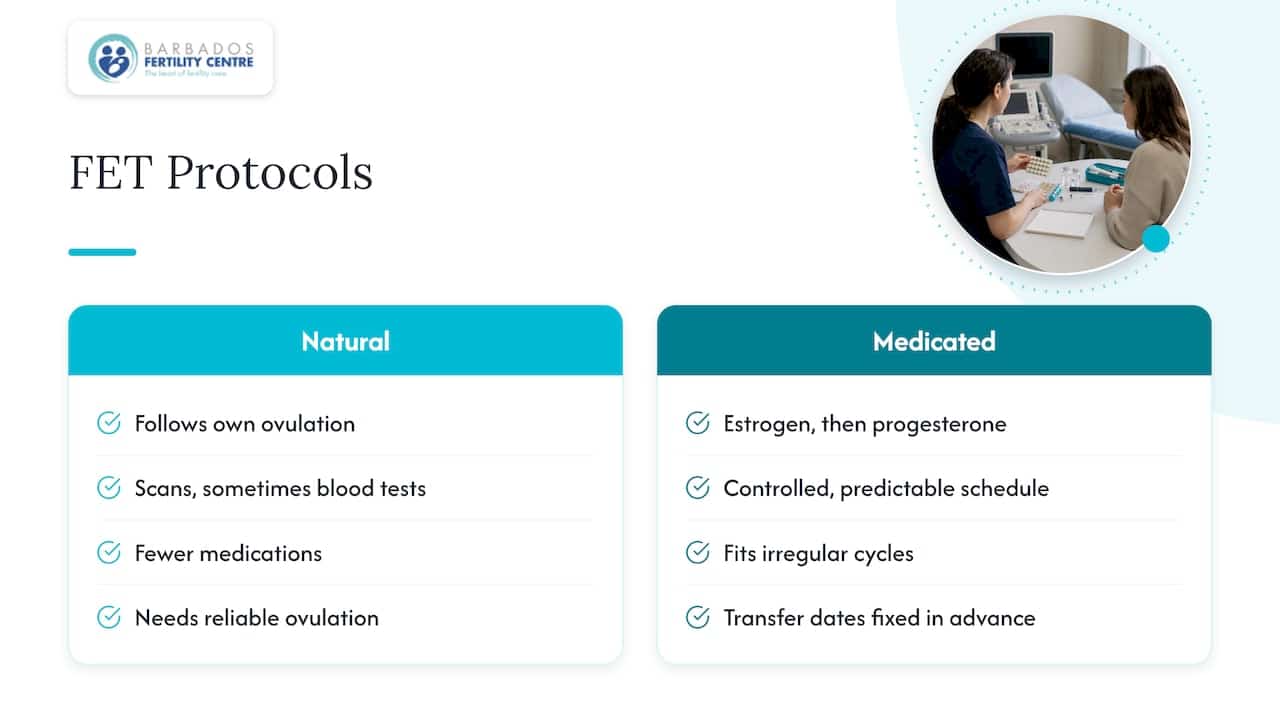
Natural-cycle FET follows your own ovulation. You are monitored with scans and sometimes blood tests, and the transfer is timed from ovulation. It involves fewer medications, but it needs reliable ovulation and flexible scheduling, because the date depends on your body.
Medicated (hormone-replacement) FET uses estrogen to build the lining and then progesterone to prepare it. Because the schedule is controlled, the transfer date is predictable. This suits patients with irregular cycles, including many with PCOS, and patients who are traveling for treatment and need dates fixed in advance.
Progesterone is given as injections, vaginal suppositories or gels, depending on the protocol. Our comparison of progesterone injections and suppositories lays out the differences, including side-by-side comparison points and questions about weight gain on progesterone.
Fresh versus frozen transfer
A fresh transfer happens in the same cycle as the egg retrieval, a few days afterward. A frozen transfer happens in a later cycle. Today, many clinics favor frozen transfers in a lot of situations, partly because the lining is not exposed to stimulation hormones and the timing is flexible.
National data from 2014 to 2020, analyzed by Wang and Seifer in Reproductive Biology and Endocrinology, found that initial frozen transfers had a live birth rate of 48.3%, against 39.8% for initial fresh transfers. The cumulative live birth rate was 74.0% versus 60.0%. These are population averages, and your own best option depends on your response to stimulation and your embryo quality, which is a conversation for your doctor.
What to expect on transfer day
The visit is simple. You are usually asked to arrive with a comfortably full bladder, because it helps the ultrasound show the uterus clearly. The embryologist confirms the embryo has thawed well. Your doctor then passes a thin, soft catheter through the cervix under ultrasound guidance and places the embryo in the uterus. ASRM’s practice guidance on performing the embryo transfer recommends ultrasound guidance and a soft catheter, based on good evidence.
Most patients feel little more than a mild pressure, similar to a Pap test. You can usually go home or back to your accommodation soon after.
In the US, nearly all transfers are single embryo transfers. SART’s 2024 outcome tables show 97 to 98% of frozen PGT-A blastocyst cycles involved a single embryo, which keeps the risk of twins low.
Care after embryo transfer
After a transfer, the embryo has to implant in the lining, which generally takes place over the following several days. You cannot speed this up, and nothing ordinary you do will dislodge an embryo. Aftercare is about taking your medication correctly and living normally.
What helps
- Take progesterone and estrogen exactly as prescribed, at the same times each day. Do not stop unless your doctor tells you to, even if you start feeling symptoms or none.
- Keep moving gently. Walking and normal daily activity are fine. ASRM’s guidance reports good evidence not to recommend bed rest after transfer, and found no study showing it helps.
- Eat regular, balanced meals and drink water. Food will not replace your prescribed progesterone. If you want to understand what diet can and cannot do here, this piece on progesterone and diet is a good place to start.
- Rest when tired. Light fatigue and mild cramping are common with the medications.
What to avoid
- Heavy lifting, intense workouts or high-impact exercise until your clinic clears you.
- Hot tubs, baths and swimming pools if your clinic advises against them while you are on vaginal medication.
- Alcohol and smoking, which are best avoided at any stage of trying to conceive.
- Starting new supplements or medicines without checking with your fertility team.
- Early home pregnancy tests. Testing too soon can give a false negative, or a misleading positive if you used a trigger injection earlier in the process.
Call your clinic promptly for heavy bleeding, severe pelvic pain, fever, or any symptom that worries you. That is when to call, not wait for your next appointment.
Can you travel or fly after an embryo transfer?
Many patients ask this, especially international patients who travel for treatment. We are not aware of evidence that ordinary flying harms a transfer, and the guidance on aftercare points toward normal activity and away from enforced rest. Your own situation still matters: your doctor may advise a day or two before a long journey, and may want you reachable by phone for the first days of medication.
Practical tips for anyone traveling after transfer:
- Carry progesterone and other medicines in your hand luggage with the prescription, and keep to your dosing times across time zones.
- Walk the aisle and drink water on long flights.
- Avoid lifting heavy bags yourself.
- Confirm with your clinic where your pregnancy test will be done if you are flying home first.
If you are coming to us from abroad, our team coordinates the treatment plan with you remotely, and our IVF treatment abroad page explains how that works.
When can you test, and what are early signs?
Implantation generally happens within several days of a blastocyst transfer, and hCG then rises. Your clinic will choose a blood test date, typically one to two weeks after the transfer. A blood test is more reliable and measures the hormone level, so it is the test that counts.
Early signs, such as mild cramping, breast tenderness, tiredness or light spotting, overlap strongly with the side effects of progesterone. They cannot tell you whether you are pregnant. Many people have no symptoms and still have a positive result, and others have many and a negative one. Try to rely on the blood test and on your clinic’s guidance.
Frozen embryo transfer success rates
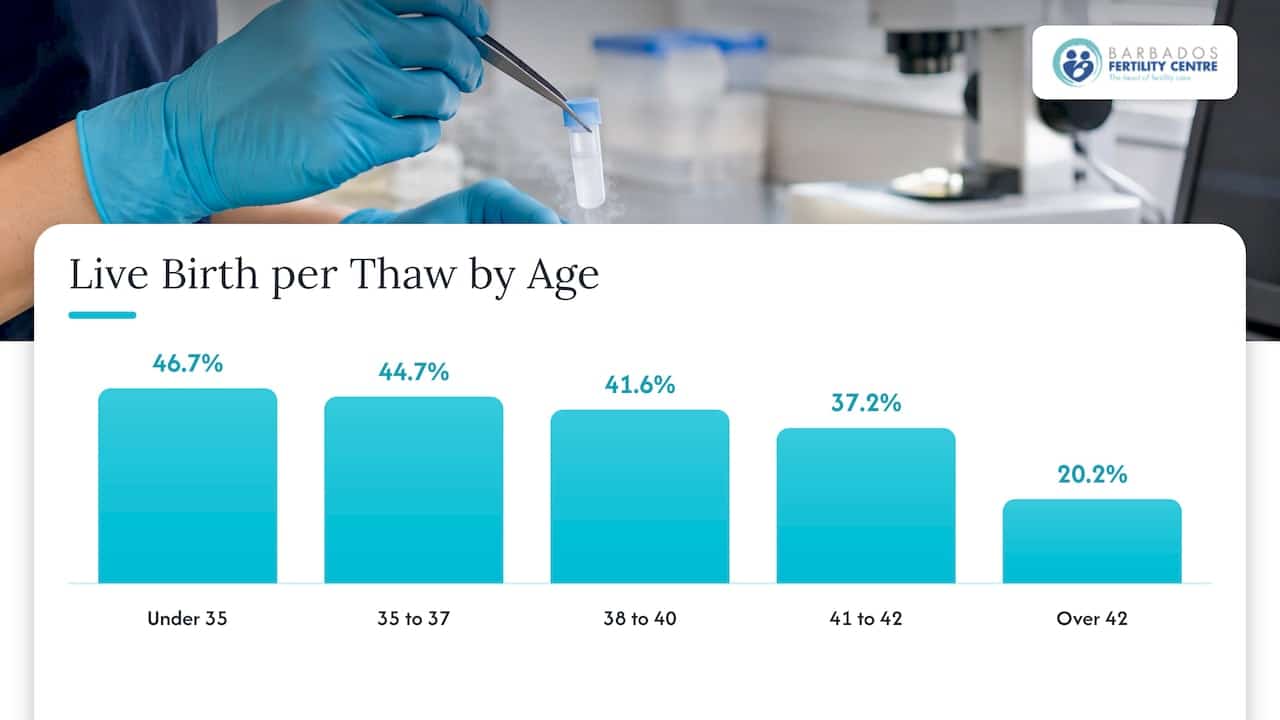
The best-known US figures come from SART, which collects data from member clinics. Live birth rates per thaw depend heavily on age at the time the eggs were frozen or retrieved, and on embryo quality.
The SART 2024 preliminary national summary reports these live birth rates per thaw for a second embryo transfer:
| Age group | Live birth rate per thaw |
|---|---|
| Under 35 | 46.7% |
| 35 to 37 | 44.7% |
| 38 to 40 | 41.6% |
| 41 to 42 | 37.2% |
| Over 42 | 20.2% |
For genetically tested embryos, the picture is more even across ages. SART’s 2024 outcome tables show a live birth rate per single frozen PGT-A blastocyst transfer of 54.9% under 35, 54.1% for ages 35 to 37, 51.6% for 38 to 40, 51.5% for 41 to 42 and 49.5% over 42. A study of 8,175 euploid single embryo transfers similarly found live birth rates between 52.2% and 62.5% across age groups, meaning embryo chromosomal status explains much of the outcome.
So what actually affects success?
- Embryo quality and chromosomal status. The age of the egg at retrieval matters most.
- Uterine receptivity. Lining thickness, uterine shape and conditions such as fibroids or polyps can matter, which is why monitoring and sometimes a uterine check come first.
- Hormone timing. Correct progesterone timing places the embryo inside its window.
- Lifestyle. Not smoking and general health support any pregnancy, but no habit guarantees an outcome.
These figures describe groups of patients, not individuals, and your doctor can put them into context for your own embryos. If age is on your mind, our article on how old is too old for IVF goes deeper.
Our perspective
At Barbados Fertility Centre, we see a frozen transfer as the stage where calm matters most. The medical work is already done: the embryos exist, and what remains is timing and care. So we try to make that stage as steady as possible.
Our approach is built on personalized protocols. We decide with each patient whether a natural or medicated cycle suits them, and we give clear dates early, which matters if you are traveling to us. Our clinic has operated since 2002, works under JCI accreditation, and has recorded thousands of pregnancies. We believe high medical standards should not require US-level cost or complexity.
Transparency is part of care. We publish our prices, and we coordinate treatment with international patients remotely before they travel, so that what they find on arrival is no surprise. Our setting in Barbados is deliberately quiet. We designed the patient experience to reduce stress, because the days after a transfer are hard enough.
Barbados
Start with a plan and a price
If you have frozen embryos, or are planning an IVF cycle that may end in a frozen transfer, we can help you map the whole process. Our published pricing starts with IVF from $5,750 and IVF with ICSI from $6,750 on the CARICOM price list, and ICSI at $7,650 on the international price list. You can estimate your own total with our IVF cost calculator, or contact us through our main site to discuss your embryos and timing.

For embryo options, such as embryo donation, see our embryo options payments page.
FAQ
How long does a frozen embryo transfer cycle take?
Most cycles take about 4 to 8 weeks from your first baseline scan to a pregnancy test, depending on the protocol and how quickly your lining develops. The transfer itself takes only a few minutes. Your clinic will give you a calendar once your protocol is chosen.
Is a day 5 transfer better than an earlier one?
A day 5 transfer places a blastocyst, an embryo that has survived to a later stage in the laboratory. Many clinics prefer it because it allows selection of embryos that continue to develop. Whether it is right depends on how many embryos you have and their quality, so your embryologist and doctor will advise you.
Is frozen embryo transfer painful?
Most patients describe mild pressure or slight cramping, and no anesthesia is needed. The hormone medications before and after are more likely to cause discomfort, such as bloating or injection-site soreness. Tell your clinic if pain is severe.
Do I need bed rest after the transfer?
No. ASRM guidance finds good evidence not to recommend bed rest after embryo transfer. Gentle walking and normal light activity are fine, and your clinic will tell you which strenuous activities to avoid.
Can I fly home soon after my transfer?
We are not aware of evidence that flying affects transfer outcomes, but follow your doctor’s advice for your own circumstances. Carry your medications in hand luggage, keep your dosing schedule, and confirm where your blood test will be done.
Sources
- SART 2024 Preliminary National Summary Report
- SART 2024 Outcome Tables
- Wang and Seifer, fresh versus frozen live birth rates (Reproductive Biology and Endocrinology)
- The impact of age beyond ploidy: outcome data from 8175 euploid transfers
- ASRM: Performing the embryo transfer, a guideline
- No Food Has Progesterone: meals and when to test
Recommended