

Implantation cramps are usually milder and shorter than period cramps, and they tend to show up several days before your period is due. Period cramps are typically stronger, can spread to the back and thighs, and often build as bleeding starts. The honest catch is that the two can feel nearly identical, and many people who are pregnant never notice implantation at all. Below we explain what each feels like, how timing and bleeding differ, what is different if you are in an IVF cycle, and which symptoms mean you should call a doctor the same day.
TL;DR
- Implantation cramps are generally mild and brief, often lasting a few hours to a few days. Period cramps are usually stronger and can last several days.
- Timing is the best clue: implantation cramping tends to come about 4 to 8 days before an expected period in a regular cycle, while period cramps arrive with or just before bleeding.
- No cramp pattern confirms pregnancy. Only a pregnancy test does, and testing too early can give a false negative.
- After embryo transfer, cramping can be normal, but severe pain, heavy bleeding, fever or fainting need a call to your clinic or urgent care right away.
Table of Contents
- Implantation cramps vs. period cramps at a glance
- When implantation cramps happen
- What each type of cramp feels like
- Bleeding: spotting vs. a period
- Why you cannot rely on cramps alone
- Cramping after embryo transfer or during an IVF cycle
- Symptoms that need prompt medical attention
- When to take a pregnancy test
- What if it turns out to be your period
- Our perspective
- Fertility treatment at Barbados Fertility Centre
- FAQ
- Sources
Implantation cramps vs. period cramps at a glance
This table summarizes how the two are typically described by the sources cited later in this article. Individual experience varies widely, so use it as a guide and not as a diagnosis.
| Feature | Implantation cramps | Period cramps |
|---|---|---|
| Typical timing | About 4 to 8 days before the expected period in a regular cycle | Right before and during the first days of bleeding |
| Intensity | Mild, sometimes moderate | Mild to severe, often building |
| Sensation | Pricking, pulling or tingling | Dull ache, or suddenly sharp |
| Location | Lower abdomen, sometimes the lower back | Lower abdomen, often spreading to the back and thighs |
| Duration | A few hours to a day, or on and off for 1 to 3 days | Often several days |
| Bleeding | None, or light spotting | Flow that usually gets heavier, then tapers |
When implantation cramps happen
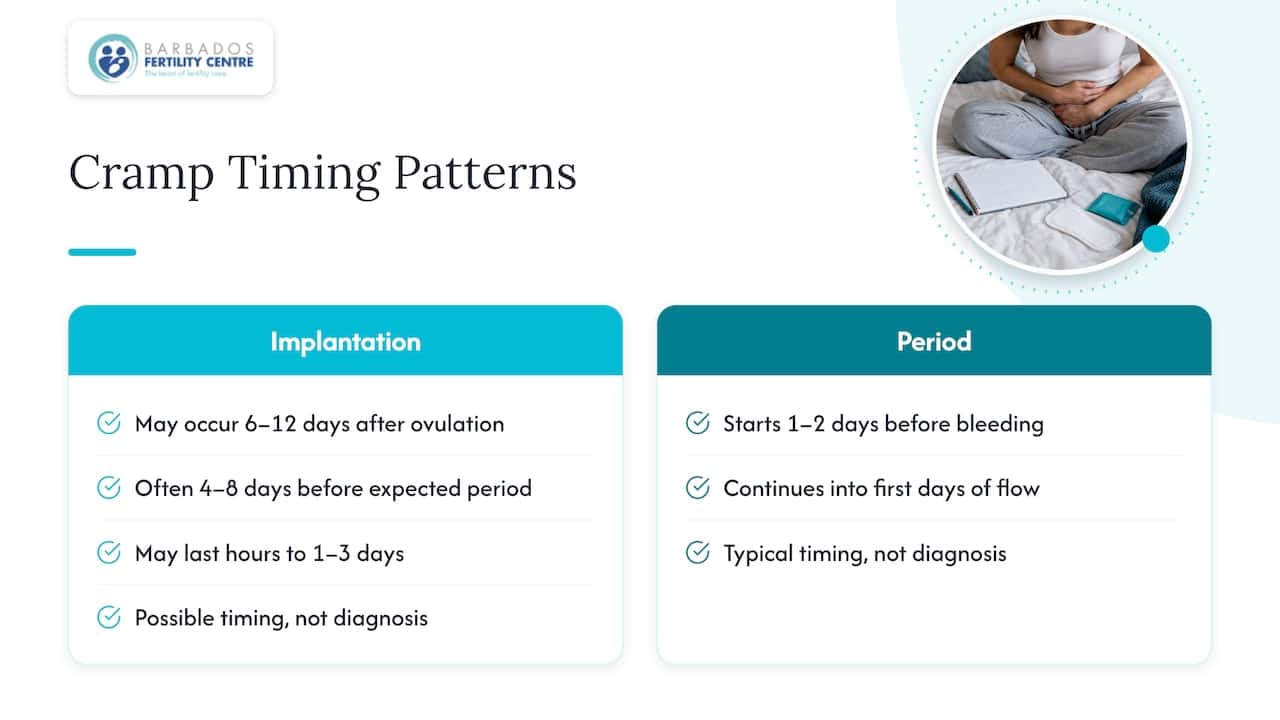
Implantation is the moment a fertilized egg attaches to the lining of the uterus. One clinical overview reports that it generally occurs 6 to 12 days after ovulation, most commonly around 8 to 9 days after conception, and that the exact day depends on when you ovulated and when conception took place. The U.S. National Institute of Child Health and Human Development likewise places implantation-related spotting at about 6 to 12 days after conception.
In practical terms, that puts any implantation cramping in the final week or so before your period. Parents reports that in an average 28-day cycle, implantation cramps may occur 4 to 8 days before the expected period. They may last a few hours or a day, or come and go for one to three days.
This matters because period cramps follow a different clock. They tend to start in the day or two before bleeding and continue into the first days of flow. If your cramps begin more than a few days before you expect your period, and they fade quickly, implantation is one possible explanation. Premenstrual symptoms are another, and that overlap is the core of the problem.
If your cycle is irregular
The “4 to 8 days before your period” window assumes a regular cycle. If your cycles vary, you may not know when your period is due, which makes timing clues far less useful. Tracking ovulation, with a calendar, temperature charting or ovulation tests, lets you count days from ovulation instead. If you are not sure when you ovulated, the cramping pattern alone will not tell you much, and a pregnancy test at the right time is the more reliable path.
What each type of cramp feels like
Implantation cramps
People describe implantation cramps as mild or moderate, with a pricking, pulling or tingling quality, according to a medical overview of the differences. They may feel like twinges in the lower abdomen or back. They are usually not the deep, rolling, wave-like pain many people associate with a heavy period.
Early-pregnancy cramping can also happen as the uterus adjusts to pregnancy. Verywell Health notes that these cramps are usually mild and short-lived, lasting two to three days, unlike more painful period cramps.
Period cramps
Period cramps can be dull or suddenly sharp, and they can spread to the back and thighs. They often intensify as bleeding begins and may need pain relief. If your usual cramps are a reliable monthly pattern, a noticeably lighter or differently timed version is worth paying attention to, though it is not proof of anything.
Bleeding: spotting vs. a period
Cramps rarely arrive alone, so bleeding is the second big clue. Implantation may come with light spotting, often pink or brown and much lighter than a period. A period usually starts light, becomes heavier over a day or two, and then tapers. If you want a closer look at color, amount and duration, this guide to implantation bleeding versus a period walks through the visual differences.
Spotting is also not guaranteed. The American College of Obstetricians and Gynecologists (ACOG) says light spotting can occur 1 to 2 weeks after fertilization when the fertilized egg implants, and also notes that bleeding in the first trimester occurs in 15 to 25 of 100 pregnancies. Light bleeding in early pregnancy is common and often not a major problem, but heavy bleeding or bleeding with significant pain needs medical attention, as covered below.
Why you cannot rely on cramps alone
It helps to be realistic about what cramps can and cannot tell you. The NICHD notes that early-pregnancy symptoms vary, and a person may experience all, some or none of them. Most people do not notice implantation symptoms at all.
One clinical perspective goes further: it is not even clear that implantation itself causes cramps. Optum Now cautions that tenderness, lower-back pain or mild cramping around this time may also reflect early hormonal changes. Other possible signs, such as breast tenderness, nausea, bloating, headaches, mood changes or discharge changes, overlap heavily with premenstrual symptoms.
So the practical rule is simple:
- Mild, short cramps a week or so before your period do not mean you are pregnant.
- Strong cramps that look like your usual period do not mean you are not pregnant, since a pregnancy can still be early.
- The only way to know is to test at the right time.
Cramping after embryo transfer or during an IVF cycle
If you are searching this topic after an embryo transfer, the picture changes a little. You know the day the embryo was placed, so you are not guessing about ovulation. But you are also watching your body more closely than you ever have, and during treatment, hormone medication can cause bloating, tenderness and mood changes that look like early pregnancy or a coming period. That makes symptom-spotting especially unreliable in an IVF cycle, in either direction.
Cramping after a transfer is common enough that clinics routinely prepare patients for it. What matters is the pattern:
- Mild, intermittent cramps or twinges that settle on their own are generally something to mention at your next scheduled contact with the clinic.
- Pain that does not improve with acetaminophen, vaginal bleeding, fever above 100°F or persistent nausea should prompt a call to your doctor, according to Emory School of Medicine’s embryo transfer guidance.
- Severe pain, fever above 100.4°F or difficulty breathing calls for urgent help from a physician, per the same guidance.
If you notice spotting rather than cramping, our page on spotting after embryo transfer and its red flags explains what clinics look at. Your progesterone support may also affect how your body feels, so it is reasonable to ask your team about it. Our comparison of progesterone injections and suppositories covers what to expect from each route.
Do not test early out of anxiety
A home test taken only a few days after transfer can mislead you. Medication used in some cycles can interfere with early results, and a very early negative may simply be too soon. Your clinic will give you a specific date for your blood test. Follow that date, not the cramps.
Symptoms that need prompt medical attention
Mild cramping can be normal. Some patterns are not, and the most important one to rule out is ectopic pregnancy, where the embryo implants outside the uterus. ACOG states that patients who undergo IVF have an increased risk of ectopic pregnancy, a life-threatening condition. Symptoms include abnormal vaginal bleeding and pelvic or abdominal pain, and in severe cases, when a rupture occurs, shoulder pain, dizziness or fainting.
Contact your ob-gyn or fertility clinic immediately, or go to urgent care or an emergency department, if you have:
- Severe or one-sided abdominal or pelvic pain, or pain that keeps getting worse.
- Heavy bleeding, especially with strong cramping. Verywell Health notes that severe or persistent cramping with heavy bleeding may signal a miscarriage or ectopic pregnancy.
- Shoulder pain, weakness, dizziness or fainting.
- Fever, or difficulty breathing.
The Cleveland Clinic similarly says mild cramping can be normal in early pregnancy, while severe pain should prompt a call to a doctor because it may signal an ectopic pregnancy. Do not wait to see whether it passes. Clinicians themselves can miss it: an American Academy of Family Physicians review reports that approximately 40% of ectopic pregnancies are misdiagnosed at the first visit. If your symptoms are severe and you were told everything is fine, it is reasonable to ask for a reassessment, and to mention if you are pregnant or have had fertility treatment.
When to take a pregnancy test
If you are not in treatment, the guidance is straightforward. The federal Office on Women’s Health advises taking a home pregnancy test one week after a missed period for a more accurate result, and says an early negative result may need repeating after a week.
A simple way to use that:
- Note the first day of your last period and your usual cycle length.
- If cramps appear a week before your period, treat them as a prompt to wait, not to conclude anything.
- If your period does not arrive, test, and repeat the test a week later if the first result is negative and your period still has not started.
- If your period arrives, count that cycle and start again.
If you have been trying to conceive for a long time, testing can become a monthly emotional event. That is a reason to talk to a specialist about the bigger picture rather than to analyze each twinge. Our overview of what IVF involves is a calm place to start if you are weighing the next step.
What if it turns out to be your period
A period that arrives despite cramps that felt “different” is a very common and deeply disappointing experience. It does not mean you misread your body, because the signs genuinely overlap. If you have had several cycles like this, particularly if you are over 35 and have been trying for six months, or under 35 and have been trying for a year, a fertility assessment can give you answers that symptom-watching cannot. Painful periods that have worsened over time are also worth raising with a doctor, since conditions like endometriosis can be involved. See our page on endometriosis and fertility for what that can mean.
If treatment has not worked, understanding why matters. Our guide to why an IVF cycle may fail goes through the most common explanations and what can change next time.
Our perspective
We speak with patients every week who are reading every sensation in the days after a transfer or at the end of a cycle. Our message is the same each time: cramps are information, but they are not an answer. A pregnancy test, at the right time, is the answer.
What we can control is how supported you feel while you wait. At Barbados Fertility Centre, we try to reduce stress during treatment, explain what is expected and what is not, and make it easy to reach the team when something feels wrong. We are JCI accredited, and our approach is designed to bring the standards patients expect from top US clinics to a calm setting, with transparent pricing and coordination that can begin remotely for international patients.
If you are in treatment, write down your symptoms and call us with questions, large or small. If you are still trying on your own and have been disappointed more than once, a fertility assessment is a practical next step, not a last resort.
Barbados
Fertility treatment at Barbados Fertility Centre
If cycle after cycle of cramps, tests and waiting has left you looking for answers, we can help you plan next steps. Our clinic offers IVF, ICSI, IUI and egg freezing, with prices published openly. Our published price list shows IVF from $5,750 and IUI from $500 per cycle, including scans, and our international list shows ICSI at $7,650 and egg freezing at $4,950. You can see the full breakdown on our CARICOM price list and international price list, or estimate your own plan with the IVF cost calculator.

If you are considering treatment away from home, our page on IVF treatment abroad explains how remote coordination works for international patients. Individual treatment plans and final costs depend on your assessment, so we encourage you to contact the team directly.
FAQ
Can implantation cramps feel exactly like period cramps?
Yes. Both can feel like a dull or pulling ache in the lower abdomen, and premenstrual symptoms overlap heavily with early pregnancy signs. Implantation cramps tend to be milder and shorter, but this is a tendency and not a rule. A pregnancy test is the only reliable way to tell.
How long do implantation cramps last?
They may last a few hours or a day, or come and go for one to three days, according to Parents. Cramps that grow stronger, last more than a few days or arrive with heavy bleeding look more like a period or a problem that needs checking.
Is cramping after embryo transfer a good sign?
It is not a sign either way. Mild cramping is common after transfer and does not confirm or rule out pregnancy. Your blood test on the date your clinic gives you is the real answer. Call right away for severe pain, heavy bleeding, fever, dizziness or fainting.
Do all pregnant people have implantation cramps or bleeding?
No. The NICHD says a person may experience all, some or none of the early-pregnancy symptoms, and most people do not notice implantation. Not having cramps or spotting says nothing negative about your chances.
When should I take a pregnancy test if I have cramps?
The Office on Women’s Health suggests testing one week after a missed period for a more accurate result, and repeating after a week if an early test is negative. If you are in an IVF cycle, test on the date your clinic gives you.
Sources
- Implantation vs. period cramps: differences and similarities, Medical News Today
- Are Your Cramps Signaling Early Pregnancy or PMS?, Verywell Health
- Implantation Cramps: Symptoms, Timing, and FAQs, Parents
- How can I tell if implantation has occurred?, Optum Now
- What are some common signs of pregnancy?, NICHD
- Bleeding During Pregnancy, ACOG
- Embryo Transfer, Emory School of Medicine
- Ectopic Pregnancy, ACOG
- 5 reliable early pregnancy signs, Cleveland Clinic
- Evaluation of Acute Pelvic Pain in Women, American Family Physician
- Knowing if you are pregnant, Office on Women’s Health
Recommended
- Clinic Triage for Spotting After Embryo Transfer: Red Flags, Evidence
- Progesterone Injections vs Suppositories in IVF
- Bed Rest: 1,002 Women, No Added Benefit After Embryo Transfer