


IUI can work well for women with PCOS whose main barrier is irregular or absent ovulation. The usual approach pairs ovulation-induction medication with a well-timed insemination, and most pregnancies from IUI happen within the first few cycles. If those cycles do not work, IVF is the logical next step. This guide explains how the two treatments fit together, what affects your chances, and how to decide when to move on.
TL;DR
- PCOS is the most common cause of infertility when ovulation is not happening, and IUI with ovulation-induction medication is often the first treatment tried.
- Oral medicines such as letrozole are usually preferred for IUI over injectable gonadotropins, because injectables carry a higher risk of multiple pregnancy.
- Most IUI pregnancies occur within the first four cycles. After that, IVF is generally worth discussing.
- PCOS raises the risk of ovarian hyperstimulation syndrome (OHSS) in IVF, so stimulation has to be individualized and carefully monitored.
- At our clinic, IUI starts from $500 per cycle including scans, and IVF starts from $5,750.
Table of Contents
- How PCOS affects ovulation and fertility
- Does IUI help if you have PCOS?
- What an IUI cycle with PCOS involves
- Which medicines are used with IUI for PCOS
- IUI success rates with PCOS
- Does PCOS affect egg quality and fertilization?
- When to move from IUI to IVF
- Staying safe during treatment
- What treatment costs at Barbados Fertility Centre
- Our perspective
- Plan your treatment with us
- FAQ
- Sources
How PCOS affects ovulation and fertility
Polycystic ovary syndrome is the most common cause of infertility when a woman is not ovulating, according to the US National Institutes of Health. Eggs may mature slowly, stall, or not be released at all, which makes cycles unpredictable and timing intercourse difficult.
That does not mean pregnancy is out of reach. Research summarized in a 2025 review in the journal Reproduction notes that many women with PCOS conceive, sometimes spontaneously. The same review reports that they more often need fertility interventions and face a higher risk of pregnancy complications such as gestational diabetes and pre-eclampsia. That is a reason for good preconception planning and monitoring, not a reason for alarm.
A few features of PCOS are worth knowing because they shape treatment choices:
- Ovulatory dysfunction: the core problem that ovulation induction is designed to fix.
- High anti-Müllerian hormone (AMH): often seen in PCOS and associated with inhibited follicle development, which is one reason stimulation protocols need to be personalized.
- Insulin resistance and elevated androgens: these can influence egg development and the uterine lining.
If you want a plain-language overview of how we think about diagnosis and the condition itself, our pages on PCOS as an under-recognized infertility issue and managing PCOS cover it in more depth.
Does IUI help if you have PCOS?
For many women with PCOS, yes. IUI works best when the fallopian tubes are open, the sperm quality is adequate and the main obstacle is ovulation. PCOS often fits that profile, which is why it is a common starting point.
IUI, short for intrauterine insemination, places washed and concentrated sperm directly into the uterus around the time an egg is released. It does not fix ovulation by itself. In PCOS it is almost always combined with medication that triggers one or a few mature follicles to develop. The insemination then gives the sperm a shorter journey at the right moment.
IUI is less suited when there are other problems alongside PCOS, such as blocked tubes, significant male factor infertility or advanced maternal age. A tube assessment such as SIS or HyCoSy is a sensible step before committing to several IUI cycles, because there is little point inseminating if the tubes cannot carry an egg.
What an IUI cycle with PCOS involves
Every plan is individual, but a typical medicated IUI cycle follows this pattern:
- Baseline assessment. A scan and bloodwork early in the cycle (or after a medication-induced bleed if your periods are infrequent) confirm where you are starting from.
- Ovulation-induction medication. Usually an oral tablet taken for several days early in the cycle. We explain how these medicines work in practice in our guide to ovulation induction meds.
- Monitoring scans. Ultrasounds track how many follicles are developing and how large they are. In PCOS, this step matters most, because the aim is one or two mature follicles, not many.
- Trigger injection. When a follicle is ready, a trigger shot prompts ovulation. Our injection instruction videos walk you through giving it yourself.
- Insemination. Performed roughly a day and a half after the trigger, using a partner’s or donor’s prepared sperm. It takes a few minutes and is similar to a routine pelvic exam.
- Pregnancy test. About two weeks later.
Monitoring is what separates a safe cycle from a risky one. If scans show too many follicles, the cycle may be adjusted or converted, which protects you from a high-order multiple pregnancy. You can read more about our approach on our IUI treatment page.
Which medicines are used with IUI for PCOS
Three families of drugs are commonly discussed:
| Medicine type | How it is taken | What the evidence says |
|---|---|---|
| Clomiphene citrate | Oral | Long-used first option, now often replaced by letrozole |
| Letrozole | Oral | Increasingly favored in PCOS, with higher live birth rates reported and particular benefit with higher BMI |
| Gonadotropins | Injection | Powerful, but carry a higher risk of multiple pregnancy, so used more cautiously with IUI |
A review of predictive factors for IUI outcomes states that oral agents are typically preferred over gonadotropins for IUI, and that letrozole is preferred for women with PCOS who have obesity. A 2018 study of IUI programs in PCOS is often cited as finding similar live birth rates across drug types, so your doctor will weigh your BMI, history and risk of multiples when choosing.
Whichever medicine is used, the goal stays the same: a small, controlled response, not maximum egg production.
IUI success rates with PCOS
Readers often want one number. Honestly, no single figure fits everyone. Outcomes depend on age, BMI, the medication, ovarian reserve and the partner’s sperm. A 2022 predictive model from US researchers found that cumulative pregnancy rates are strongly associated with partner age, parity and diagnosis. Such models use factors like age, BMI and ovarian reserve to estimate individual chances and can help decide when IVF becomes the better option.
What the evidence does support is a pattern across cycles. Most pregnancies occur within the first four IUI cycles, after which IVF should be considered. In practice, that means:
- Two to three well-monitored cycles with a clear response are a reasonable trial.
- If you ovulate well but do not conceive, the cause may lie elsewhere, and a re-evaluation is better than repeating the same cycle.
- If you are over 35, or you have additional factors, the window for IUI is often shorter.
Does PCOS affect egg quality and fertilization?
This is a fair worry, and the research is nuanced. Even when ovulation occurs, infertility in PCOS may involve impaired oocyte competence, changes in the uterine lining that affect implantation, or factors such as high androgens and insulin. Some researchers suggest PCOS changes the follicular microenvironment, including oxidative stress and inflammation.
None of that is a verdict on your eggs. PCOS usually means a large number of follicles, and quantity gives us more to work with. But it explains why IUI sometimes fails despite perfect ovulation, and why IVF, which lets us see fertilization and embryo development directly, can be more informative.
When to move from IUI to IVF
Consider IVF if any of these apply:
- You have completed three to four medicated IUI cycles with good ovulation and no pregnancy.
- Tube problems, endometriosis or male factor infertility are present alongside PCOS.
- You are older and time matters.
- You want the highest chance per cycle and the option of genetic testing or embryo freezing.
What PCOS changes in IVF
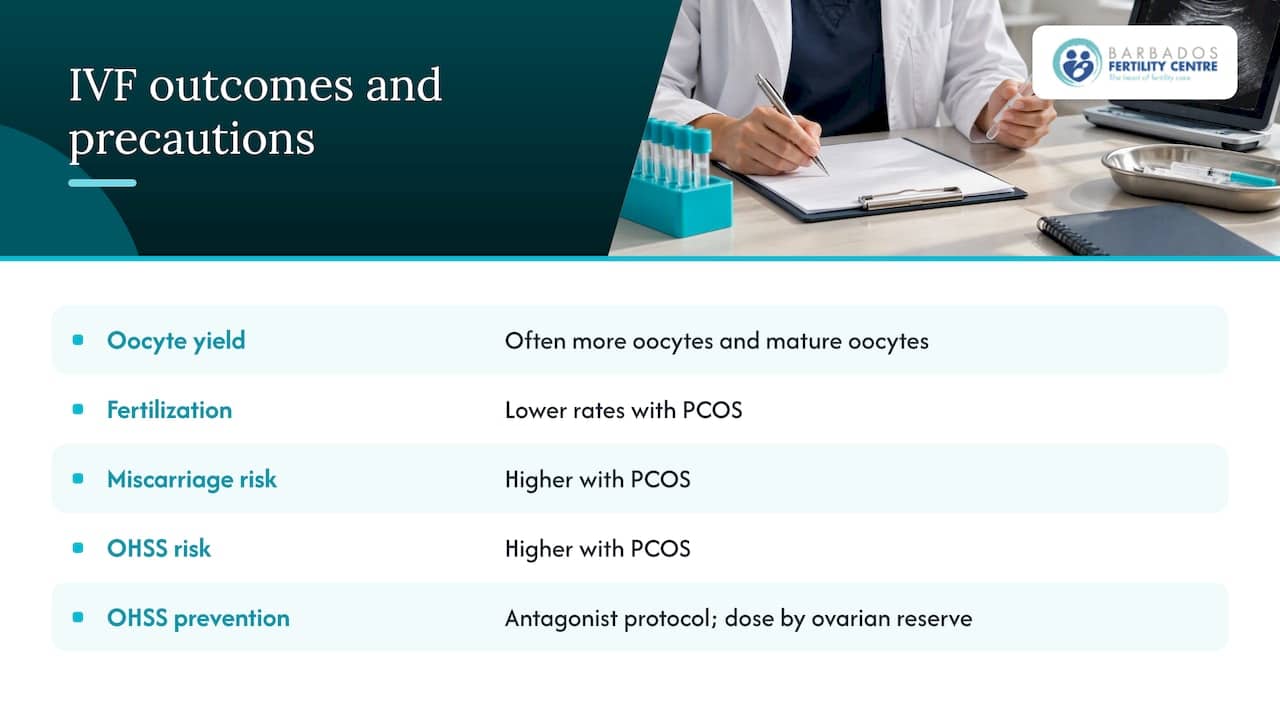
PCOS shapes IVF in two directions. Meta-analyses show that women with PCOS often yield more oocytes and mature oocytes, but may have lower fertilization rates and higher risks of miscarriage and OHSS than women without PCOS. Insulin resistance in particular has been linked to higher miscarriage and lower clinical pregnancy rates in IVF/ICSI among women with PCOS.
The practical answer is individualized care. The American Society for Reproductive Medicine’s 2023 guideline on OHSS prevention recommends using GnRH antagonist protocols rather than agonists and adjusting gonadotropin doses to ovarian reserve. It also advises that letrozole should not be given solely to reduce OHSS, and that metformin should not be used solely for that purpose in antagonist cycles.
If fertilization is a concern, ICSI, where a single sperm is injected into each mature egg, may be recommended. Our page on ICSI explains when it helps, and our IVF page describes the standard process. To learn what to ask before starting, see IVF: what you should be asking.
Staying safe during treatment
Safe treatment in PCOS comes down to monitoring and honesty with your doctor.
- Report symptoms early. Rapid weight gain, severe bloating, abdominal pain or shortness of breath after stimulation or trigger need same-day medical attention, as they can signal OHSS.
- Do not adjust doses yourself. Medication changes should come from your clinic after a scan.
- Tell your clinic about everything you take. That includes metformin, inositol and other supplements. If you are exploring options, a resource on evidence-backed supplements for PCOS can help you prepare questions, but review any supplement with your physician before starting during a treatment cycle.
- Ask about your multiple-pregnancy risk. It is higher with injectables, which is why monitoring decides whether a cycle goes ahead.
What treatment costs at Barbados Fertility Centre
Cost is often what decides between IUI and IVF, so here are our published prices. These are from our price lists and cover the treatment itself; medication and any extras are separate, and our IUI cost guide explains how meds and monitoring add up.
| Treatment | Price |
|---|---|
| IUI (partner or donor sperm, per cycle, including scans) | from $500 |
| IVF | from $5,750 |
| IVF with ICSI | from $6,750 |
| ICSI | $7,650 |
The lower figures are on our CARICOM price list, and the others are on the international price list. For a personalized figure, our IVF cost calculator is a good place to start.
Our perspective
We see PCOS patients who have been told to keep trying on their own, or who have repeated cycles without a clear plan. Our view is simple: a defined plan with a clear limit works better than open-ended trying.
For many women, two to three carefully monitored IUI cycles are a sensible first step, especially when the tubes are clear and sperm parameters are good. We keep the response controlled, because one or two mature follicles is the goal, and we would rather adjust a cycle than risk a multiple pregnancy.
When IUI has had a fair trial, we do not believe in delay. IVF gives us the most control and the most information, and our JCI-accredited laboratory and individualized stimulation protocols are designed with PCOS in mind. Cost is a real barrier for many families, which is why we publish our prices and coordinate remote care for international patients, so you can see the full picture before you travel.
Barbados
Plan your treatment with us
If you have PCOS and are weighing IUI against IVF, we can review your history, tests and goals and give you a plan with transparent pricing. We have been treating patients since 2002 and work with many international patients, including remote coordination of tests and scans before you travel.
See our IVF treatment in Barbados page, or explore IVF treatment abroad to understand how the process works for overseas patients. If you are a single woman planning with donor sperm, our single women program explains your options.
FAQ
Does IUI work if you have PCOS?
It can. IUI combined with ovulation-induction medication is a common first treatment when PCOS is the main problem and the tubes and sperm are normal. Most IUI pregnancies happen within the first four cycles, so if you have not conceived by then, a plan change is reasonable.
How many IUI cycles should I try with PCOS?
Two to four monitored cycles is the usual range. Your age, ovarian reserve and any other fertility factors can shorten it. A doctor can use your results to tell you where you fall.
Is IVF more successful than IUI for PCOS?
IVF generally offers a higher chance per cycle, but it costs more and involves a more intensive stimulation. With PCOS, the risk of OHSS means IVF needs careful, individualized dosing. Many women try IUI first and move to IVF if it does not work.
Does PCOS affect egg quality?
Some research suggests PCOS can affect egg competence and the follicular environment, and insulin resistance may play a role. Women with PCOS often produce many eggs, which gives IVF more to work with. Your clinic can assess your individual picture.
Sources
- Polycystic Ovary Syndrome (PCOS), NIH Office on Women’s Health
- Polycystic ovary syndrome: origins and implications, Reproduction (2025)
- Women with PCOS who undergo IVF: a comprehensive review (2023)
- Predictive factors for intrauterine insemination outcomes (2020)
- A personalized medicine approach to ovulation induction and IUI (2022)
- In vitro fertilization outcomes in women with polycystic ovary syndrome (meta-analysis)
- Follicular fluid composition and reproductive outcomes of women with PCOS (2023)
- Evidence-backed supplements for PCOS by phenotype
Recommended
- Intrauterine Insemination (IUI) at Barbados Fertility Centre
- What is IVF?
- Polycystic Ovarian Syndrome (PCOS): an infertility issue that is little understood.
- IVF Treatment in Barbados | Affordable IVF with High Success