

Most U.S. programs accept egg donors who are healthy adults between about 21 and 30, and professional guidance allows up to 34. Donors are non-smokers with a healthy BMI and a clear medical and family history. They must pass federally required infectious-disease testing, plus the genetic and psychological screening that professional guidelines recommend. Programs set their own stricter limits on top of that, so the exact cutoffs depend on the clinic and the state. This guide covers who qualifies, what screening involves, what donation asks of a donor, and how recipients choose a donor and decide whether donor eggs are right for them.
TL;DR
- Professional guidance prefers donors aged 21 to 34. Under 21 requires a psychological evaluation, and over 34 requires a specific informed-consent discussion about chromosomal risks.
- Every donor must go through an FDA-mandated eligibility determination. This includes a physical exam, a questionnaire and infectious-disease testing.
- ASRM also recommends medical history review, genetic screening based on ancestry and psychoeducational counseling.
- State rules and individual clinics can be stricter than federal rules. Always ask a program for its own written criteria.
- If you are a recipient, you can compare donors on health history, characteristics and the program’s rules on information-sharing and future contact.
Table of Contents
- Who can be an egg donor
- How age limits work
- What egg donor screening involves
- The step-by-step donor process
- What donation asks of a donor
- Choosing an egg donor as a recipient
- Donor eggs: pros and cons for recipients
- Perspective
- Donor egg treatment at Barbados Fertility Centre
- How to choose a clinic for donor egg treatment
- FAQ
- Sources
Who can be an egg donor
The American Society for Reproductive Medicine (ASRM) guidance on gamete and embryo donation says oocyte donors should be of legal age, preferably 21 to 34, and healthy. That is the professional baseline. Individual programs usually narrow it.
The pages that rank for this topic show the typical pattern. Many programs set the window at 21 to 29 or 21 to 30. Others go to 32. Most ask for non-smokers, a healthy weight for height, reliable and mature candidates, and sometimes a high school diploma. Some require you to live within a few hours of the clinic because of the number of monitoring visits.
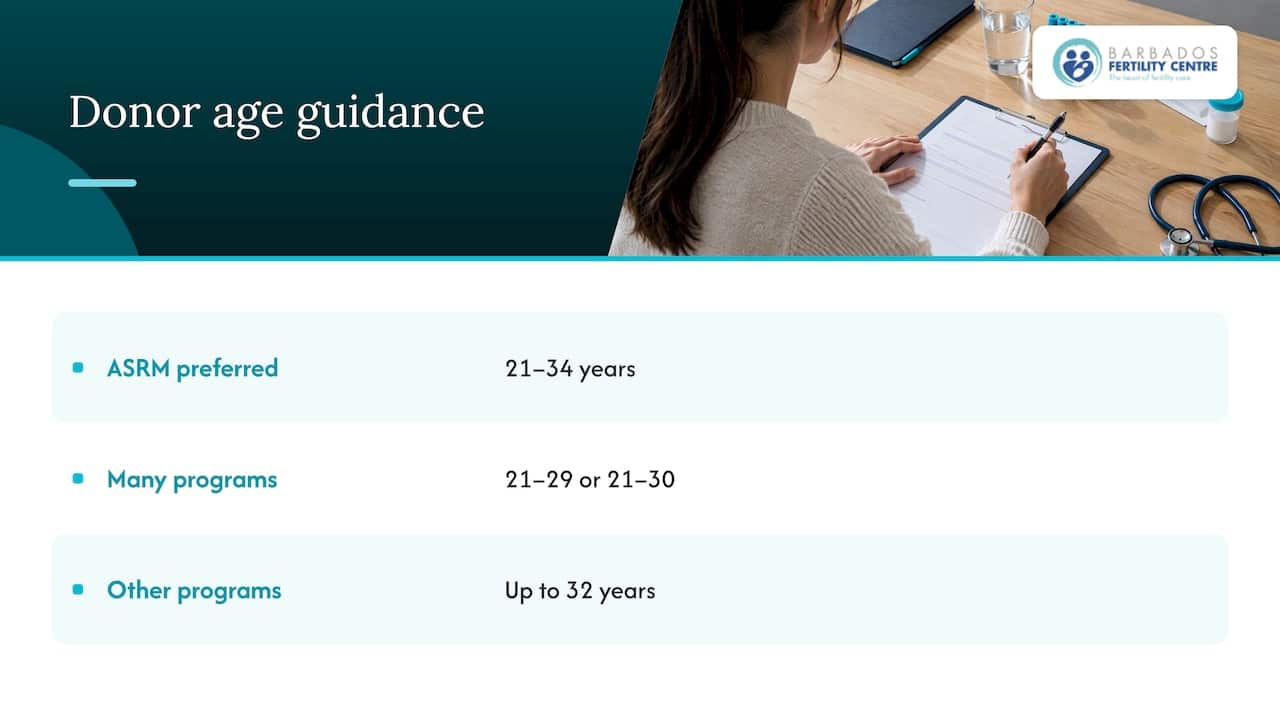
So if you are 32 and wondering whether you can donate, the answer is yes under ASRM’s preferred range. Whether a particular clinic accepts you is a separate question, because many set their own upper limit below 34.
Common criteria at a glance
| Criterion | What guidance says | What programs often add |
|---|---|---|
| Age | Preferably 21 to 34 | A narrower window such as 21 to 29 or 21 to 30 |
| General health | Healthy, with medical history reviewed | Physical exam, normal ovarian function |
| Substance use | Screened in the questionnaire | Non-smoker, no recreational drug use |
| Weight | Healthy range | A BMI cap, often under 30 |
| Psychological readiness | Psychoeducational counseling recommended | A mental health evaluation and interview |
| Location | Not part of guidance | Living within driving distance for monitoring |
The left column rests on professional guidance. The right column describes what individual clinics commonly ask, so treat it as a pattern and not a rule.
How age limits work
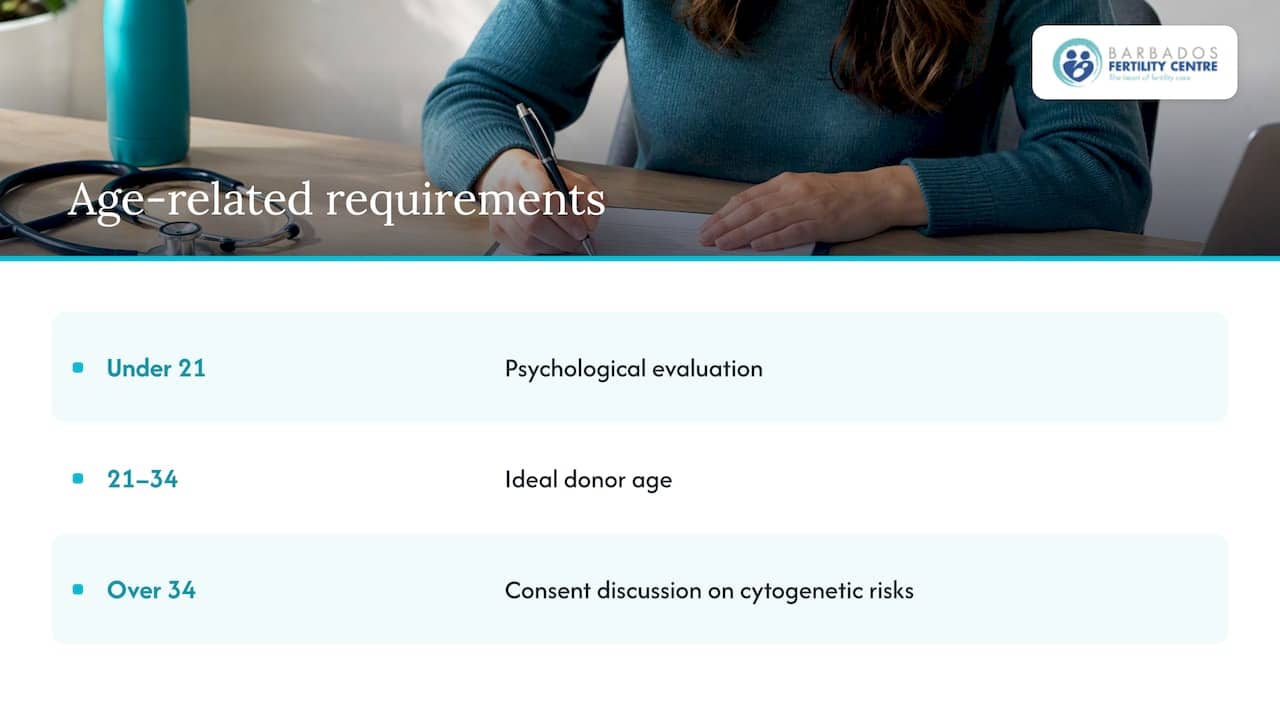
According to ASRM’s 2024 guidance, donors should ideally be 21 to 34. Candidates under 21 need a psychological evaluation. Candidates over 34 need a specific informed-consent discussion about cytogenetic risks, meaning the higher chance of chromosomal abnormalities in eggs as age rises.
A 2025 academic review of egg donation policies explains that age limits are designed to safeguard egg quality and the safety of both mother and child. That is why a clinic that wants the best chance of a healthy pregnancy for its recipients prefers younger donors, even when guidance technically allows older ones.
What egg donor screening involves
Screening happens in layers: federal, professional and state.
Federal screening: the FDA eligibility determination
As ASRM’s guidance describes, the FDA mandates a donor eligibility determination before donor oocytes are used in the United States. It focuses on infectious-disease risk. It includes a physical exam, a screening questionnaire and testing for infections such as HIV, syphilis and hepatitis.
Professional screening: what ASRM adds
ASRM additionally recommends psychoeducational counseling, genetic screening and a full medical history. The genetic evaluation is based on the donor’s ancestry, so the conditions tested for may differ between donors.
State requirements
The same ASRM document notes that state-level requirements may be more restrictive than federal FDA regulations and encourages clinics to consult local officials for minimum standards. New York is a good example. Its guidelines for assisted reproductive technology say all donors should have a genetic evaluation. Cystic fibrosis testing should be done on all donors, and fragile X testing should be strongly considered.
Psychological screening
Psychological screening is mandatory at some programs and strongly recommended by professional bodies. Its purpose is to assess mental readiness and make sure the donor understands the long-term implications. The New York State Department of Health’s guide for prospective donors adds that counseling should help donors weigh their own desire to donate. It also says known donors, such as a friend or relative, should be screened for pressure to take part.
The step-by-step donor process
The order varies by program, but the usual sequence looks like this:
- Application. You submit basic details on age, height, weight, health and family history.
- Initial review. The program checks your answers against its criteria.
- Medical and physical exam. Clinicians check general health and reproductive health.
- Infectious-disease and genetic testing. Blood and sometimes other tests, as above.
- Psychological evaluation and counseling. An interview and often a questionnaire, plus education about the process.
- Informed consent. The donor confirms she understands the process and its risks before proceeding.
- Matching. The donor is listed for recipients or matched with known intended parents.
- Stimulation, monitoring and retrieval. Injectable medication, regular scans and bloodwork, then a short procedure.
The New York Department of Health’s egg donation fact sheet is one of the pages that ranks for this topic. It stresses that informed consent comes before anything else: the donor must understand the process and its risks.
What donation asks of a donor
Donation is a medical process, not just an application. Induced ovulation carries inherent medical risks such as ovarian hyperstimulation syndrome (OHSS), according to the 2025 policy review in Humanities and Social Sciences Communications. The same review lists pelvic bleeding and other complications, and says clinicians should use individualized low-dose protocols. Donors should expect:
- Daily injections for roughly two weeks, which a nurse will teach you to give.
- Frequent ultrasound and blood-test appointments.
- A retrieval procedure under sedation.
- Possible bloating, discomfort and a few days of reduced activity afterward.
If you have a medical condition, take regular medication, or have had any concern around ovarian health, tell the screening team before you apply and ask your own doctor about it. Questions about nutrition or supplements during a cycle should go to the clinic first. If you want background reading on ingredients, an ingredient guide to supplements for fertility can help you prepare questions, but the clinic decides what is appropriate during stimulation.
Choosing an egg donor as a recipient
If you are on the other side of the process, the criteria above protect you too. A donor who has cleared FDA eligibility, genetic screening and a psychological evaluation gives you a documented starting point.
ASRM’s 2019 ethics opinion on gamete and embryo donation says intended parents should consider a donor’s physical, psychological and cognitive characteristics, plus family and personal health history. They should also consider the program’s policies on information-sharing and future contact.
A practical checklist
- Health history. Ask what was tested, and what the donor’s family history shows.
- Characteristics. Physical traits, education and interests are usually in the donor profile.
- Known or non-disclosed. Decide whether you want a donor you know or one whose identity is protected.
- Contact and information-sharing. Ask how the program handles questions from a future child.
- Cost and logistics. Find out what the price includes and whether you must travel.
The same ethics opinion advises that programs must inform all parties of the medical, legal and psychosocial issues involved. That includes the possibility that anonymity is no longer guaranteed because of modern consumer genetic testing. If anonymity matters to you, discuss it openly with your program and, for legal questions, a reproductive attorney in your state.
Donor eggs: pros and cons for recipients
Donor eggs can help people facing a lack of viable eggs or a genetic risk they do not want to pass on. They can also give a path to pregnancy when treatment with your own eggs has not worked. The academic review linked above notes that egg donation also raises ethical and legal issues, so it is a decision worth taking time over.
Things to weigh:
- Genetic connection. The child will not share your eggs’ DNA. Many families find that pregnancy, birth and parenting create the bond they want, but counseling can help you think this through.
- Emotional readiness. Psychoeducational counseling is recommended for recipients as well as donors.
- Disclosure. Plan early how and when you will talk with your child.
- Cost. Donor cycles cost more than cycles with your own eggs because they include donor-related steps.
Own eggs or donor eggs?
This is a medical question first. Your age, ovarian reserve, previous cycle results and any genetic risk all matter. A fertility specialist can review your history and tell you what chance you have with your own eggs. Our own guide to what you should be asking before IVF is a good list to bring to that conversation.
Perspective
We built our program around a simple idea: donor egg treatment should be clear, carefully screened and within reach. Barbados Fertility Centre was established in 2002 and operates under JCI accreditation, which means the way we run screening, consent and laboratory work is held to an international standard.
When couples and individuals come to us for donor eggs, they are often tired of treatment that feels overwhelming. We try to take out what we can: transparent pricing, remote coordination before you travel, and personalized care from the first conversation. We offer known donor and non-disclosed donor options, and we explain each so you can choose with confidence.
Our view is that good donor programs start with honest criteria. Age, health, genetic and psychological screening are not hurdles for their own sake. They protect the donor, the recipient and the child. If you are considering donation or donor eggs, we would rather answer every question early than leave you guessing.
Barbados
Donor egg treatment at Barbados Fertility Centre
If you are ready to look at donor egg treatment, here are the published prices, all in US dollars and listed as one-off amounts:
| Treatment | Published price |
|---|---|
| ICSI with Known Donor Eggs | from 9500 USD |
| ICSI with Non Disclosed Donor Eggs | from 10750 USD |
| Embryo Donation Cycle | 5000 USD |
You can see how each is built on our CARICOM price list and our international price list. For what the program involves, read about our affordable donor egg IVF. If you are thinking of donating, start with our egg donation page and the donor information we provide.

We coordinate treatment remotely for international patients, so you can complete much of the planning before you travel. Our page on IVF treatment abroad explains how that works, and the IVF cost calculator gives you a personalized estimate.
How to choose a clinic for donor egg treatment
Whatever clinic you consider, compare these points in writing:
- Accreditation. Ask which independent body accredits the clinic and the laboratory.
- Screening standards. Ask for the donor criteria, including age limits, genetic panels and psychological evaluation.
- Pricing. Ask what is included and what is billed separately, such as medication, monitoring and donor-related costs.
- Success reporting. Ask how the clinic reports results and for which patient groups.
- Support. Ask who you will speak with before, during and after treatment, especially if you travel.
A clinic that answers these in detail, and in writing, is one you can plan around.
FAQ
Can I donate eggs at 32?
Often yes. ASRM’s preferred donor range is 21 to 34, so 32 falls inside it. Many individual programs set a lower cutoff such as 29 or 30, so check each program’s criteria.
What tests does an egg donor have to pass?
Every donor must have an FDA eligibility determination, which includes a physical exam, a questionnaire and infectious-disease testing. ASRM also recommends a medical history review, genetic screening based on ancestry and psychoeducational counseling. Some states add requirements, such as specific genetic tests.
Will the child have my DNA if I donate my eggs?
Yes. The child is genetically related to the egg donor, not to the recipient who carries the pregnancy, unless the recipient is also the egg source. This is why donor counseling and informed consent come before any cycle.
What should I look for when choosing an egg donor?
Look at the donor’s physical, psychological and cognitive characteristics and her family and personal health history. Also ask about the program’s rules on information-sharing and future contact, since anonymity can no longer be guaranteed.
How do I decide between my own eggs and donor eggs?
Start with a fertility assessment that looks at your age, ovarian reserve and treatment history. Your specialist can explain your realistic chances with your own eggs. Counseling can then help you weigh the emotional side of using donor eggs.
Sources
- Exploring effective human egg donation policies: global perspectives
- Guidelines for Assisted Reproductive Technology, New York State Department of Health
- Becoming An Egg Donor, New York State Department of Health
Recommended
- Egg Donation
- Egg Donation Program at Barbados Fertility Centre
- Donor Information
- Affordable Donor Egg IVF at Barbados Fertility Centre