


Recurrent miscarriage testing usually starts with chromosome analysis of the pregnancy tissue. It then moves to a check of the uterine cavity and to blood tests chosen for your history. The American Society for Reproductive Medicine (ASRM) now defines recurrent pregnancy loss (RPL) as two or more pregnancy losses, so you do not need three losses before asking for an evaluation. Below, we explain each test, what it can and cannot tell you, and how to decide on next steps.
TL;DR
- RPL means two or more pregnancy losses, and they do not have to be consecutive. Biochemical losses count too.
- The first-line step is array-based chromosome testing of miscarriage tissue, when it is feasible.
- Every patient should have the uterine cavity assessed. Blood tests for thyroid disease, diabetes or antiphospholipid syndrome are added when your history points to them.
- For many people no cause is found. That does not mean treatment is out of reach, and most patients still go on to a successful pregnancy.
- A specialist can build a stepwise plan so you avoid unnecessary tests and cost.
Table of Contents
- What counts as recurrent pregnancy loss
- Why testing follows a stepwise order
- Step 1: Chromosome testing of the miscarriage tissue
- Step 2: Looking at the uterus
- Step 3: Blood tests chosen for your history
- Step 4: Parental chromosome testing
- What if every test comes back normal?
- When to see a specialist
- How to prepare for your evaluation
- Perspective
- Treatment at Barbados Fertility Centre
- FAQ
- Sources
What counts as recurrent pregnancy loss
ASRM’s 2026 committee opinion describes RPL as the spontaneous loss of two or more pregnancies. Confirmed molar and ectopic pregnancies are excluded. Biochemical pregnancies (a positive test followed by an early loss) are included, and the losses do not need to be in a row.
This matters because many people are told to wait for a third loss. The current professional definition supports starting the conversation earlier. ASRM also recommends offering genetic evaluation of the miscarriage tissue after a second miscarriage or when there is a history of recurrent miscarriage.
The cause of a single miscarriage is often a random chromosome error in the embryo. Repeated losses raise the question of whether something else is going on, and testing is how you look for it.
Why testing follows a stepwise order
Testing for RPL is not one panel that you order all at once. ASRM recommends a stepwise algorithm. It begins with chromosome evaluation of the miscarriage and adds further testing as indicated. The stated aims are to avoid unnecessary testing and to save costs.
In practice, the order looks like this:
- Review your history: ages, number and timing of losses, any earlier live births, medical conditions, surgeries and family history.
- Chromosome evaluation of miscarriage tissue, when tissue is available.
- Assessment of the uterine cavity.
- Targeted blood tests based on your history, symptoms or earlier findings.
- Parental chromosome testing in specific circumstances.
Your doctor may reorder these. A patient with irregular cycles, for example, may have hormone testing earlier than a patient with regular cycles.
Step 1: Chromosome testing of the miscarriage tissue
ASRM recommends array-based chromosome evaluation of miscarriage tissue as a first step for all patients, when feasible. The goal is to find out whether the loss was caused by an extra or missing chromosome in the embryo (aneuploidy). Sporadic aneuploidy is a common cause of pregnancy loss.
Why start here? The result changes how every later test is read.
- Abnormal embryo chromosomes: the loss has an explanation that is usually not tied to anything wrong with your uterus or blood. That can be reassuring, though repeated aneuploid losses may lead to a discussion of treatment options.
- Normal embryo chromosomes: the loss is called euploid. Doctors then look harder at the uterus, blood-clotting and endocrine factors.
The practical catch is timing. The test needs usable tissue, so tell your doctor as soon as you know a miscarriage is happening or has happened. Ask what the lab needs and how the sample should be handled. If you have already had losses without testing, say so. The next loss can still give you useful information.
If you have heard about MTHFR variants in the context of miscarriage, you may find a plain explanation of MTHFR testing and when it helps useful alongside your doctor’s advice on which blood tests fit your history.
Step 2: Looking at the uterus
ASRM recommends that every RPL patient have the uterine cavity assessed. The purpose is to detect congenital anomalies, adhesions or other structural defects. Options include:
| Test | What it is | What it can show |
|---|---|---|
| Hysterosalpingogram (HSG) | X-ray with contrast dye passed through the cervix | Cavity shape, tube openness |
| Saline sonogram | Ultrasound with saline placed in the uterus | Polyps, fibroids bulging into the cavity, adhesions |
| Hysteroscopy | A thin camera passed into the uterus | Direct view of the cavity, scar tissue, septum |
| 3D ultrasound or MRI | Imaging of the uterine shape | Congenital anomalies such as a septum |
The list of methods follows the ASRM committee opinion, and NYU’s fertility program describes a similar menu of ultrasound, saline ultrasound, HSG, MRI and hysteroscopy. Which one fits depends on your history and what your clinic offers.
A saline-based ultrasound check is something we can arrange. You can read how we use it on our SIS/HyCoSy page. Scarring and infection also matter for the lining, which we cover in our guide to thin uterine lining.
Step 3: Blood tests chosen for your history
Blood tests are not a fixed shopping list. ASRM says endocrine testing, such as for thyroid dysfunction or diabetes, is done based on your history, symptoms or prior findings. Testing for antiphospholipid syndrome (APS), an immune and clotting condition, is part of the evaluation too. APS is one of the causes that testing can identify, along with embryonic aneuploidy and uterine abnormalities.
The tests your doctor may consider include:
- Antiphospholipid antibodies, to look for APS.
- Thyroid function, especially if you have symptoms or a thyroid history.
- Blood sugar markers, if you have diabetes or risk factors for it.
- Other hormone tests, such as prolactin or ovarian reserve, when your cycle history suggests them. A 2009 review in Fertility and Sterility lists these among the tests that may be considered.
A positive antiphospholipid result is usually repeated before it is acted on, so do not draw conclusions from a single report. Ask your doctor which result counts as meaningful and what happens next.
Step 4: Parental chromosome testing
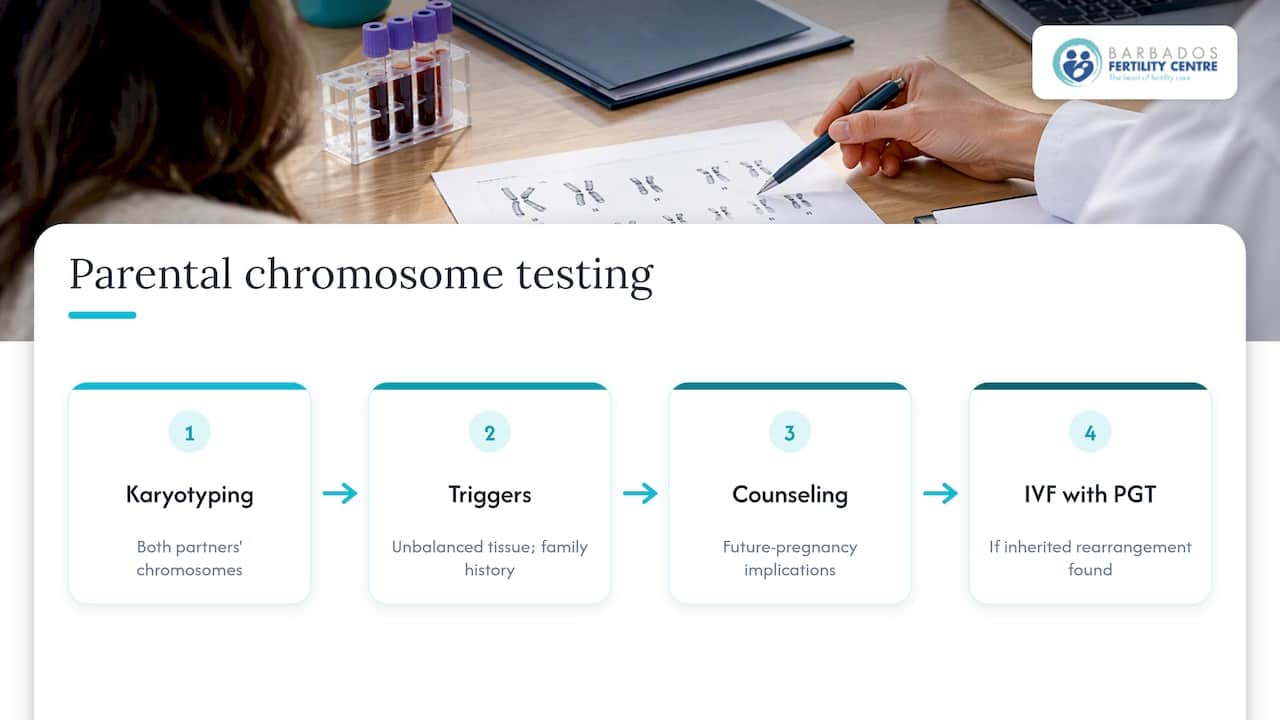
Parental karyotyping looks at the chromosomes of both partners. It is meant to find balanced translocations. A balanced translocation means chromosome material has swapped places without being lost. The parent is healthy, but the couple may produce embryos with an unbalanced genetic makeup.
ASRM recommends this only in specific circumstances. It is not a routine test for everyone with two losses. Your doctor may suggest it if miscarriage tissue testing shows an unbalanced rearrangement, or if there is a relevant family history. Genetic counseling helps you understand what the result means for future pregnancies.
If an inherited rearrangement is found, one option some couples consider is IVF with preimplantation genetic testing of embryos. ACOG-aligned guidance and clinic pages often mention this route, as does AZ Reproductive Medicine’s page on preimplantation testing for chromosomal causes. Our own patients’ experience of this path is described in a journey from a Canadian patient who needed genetic testing.
What if every test comes back normal?
This is the most common outcome, and it is hard to hear after so much testing. ACOG notes that for more than half of women, no clear cause for repeated pregnancy loss is ever found.
ASRM calls euploid miscarriages with no other finding unexplained, and reports that 50% to 80% of patients succeed in a subsequent pregnancy attempt with no specific intervention. A normal workup is therefore not a dead end. It often means the structure of your uterus, your blood and your hormones are not the obstacle.
If you are also facing a long time without a pregnancy, our article on explaining “unexplained” infertility walks through what that label means and what options follow.
When to see a specialist
You do not need to wait for a third loss. Under the ASRM definition, two losses meet the threshold for RPL, and genetic evaluation of tissue is something to ask about after a second miscarriage. Consider seeing a reproductive endocrinologist if:
- You have had two or more losses, whether or not they were consecutive.
- You have had a biochemical loss followed by a miscarriage.
- You are older and time matters to your plan.
- You know of a uterine difference, thyroid disease, diabetes or a clotting disorder.
- You have a family history of recurrent loss or chromosome rearrangements.
- You are going through IVF and have had a loss after transfer.
If you are bleeding heavily, in severe pain or feel faint during a pregnancy, seek urgent care from your local emergency service or your obstetric provider rather than waiting for a fertility appointment.
How to prepare for your evaluation
A little preparation makes the first visit more productive.
- Gather records. Ultrasound reports, hCG values, any pathology or genetic results, and operative notes from any D&C.
- Write a timeline. Dates, gestational ages at loss and whether a heartbeat was seen.
- List your medical history. Thyroid, diabetes, autoimmune disease, surgeries and medicines.
- Ask about tissue. If a loss is ongoing, ask whether the tissue can be sent for chromosome testing.
- Ask about cost and sequence. The stepwise approach exists to keep testing focused, so ask which tests are needed first and which can wait.
For patients who travel, much of this can be done by sharing records remotely before you book flights. Our IVF treatment abroad page explains how we coordinate care for international patients.
Perspective
Patients come to us after losses with a lot of questions and, often, a lot of tests behind them. Our view is that the evaluation should be orderly, explained in plain language and tied to a plan.
We start from the history, then look at chromosomes, the uterine cavity and targeted blood tests, as professional guidance describes. We would rather you understand each result than collect a stack of reports that nobody has connected.
Because we are a JCI-accredited clinic with a calm setting and transparent pricing, many of our international patients find the process less stressful than they expected. If treatment such as IVF, ICSI or donor options becomes part of your plan, you will see the costs up front and have one team coordinating your care. You can read more about our approach on our recurrent pregnancy loss page.
Barbados
Treatment at Barbados Fertility Centre
If your evaluation points toward IVF or ICSI, we publish our prices. ICSI is $7,650 on our international price list, and our CARICOM price list shows IVF from $5,750. You can estimate your own total with our IVF cost calculator.

We offer IVF, ICSI, IUI, egg freezing, egg donation and embryo donation, along with male and female fertility assessments. To talk through your history and records, start from our home page and contact our team. We will tell you what we would suggest and what it would cost.
FAQ
Do I need three miscarriages before I can be tested?
No. ASRM’s 2026 committee opinion defines recurrent pregnancy loss as two or more losses, and recommends offering genetic evaluation of miscarriage tissue after a second miscarriage. Ask your doctor about testing after your second loss.
What is the first test for recurrent miscarriage?
The recommended first step is array-based chromosome testing of the miscarriage tissue, when feasible. It checks whether an embryo chromosome error explains the loss. Other tests are then chosen based on that result and your history.
Can testing always find the cause?
No. ACOG says that for more than half of women, no clear cause is found. ASRM reports that 50% to 80% of patients with unexplained loss go on to a successful pregnancy without a specific intervention.
Which tests look at the uterus?
Doctors use HSG, saline sonography or hysteroscopy, and sometimes MRI or 3D imaging. ASRM recommends cavity assessment for all RPL patients to look for congenital anomalies, adhesions or other defects.
Sources
- Repeated Miscarriages, ACOG
- Recurrent pregnancy loss: etiology, diagnosis, and therapy, 2009
- Recurrent Miscarriage, AZ Reproductive Medicine
Recommended
- Recurrent Pregnancy Loss Treatment in Barbados
- Under 7 mm Thin Uterine Lining? IVF Patients: Rule Out Scars or Infection First