


A standard IVF cycle uses four groups of medication: gonadotropins to grow several follicles, GnRH agonists or antagonists to stop eggs from releasing too early, a trigger shot to mature the eggs, and progesterone to support the uterine lining after transfer. Your doctor chooses the brands, doses and order. This guide explains what each group does, how long you take it, which side effects are common and which symptoms need a call to your clinic the same day.
TL;DR
- IVF medications fall into four groups: gonadotropins (stimulation), GnRH agonists or antagonists (preventing early ovulation), the trigger shot (egg maturation) and progesterone (luteal support).
- Gonadotropin injections are commonly used for 7 to 12 days, with ultrasound and estrogen blood tests along the way.
- Bloating, breast tenderness, mood changes and injection-site soreness are common. Rapid weight gain, severe pain, shortness of breath or very little urine need prompt medical attention.
- Medication is a large share of the cost of a cycle, so ask for a full written drug list and price before you start.
Table of Contents
- The IVF medication list at a glance
- Stimulation: gonadotropins
- Preventing early ovulation: GnRH agonists and antagonists
- The trigger shot
- Progesterone and luteal support
- Common side effects of IVF medications
- OHSS: the symptoms that need prompt attention
- How long you take them and how many injections to expect
- Taking your medications safely
- Our perspective
- What medication adds to the cost of a cycle
- Treatment at Barbados Fertility Centre
- FAQ
- Sources
The IVF medication list at a glance
Protocols differ from clinic to clinic and from patient to patient. This table shows the usual roles, with examples named by the American Society for Reproductive Medicine (ASRM) and the Society for Assisted Reproductive Technology (SART).
| Group | Examples | What it does | Typical pattern |
|---|---|---|---|
| Gonadotropins | Follistim, Gonal-F (FSH); Menopur (FSH and LH) | Stimulate several ovarian follicles to grow | Daily injections early in the cycle, commonly 7 to 12 days |
| GnRH agonists | Lupron | Prevent a premature LH surge | Short-acting forms daily; long-acting forms last 1 to 3 months |
| GnRH antagonists | Prescribed per protocol | Block the LH surge during stimulation | Started during stimulation, as your doctor directs |
| Trigger shot | hCG (Pregnyl, Novarel, Ovidrel) or Lupron in suitable protocols | Completes egg maturation before retrieval | One timed injection |
| Luteal support | Progesterone | Supports the uterine lining after retrieval and transfer | Daily, by injection or suppository, as prescribed |
The sources behind the first four rows: SART’s guide to ART medications and SART’s step-by-step guide.
Stimulation: gonadotropins
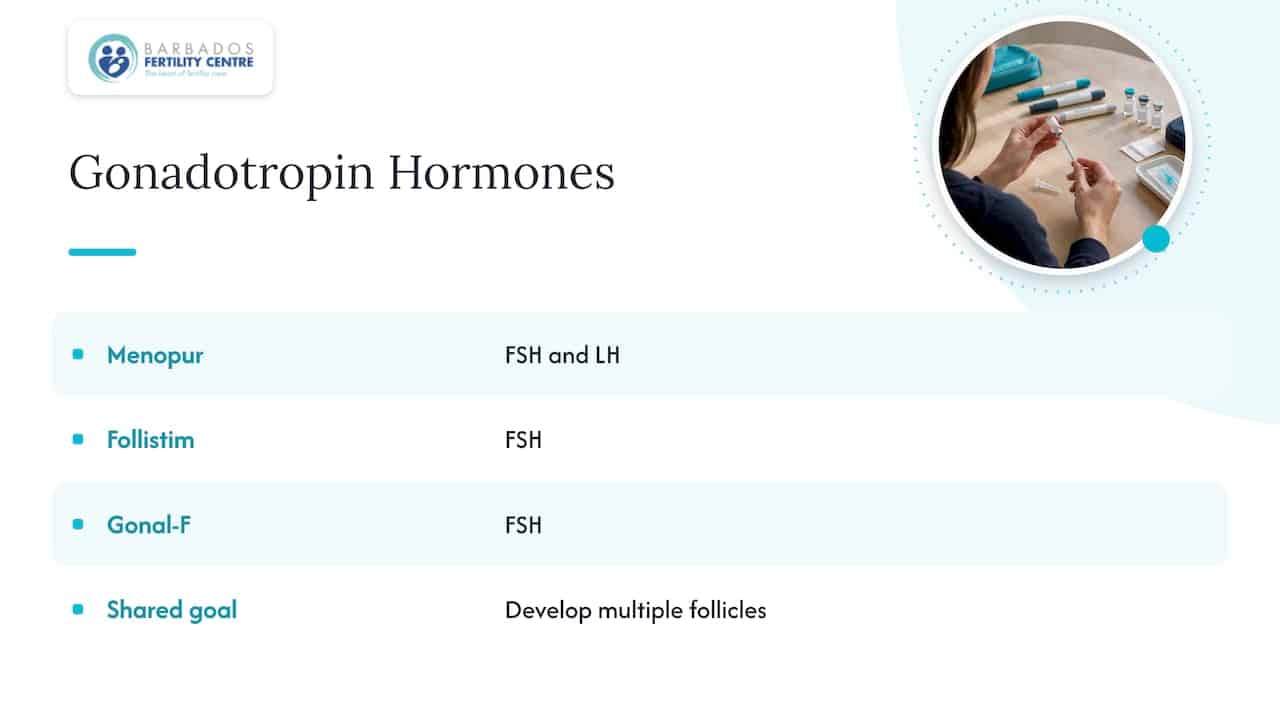
Gonadotropins are the core of the list. They are injectable hormones that push the ovaries to develop multiple follicles in one cycle instead of the single follicle of a natural cycle. SART explains that Menopur contains both FSH and LH, while Follistim and Gonal-F contain FSH. All of them aim to develop several follicles at once.
NICHD notes that gonadotropins are prescribed when a woman does not respond to clomiphene, or to stimulate follicle growth for assisted reproduction. The injections start early in the menstrual cycle and continue for 7 to 12 days. Your care team follows your response with transvaginal ultrasound and frequent estrogen blood tests, which show how many follicles are growing and how your ovaries are responding.
Follistim and Gonal-F do the same job, so a clinic may let you choose between them or may choose based on pharmacy coverage and supply. Some patients also look at nutrition while on stimulation. If you want to see how the research behind common fertility supplement ingredients is rated, review it, then bring any product you are considering to your doctor before you take it alongside your prescribed drugs.
Our injection instruction videos show step by step how patients give these injections at home, which many people find calms the first-night nerves.
Preventing early ovulation: GnRH agonists and antagonists
With many follicles growing, the body can release its own LH surge too soon, and eggs could be released before retrieval. Two drug classes prevent this.
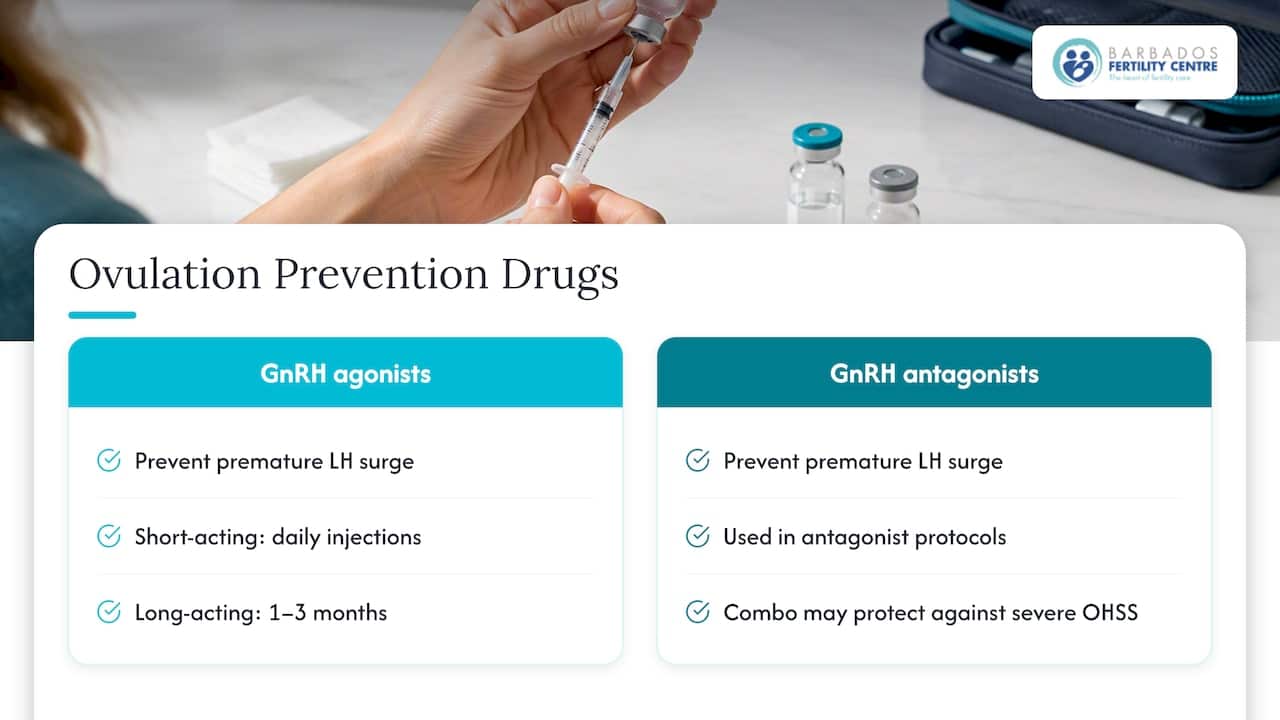
GnRH agonists such as Lupron. According to SART, they prevent a premature LH surge. Short-acting forms need daily injections, while long-acting preparations last 1 to 3 months.
GnRH antagonists do the same job by a different route and are used in antagonist protocols. SART also says an antagonist protocol combined with an agonist trigger may offer protection from severe ovarian hyperstimulation syndrome (OHSS). That is one reason your doctor may choose this combination if you have many follicles.
Which class you receive depends on your protocol, age, ovarian reserve and history. Neither is better in every case, and your doctor will explain why one fits you.
The trigger shot
The trigger is the injection that finishes egg maturation. ASRM explains that hCG is given after stimulation to prompt egg release once the eggs are mature. SART lists hCG products (Pregnyl, Novarel or Ovidrel) and Lupron, in suitable protocols, as options for the final trigger.
Timing is the part that matters most. Retrieval is scheduled around the trigger, so you take it at the exact time your clinic gives you, not roughly that evening. Our guide to trigger shot timing covers how that timing works before retrieval or IUI, and our article on ovulation induction medications in practice explains what happens in the 36 to 48 hours afterward.
Progesterone and luteal support
After retrieval, progesterone is typically prescribed to support the uterine lining so an embryo has the best chance to implant. It comes as injections or as suppositories, and the choice depends on your clinic’s protocol and your own tolerance. We compare both in progesterone injections vs. suppositories, and our page on luteal phase support explains how we plan this phase.
Common side effects of IVF medications
Most side effects are temporary and tied to hormone levels rising during stimulation.
Gonadotropins. ASRM’s patient booklet lists injection-site swelling or rash, abdominal bloating, mild abdominal pain, breast tenderness and mood changes among the possible effects.
IVF injectables in general. ASRM’s IVF risk fact sheet adds bruising or soreness, redness or itching at the injection site, nausea or occasional vomiting, increased vaginal discharge, mood swings and fatigue.
Practical ways to make injections easier:
- Rotate injection sites as your nurse shows you.
- Let the skin dry fully after cleaning it.
- Use a cold pack briefly before the injection if soreness bothers you, if your team agrees.
- Keep a written log of doses and times.
- Tell your clinic about mood changes, as they are expected and worth discussing.
OHSS: the symptoms that need prompt attention
Ovarian hyperstimulation syndrome happens when the ovaries react strongly to stimulation. ASRM states that mild OHSS occurs in 10% to 20% of cycles and severe OHSS in about 1%. Mild symptoms such as nausea, bloating and pelvic discomfort usually go away within a few days after egg collection.
Call your clinic right away, or seek emergency care if you cannot reach them, if you notice any of these, all listed by MedlinePlus:
- Abdominal pain or bloating that keeps getting worse
- Rapid weight gain, about 10 pounds (4.5 kg) within 3 to 5 days
- Decreased urination even though you are drinking fluids
- Nausea and vomiting
- Shortness of breath
MedlinePlus adds that severe cases may require fluid drainage and possibly hospitalization. The FDA-approved Gonal-F label also warns about ovarian torsion, abnormal ovarian enlargement, blood clots and serious allergic reactions. It directs that gonadotropins, including hCG, be stopped if serious OHSS occurs, and that hospitalization be considered. That decision belongs to your doctor, so do not adjust or stop doses on your own unless instructed.
How long you take them and how many injections to expect
Stimulation usually lasts 7 to 12 days, according to NICHD. The number of daily injections depends on the protocol. Some patients take one gonadotropin; others combine products, and an antagonist or agonist and the trigger are added at set points. Ask for a calendar that shows every drug, dose and time before day one. Long-acting agonist preparations last 1 to 3 months, so they can reduce the number of daily shots in a protocol where they are used.
Taking your medications safely
- Monitoring is part of treatment. The Gonal-F label states that therapy should be managed by physicians experienced in infertility treatment, with appropriate monitoring. ASRM likewise advises close ultrasound monitoring during injectable treatment to minimize side effects and risks. Keep every scan and blood test appointment.
- Missed dose. The Gonal-F label says not to double the next dose. Call your clinic for instructions instead.
- Anything extra. Tell your team about every supplement, over-the-counter product and prescription you take.
- Storage and mixing. Follow the pharmacy label and your nurse’s teaching for each product, since requirements differ by brand.
Our perspective
IVF medication is where many patients feel the most pressure: the schedule, the injections and the bill. In our experience at Barbados Fertility Centre, much of that pressure eases when the plan is written down early and explained plainly.
We start with a clear drug-by-drug plan, shown with its purpose, so you know why each injection is in your schedule. We back that with monitoring and our video injection guides, so you can give treatment at home with confidence.
Our clinic has operated since 2002 under JCI accreditation, a standard of medical quality comparable to leading US clinics, and we work to keep treatment affordable and stress low. For international patients, we coordinate much of the process remotely, so you arrive in Barbados knowing what to expect.
We believe medication planning should be personal. Ovarian reserve, age, history and goals all shape the protocol, and we adjust to you rather than applying one template.
Barbados
What medication adds to the cost of a cycle
In the United States, medication is billed separately from the clinic’s procedure fees, and it can change the total considerably. Our guide to U.S. IVF medication costs states that stimulation drugs often run $3,000 to $7,000. Insurance coverage varies widely by plan and state, so ask your pharmacy and insurer for exact figures before you order. Our IUI cost breakdown explains how medications and monitoring affect that treatment as well.
When you compare options, ask each clinic what its quoted price includes: monitoring scans, medication, retrieval, embryo transfer and freezing. Our list of questions to ask about IVF is a good starting point.
Treatment at Barbados Fertility Centre
We publish our prices openly. IVF starts from $5,750, IVF with ICSI from $6,750, ICSI is $7,650, and an egg freezing cycle is $4,950, all as listed on our CARICOM price list and international price list. IUI starts from $500 per cycle, scans included. Our IVF cost calculator helps you estimate your own plan, and our page on IVF treatment abroad explains how travel and remote coordination work.

If you want your medication plan reviewed alongside a transparent treatment price, contact Barbados Fertility Centre and tell us your history, and we will help you plan next steps.
FAQ
How many injections does IVF involve?
It depends on your protocol. Gonadotropin injections are commonly given for 7 to 12 days, and a medication to prevent early ovulation and a trigger shot are added at set points. Your clinic should give you a calendar listing each one.
Are Follistim and Gonal-F the same?
Both are FSH products used to stimulate follicle growth, as SART describes. Clinics often let patients choose between them or select one based on what the pharmacy supplies. Your doctor sets the dose for either.
What are the most common gonadotropin side effects?
Injection-site swelling or rash, bloating, mild abdominal pain, breast tenderness and mood changes are the most common, according to ASRM. Severe pain, fast weight gain or trouble breathing are not routine and need immediate medical attention.
What should I do if I miss a dose?
Do not double the next dose. The Gonal-F label gives this instruction, so call your clinic promptly and follow their directions for your protocol.
Sources
Recommended
- Cut U.S. IVF Medication Costs: Stimulation Drugs Often $3,000–$7,000
- IVF – What You Should Be Asking
- Progesterone Injections vs Suppositories in IVF
- IVF Patients: Evidence First Luteal Phase Support and JCI Clinic Plan