


Light spotting after an embryo transfer is common and usually not a reliable sign of success or failure, but some bleeding patterns require urgent evaluation. Pink or brown spotting that stays light often reflects implantation, progesterone use, or minor irritation from the transfer procedure. Heavy bleeding, soaking a pad within an hour, severe pelvic pain, or fever above 100°F warrant an immediate call to your clinic or emergency care.
TL;DR:
- Light spotting within 48 hours of transfer usually results from cervical irritation, not signals of pregnancy.
- Spotting occurring between days 4 and 10 post-transfer may indicate implantation, but persistence or heavier flow warrants caution.
- Heavy bleeding, severe pain, dizziness, or fever above 100°F should prompt immediate medical evaluation or emergency care.
- Confirming pregnancy viability relies on ultrasound and serial β-hCG testing, as spotting alone does not predict outcomes.
- Maintaining routine medications, tracking symptoms, and seeking prompt care for red flags improve safety during the two-week wait.
Table of Contents
- Quick checklist: appearance, amount, and red flags
- When spotting happens and what the timing suggests
- What actually causes spotting after your transfer
- When to contact your clinic versus the emergency room
- How clinics evaluate bleeding after a transfer
- What the evidence says about spotting and outcomes
- Managing spotting and anxiety during the two week wait
- What accredited clinics do next
- A clinical perspective on spotting and peace of mind
- How we can help if you’re evaluating post-transfer symptoms
- FAQ
- Sources
Quick checklist: appearance, amount, and red flags
Most spotting after an embryo transfer looks like light pink or brown discharge on a liner or toilet paper, not a flow heavy enough to need a pad. It can appear on and off for a day or two without signaling anything wrong.
- Typical pattern: pink or brown spotting, light in volume, visible on wiping or underwear.
- Red flags: soaking a pad in an hour, large clots, severe one-sided pain, dizziness, or a fever over 100°F.
- What to tell triage: how many days since your transfer, which medications you are taking, the color and amount of blood, and any pain.
According to ACOG, light bleeding after transfer is a frequent, expected experience rather than an outlier.
When spotting happens and what the timing suggests
The day spotting appears often matters more than its color alone. Mapping the timing against your transfer date helps narrow down the likely cause before you even pick up the phone.
- Same day to 48 hours after transfer: usually reflects cervical irritation from the speculum or catheter used during the procedure, not a pregnancy sign.
- Days 4 to 10 after transfer: may represent implantation-related spotting, which the Cleveland Clinic describes as light, pink or brown, and lasting a few hours to a couple of days, occurring about 7 to 14 days after fertilization.
- Around your expected period date: more likely to represent a true menstrual bleed, especially if flow increases rather than staying light.
Color and duration add useful clues. Spotting that stays pink or brown and resolves within two days carries less concern than bright red bleeding that gets heavier over time.
What actually causes spotting after your transfer
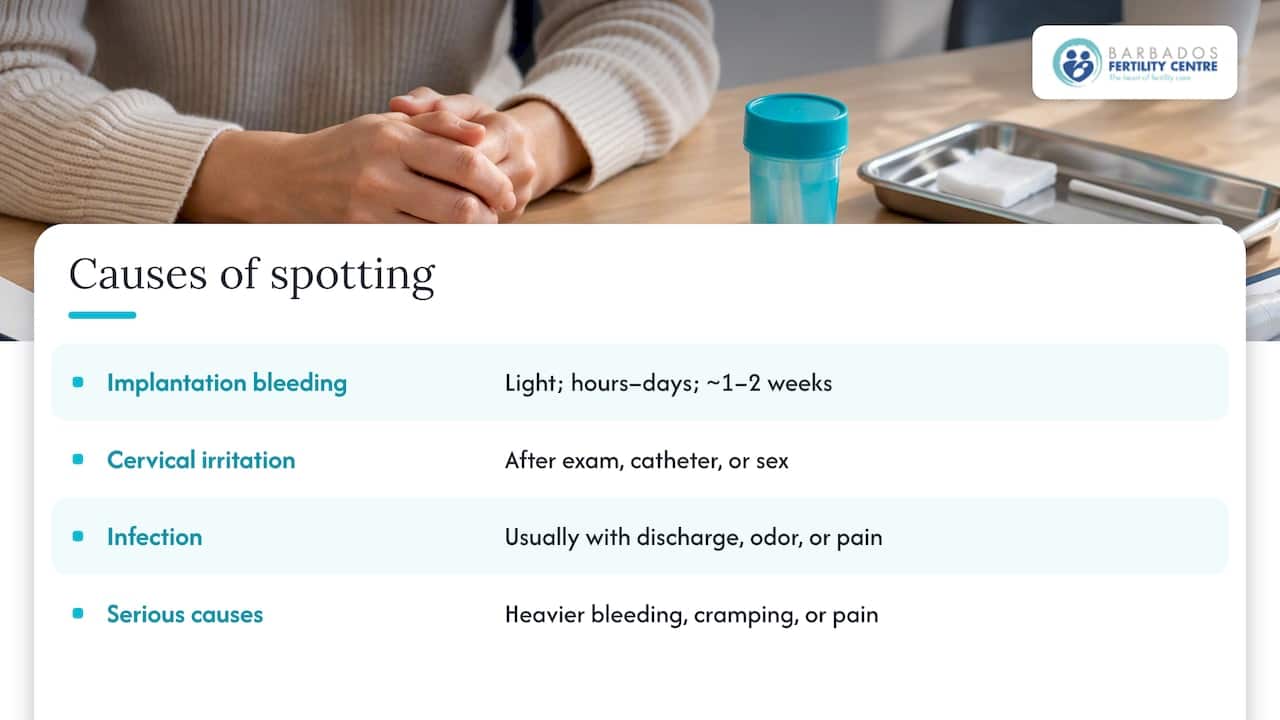
Several distinct mechanisms can produce spotting after an embryo transfer, and they do not all carry the same weight. Implantation bleeding happens when the embryo burrows into the uterine lining, causing minor disruption to small blood vessels. The Cleveland Clinic notes it typically lasts a few hours to a couple of days and appears about one to two weeks after fertilization.
Vaginal progesterone, used routinely for luteal support after transfer, can make cervical tissue more sensitive and prone to light bleeding, particularly after insertion or a pelvic exam. The catheter and speculum used during the transfer itself can cause small amounts of cervical trauma, which is why some patients notice spotting within the first day or two that has nothing to do with the embryo at all.
Other causes include intercourse, which can irritate a sensitive cervix during the two week wait, and infection, which usually comes with discharge, odor, or discomfort rather than isolated spotting. Less common but more serious causes include subchorionic hemorrhage, ectopic pregnancy, and early pregnancy loss, each of which tends to present with heavier bleeding, cramping, or pain rather than light spotting alone. Distinguishing these from benign spotting is exactly why clinics rely on testing rather than guesswork.
When to contact your clinic versus the emergency room
Specific thresholds remove the guesswork from a stressful moment. According to Emory School of Medicine, you should call your provider or go to urgent care if bleeding is heavy enough to soak a pad within an hour, or if it comes with severe pelvic pain, shoulder-tip pain, dizziness, fainting, or a fever above 100°F.
| Symptom | Possible concern | Action |
|---|---|---|
| Soaking a pad per hour | Significant bleeding | Call clinic or go to urgent care/ED now |
| Shoulder-tip pain, dizziness, fainting | Possible ectopic pregnancy | Seek emergency care immediately |
| Fever above 100°F | Possible infection | Contact clinic promptly |
| Light pink or brown spotting | Implantation or irritation | Monitor, note timing, call clinic if it worsens |
When you call, have a few details ready:
- Days since your transfer and whether it was fresh or frozen.
- Current medications, especially progesterone or blood thinners.
- Amount and color of bleeding, plus any pain or associated symptoms.
How clinics evaluate bleeding after a transfer
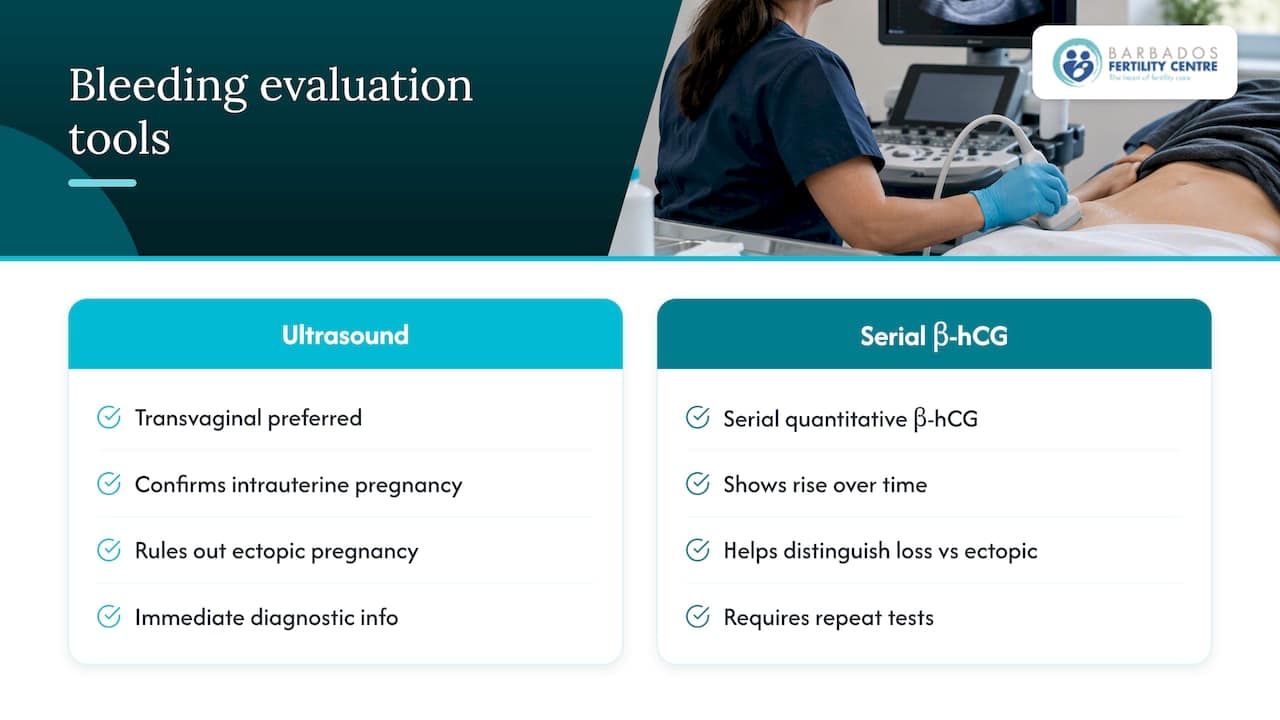
When bleeding raises questions, clinicians lean on two main tools rather than acting on symptoms alone. Transvaginal ultrasound confirms whether a pregnancy is developing inside the uterus and rules out an ectopic pregnancy. The ACOG Practice Bulletin on early pregnancy loss identifies ultrasound, preferably transvaginal, alongside serial quantitative serum β-hCG testing as the preferred modalities for distinguishing intrauterine pregnancy from ectopic pregnancy or early loss.
Serial β-hCG tests, drawn a couple of days apart, show whether hormone levels are rising as expected. A single low reading without ultrasound confirmation is not diagnostic, which is why clinicians often prefer repeat testing over immediate conclusions. Acting on one data point alone risks an incorrect diagnosis, so most clinics wait for a clearer pattern before recommending any intervention.
What the evidence says about spotting and outcomes
Spotting alone is a weak predictor of how a cycle will turn out. ACOG notes that implantation bleeding is reported by about 1 in 4 pregnant women, and light bleeding during pregnancy occurs in roughly 15 to 25 out of every 100 pregnancies in the first trimester, underscoring how common it is across both spontaneous and assisted pregnancies.
Research on blood found on the embryo transfer catheter tells a similarly mixed story. A 2025 study in IJRCOG found conflicting results on whether catheter blood predicts implantation or live birth, with transfer difficulty itself acting as a likely confounder rather than the blood being the direct cause of poorer outcomes.
Managing spotting and anxiety during the two week wait
Light spotting rarely requires changes to your routine, but a few simple steps reduce irritation and make any follow-up call more efficient. Continue your prescribed progesterone and other medications unless your clinic tells you otherwise, since stopping abruptly can affect a developing pregnancy.
- Use a panty liner rather than a tampon to track flow without adding irritation.
- Avoid intercourse if your clinic has advised pelvic rest during the two week wait.
- Keep a simple log: date, color, amount, and any pain or other symptoms.
- Rest when you need to, but normal daily activity is generally fine unless told otherwise.
Pro Tip: Keep a short daily note of bleeding color, amount, and any symptoms on your phone so you can read it straight to the triage nurse instead of trying to recall details under stress.
What accredited clinics do next
Most fertility clinics follow a similar sequence once a patient reports spotting: a phone triage call to assess severity, followed by a transvaginal ultrasound or serial β-hCG draws depending on timing and symptoms. Clinics accredited by bodies such as Joint Commission International generally maintain standardized protocols for exactly this kind of follow-up, which supports consistent triage decisions rather than ad hoc judgment calls. High patient volume also means staff have seen a wide spectrum of bleeding patterns, which helps them calibrate when a symptom needs same-day imaging versus a scheduled recheck a few days later.
A clinical perspective on spotting and peace of mind
Spotting after a transfer unsettles almost everyone going through the two week wait, and that reaction is understandable given how many rides on the outcome. What matters more than the spotting itself is how quickly you act when a red flag appears, and how clearly you can describe what you are experiencing. A short symptom log turns a panicked phone call into a useful one, and that alone can speed up the right next step.
— Barbados
How we can help if you’re evaluating post-transfer symptoms
If spotting after your transfer has you wondering what happens next, our team combines internationally accredited medical standards with direct access to ultrasound and β-hCG testing, so questions about bleeding get a clear answer rather than a guess.

We coordinate care for international patients from the first consultation through testing and treatment, helping patients stay supported through post-transfer questions even from a distance. If you are also exploring what a prenatal ultrasound involves once a pregnancy is confirmed, this overview of safe 3D and 4D ultrasound procedures explains what to expect during those scans.
- IVF starts from $5,750 for CARICOM patients, with ICSI priced at $7,650 for international patients.
- We offer a range of fertility treatments alongside diagnostic support for patients monitoring symptoms after a transfer.
- You can review full treatment pricing and reach our clinical team directly to schedule an evaluation or ask about your specific symptoms.
This article is general information, not a substitute for advice from a qualified doctor. Consult a qualified healthcare professional about your own circumstances before acting on anything here.
FAQ
Is constipation a common side effect after embryo transfer?
Constipation is a commonly reported side effect after embryo transfer, often linked to progesterone supplementation and reduced activity during the two week wait. It is generally not a cause for concern and tends to improve with hydration and gentle movement, though persistent or severe symptoms should be mentioned to your clinic.
What is implantation bleeding and when does it occur?
Implantation bleeding happens when a developing embryo attaches to the uterine lining, causing minor spotting. According to the Cleveland Clinic, it is usually light, pink or brown, lasts a few hours to a couple of days, and occurs about 7 to 14 days after fertilization.
What are some positive signs that might appear after embryo transfer?
Light spotting, mild cramping, and breast tenderness are sometimes reported in early pregnancy, though none of these signs reliably confirm success on their own. The only dependable confirmation comes from a blood test and, later, an ultrasound performed by your clinic.
Is cramping normal after embryo transfer?
Mild cramping is common after embryo transfer and can relate to the procedure itself, progesterone support, or early implantation. Cramping that becomes severe, one-sided, or accompanied by heavy bleeding or fever should prompt a call to your clinic rather than waiting it out.
How do clinics confirm whether spotting is linked to a healthy pregnancy?
Clinics typically combine a transvaginal ultrasound with serial quantitative β-hCG blood tests rather than relying on symptoms alone. As the ACOG Practice Bulletin on early pregnancy loss notes, these tools together distinguish a developing intrauterine pregnancy from an ectopic pregnancy or early loss.
Sources
- Bleeding during pregnancy | ACOG
- Implantation bleeding: Cleveland Clinic
- Study: blood at embryo transfer and outcomes | IJRCOG (2025)