


Stimulation medications typically run $3,000 to $7,000 per cycle, while a full IVF cycle commonly totals $15,000 to $30,000 depending on the services your clinic bundles in. Your own number depends heavily on your protocol and how your body responds to stimulation. Below, we break down exactly where medication costs come from, what drives them up or down, and how to manage the bill without compromising your care.
TL;DR:
- Gonadotropins are the most expensive drug class in IVF stimulation, often accounting for the largest portion of medication costs, which vary based on dosing needs.
- Medication costs can range from $3,000 to over $7,000 per cycle, representing roughly 15% to 35% of the total IVF expense depending on protocols and individual response.
- Shorter stimulation phases typically lower drug costs, but unpredictable dose adjustments during treatment can cause the final medication bill to increase unexpectedly.
- Patients can reduce medication expenses by shopping around, applying for assistance programs, and requesting detailed, itemized estimates before starting treatment.
- Variations in ovarian response, protocol choices, and pharmacy sourcing mainly drive differences in medication costs between patients.
Table of Contents
- What Makes Up an IVF Bill, and Where Medications Fit In
- Common Drug Classes Used in Stimulation and Realistic Price Ranges
- Why Two Patients See Different Medication Bills
- How Medication Costs Translate Into a Full-Cycle Budget
- Where to Buy IVF Medications and What Discounts Actually Cover
- Practical Ways to Reduce Out-of-Pocket Medication Spending
- How Long You’ll Take Medications, and Why It Affects Cost
- What Else Gets Added to the Medication Line Item
- Our Perspective on Transparent Pricing and Medication Coordination
- Transparent IVF Pricing With Barbados Fertility Centre
- FAQ
- Sources
What Makes Up an IVF Bill, and Where Medications Fit In
An IVF estimate is rarely one number. It is a stack of line items, and medications are just one piece of it, though often one of the largest. A typical bill includes:
- Stimulation medications (the injectable hormones that grow multiple eggs)
- Monitoring, including ultrasounds and blood draws throughout the cycle
- Egg retrieval and anesthesia
- Lab procedures, including fertilization by IVF or ICSI
- Embryo transfer
- Embryo or egg freezing and storage
- Optional genetic testing of embryos
In an 18-month prospective cohort study, medications accounted for roughly 22% of cycle-based treatment costs, with median medication spending around $1,182 against a median total IVF cost of $24,373 over the study period. Industry price surveys put the medication share of a single cycle a bit higher, commonly 15% to 35% of total cost, since stimulation protocols vary so widely.
This is also why many clinics quote a “base package” price and then bill medications separately. The base package covers the clinical procedures, which are fairly predictable. Medications are not, because your dose depends on how your ovaries respond, and that is not fully known until your cycle is underway.
Common Drug Classes Used in Stimulation and Realistic Price Ranges
Every stimulation protocol draws from a handful of drug categories, each doing a distinct job:
- Gonadotropins (recombinant FSH or urinary FSH/hMG): stimulate the ovaries to produce multiple eggs and typically form the bulk of the medication bill
- GnRH antagonists: prevent premature ovulation during stimulation
- GnRH agonists: used in longer protocols, sometimes also for the trigger shot
- Trigger medications (hCG or a GnRH agonist trigger): mature the eggs before retrieval
- Luteal-phase progesterone (vaginal suppositories or intramuscular injections): support the uterine lining after transfer
- Ancillary medications, such as antibiotics or estrogen support, added case by case
Gonadotropins are typically the single most expensive medication class in a stimulation cycle, and clinical guidance notes dosing varies substantially based on individual response, which is the main reason two patients on the same protocol can see very different totals. Brand-name gonadotropins in prefilled pens tend to cost more than vial-and-syringe formulations, and urinary-derived products sometimes run cheaper than recombinant versions, though your clinician’s protocol choice usually matters more than the brand itself.
Why Two Patients See Different Medication Bills
Medication costs are personal, not fixed. A few factors explain most of the variation:
- Ovarian response: your AMH level and antral follicle count help your clinician predict how much stimulation you will need, and higher doses or longer stimulation mean a higher bill
- Protocol choice: an antagonist protocol often uses fewer total medication days than a long agonist protocol, and trigger choice (hCG versus a GnRH agonist) affects which drugs appear on your list
- Patient variables: age, diminished ovarian reserve, body mass index, and your response in a prior cycle all influence dosing
- Pharmacy sourcing: the same drug can carry different markups depending on whether your clinic dispenses it directly or you fill it through a specialty pharmacy
None of these factors are things you can fully control, but understanding them helps you ask better questions before your cycle starts.
How Medication Costs Translate Into a Full-Cycle Budget
Three illustrative scenarios show how the pieces stack up. These are hypothetical examples for planning purposes, not quoted prices.
- Lower end: a younger patient with a strong ovarian reserve on a short antagonist protocol might see medications around $3,000, with total cycle costs (procedures, lab, transfer) landing near the lower part of the $15,000 to $30,000 range.
- Average case: a standard stimulation with moderate dosing often lands medications in the $4,000 to $5,500 range, pushing the total cycle toward the middle of that band.
- Higher end: a patient needing higher doses, a longer stimulation, or a repeat cycle can see medications climb toward $7,000 or beyond, with the total cycle pushing past $30,000 once add-ons are included.
A word of caution: cost-per-live-birth figures you may see in research are useful for population-level policy discussion, but they are not a budgeting tool for your own cycle. Surprise add-ons, including preimplantation genetic testing, extended embryo storage, and anesthesia fees, are the most common reasons a final bill exceeds the original estimate.
Where to Buy IVF Medications and What Discounts Actually Cover
Most patients fill prescriptions through a specialty pharmacy that your clinic recommends, though some choose to shop independently and have medications shipped. Insurance, where it applies to fertility drugs at all, usually interacts with specialty pharmacy networks rather than retail chains.
A few discount avenues exist, each with real limits:
- Manufacturer assistance and copay cards: these can shave a few hundred dollars off specific drugs but rarely cover a full medication list
- Government or portal-based discounts: a federal initiative negotiated reduced prices on a narrow set of IVF drugs through a dedicated portal, with estimated savings of up to roughly $2,200 per cycle for eligible patients and eligible drugs only, not a full regimen
- Warehouse club pharmacies or importing: some patients explore these routes for lower list prices, but availability, legality, and quality assurance vary by source, so verify any pharmacy’s licensing before ordering
Pro Tip: Ask your clinic for the exact drug names and doses before you shop, so you can compare apples to apples across pharmacies and discount programs.
Practical Ways to Reduce Out-of-Pocket Medication Spending
A lower medication bill rarely comes from one trick. It comes from stacking a few habits together.
- Get an itemized medication list and written estimate before your cycle begins, then shop that exact list across two or three specialty pharmacies.
- Ask about dose tailoring, including whether a lower starting dose is clinically appropriate for your ovarian reserve and age.
- Apply for manufacturer patient-assistance or copay programs for each drug on your list, and check whether your employer offers a health reimbursement arrangement, since limited excepted benefits have been capped around $2,150 in recent policy.
- Look into medication bundles, grants, or financing offered by your clinic or by fertility-focused lenders, particularly if you anticipate more than one cycle.
Pro Tip: Request your medication estimate in writing before your baseline appointment, not after, so you have time to shop around without delaying your cycle.
How Long You’ll Take Medications, and Why It Affects Cost
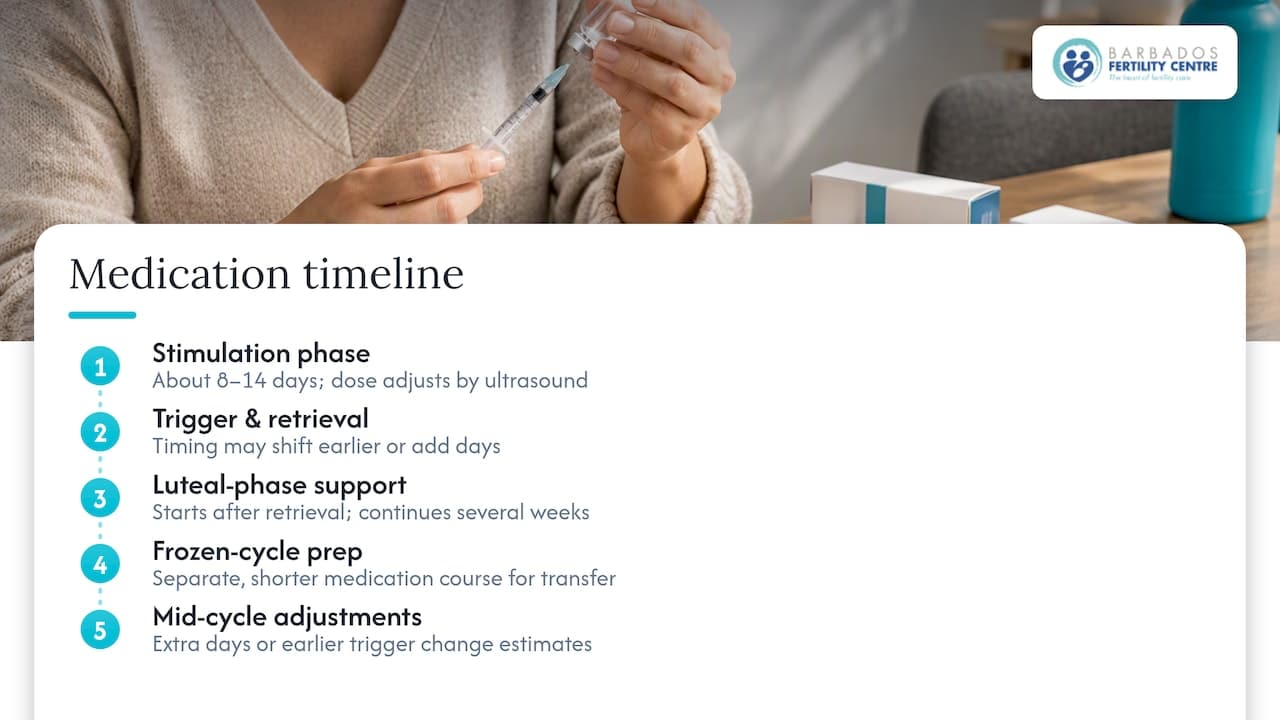
A typical stimulation phase runs about 8 to 14 days, though your clinician adjusts this based on how your follicles respond on ultrasound. Shorter stimulation generally means fewer total vials or pens, which lowers your medication bill. Longer stimulation, often needed for slower-responding ovaries, adds days of gonadotropins and sometimes an extra monitoring visit or two.
Luteal-phase support, usually progesterone, starts after retrieval and continues for several weeks if a transfer proceeds, adding a smaller but steady cost on top of the stimulation phase. If your cycle is frozen for a later transfer, you will take a separate, shorter course of medications to prepare your uterine lining before that transfer, which is a distinct cost from your original stimulation.
Because dosing decisions happen in real time based on your bloodwork and ultrasound results, your clinician may add extra days of medication mid-cycle if your follicles are developing more slowly than expected, or trigger earlier if they are ahead of schedule. This is the single biggest reason an initial medication estimate can shift once your cycle actually starts, and it is worth asking your clinic how they handle mid-cycle dose adjustments and whether those changes affect your bill.
What Else Gets Added to the Medication Line Item
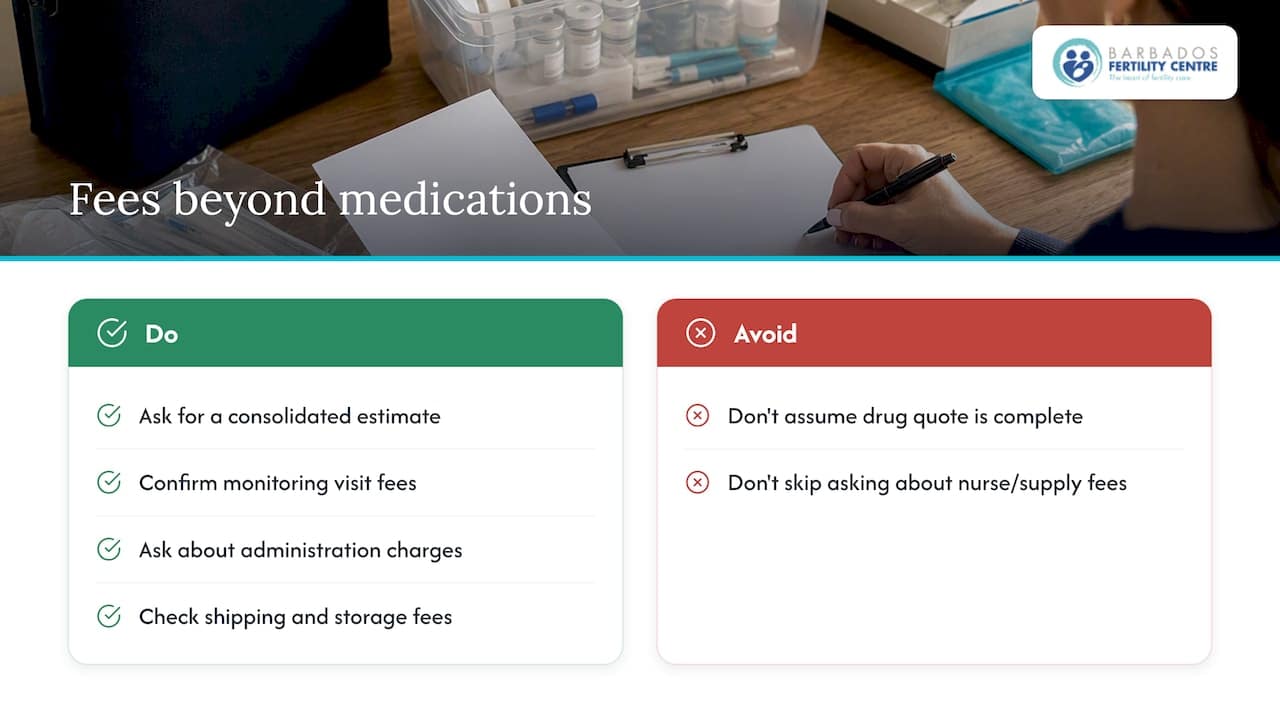
Medications rarely arrive on your bill alone. Monitoring visits, the ultrasounds and bloodwork that track your response every two to three days during stimulation, carry their own fees separate from the drugs themselves, and a longer stimulation phase means more monitoring visits, not just more medication.
Administration costs are another line worth asking about. Some clinics include injection teaching and nursing support in the base package, while others charge separately for administration supplies like needles, alcohol swabs, and sharps containers, or for a nurse to administer trigger shots. These are modest individually but add up over a two-week stimulation window.
If your cycle involves a frozen embryo transfer later, add the cost of the lining-preparation medications and the monitoring visits tied to that separate cycle. Shipping and storage fees for temperature-sensitive medications can also apply if you order through a mail-order specialty pharmacy, particularly for international patients coordinating treatment from a distance. Asking your clinic for a single consolidated estimate that includes monitoring and administration fees, not just the drug costs, gives you a far more accurate picture than the medication quote alone.
Our Perspective on Transparent Pricing and Medication Coordination
We built our pricing around the idea that patients should know what they are paying for before treatment begins. As a JCI-accredited fertility center offering IVF, ICSI, IUI, and egg freezing, with thousands of successful pregnancies on record, we provide itemized price lists rather than a single bundled figure that hides where medication costs fall.
For patients coordinating treatment from abroad, we help plan medication logistics in advance, including what to source locally versus what to bring, so there are fewer surprises once a cycle starts. If you want a clear picture specific to your protocol, request a personalized estimate before committing.
— Barbados
Transparent IVF Pricing With Barbados Fertility Centre
We offer IVF, IVF with ICSI, ICSI, and Egg Freezing Cycles with pricing that is itemized from the start, rather than bundled into a single number that leaves medication costs unclear.
A few starting points if you want specifics:
- Review our CARICOM price list for itemized IVF, IVF with ICSI, and Egg Freezing Cycle pricing.
- Check our international price list for ICSI, Egg Freezing, and donor-egg program pricing.
- Visit our clinic overview to learn more about our services and request a personalized estimate.
If you are also planning prenatal imaging around your treatment timeline, BabyView3D’s ultrasound packages are worth a look for later in your journey.
This article is general information, not a substitute for advice from a qualified doctor. Consult a qualified healthcare professional about your own circumstances before acting on anything here.
FAQ
Did Trump actually make IVF cheaper?
A federal initiative negotiated discounts on a narrow set of IVF drugs through a dedicated portal, with estimated savings of up to about $2,200 per cycle for eligible patients. The discount applies only to select medications and eligibility rules, so it does not reduce the cost of a full IVF cycle or medication regimen.
How much do Costco IVF medications cost?
Pricing for fertility medications through warehouse club pharmacies varies by drug, dose, and location, and is not published in a standardized way. Patients considering this route should confirm pricing directly and verify the pharmacy carries the exact medication and dose their clinic has prescribed.
Which IVF medication is most expensive?
Gonadotropins, the injectable hormones used to stimulate the ovaries, are typically the most expensive single medication class in a stimulation cycle. Costs vary by brand, dose, and how many days of stimulation a patient needs.
Where is the cheapest place to buy IVF medication?
There is no single cheapest source, since prices vary by specialty pharmacy, manufacturer assistance eligibility, and whether a government discount portal covers that specific drug. Comparing quotes across two or three licensed specialty pharmacies, and checking manufacturer copay programs, is the most reliable way to find the lowest price for your exact prescription.
What percentage of IVF cost is medication?
Research and industry data vary, with one prospective cohort study finding medications made up about 22% of cycle-based treatment costs, while industry price surveys put the range closer to 15% to 35% depending on protocol. Your own share depends on the dose and duration of stimulation your body requires.
Sources
- Costs of infertility treatment: Results from an 18‑month prospective cohort study – PMC
- The cost of IVF by city – FertilityIQ