

Yes, IVF can be a tax-deductible medical expense in the United States, but only in part. You deduct the portion of your unreimbursed medical costs that exceeds 7.5% of your adjusted gross income (AGI), and only if you itemize on Schedule A. The IRS says in Publication 502 that procedures to overcome an inability to have children, such as IVF and temporary storage of eggs or sperm, can be included when they are performed on you, your spouse or your dependent.
This guide walks through how the math works, what counts, where the IRS draws lines, how travel for treatment fits in, and how to ask for time off work. It is general information, not tax advice. Your situation (marital status, diagnosis, other deductions) changes the answer, so confirm the final numbers with a CPA or enrolled agent.
TL;DR
- IVF costs are deductible as medical expenses only above 7.5% of your AGI, and only if you itemize instead of taking the standard deduction.
- There is no separate federal $6,000 IVF deduction in 2026. The general medical expense rules still apply.
- Costs tied to a gestational surrogate are not deductible. Costs for your own treatment can be, so keep invoices that separate the two.
- Travel and lodging for treatment may qualify, with limits. Ask your tax professional how that applies to care abroad.
- FMLA covers fertility treatment only when it meets the law’s “serious health condition” test, so get medical certification early.
Table of Contents
- How the IVF tax deduction works
- What counts as a deductible IVF expense
- Is there a $6,000 IVF deduction in 2026?
- Can you deduct travel for fertility treatment?
- Keep records that stand up to a question
- Time off for IVF: how FMLA fits
- Our perspective: plan for the cost you will actually bear
- What treatment costs at our clinic
- A short checklist before you file
- FAQ
- Sources
How the IVF tax deduction works
The deduction comes from Section 213 of the tax code, which allows you to deduct medical care expenses you paid during the year that insurance or anyone else did not reimburse. Three conditions decide whether you get any benefit:
- The expense is medical care for you, your spouse or your dependent. IVF, medication, monitoring and egg or sperm storage fit here, according to Publication 502.
- It exceeds 7.5% of your AGI. You do not deduct the full cost of treatment. You deduct only the amount above the floor. With an AGI of $100,000, the first $7,500 of qualifying medical expenses gets you nothing.
- You itemize. If you take the standard deduction, you cannot claim medical expenses at all.
That third condition is where many patients are surprised. The 2026 standard deduction is $16,100 for single filers and $32,200 for married couples filing jointly. Itemizing only helps if your total itemized deductions (medical above the floor, state and local taxes, mortgage interest, charitable gifts) beat those figures.
A worked example
The numbers below are an illustration, not a prediction for your return.
A married couple filing jointly has an AGI of $120,000. Their floor is 7.5% of that, or $9,000. They pay $18,000 out of pocket for an IVF cycle and medication, plus $3,000 in other unreimbursed medical bills, for $21,000 in total.
- Deductible medical amount: $21,000 minus $9,000 = $12,000.
- If their other itemized deductions (mortgage interest, state taxes, donations) total $15,000, itemizing gives $27,000.
- The joint standard deduction is $32,200, so they would take the standard deduction and the IVF spending would produce no federal tax benefit.
Change one input and the result flips. If they had $22,000 in other itemized deductions, itemizing would yield $34,000 and beat the standard deduction. Run both calculations, or ask a preparer to, before you assume the deduction helps.
What counts as a deductible IVF expense
Publication 502 treats the following as potentially qualifying when they relate to your own treatment:
- Fees for the IVF procedure itself, including egg retrieval and embryo transfer
- Fertility medication prescribed for your treatment
- Monitoring, screenings and lab work connected to the cycle
- Temporary storage of eggs, sperm or embryos, as the publication lists storage of eggs or sperm among eligible procedures
The IRS’s reasoning appears in a 2025 determination letter, Letter Ruling 202518023, which allowed a taxpayer’s own unreimbursed IVF expenses. The Tax Adviser’s summary notes that the letter was issued on February 4, 2025 and released on May 2, 2025. A determination letter applies to the taxpayer who asked for it and is not binding precedent for everyone else, but it shows how the IRS reads the statute.
What the IRS does not allow
The same letter denied costs associated with a gestational surrogate. According to the IRS letter, that includes the surrogate’s compensation, pre-transfer testing for the surrogate, embryo transfer fees, her insurance premiums and legal fees to establish parentage. The reason is that those costs are incurred for a third party rather than for medical care of the taxpayer, spouse or dependent.
Also keep in mind:
- Reimbursed costs do not count. If your employer’s plan pays for part of a cycle, you deduct only what you paid yourself.
- Your status matters. USA Today’s reporting quotes tax experts who say the rules are murkiest for single people, unmarried couples and same-sex couples, because precedent centers on a medical diagnosis of infertility. If that describes you, a tax professional’s read of your facts is worth paying for.
- Donor programs need care. Costs for donor eggs or donated embryos are a gray area for many filers. Ask your preparer how to treat them before you file, and do not assume they follow the same logic as your own egg retrieval.
Is there a $6,000 IVF deduction in 2026?
No. Readers often ask about a flat $6,000 deduction, and it is easy to see why: several temporary deductions exist in current tax law, some aimed at seniors. But there is no federal provision giving a flat $6,000 deduction for fertility treatment. You still rely on the general itemized medical expense rules, as outlined in the Congressional Research Service table of deduction amounts.
Proposals for a dedicated credit have been introduced in Congress. The IVF for Families Act in the 118th Congress would have created a nonrefundable credit of up to $15,000 for qualified fertility treatment expenses. A bill introduced in 2024 sought a refundable credit with a lifetime cap of $30,000. Introduced bills are not law. Do not plan your budget around one unless it has passed.
Can you deduct travel for fertility treatment?
Medical travel is a separate line in the deduction. Publication 502 lets you include transportation costs primarily for and essential to medical care, and lodging within limits (up to $50 per night per person under the publication’s lodging rule). Meals are generally not deductible unless they are part of inpatient care.
Some practical points:
- The trip has to be mainly for medical care. A vacation with an appointment attached is harder to defend than a trip organized around a cycle.
- Keep a log. Dates, destinations, mileage or airfare receipts and lodging receipts all belong in your file.
- Ask about treatment abroad. If you travel outside the U.S. for care, talk to your preparer about how Publication 502 applies to your facts. We are a clinic, not tax advisers, and we do not want you to rely on our reading of the tax code.
- Travel still has to clear the 7.5% floor. It adds to your total medical expenses. It is not deductible on its own below the threshold.
If you are weighing the total cost of treatment in another country, our breakdown of clinic fees, medications and travel shows the components you would be comparing.
Keep records that stand up to a question
The cleanest return is the one with documents behind every number. Tax professionals quoted by The Tax Adviser point out that lump-sum invoices can cause trouble when treatment and third-party services are mixed. A breakdown that ties each cost to you or your spouse is the strongest support.
A practical file for an IVF year includes:
- Itemized invoices from the clinic, not just a card statement
- Pharmacy receipts for stimulation and trigger medication
- Insurance explanation-of-benefits statements showing what was reimbursed
- Mileage logs, airfare and lodging receipts
- A letter or note from your physician confirming the treatment is for your diagnosis
When invoices arrive, it helps to compare line items before you pay against what your insurer processed, so you do not claim a cost that was later reimbursed. Reconcile at the end of each year, not at filing time.
HSAs, FSAs and employer coverage
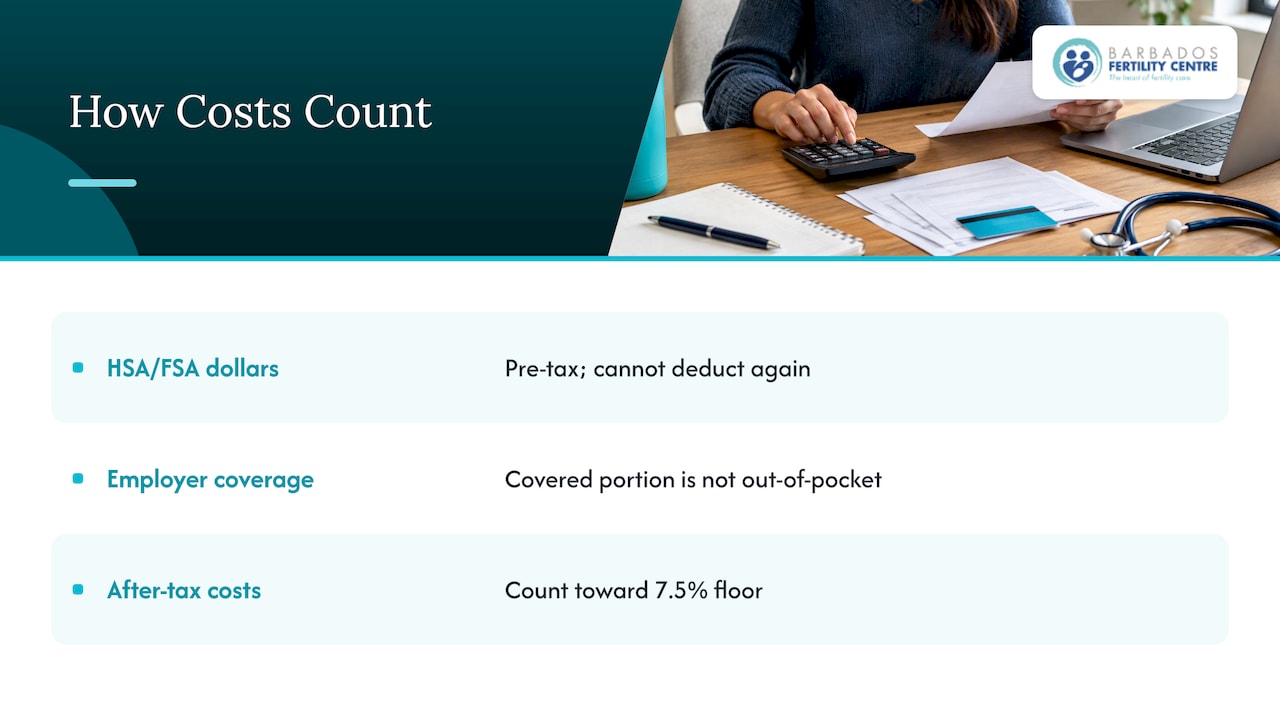
If you pay with a health savings account or flexible spending account, those dollars were already set aside pre-tax. You cannot deduct the same dollars again. Count only what you paid with after-tax money toward the 7.5% floor. If your employer’s health plan covers fertility treatment, you generally have nothing to report for the covered portion, since it is not an out-of-pocket cost to you.
Time off for IVF: how FMLA fits
The tax question is usually followed by a scheduling one: how do you get through monitoring visits, retrieval and transfer without running out of leave?
The Family and Medical Leave Act provides up to 12 workweeks of leave in a 12-month period for qualifying reasons, including a serious health condition. Fertility treatment is not automatically a qualifying event. As the Department of Labor explains, the condition has to meet the law’s definition, typically involving inpatient care or continuing treatment by a health care provider.
A law firm’s employer-side analysis and a public-sector guidance note both reach the same practical conclusion: absences for infertility treatment can count toward FMLA when they meet the serious health condition criteria. Routine appointments alone may not.
What to do:
- Check eligibility first. FMLA applies to certain employers and employees only. Ask HR whether you are covered.
- Give notice early. If you know you will need leave, the Department of Labor says you must give at least 30 days’ notice when it is foreseeable.
- Get medical certification. Ask your physician to document the medical need for time off, especially around retrieval, which involves sedation, and any complication.
- Look beyond FMLA. Some employers offer fertility leave, sick time or flexible schedules. Some states have their own leave laws. Ask HR what is available.
If you are planning treatment abroad, a clinic that coordinates the work-up remotely can reduce the number of days you need to be away. We explain how in our guide to IVF treatment abroad.
Our perspective: plan for the cost you will actually bear
We see the tax deduction as a real but modest help, not a funding plan. Because the benefit begins only above 7.5% of AGI and only when you itemize, a patient with a moderate income and a single cycle may get little or nothing back. The deduction rewards high spending, which is exactly the situation many U.S. patients find themselves in.
Our advice, based on how patients talk to us about money:
- Start with the price, not the refund. A deduction reduces taxes on money you have already spent. Lowering the amount you spend in the first place is more reliable.
- Ask for itemized pricing. You want to see the clinic fee, medication, monitoring and any add-ons separately, for budgeting and for your tax file.
- Look at medication costs. In the U.S., stimulation drugs alone often run into the thousands. We cover this in our guide to IVF medication costs.
- Treat the tax benefit as a bonus. If it arrives, good. If not, your plan still works.
Barbados Fertility Centre has operated since 2002 and holds JCI accreditation, and our fees are published openly so you can plan before you commit.
— Barbados
What treatment costs at our clinic
If you are comparing the cost of a cycle, these are our published prices, in US dollars:
| Treatment | Price |
|---|---|
| IVF | from 5750 USD |
| IVF with ICSI | from 6750 USD |
| ICSI | 7650 USD |
| Egg freezing cycle | from 4950 USD |
| IUI (partner or donor sperm, per cycle, including scans) | from 500 USD |
| ICSI with known donor eggs | from 9500 USD |
| ICSI with non-disclosed donor eggs | from 10750 USD |
| Embryo donation cycle | 5000 USD |
These come from our CARICOM price list and international price list, and the list that applies to you depends on where you live. Medication, travel and lodging are separate from the clinic fee. To see an estimate for your own plan, use our IVF cost calculator, or read about IVF treatment in Barbados to see how a cycle runs.
Because we publish itemized prices, you can hand your tax preparer a clear record of what each service cost. That is not tax advice and it does not guarantee any deduction, but it makes the paperwork easier.
A short checklist before you file
- Add up unreimbursed medical costs for the whole year: treatment, drugs, storage, travel, dental, vision, and other bills for you, your spouse and dependents.
- Multiply your AGI by 7.5% to find your floor.
- Subtract any HSA or FSA dollars and insurance reimbursements.
- Compare your total itemized deductions to the standard deduction for your filing status.
- Separate any third-party costs, such as surrogacy, and exclude them from the medical deduction.
- Give your preparer itemized invoices and your physician’s documentation.
FAQ
Are IVF expenses tax deductible?
Often in part. The IRS allows unreimbursed IVF costs for you, your spouse or your dependent as medical expenses under Publication 502, but only the portion above 7.5% of your AGI, and only if you itemize. A tax professional can tell you whether your facts fit.
Can I claim embryos or surrogacy costs?
Surrogacy is the harder one. The IRS denied the costs of a gestational surrogate in its 2025 determination letter, including her compensation, insurance and legal fees. Costs for your own medical treatment and storage may qualify, so ask for invoices that keep the two separate.
Is IVF tax deductible in 2026?
The same Section 213 rules apply, and the 2026 standard deduction is $16,100 for single filers and $32,200 for joint filers, per the CRS table. Expenses paid in 2026 are claimed on the return you file in 2027. Rules can change, so check current IRS guidance when you file.
Does FMLA cover time off for IVF?
Only when the treatment qualifies as a serious health condition under the law, which usually means inpatient care or continuing treatment by a provider. Routine visits may not qualify. Ask your doctor for certification and your HR department about eligibility and notice.
Can I deduct travel to a fertility clinic?
Publication 502 allows transportation and limited lodging costs for medical care, and they count toward the 7.5% floor. Keep every receipt and log. If the clinic is outside the U.S., have your tax preparer confirm how the rules apply to you.
Sources
- IRS Publication 502, Medical and Dental Expenses
- IRS Letter Ruling 202518023
- The Tax Adviser: IRS approves medical deduction for IVF, denies it for surrogacy
- Congressional Research Service: standard deductions 1988 to 2026
- USA Today: Is IVF tax deductible?
- Congress.gov: H.R.9333, IVF for Families Act
- U.S. Department of Labor: How to talk to your employer about leave
- Holland & Hart: Work absences for fertility treatments and FMLA
- TASB: Infertility treatment and FMLA
Recommended
- IVF Cost Calculator – Find Out How Much IVF Treatment Will Cost
- What is IVF?
- IVF Cycles Per Year: How Many Is Safe? Expert Fertility Guide
- Cut U.S. IVF Medication Costs: Stimulation Drugs Often $3,000–$7,000