


There is no single national BMI law that governs IVF eligibility. Instead, individual clinics set their own thresholds, commonly somewhere between BMI 35 and 45 kg/m², though this varies by facility. BMI at either end of the spectrum can influence procedural safety and treatment outcomes, which is why clinics build policies around it rather than treating it as a formality.
TL;DR:
- Most clinics set BMI thresholds for IVF between 35 and 45 kg/m², influenced by anesthesia capabilities, equipment limits, and safety considerations.
- Elevated BMI reduces implantation, clinical pregnancy, and live-birth rates, with each five-unit increase associated with a 5 to 7% drop in success and a 9% rise in miscarriage risk.
- High BMI poses procedural safety risks such as airway management and imaging challenges, while also increasing obstetric risks like gestational diabetes and preterm birth.
- For patients outside thresholds, requesting individualized risk assessments, writing policies, and exploring alternative clinics or procedures can improve access to fertility treatment.
- Underweight BMI carries its own risks, including irregular ovulation and adverse obstetric outcomes, so balanced weight gain and age-aware timelines benefit fertility prospects.
Table of Contents
- How BMI affects IVF outcomes: what the evidence shows
- What clinics actually require: typical thresholds and policy variation
- Why clinics set BMI cutoffs: safety reasons explained
- If your BMI falls outside a clinic’s threshold: your options
- Professional guidance and the ethical debate around BMI cutoffs
- How Barbados Fertility Centre approaches BMI and eligibility
- Underweight BMI effects and the timeline versus age tradeoff
- How BMI shapes medication dosing and stimulation protocols
- Psychological and emotional considerations around BMI and IVF
- Alternative paths for those outside a clinic’s BMI criteria
- When to seek medical advice on weight before starting IVF
- Long-term health effects for mothers and children linked to BMI
- Our take on BMI rules in fertility treatment
- Barbados Fertility Centre: a practical next step
- Sources
- FAQ
How BMI affects IVF outcomes: what the evidence shows
Research on body weight and fertility treatment points in a fairly consistent direction, with some important caveats. A systematic review of IVF outcomes found that obesity correlates with lower implantation rates, lower clinical pregnancy and live-birth rates, and higher miscarriage rates across the studies pooled.
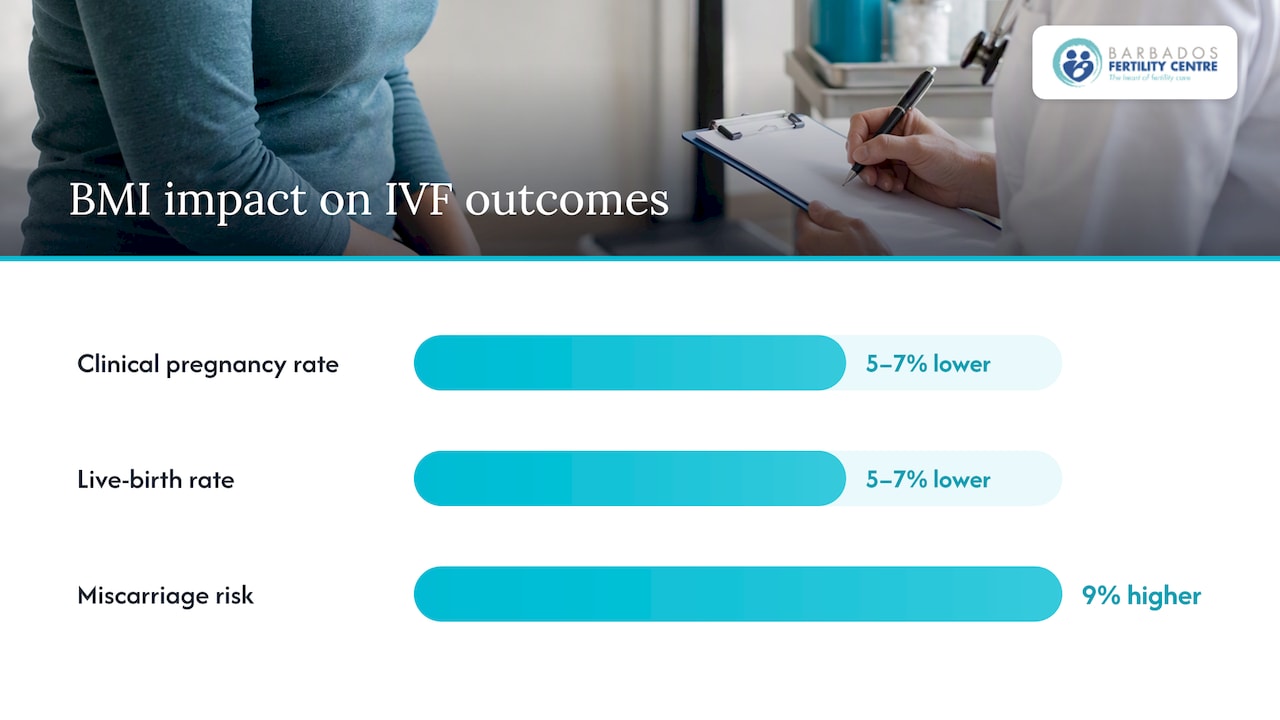
For every five-unit increase in BMI, pooled analyses linked a 5 to 7% reduction in clinical pregnancy and live-birth rates, alongside a 9% rise in miscarriage risk, according to the same review. That is a meaningful signal, but it describes a population-level trend, not a guarantee for any individual.
Several factors shape why BMI matters biologically and how much it matters for a given patient:
- A higher-BMI environment can alter the oocyte and endometrial conditions that support implantation.
- Low-grade inflammation associated with excess weight may affect egg quality and uterine receptivity.
- Age, ovarian reserve, and conditions like PCOS often interact with BMI in ways that change the overall risk picture.
- Fresh embryo transfers appear more sensitive to BMI-related effects than frozen transfers in some analyses, though findings are not uniform across studies.
Not every study agrees on the scale of the effect. Some research finds limited impact of BMI on euploid embryo rates, suggesting that genetic quality of embryos may be less affected than implantation and carry-to-term outcomes. This matters for patients using preimplantation genetic testing, since a euploid embryo might still transfer successfully even when other BMI-related risks remain elevated.
What clinics actually require: typical thresholds and policy variation
Clinic policies on BMI are not arbitrary, but they are also not standardized. The ASRM committee opinion on obesity and reproduction notes that among surveyed SART-member programs, thresholds typically fall between 35 and 45 kg/m², with some centers setting limits higher or lower depending on their own resources.
A few things explain why the number you are quoted might differ from a number a friend heard elsewhere:
- Anesthesia capability varies: a clinic with on-site anesthesiology and airway management support can often accommodate higher BMI patients than one without it.
- Ambulatory versus hospital-based settings change what is feasible: outpatient surgical suites often have lower thresholds than hospital-affiliated programs.
- Equipment limits play a role too, since ultrasound imaging and procedure tables have practical weight and depth constraints.
Clinics frequently look beyond BMI alone. Waist circumference, overall comorbidity profile (such as diabetes or hypertension), and in some cases estimated body fat percentage round out the eligibility picture, since BMI alone does not capture fat distribution or metabolic health.
Why clinics set BMI cutoffs: safety reasons explained
BMI cutoffs are mostly about procedural safety rather than a judgment on a patient’s chances. Anesthesia teams face genuine airway and monitoring challenges at higher BMI levels, and oxygenation during sedation becomes harder to manage reliably.
- Airway access and ventilation become more difficult to secure safely under sedation at higher BMI levels.
- Transvaginal ultrasound imaging during egg retrieval can lose clarity when abdominal tissue depth increases.
- Outpatient surgical suites may lack the monitoring equipment that a hospital-affiliated program keeps on hand.
Separately, a study on obesity and obstetric and perinatal risks found that higher maternal BMI categories carry increased risk of hypertensive disorders, gestational diabetes, preterm birth, and fetal macrosomia. These are pregnancy-outcome concerns, distinct from the procedural risks above, and clinics sometimes cite both when explaining a threshold.
Pro Tip: Ask your clinic directly whether its BMI policy is based on anesthesia capacity, equipment limits, or pregnancy-risk counseling, since the answer changes what might actually resolve the restriction.
If your BMI falls outside a clinic’s threshold: your options
Being told you exceed a clinic’s BMI threshold is not the end of the conversation. Ask for the policy in writing, request an anesthesia evaluation, and push for an individualized risk assessment rather than a blanket rejection. The ASRM committee opinion explicitly cautions against refusing care based solely on an arbitrary cutoff, since that raises fairness concerns around patient autonomy.
On the weight-loss side, the evidence is more nuanced than it might seem:
- Modest weight loss of 5 to 10% of body weight can improve metabolic markers and fertility parameters for many patients, according to a meta-analysis on pre-IVF weight loss.
- GLP-1 therapies are increasingly discussed for preconception weight management, but they require medical supervision and a clear washout period before stimulation begins.
- Bariatric surgery can produce substantial weight loss, though most surgeons and fertility specialists recommend waiting a defined period after surgery before pursuing pregnancy, since rapid post-surgical weight loss can itself affect nutritional status.
Randomized trials of pre-IVF weight-loss interventions show mixed or inconclusive effects on live-birth rates, per the Scientific Reports meta-analysis: some interventions increase pregnancy rates or lead to unassisted conception during the waiting period, but a consistent live-birth benefit from delaying IVF to lose weight has not been established. That is the central tradeoff. For a 42-year-old with declining ovarian reserve, a six-month delay to pursue weight loss carries a different cost than it does for a 29-year-old, and any weight-loss plan should be agreed with your clinic rather than pursued in isolation.
Professional guidance and the ethical debate around BMI cutoffs
The ASRM committee opinion is the most cited professional guidance on this subject. It confirms there is no national mandate on BMI for IVF and cautions against treating any single cutoff as universally appropriate, recommending instead that policies stay individualized and tied to a facility’s actual capabilities.
- ASRM recommends consulting anesthesia teams and weighing comorbidities rather than applying one fixed number to every patient.
- Clinics with strong anesthesia support and hospital affiliation are more likely to accept higher-BMI patients because they can manage airway and equipment needs safely.
- Some publicly funded fertility programs in other systems set firmer thresholds for funding eligibility, which is a different question from clinical safety.
If you are told you do not qualify, a second opinion and a documented clinical assessment are reasonable next steps, and they put the decision on record rather than leaving it as an informal judgment call.
How Barbados Fertility Centre approaches BMI and eligibility
Barbados Fertility Centre has operated as a JCI-accredited clinic since 2002, offering IVF, ICSI, IUI, and egg freezing. Eligibility assessments are individualized, with anesthesia capability factored into the review. Readers can request written eligibility criteria or an anesthesia consult directly from the clinic.
Underweight BMI effects and the timeline versus age tradeoff
BMI thresholds get most of the attention at the upper end, but being underweight carries its own risks. National ART data shows that underweight status, like obesity, is associated with adverse obstetric outcomes including low birth weight and preterm delivery.
Underweight patients may also face irregular ovulation or thinner endometrial lining, which can complicate both natural conception and IVF cycle planning. Clinics sometimes recommend a modest weight gain before stimulation begins, aiming for a BMI that supports more predictable hormonal response and a receptive uterine lining.
The timeline tradeoff cuts both ways here too. A 35-year-old with a low BMI and normal ovarian reserve has more room to spend a few months on nutritional support before starting treatment than a 40-year-old facing the same recommendation. Ovarian reserve naturally declines with age regardless of BMI, so the conversation about delaying treatment to adjust weight should always account for where a patient stands on that curve. For some underweight patients, especially those with a history of disordered eating or very low body fat, working with a dietitian alongside the fertility team produces steadier, more sustainable progress than attempting rapid change on a deadline.
How BMI shapes medication dosing and stimulation protocols
BMI does not just affect eligibility screening, it also shapes how a stimulation protocol is built. Higher BMI is often associated with a blunted ovarian response to standard gonadotropin doses, which means some patients need higher doses of stimulation medication to achieve comparable follicle growth.
This has practical consequences. Higher medication doses raise treatment costs and can extend the number of injection days before retrieval is scheduled. Clinics monitor response closely through bloodwork and ultrasound, adjusting the protocol in real time rather than committing to a fixed dose for the entire cycle.

At the other end, underweight patients sometimes respond unpredictably to standard dosing as well, which is one reason individualized protocol design, rather than a one-size approach, tends to produce more consistent results. A patient’s BMI is one input among several, alongside age, ovarian reserve markers like AMH, and prior cycle history, that a reproductive endocrinologist weighs before finalizing a protocol. None of this means a higher-BMI patient cannot respond well to stimulation, only that the path to a good response may take more careful calibration.
Psychological and emotional considerations around BMI and IVF
Being told that your weight affects your fertility treatment eligibility can land hard, especially after months or years of trying to conceive. It is a different kind of disappointment than a failed cycle, because it can feel like a judgment on the body itself rather than a medical variable among many.
Patients navigating this often describe a mix of frustration and pressure, particularly when a clinic’s timeline for weight change collides with the sense that every month matters more as they get older. That tension is real, and it deserves acknowledgment rather than a brisk reminder to just lose the weight.
Support from a counselor familiar with fertility-related stress, or from patient communities who have faced similar eligibility conversations, can make the weight-loss period feel less isolating. Clinics that communicate BMI policy clearly and explain the medical reasoning tend to reduce the sense that the rule is arbitrary, even when patients still find it difficult to meet. Asking a clinic to walk through its reasoning in plain terms is a reasonable request, not an imposition.
Alternative paths for those outside a clinic’s BMI criteria
When a BMI threshold rules out immediate IVF at one facility, several paths remain worth exploring rather than treating it as a closed door. Intrauterine insemination, which involves lower procedural intensity than IVF, is an option some clinics will consider at higher BMI levels since it does not require the same anesthesia or egg retrieval logistics.
Seeking a second clinic with greater anesthesia resources or a hospital affiliation can open up options that a smaller outpatient facility cannot offer. As noted earlier, the ASRM opinion points out that clinics vary meaningfully in what they can safely accommodate, so one rejection does not reflect a universal rule.
Egg freezing, when fertility preservation rather than immediate pregnancy is the goal, sometimes carries different thresholds than a full IVF cycle with transfer, since it removes the pregnancy-risk component from the equation. Donor egg or embryo donation pathways are also worth discussing with a reproductive endocrinologist if age and ovarian reserve are compounding factors alongside BMI. None of these alternatives should be pursued without a direct conversation about why the original threshold applied and whether it still applies to the alternative pathway.
When to seek medical advice on weight before starting IVF
The right time to start a weight management conversation is before you schedule your first consultation, not after a clinic flags a concern. A primary care physician or a reproductive endocrinologist can order baseline bloodwork, check for conditions like insulin resistance or thyroid dysfunction that often accompany weight changes, and help set a realistic target tied to your specific BMI and age.
If a clinic has already indicated that your BMI is a barrier, ask for a specific target number and a reasonable timeframe rather than an open-ended instruction to lose weight. A GLP-1 medication program, supervised nutritional counseling, or a referral to a bariatric specialist are all legitimate next steps, but each carries its own timeline and washout considerations before stimulation can begin safely.
Patients over 38, or those with diminished ovarian reserve markers, should raise the age-weight tradeoff explicitly with their physician rather than assuming more time is automatically the safer choice. A short, supervised, clinic-agreed plan, checked against your specific fertility profile, tends to produce a better outcome than an indefinite delay chasing a number without a deadline.
Long-term health effects for mothers and children linked to BMI
The implications of BMI in IVF extend beyond the pregnancy test. The obstetric and perinatal risk study found that higher maternal BMI is linked to increased rates of gestational diabetes, hypertensive disorders, preterm birth, and fetal macrosomia, all of which carry downstream health implications for both mother and child.
Mothers who experience gestational diabetes or hypertensive disorders during pregnancy face a higher long-term risk of developing type 2 diabetes or cardiovascular disease later in life. Children born with macrosomia or after a preterm delivery can face elevated risk of metabolic issues in childhood, which is part of why clinics weigh BMI as a pregnancy-outcome factor and not only as a procedural one.
On the underweight side, national ART data also links low maternal BMI to low birth weight and preterm delivery, underscoring that the long-term stakes run in both directions. None of this means a given pregnancy will follow the statistical pattern, but it does explain why a fertility team’s interest in BMI rarely ends once a cycle begins. Ongoing obstetric monitoring, often in coordination with a maternal-fetal medicine specialist for higher-risk BMI categories, is part of how clinics try to manage these risks through delivery rather than only at the point of treatment eligibility.
Our take on BMI rules in fertility treatment
The research supports a more modest claim than most patients hear in practice: BMI correlates with outcomes at the population level, but it does not predict any one person’s chances with precision. The conventional advice, lose weight before anything else, often ignores the age clock entirely, and the meta-analysis evidence on pre-IVF weight loss does not back up blanket delays as a live-birth strategy.
What gets overlooked is that a clinic’s BMI threshold often says more about its anesthesia resources and equipment than about a patient’s biology. That is worth separating out, because it changes where you look for a solution: sometimes the fix is a different facility, not a different body.
If you take one thing from this, let it be this order of operations: get the policy in writing, ask what specifically drives the number at that clinic, and only then decide whether a weight-change plan makes sense given your age and ovarian reserve. Chasing a number without that context wastes time you may not have to spare.
— Barbados
Barbados Fertility Centre: a practical next step
If a BMI threshold has closed a door at one clinic, it is worth knowing that eligibility criteria vary by facility, and some centers are equipped to assess higher-BMI patients individually rather than by a fixed number alone. Barbados Fertility Centre has operated since 2002 under JCI accreditation, offering IVF, ICSI, IUI, and egg freezing with individualized assessment built into the intake process.
You can request a written eligibility review or an anesthesia consult before committing to a treatment plan, which gives you a clear answer rather than a guess. Current pricing includes IVF from $5,750 and ICSI at $7,650, with full package details available for both CARICOM and international patients. If you want to calculate your BMI accurately before reaching out, the Free BMI Calculator from GLPCare is a straightforward starting point, and for those considering medically supervised weight management, information on compounded semaglutide from Vivo covers what a GLP-1 program typically involves.
Reach out to Barbados Fertility Centre to request your written eligibility criteria and schedule an initial consultation.
This article is general information, not a substitute for advice from a qualified doctor. Consult a qualified healthcare professional about your own circumstances before acting on anything here.
Sources
For deeper reading, consult the ASRM committee opinion, the PMC systematic review, the CDC’s BMI basics, and the Scientific Reports meta-analysis on pre-IVF weight loss.
- Systematic review: obesity and IVF outcomes (PMC)
- Study on obesity and obstetric/perinatal risks (Nature, 2022)
FAQ
What BMI is too high for IVF?
There is no single number, since clinics set their own thresholds, commonly between 35 and 45 kg/m², according to ASRM. A clinic with stronger anesthesia resources may accept a higher BMI than one without hospital affiliation.
What disqualifies you from doing IVF?
Few conditions result in an outright disqualification everywhere, since most eligibility decisions are facility-specific and individualized rather than based on a single rule. BMI outside a clinic’s threshold, certain uncontrolled medical conditions, or safety concerns identified during an anesthesia evaluation are the most common reasons a specific clinic may decline or delay treatment.
Can a 300 lb woman get pregnant?
Weight in pounds alone does not determine fertility, since BMI depends on height as well, and pregnancy is possible across a wide range of body sizes. Higher BMI is associated with lower clinical pregnancy and live-birth rates in pooled IVF data, but individual outcomes vary, and a clinic with appropriate anesthesia and monitoring resources may still offer treatment after an individualized assessment.
What BMI is too low for fertility?
There is no single universal cutoff for being underweight in fertility treatment, but very low BMI is associated with irregular ovulation and, per national ART data, adverse obstetric outcomes including low birth weight and preterm delivery. Clinics sometimes recommend modest weight gain before starting stimulation to support more predictable hormonal response.