


Most clinics schedule intrauterine insemination (IUI) about 24 to 36 hours after the hCG trigger shot. That is the window most US guidance points to, and it is the one your own nurse is most likely to give you. Ovidrel is one brand of hCG, so the same window applies to it. Your exact hour depends on your follicle scan, the type of sperm used and your clinic’s lab schedule. At Barbados Fertility Centre, IUI starts from $500 per cycle with scans included, and the exact timing is set for you by the care team. This guide explains how the window works, why it exists and what to do if your plan feels unclear.
TL;DR
- The usual IUI window is 24 to 36 hours after the hCG trigger. ASRM’s 2020 guideline supports a single IUI anywhere from 0 to 36 hours after hCG.
- Ovidrel is an hCG trigger, so it follows the same logic. An evening injection often means an IUI on the second morning, roughly 36 hours later.
- Frozen sperm usually calls for tighter timing than fresh sperm, and your clinic’s lab schedule affects the exact hour.
- Take the trigger at the time your clinic gives you, to the minute where you can. If you are unsure, call your clinic before you inject, not after.
Table of Contents
- What the trigger shot does and why IUI follows it
- How many hours after the trigger is IUI done?
- IUI after Ovidrel: is the timing different?
- What changes the timing for your cycle
- When taking the trigger at the right time matters most
- What to do if you are unsure about timing
- What the cost of a timed cycle includes
- Our perspective
- Plan your IUI with us
- FAQ
- Sources
What the trigger shot does and why IUI follows it
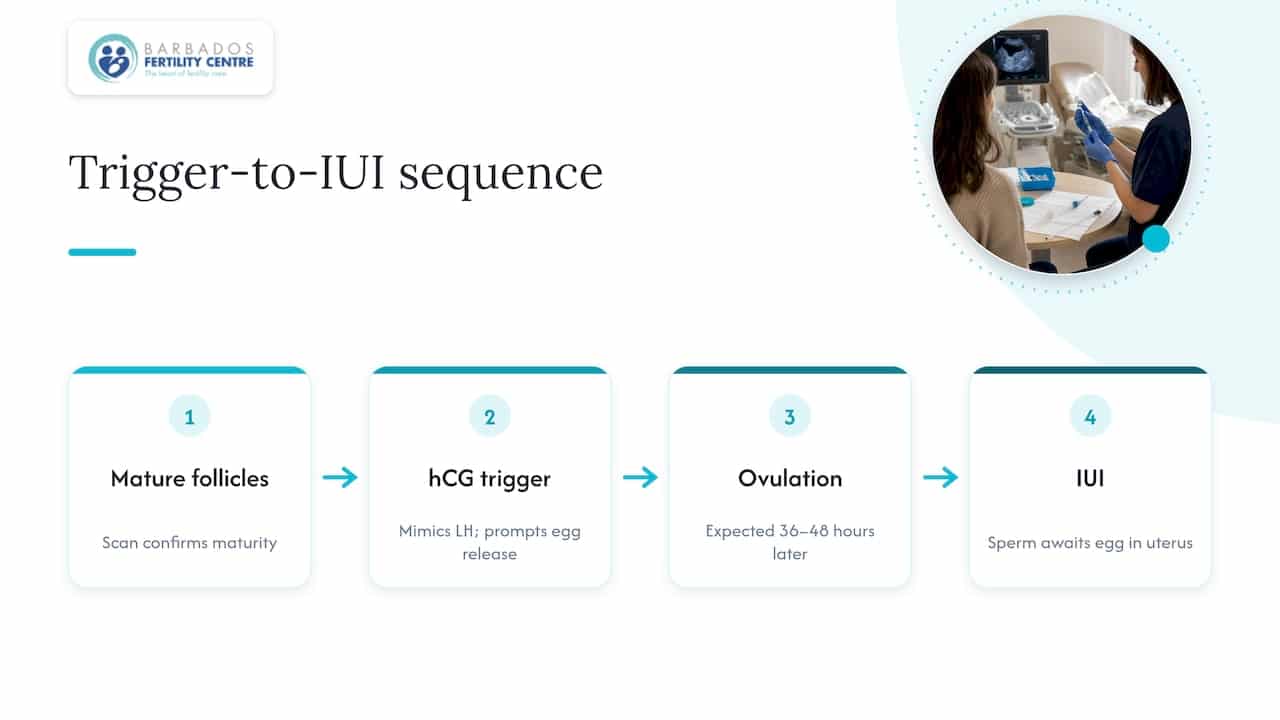
During an IUI cycle you may take fertility medication so that one or more follicles grow. A follicle is a small fluid-filled sac in the ovary that holds an egg. When a scan shows the follicles are mature, you take a trigger shot. It contains hCG (human chorionic gonadotropin), a hormone that acts like your body’s natural LH surge and tells the follicle to release its egg.
Ovulation does not happen right away. The British Fertility Society’s 2026 IUI guideline notes that ovulation is usually expected 36 to 48 hours after the hCG trigger. IUI is timed so that washed, concentrated sperm is already in the uterus when the egg is released. If you want a deeper look at the shot itself, our page on trigger shot timing walks through what it does.
How many hours after the trigger is IUI done?
The short answer is 24 to 36 hours. The longer answer is that studies show a range, and clinics choose a point inside it.
| Source | What it says about IUI timing |
|---|---|
| ASRM guideline, 2020 (US) | A single IUI between 0 and 36 hours relative to the hCG injection |
| British Fertility Society, 2026 (UK) | IUI at 32 to 36 hours and up to 48 hours after the trigger. Early IUI under 24 hours is not recommended |
| Randomized trial of three timings (AboulGheit, 2010) | No significant difference in pregnancy rates for IUI anywhere between 24 and 48 hours after hCG |
These numbers do not all agree, and that is normal. The research is a mix of trials with different drugs, different patients and different sperm. A clinic weighs that evidence against what it sees on your scan.
What the studies found
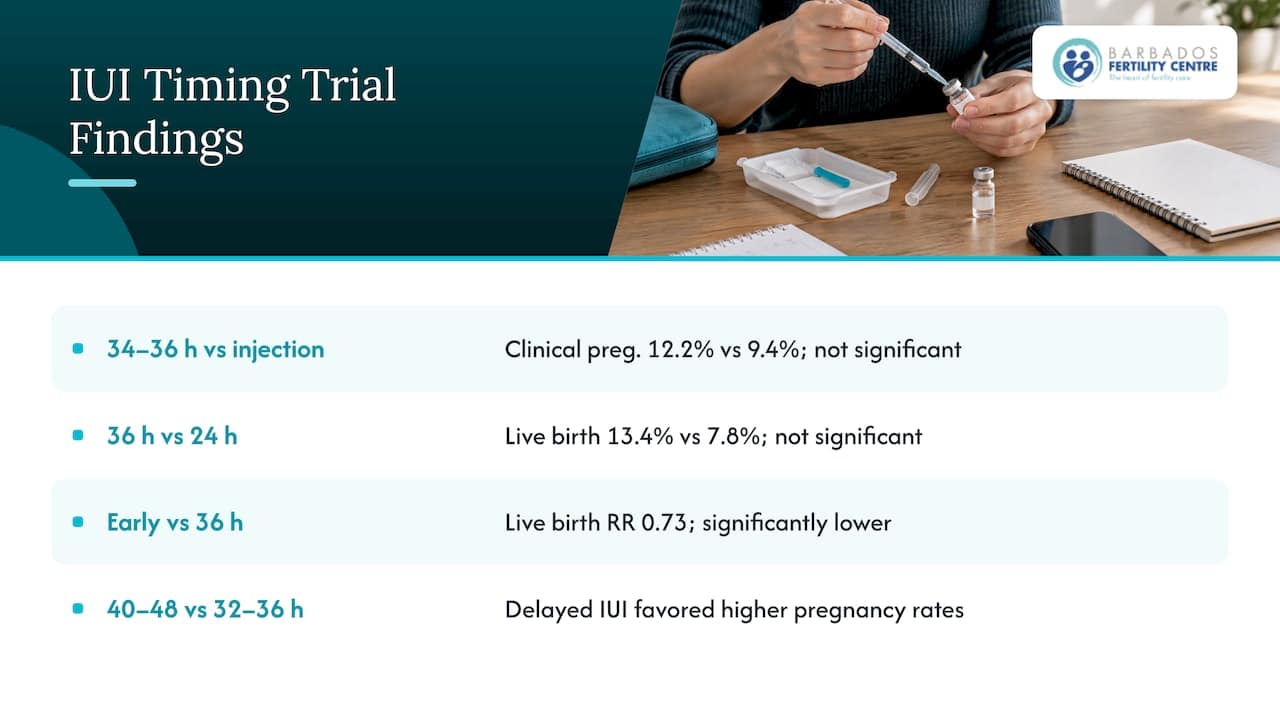
The ASRM guideline describes a trial that compared IUI 34 to 36 hours after hCG with IUI at the same time as the injection. Clinical pregnancy rates were 12.2% versus 9.4%, a difference that was not statistically significant. Another trial in couples using clomiphene found live-birth rates of 13.4% when IUI was done at 36 hours and 7.8% at 24 hours, again not a significant gap (P=.07).
The 2026 British Fertility Society guideline pooled nine trials covering 2,586 IUI cycles. It reported that early IUI had significantly lower live-birth rates than IUI at 36 hours (RR 0.73), and that delayed IUI at 40 to 48 hours favored better pregnancy rates than 32 to 36 hours. In plain terms, doing IUI too early is the pattern the evidence warns about most. Going a little later has not been shown to hurt.
IUI after Ovidrel: is the timing different?
Ovidrel is a brand of hCG trigger in a prefilled syringe. Other hCG triggers include Pregnyl and Novarel. The drug in the syringe is the same hormone, so the 24 to 36 hour logic carries over. Some clinics use a different dose or product, and some use a trigger that works through a different pathway, so your clinic’s written instruction is the final word.
A worked example shows how this looks in a real week:
- Your scan on cycle day 12 shows a mature follicle.
- You inject Ovidrel at 9 pm that evening, as instructed.
- IUI is booked for about 36 hours later, which is the morning of day 14.
If your clinic prefers 24 hours, the same 9 pm injection would lead to an IUI in the late evening or, more commonly, the next day. Clinics often pick the morning slot nearest their target because that is when the lab can wash the sample and the doctor is available.
What changes the timing for your cycle
There is no single hour that fits everyone. These are the factors your care team weighs.
Follicle number and size
A peer-reviewed review in PMC lists the timing of insemination and the number of preovulatory follicles on the day of hCG among the key factors that predict IUI success. More than one mature follicle may change how a doctor thinks about the window, and it is one reason your trigger decision is based on a scan and not a calendar day.
Fresh or frozen sperm
Fresh sperm gives some wiggle room. A sample is collected, washed in the lab and placed in the uterus within a short time. Frozen sperm, such as donor sperm, is thawed on the day and generally lives a shorter time after thawing, so clinics usually aim for a tighter match with ovulation. If you are using donor sperm, expect your clinic to be more exact about the hour. Our IUI service covers both partner and donor sperm cycles.
Lab logistics on the day
The same PMC review notes that delays between collection, processing and insemination can affect results. It reports that delaying semen processing from 30 minutes to an hour, or delaying IUI from 90 minutes to two hours after collection, compromised pregnancy outcomes in gonadotropin IUI cycles. This is why clinics build in a set morning slot and ask the sperm provider to arrive on time.
Sperm quality going into the day matters too. If you want background on one supplement often discussed for men trying to conceive, this overview of CoQ10 and male fertility explains the ingredient and typical dosing. Ask your doctor before starting any supplement during treatment.
Abstinence period
Most clinics ask the male partner to abstain for a short period before the sample is given, commonly two to five days. Your clinic will tell you the number it wants. Do not guess, because too short or too long can lower sample quality.
When taking the trigger at the right time matters most
The trigger is the clock that starts everything else. If you inject a few hours late, your IUI window may shift with it. Our guide on what happens if you take it late, early or not at all gives the general picture. Here are practical habits that keep the plan on track:
- Set two phone alarms for the injection time and one for the IUI appointment.
- Prepare the syringe and read the instructions earlier in the day, so the evening is calm.
- Write down the exact minute you injected. Tell the clinic if it differs from the plan.
- Confirm your IUI time and who needs to be at the clinic, especially if a partner or donor sample is involved.
For a fuller list, see our practical steps for a smooth trigger night.
What to do if you are unsure about timing
If you cannot tell when to inject, or your IUI time does not seem to match the hours you were told, contact your treating clinic before you take the shot. Your doctor or nurse can see your scan and your protocol. Online forums are full of people reporting IUIs at 16, 23 or 36 hours, and none of those stories tells you what is right for your follicles.
Call the clinic straight away if:
- you missed the trigger time or injected at a different hour;
- you are unsure whether the shot went in properly, for example if some liquid leaked out;
- you have severe pelvic pain, rapid weight gain, bloating that worsens or trouble breathing after the trigger, which can be signs of ovarian hyperstimulation and need urgent medical attention.
If you take Ovidrel and your IUI is not yet booked, ask the clinic to confirm the hour so that you are not planning around guesses.
What the cost of a timed cycle includes
Timing depends on monitoring, so the cost of a cycle depends on scans as much as on the IUI itself. At Barbados Fertility Centre, IUI with a partner’s sperm or donor sperm starts from $500 per cycle, and scans are included. Medication is a separate matter, and the page on IUI cost, meds and monitoring explains how a cycle can grow in cost. If you have PCOS, our guide to PCOS and IUI explains how timing and medication work together, and when IVF may be worth a look.
Our perspective
We think timing is the part of IUI that patients worry about most, and also the part they can control least on their own. The trigger hour, the scan and the lab slot all have to line up, and a plan that is written down clearly is half the battle.
At Barbados Fertility Centre, we have treated patients since 2002, and our approach is to explain each step before it happens so that you are never guessing at an hour. We offer IUI, ovulation induction and IVF under one roof, in a JCI-accredited private facility, with transparent pricing. For international patients we coordinate treatment remotely, so you know what is expected before you travel.
The same team that monitors your cycle sets your IUI timing, which keeps the process simple and personal. If IUI does not lead to a pregnancy after a few cycles, you can move to IVF or ICSI without changing clinics.
Barbados
Plan your IUI with us
If you are comparing options for a timed cycle, our IUI treatment page shows how a cycle runs at our clinic, from monitoring to insemination. IUI starts from $500 per cycle, with scans included. If you are an international patient, our IVF treatment abroad page explains how remote coordination works before you arrive. When you are ready to talk about your own cycle, start at barbadosivf.com.

FAQ
How long after Ovidrel should I do IUI?
Most protocols place IUI about 24 to 36 hours after an Ovidrel injection. An evening injection often leads to an IUI on the second morning. Your clinic sets the exact hour from your scan and protocol, so follow its instructions.
Is IUI done the same day as the trigger shot?
Sometimes. The ASRM guideline covers a range from 0 to 36 hours after hCG, and one trial it cites found no significant difference in pregnancy rates between IUI at the time of hCG and at 34 to 36 hours. Most clinics still choose a later time, because ovulation is expected 36 to 48 hours after the trigger.
Does frozen sperm change the timing?
It often does. Frozen sperm is thawed on the day and usually has a shorter useful life, so clinics tend to be more exact about the hour. Your clinic will tell you if donor sperm changes your schedule.
Can I have intercourse after the trigger?
Some protocols ask for intercourse the night of the trigger, and others ask you to avoid it before IUI. This depends on your clinic and on whether the sample is fresh. Ask your care team which applies to you.
What if I miss the trigger time?
Call your clinic immediately and tell them the exact time you injected, or that you did not. The doctor can adjust the IUI time based on that information. Do not move the IUI yourself.
Sources
- ASRM, Evidence-based treatments for couples with unexplained infertility: a guideline (2020)
- British Fertility Society, Optimising IUI: evidence-based guidance (2026)
- Allahbadia, Intrauterine Insemination: Fundamentals Revisited (PMC, 2017)
- AboulGheit et al., Pregnancy rates following three different timings of IUI (2010)