

Embryo grading is a standardized way for embryologists to describe how an embryo looks under the microscope: how many cells it has, how even they are, and, for a day 5 or 6 embryo, how far it has expanded and how its inner and outer cell groups look. A grade such as 4AA or 8I is a snapshot of appearance. It helps your care team decide which embryo to transfer or freeze first, and it is one piece of information next to your age and history.
If you have a report in front of you, the sections below show how to decode it. If you are still comparing clinics, the last sections explain what to ask about grading and where our treatment prices stand.
TL;DR
- Embryos are graded by appearance: cell number, symmetry and fragmentation on day 3, and expansion plus two letter grades on day 5 or 6.
- In a blastocyst grade like 4AA, the number (1 to 6) is expansion, the first letter is the inner cell mass (the future baby) and the second is the trophectoderm (the future placenta).
- Higher grades are linked to higher implantation and live birth rates, but lower-grade embryos still result in healthy babies.
- Scales differ between laboratories, so ask your clinic for its own key before comparing numbers with anyone else’s.
Table of Contents
- What embryo grading is and what embryologists look at
- How day 3 embryos are graded
- How blastocysts (day 5 and 6 embryos) are graded
- Reading your grade: worked examples
- What a grade tells you about your chances
- Why grades differ between laboratories
- Questions to ask your clinic about your embryo grades
- Grading and donor embryos
- Perspective
- What treatment costs at Barbados Fertility Centre
- FAQ
- Sources
What embryo grading is and what embryologists look at
An embryologist is the laboratory specialist who cares for eggs, sperm and embryos during IVF. Each day the embryologist examines your embryos and records what they see. Two things matter most: the stage of development and the appearance of the cells.
The American Society for Reproductive Medicine (ASRM) publishes grading scales for this purpose, and U.S. clinics report embryo morphology (shape and structure) to a national registry. A 2014 study of the SART registry data explains that this reporting became mandatory in 2010. It records stage, an overall good, fair or poor grade, and symmetry and fragmentation for day 2 and 3 embryos, and inner cell mass and trophectoderm quality for days 5 to 7.
The timing matters because a grade means different things on different days. The same embryo is described with one system on day 3 and a different one on day 5.
How day 3 embryos are graded
On day 3 an embryo is usually made of cells called blastomeres. Embryologists count them and look at two features:
- Symmetry: are the cells roughly equal in size?
- Fragmentation: how much of the embryo is small bits of cellular debris rather than healthy cell?
One widely used format is the Stanford Children’s embryo grading guide, which gives the cell count followed by a Roman numeral from I to V:
| Grade | Cell size | Fragmentation |
|---|---|---|
| I | Equal | None |
| II | Equal | Under 10% |
| III | Distinctly unequal | 10% to 25% |
| IV | Equal or unequal | 25% to 50% |
| V | Few cells | Over 50% |
So “8I” means eight cells of equal size with no fragmentation, the ideal picture for day 3. “7II” means seven equal cells with a little fragmentation. A 2015 review of morphology methods notes that day 3 embryos are expected to have about 7 to 10 cells, and that more than 25% fragmentation is linked to lower implantation potential.
Other laboratories use letters (A to D) or a simple good, fair, poor label. That is why two reports can look different while describing similar embryos.
How blastocysts (day 5 and 6 embryos) are graded
By day 5 or 6, a healthy embryo may have become a blastocyst: a fluid-filled ball with two distinct parts. The inner cell mass (ICM) becomes the baby. The trophectoderm (TE) is the outer layer that becomes the placenta.
The ASRM scale gives a blastocyst up to three characters, such as 4AA or 5BB.
The number: expansion
The ASRM grading scales define the number from 1 to 6:
- Early blastocyst, with the fluid cavity less than half the embryo.
- Blastocyst, with the cavity at least half the embryo.
- Full blastocyst, with the cavity filling the embryo.
- Expanded blastocyst, with a thinning outer shell (the zona pellucida).
- Hatching blastocyst, with cells pushing out through the shell.
- Hatched blastocyst, fully out of the shell.
The first letter: inner cell mass
A means many tightly packed cells. B means several cells in a loose group. C means very few cells. A 2023 expert consensus adds a grade D for an ICM with no cells or only degenerating ones, which it says should be discarded.
The second letter: trophectoderm
A means many cells forming a cohesive layer. B means few cells forming a looser layer. C means very few large cells.
Letters are assigned to blastocysts at stages 3 to 6. Early stages 1 and 2 are typically described by number only and graded again after more growth, which is why a combination like “2AB” is not an entry in the ASRM chart.
Reading your grade: worked examples
- 4AA: an expanded blastocyst with an excellent inner cell mass and trophectoderm.
- 4BB: an expanded blastocyst with a B-grade inner cell mass and B-grade trophectoderm. It is a mid-range grade, and the next section shows that embryos at this level are transferred and implant regularly.
- 5AB: a hatching blastocyst, A inner cell mass, B trophectoderm.
- 3BC: a full blastocyst with a B inner cell mass and a C trophectoderm.
- 8I: a day 3 embryo, eight cells, equal size, no fragments.
If your report shows an early blastocyst (stage 1 or 2), it may simply need more time. The 2023 consensus recommends that day 6 embryos at stage 1 or 2 be cultured to day 7, and that those reaching stage 4 or higher with AA, AB, BA or BB grades can be used.
What a grade tells you about your chances
Grades matter, and the research shows how much.
A study of 717 fresh single blastocyst transfers used the simplified SART scoring system. Good-grade embryos had a 63% implantation rate and a 53% live birth rate. The score was significantly correlated with both outcomes after adjusting for age, BMI and blastocyst stage.
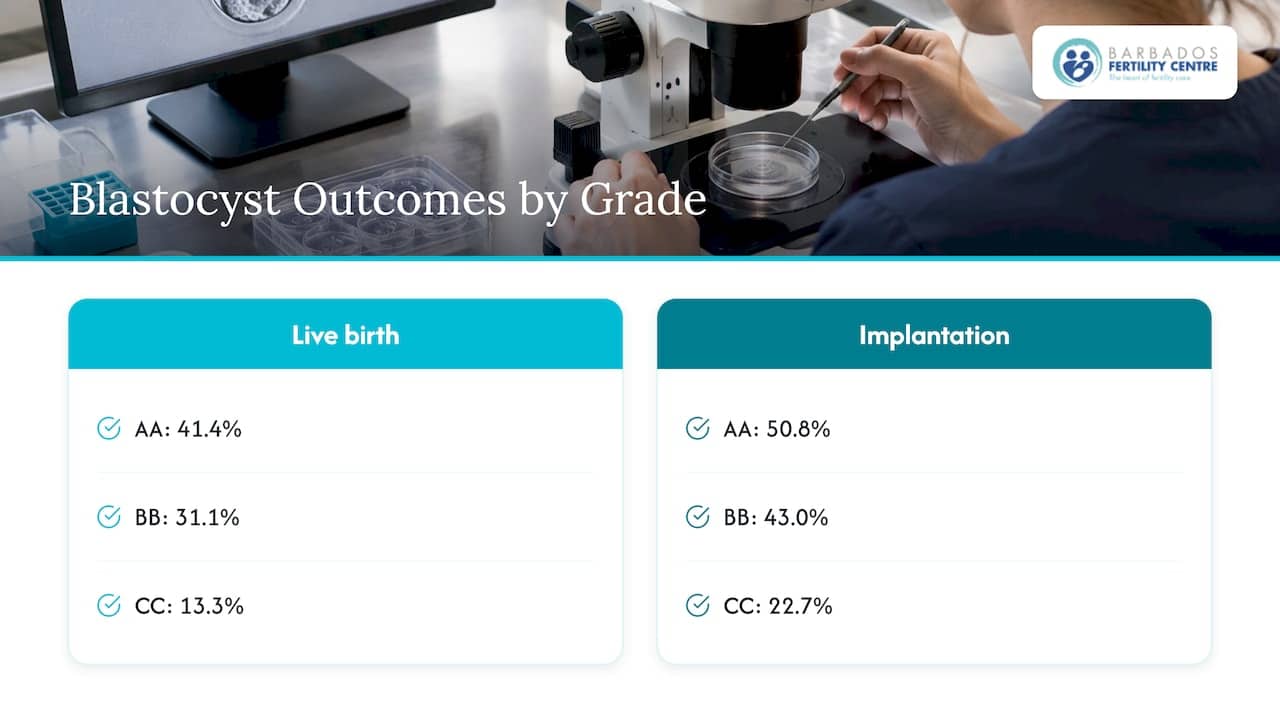
A 2020 Canadian study looked at grades by letter. Live birth rates were 41.4% for AA blastocysts, 31.1% for BB and 13.3% for CC. Implantation rates were 50.8%, 43.0% and 22.7%.
The trophectoderm appears to carry a lot of the signal. A U.S. single embryo transfer study found that trophectoderm quality, embryo stage and patient age were independent predictors of pregnancy and live birth. Live birth rates by trophectoderm score were 50% for good, 41.9% for fair and 30% for poor. A review in Reproductive BioMedicine Online adds that scoring expansion, ICM and trophectoderm together improves selection compared with a single feature.
A lower grade is not the end of the story
A grade describes probability, not destiny. In the Canadian study above, even BB blastocysts had a live birth rate near one in three per transfer, and CC embryos still produced births. A Japanese comparison of obstetric outcomes counted 25 live singleton births from poor-quality embryo transfers alongside 80 from good-quality ones between 2008 and 2014. Age is a strong factor too, and an embryo grade is always read together with it.
That is why your embryologist and physician look at the whole picture: how many embryos you have, their grades, your age, your uterine lining and your history.
If you transfer an embryo and are waiting for results, the two-week wait brings its own questions. Our partners at a pregnancy-planning site explain implantation bleeding versus a period and when to test, which many patients find useful during that time.
Why grades differ between laboratories
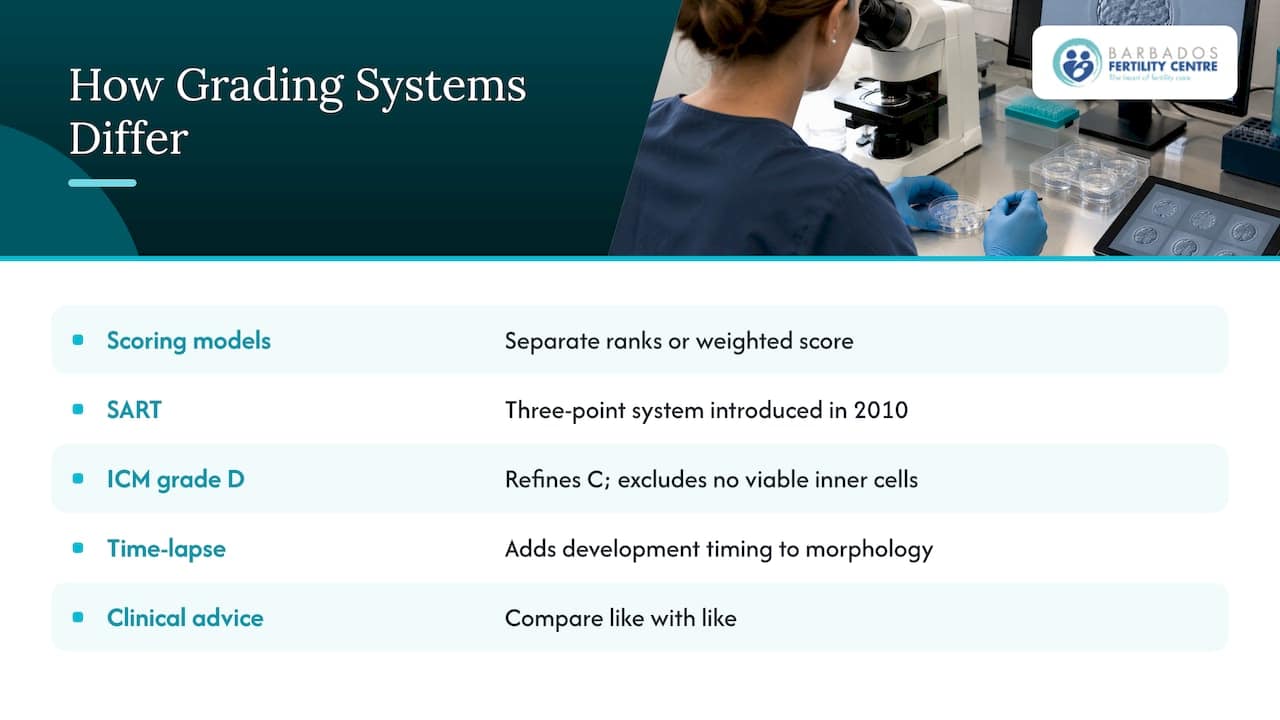
There is no single universal scale. The Reproductive BioMedicine Online review describes systems that rank features separately and others that combine them into a weighted score. SART’s three-point system was introduced in 2010 to add morphology to its national database.
The 2023 consensus explains one reason scales keep evolving: adding an ICM grade D refines the old grade C so that embryos with no viable inner cells are not carried forward, reducing the financial burden on patients and workload in the laboratory.
Time-lapse imaging, which films embryo development, is another area of study. A 2018 Japanese study notes that many studies report better IVF outcomes when timing of development is added to conventional morphology, while long-term outcomes still need study.
The practical lesson: a 4BB at one laboratory may not be described identically at another. Ask for the key your clinic uses and compare like with like.
Questions to ask your clinic about your embryo grades
Whether you are in treatment or planning it, these questions turn a grade into a decision:
- Which grading scale does the laboratory use, and can I have the key in writing?
- On which day are embryos graded, and how often is the grade updated?
- How many embryos reached blastocyst, and how many are suitable to freeze?
- Given my age and history, which embryo would you transfer first, and why?
- If no embryo is top grade, what are my options for the next cycle?
Our guide IVF: what you should be asking covers more questions for your first consultation, and what is IVF walks through each stage of a cycle. If a cycle did not work, why did my IVF fail explains the common reasons.
Grading and donor embryos
If you are considering donated embryos, grading is part of how they are described. Our page on donated embryo characteristics sets out what information is available about them.
Perspective
At Barbados Fertility Centre, we want every patient to understand their embryo report before they make a decision. A grade is a language, and it should be explained plainly, not handed over as a number.
We have treated patients since 2002, and we work in a JCI-accredited, private facility. Our approach is personalized: we look at your age, history and embryo development together, and we talk through what the grades mean for your plan. For international patients, we coordinate treatment remotely before you travel, so the questions about your embryos can be answered before you arrive.
We also believe cost should not stand between a patient and a full cycle. Our prices are published openly so you can plan your treatment with clarity.
Barbados
What treatment costs at Barbados Fertility Centre
Good embryo selection depends on having enough embryos to choose from, and that depends on being able to afford a complete cycle. Our published prices are in US dollars. IVF starts from $5,750 and IVF with ICSI from $6,750 on the CARICOM price list. On the international price list, ICSI is $7,650 and egg freezing is $4,950. Prices are per cycle and the lists show what each includes.
Our IVF treatment page explains how a cycle works, and the IVF cost calculator helps you estimate a plan. If you are coming from abroad, see IVF treatment abroad. To talk through your own embryo reports or begin planning, contact us through barbadosivf.com.

FAQ
Is a 4BB embryo good?
Yes. The ASRM chart defines 4BB as an expanded blastocyst with B-grade inner cell mass and trophectoderm. In a 2020 study, BB blastocysts had a 31.1% live birth rate and a 43.0% implantation rate. Your physician will consider it together with your age and your other embryos.
What does a 2AB embryo grade mean?
The ASRM chart gives letter grades only to blastocysts at stages 3 to 6, so a stage 2 embryo is usually described by its number first. It means the cavity is at least half the embryo’s volume. Embryologists often check again as it grows, so ask your clinic how it records early blastocysts.
Does the embryo grade determine the baby’s sex or health?
No. Grading describes appearance and development, not sex or a baby’s future health. Questions about genetic testing are best discussed with your physician.
Can a lower-grade embryo still lead to a pregnancy?
Yes. Studies report live births from lower-grade blastocysts, although the chance per transfer is lower than for top grades. In one Canadian study, 13.3% of CC blastocyst transfers resulted in a live birth. Your care team can advise which embryo to transfer first.
Sources
- Embryo Grading Guide, Stanford Children’s Health
- Expert consensus on the morphological evaluation of human embryos (2023)
- An Overview of the Available Methods for Morphological Scoring of Pre-Implantation Embryos (2015)
- The simplified SART embryo scoring system and live birth
- Blastocyst expansion score and trophectoderm morphology
- Transfers of lower quality embryos based on morphological criteria
- Quality control and standardization of embryo morphology scoring
- Using the SART CORS morphologic measures to predict live birth
- Comparative study of obstetric and neonatal outcomes of good and poor quality embryos