


Insulin resistance can make ovulation less regular and, in some women, lower the odds of conceiving without help. It is also manageable. With lifestyle changes, ovulation medication and, when needed, IVF, most women with insulin resistance and PCOS (polycystic ovary syndrome) have a realistic path to pregnancy. At Barbados Fertility Centre we offer IVF, ICSI, IUI and ovulation induction, with transparent published prices, for patients who want accredited care without US costs.
TL;DR
- Insulin resistance means your cells respond poorly to insulin, so your body makes more of it. High insulin can raise androgens (male-type hormones) and disrupt ovulation.
- It is especially common with PCOS, but a US study of national survey data also linked a higher insulin resistance score to female infertility.
- Routine fasting insulin tests are not recommended; a glucose tolerance test and your overall metabolic picture guide care.
- Weight loss of 5% to 10% (if you are overweight), letrozole or clomiphene, and sometimes metformin can restore ovulation. IUI or IVF follow when they do not.
Table of Contents
- What insulin resistance is and why it matters for fertility
- How insulin resistance affects ovulation
- Eggs, embryos and IVF outcomes
- Can you still get pregnant?
- How insulin resistance is assessed
- Lifestyle changes that support insulin sensitivity
- Medications that can restore ovulation
- When IUI or IVF becomes the next step
- Our perspective
- Treatment options and published prices
- FAQ
- Sources
What insulin resistance is and why it matters for fertility
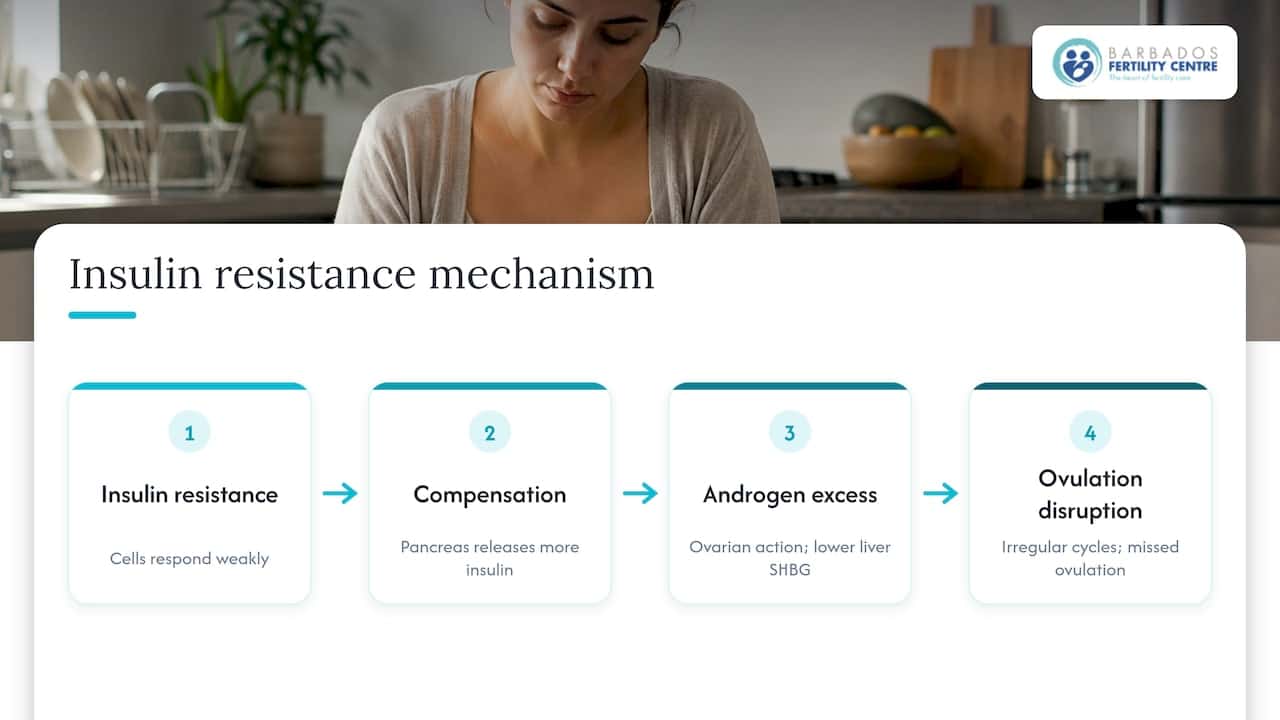
Insulin is the hormone that moves sugar from your blood into your cells. In insulin resistance, cells respond weakly, so the pancreas releases more insulin to compensate. High insulin levels are not harmless to the ovaries.
The American Society for Reproductive Medicine explains that insulin resistance and high insulin promote excess androgens, through direct action on the ovaries and by lowering the liver’s production of sex hormone-binding globulin (SHBG, a protein that keeps testosterone in check). The result can be irregular cycles and missed ovulation.
A 2025 review of metformin in PCOS describes PCOS as an insulin-resistant state in which this mechanism drives anovulatory infertility, meaning infertility from not releasing an egg.
How insulin resistance affects ovulation
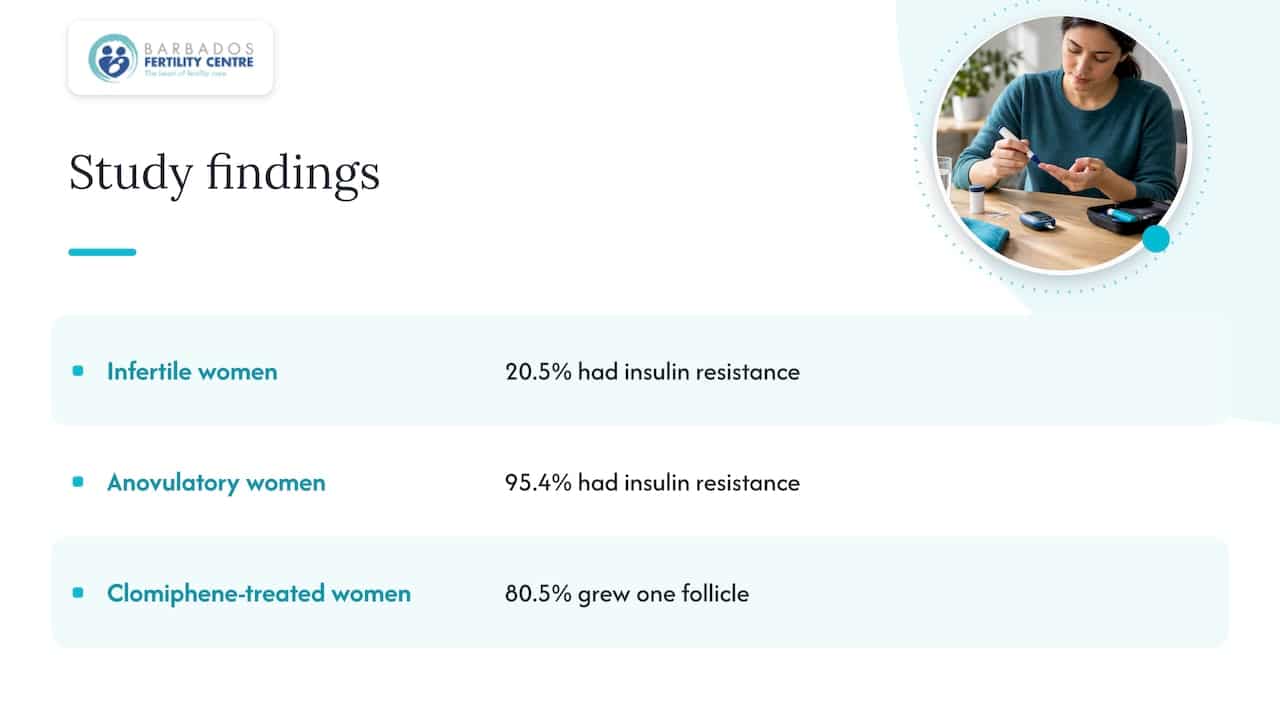
The link is clearest in women who rarely ovulate. In a 2022 study from India, insulin resistance was found in 20.5% of infertile women but 95.4% of those who were anovulatory. Among women with insulin resistance given clomiphene to induce ovulation, 80.5% grew only a single follicle, and they were less likely to conceive than women without it.
A 2024 review adds that women with long cycles of 36 to 45 days have a higher risk of anovulation and infertility. It also notes that higher free fatty acids in follicular fluid, the fluid around a developing egg, can impair egg maturation when insulin resistance is present.
If your cycles are longer than about 35 days or unpredictable, that is a signal worth investigating, with or without a PCOS diagnosis.
Eggs, embryos and IVF outcomes
Insulin resistance may also touch egg and embryo quality, though findings are mixed and depend on who is studied.
- In lean women without PCOS having IVF, insulin resistance was linked to a lower share of mature eggs (85.17% vs 90.53%), fewer blastocysts suitable for freezing (39.15% vs 46.46%) and longer stimulation (13.83 vs 12.70 days).
- A 2022 cohort of non-PCOS women found that insulin resistance went with longer stimulation, higher gonadotropin doses and lower peak estradiol, but not with different clinical pregnancy, live birth or miscarriage rates.
The practical message: insulin resistance can change how your ovaries respond to stimulation medication, so your protocol and monitoring should be individualized. A cycle built around your response, rather than a standard dose, is the point of personalized IVF care.
Can you still get pregnant?
Yes. A 2025 review on PCOS concludes that with early, effective treatment of excess weight and the use of assisted reproduction, a woman with PCOS has a chance of having at least one child similar to women without the syndrome. It recommends lifestyle change plus metformin as first-line treatment.
Pregnancy planning matters too. A 2022 expert opinion recommends assessing modifiable risks, such as blood sugar and weight, before conception.
How insulin resistance is assessed
Many women expect a simple fasting insulin test. Guidelines point elsewhere.
- Glucose tolerance test. The 2023 International PCOS Guideline recommends considering an oral glucose tolerance test (OGTT, where blood sugar is checked before and after a sugary drink) for women with PCOS who are planning pregnancy or starting fertility treatment. The same guideline says routine insulin assays are of limited use.
- Not routine insulin levels. A 2026 Cleveland Clinic Journal of Medicine update says fasting insulin and insulin-resistance indexes are not recommended because assays vary and are poorly standardized.
- PCOS evaluation. The same update notes that anti-müllerian hormone (AMH) can now substitute for ultrasound in diagnosing PCOS in adults.
- Pregnancy screening. The 2022 expert opinion suggests a 75-g OGTT before conception or within the first 20 weeks of pregnancy, repeated at 24 to 28 weeks. Pregnancy nutrition guidance on what to eat with blood sugar concerns can help you plan meals once you conceive.
A fertility workup that covers hormones, ovarian reserve, ultrasound and your partner’s semen analysis puts these results in context. Our fertility healthcheck is built for that purpose, and international patients can start with remote coordination before traveling.
Lifestyle changes that support insulin sensitivity
Weight
For women with PCOS who are overweight, the 2026 Cleveland Clinic update states that losing 5% to 10% of body weight can help regulate the menstrual cycle and increase fecundity, the chance of conceiving each cycle. Understanding how weight management affects cycles and ovulation helps you set steady, realistic goals. Note that many clinics set BMI limits for treatment; we explain them in our guide to BMI requirements for IVF.
Food
A 2025 systematic review identifies low-glycemic-index foods as helpful: oats, quinoa, barley, beans, lentils, berries, apples, pears, leafy greens, broccoli and cauliflower, plus high-fiber and lean-protein choices that slow glucose absorption. In a trial of 37 women with PCOS, a low-GI diet increased ovulatory cycles and lowered androgens.
What progress looks like
There is no single sign that insulin resistance is reversing. In one eight-week program of 24 women with PCOS and excess weight, average weight fell 8.6 kg, waist circumference dropped 8.4 cm and HOMA-IR, a blood-based insulin resistance index, fell by 1.9. Measurable markers such as waist size, cycle regularity and blood sugar results are more useful than any one number. Ask your doctor which to track.
Medications that can restore ovulation
Your doctor chooses medication based on your history. The main options:
- Letrozole. A trial of 750 women with anovulatory PCOS found 27.5% cumulative live birth with letrozole versus 19.1% with clomiphene, making it first-line therapy there.
- Clomiphene. The NICHD notes ACOG recommends it as the primary medication for PCOS-related infertility, and that it is FDA-approved for this use. It raises the chance of twins slightly.
- Metformin. A diabetes drug that improves insulin action. The NICHD says it may be used alone or with clomiphene, though it is not FDA-approved for this purpose. The 2025 metformin review found it improved ovulation rates, and that adding it to letrozole was not more effective than letrozole alone.
- GLP-1 medicines. The 2025 PCOS review reports they can improve insulin action and pregnancy rates in women with excess weight, but they are contraindicated in pregnancy, so timing must be planned with your physician.
Supplements such as myo-inositol have shown lower fasting insulin in PCOS in the 2024 review. Discuss any supplement with your doctor first.
When IUI or IVF becomes the next step
If ovulation returns but pregnancy does not follow, the next step depends on age, tubes, semen quality and how long you have been trying. IUI places prepared sperm in the uterus around ovulation, and it often pairs with ovulation induction. Our guide to PCOS and IUI explains when to move on to IVF. If you want to confirm your fallopian tubes are open before IUI, see SIS/HyCoSy.
IVF bypasses ovulation problems by stimulating several follicles at once and retrieving eggs directly. For insulin-resistant patients, close monitoring of stimulation is useful, given the longer stimulation and higher doses seen in studies.
If you are not ready to conceive, egg freezing can preserve eggs while you work on metabolic health.
Our perspective
Insulin resistance rarely closes the door on pregnancy. It changes the route. Many patients arrive after months of cycles that were hard to predict, and what they want first is a clear plan.
At Barbados Fertility Centre, we assess your hormones, ovarian reserve and history, then recommend the least complicated treatment that fits: ovulation induction, IUI, or IVF with or without ICSI. Our clinic has operated since 2002 under JCI accreditation, and we publish our prices so you can compare the cost of a cycle with US clinics before you commit.
We also coordinate treatment remotely for international patients, so much of the planning can happen from home. Our aim is a calmer experience, where care is personal and the setting helps you stay steady through treatment.
Barbados
Treatment options and published prices
Published prices include the following; the full lists are on our CARICOM price list and international price list.
| Treatment | Published price |
|---|---|
| IUI (partner or donor sperm, per cycle, including scans) | from 500 USD |
| IVF | from 5,750 USD |
| IVF with ICSI | from 6,750 USD |
| ICSI | 7,650 USD |
| Egg freezing | 4,950 USD |
To estimate your own total, use our IVF cost calculator, or read about IVF treatment abroad.
If you have PCOS, irregular cycles or a blood sugar concern and want a plan, we can review your history and recommend a first step. Learn more about IVF at Barbados Fertility Centre or contact us through our website.
FAQ
Can I get pregnant with insulin resistance?
Yes. Many women do, often after improving weight and metabolic health, restoring ovulation with medication, or using IUI or IVF. Research on PCOS shows that, with effective treatment, the chance of having a child is similar to that of women without it.
Does insulin resistance cause miscarriage?
The evidence is mixed. One 2022 cohort in non-PCOS women found no difference in miscarriage rates, while the 2025 metformin review suggests continuing metformin through the first trimester may help reduce miscarriage in PCOS. Your physician should guide whether that applies to you.
Do I need an insulin test before fertility treatment?
Not necessarily. Guidelines advise against routine fasting insulin testing because results are unreliable. A glucose tolerance test is more commonly recommended for women with PCOS planning pregnancy.
Does insulin resistance affect men?
Men are outside the studies cited here, so we do not draw conclusions. A semen analysis is part of any complete fertility assessment for couples.
Sources
- Association between METS-IR and female infertility, Frontiers in Nutrition (2025)
- Obesity and reproduction: a committee opinion, ASRM (2021)
- Update on the therapeutic role of metformin in PCOS (2025)
- The Effect of Insulin Resistance on Ovulation Induction (2022)
- Advances in the study of the correlation between insulin resistance and infertility (2024)
- Insulin Resistance Adversely Affect IVF Outcomes in Lean Women Without PCOS (2021)
- Effect of Hyperinsulinemia and Insulin Resistance on Assisted Reproduction (2022)
- Polycystic ovary syndrome: What to say when asked about the future (2025)
- Clinical management of pregnancy in women with PCOS (2022)
- 2023 International Evidence-based PCOS Guideline
- Polycystic ovary syndrome: An update on diagnosis and treatment, Cleveland Clinic Journal of Medicine (2026)
- The Role of Lifestyle Interventions in PCOS Management (2025)
- Dairy Consumption and Its Impact on PCOS (2025)
- Treatments for Infertility Resulting from PCOS, NICHD