


A uterine septum is a band of tissue that divides part or all of the uterine cavity. The short answer for anyone trying to conceive: it is more clearly linked to miscarriage and pregnancy complications than to an inability to get pregnant. Many people with a septum conceive, and an accurate diagnosis tells you whether you need surgery, a treatment cycle or simply a plan. At Barbados Fertility Centre, IVF starts from $5,750, so a septum finding does not have to turn into an overwhelming cost question.
TL;DR
- Current ASRM guidance makes no recommendation on whether a septum causes infertility, because the evidence is insufficient.
- A septum is more clearly associated with first- and second-trimester miscarriage, preterm birth and other pregnancy complications.
- Surgery (hysteroscopic septum incision) is recommended to be offered after recurrent miscarriage. For infertility or IVF, it may be offered, but it may or may not raise live birth rates.
- Diagnosis usually starts with a 3D transvaginal ultrasound, with or without saline infusion.
- A septum is not a reason to give up on IVF. It is a finding to understand before you plan your cycle.
Table of Contents
- What a uterine septum is
- Can a septate uterus cause infertility?
- What a septum can do to a pregnancy
- How a septum is found
- Should the septum be removed?
- Septum and IVF: planning your cycle
- What treatment costs when a septum is part of the picture
- Our perspective
- Plan your treatment with us
- FAQ
- Sources
What a uterine septum is
The uterus forms before birth from two tubes that fuse and then open into one cavity. If the wall between them does not fully dissolve, a septum remains. It is a congenital difference, meaning you were born with it, and it is not caused by anything you did.
Two terms come up in reports:
- Septate uterus: the septum divides the cavity from the top (the fundus) down toward the cervix.
- Subseptate uterus: the septum is incomplete. It projects into the cavity but does not reach the cervix, unlike a complete septate uterus, where the division runs from fundus to cervix.
If your report says “subseptate,” you have the partial form. The same words matter for treatment planning, because the length and thickness of the septum shape what, if anything, is recommended.
Septum or heart-shaped uterus?
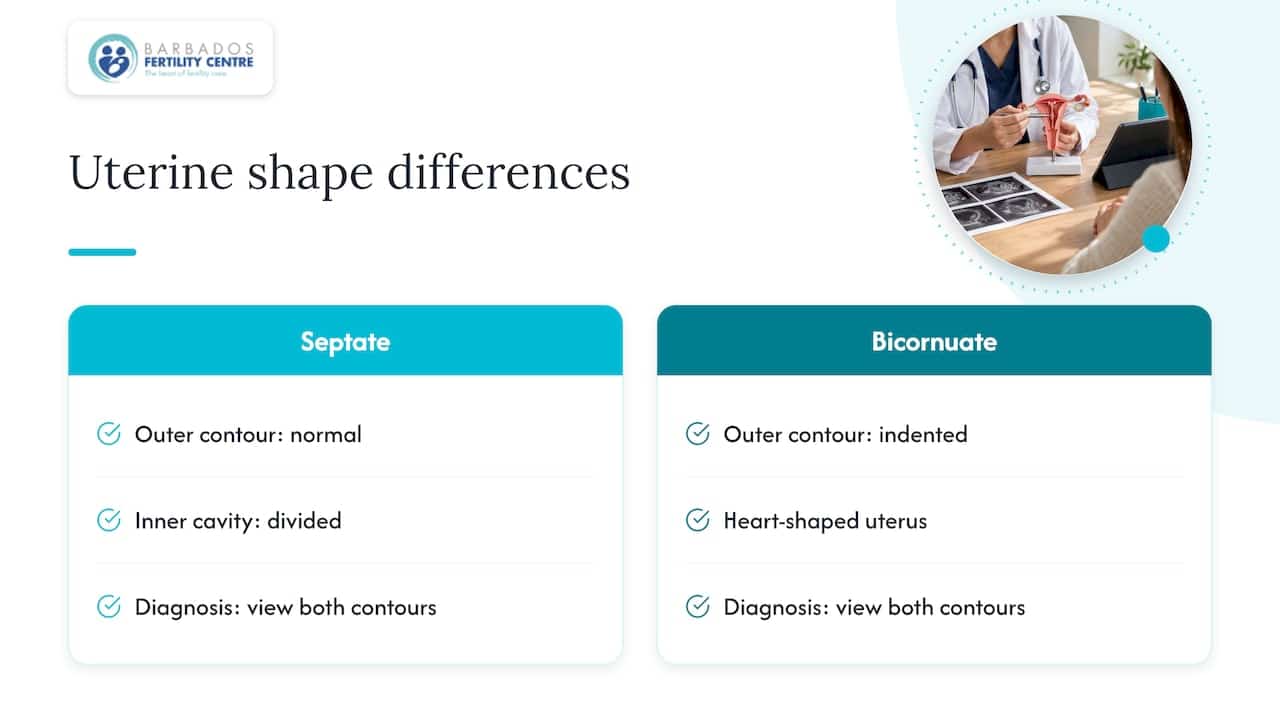
They are not the same, though they can look alike on a flat scan. A septate uterus has a normal outer contour with a divided inside. A heart-shaped (bicornuate) uterus has an indented outer contour. ASRM says telling anomalies apart accurately requires viewing both the internal and external contours of the uterus. This is why a good diagnosis matters: the two conditions are managed differently.
Can a septate uterus cause infertility?
The honest answer is that nobody can say for certain. ASRM’s 2024 guideline does not conclude that a septum causes infertility, and it makes no recommendation on the association because the evidence is insufficient. The same guideline describes the stronger link: a septum is more clearly associated with miscarriage and adverse obstetric outcomes than with failing to conceive.
Some clinic websites explain that a large septum may act like an intrauterine device, blocking implantation. That is a reasonable theory, but it is a theory. In practice, this means:
- You can conceive naturally with a septum, and many people do.
- If you have been trying for a long time, the septum may be one factor among several, such as ovulation, sperm quality, tubal health or age.
- Finding a septum does not by itself explain why you have not conceived, so the rest of your fertility picture still needs checking.
If you are working out where you stand, our Fertility Healthcheck is a practical starting point, and our page on unexplained infertility explains how causes are sorted when a single answer is not obvious.
What a septum can do to a pregnancy
The stronger evidence concerns what happens after you conceive. ASRM reports an increased risk of first- and second-trimester spontaneous abortion (the medical term for miscarriage), along with higher risks of:
- preterm birth
- the baby lying in an abnormal position (malpresentation)
- cesarean delivery
- fetal growth restriction
- placental abruption, where the placenta separates early from the uterine wall
The same guideline cites one study in which first-trimester loss occurred in 42% of pregnancies among 29 patients with a septate uterus, versus 12% in patients without a uterine anomaly. That is a small study, so treat it as an illustration of direction, not a personal forecast. Your own risk depends on the size and type of the septum and your history.
Two practical points follow. First, a septum is a reason for closer monitoring in pregnancy, not a reason to expect a bad outcome. Second, if you have had one or more losses, tell your care team, because that history changes what is recommended.
How a septum is found
Most people have no symptoms. A septum is usually discovered during a fertility evaluation or after recurrent miscarriage. The tests, in the order they are typically used:
- 3D transvaginal ultrasound, with or without saline infusion. ASRM recommends this as the first-line noninvasive test. It shows both the inside and the outside shape of the uterus.
- Hysterosalpingogram (HSG), an X-ray with dye. It often provides the first hint of an anomaly during an infertility or pregnancy-loss workup, but it cannot reliably separate a septate uterus from a bicornuate one.
- MRI or hysteroscopy, a camera inspection of the cavity, when the picture is still unclear or a procedure is being planned.
We offer SIS/HyCoSy at Barbados Fertility Centre, one of the ultrasound-based ways of looking at the uterine cavity and tubes. If you have an earlier HSG that mentioned an “arcuate,” “subseptate” or “possible septate” uterus, ask for a scan that shows the outer contour before you decide anything. Uncertain labels are common, and the label drives the treatment choice.
Should the septum be removed?
This is the question that matters most, and the answer depends on your history.
The procedure is hysteroscopic septum incision (also called resection): a surgeon passes a thin camera through the cervix and divides the septum, with no cut to the abdomen. It is a decision for a gynecologic surgeon experienced in hysteroscopy, made together with you.
If you have had recurrent miscarriage
ASRM recommends that incision be offered through shared decision-making for patients with recurrent miscarriage. This is the group where the case for surgery is strongest.
If the issue is infertility or IVF
Here the guidance is softer. ASRM says incision may be offered for infertility or before fertility treatment, but it may or may not increase live births. The more recent research explains the caution:
- A Cochrane review current to September 2025 included one randomized trial of 79 women (39 resection, 40 expectant management) and found little or no difference in live birth, ongoing pregnancy or clinical pregnancy.
- A 2024 meta-analysis of 468 patients from two randomized trials and one cohort study found no significant improvement in live birth after resection (RR 0.84, 95% CI 0.56 to 1.25), and no significant differences in clinical pregnancy, miscarriage or preterm delivery.
These are small bodies of evidence, which is exactly why ASRM frames the choice as shared. Older reports that looked more favorable were observational, which means they compared groups that were not randomly assigned.
Risks of the procedure
Surgery carries its own risks. The Cochrane review reported one uterine perforation and one residual septum in its randomized trial. Observational studies mainly reported perforation, bleeding or a residual septum needing repeat surgery, although several reported no complications. Ask your surgeon how often they perform the procedure and what follow-up imaging they use.
A useful way to frame your decision:
| Your situation | What guidance suggests |
|---|---|
| Two or more miscarriages and a confirmed septum | Surgery should be offered and discussed |
| Trying to conceive, no losses, septum found incidentally | A shared decision; benefit for live birth is uncertain |
| Preparing for IVF with a septum on imaging | A shared decision; may be offered, may or may not raise live births |
| Unclear label (arcuate, subseptate, possible bicornuate) | Get a 3D ultrasound first, then decide |
Septum and IVF: planning your cycle
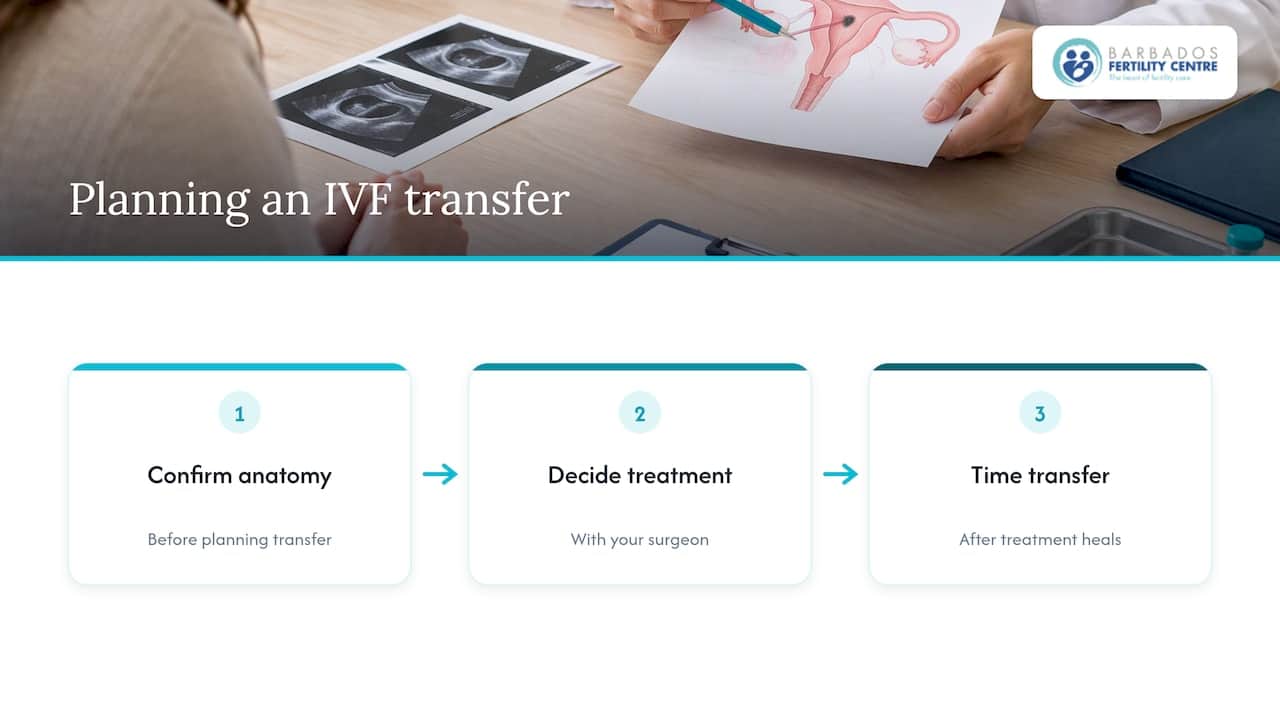
IVF bypasses some of the steps a natural conception needs, but the embryo still has to implant in the uterus. So the cavity matters. Your fertility team can plan around a septum in a few ways: confirming the anatomy first, agreeing with you and your surgeon whether to treat the septum before transfer, and timing the transfer once any treatment has healed.
If you have a freeze-all or frozen transfer plan, the embryos can wait while the uterus is assessed or treated. Our guide to the frozen embryo transfer timeline walks through that process. Related uterine factors are covered in our pages on thin uterine lining and uterine niche after cesarean, which can look similar on a scan but are separate issues.
If you are also egg freezing for the future, a septum does not affect the eggs themselves. Egg retrieval does not depend on the uterine cavity, so the uterus can be dealt with when you are ready to use the eggs.
What treatment costs when a septum is part of the picture
Cost is often the first worry. Our published prices, read from our site in 2026, are:
| Treatment | Price |
|---|---|
| IVF | from $5,750 |
| IVF with ICSI | from $6,750 |
| ICSI | $7,650 |
| Egg freezing | $4,950 |
| IUI (per cycle, including scans) | from $500 |
The full lists are on our CARICOM price list and international price list, and the IVF cost calculator lets you build an estimate for your own plan. Any surgery to treat a septum is a separate procedure and is not part of these prices.
If you live abroad and are comparing how private cover treats this care, this overview of fertility treatment and private insurance shows how one country handles it. Rules differ by country and by plan, so check your own policy.
Our perspective
When someone arrives with the word “septum” on a report, the first thing we see is worry, often because an internet search has linked it to infertility and loss in one breath. The evidence is more measured than that. A septum is a structural finding with a clear link to pregnancy complications, a less certain link to difficulty conceiving, and a treatment question that the best current research has not settled.
That is why we think the right order is understanding first, then planning. Get the anatomy defined properly. Decide on any surgery with a hysteroscopic surgeon, using the guidance for your situation. Then build the treatment cycle around that decision.
We built our approach around personalized care in a calm setting, with transparent pricing and an accredited facility (we operate under JCI accreditation). For patients travelling from the United States, our team coordinates treatment remotely, so the planning, scans and decisions can be settled before you travel. A septum is one more thing to plan for, not a reason to stop.
Barbados
Plan your treatment with us
If a septum has been found and you are ready to plan IVF, ICSI or an IUI cycle, we can review your reports and talk you through the options and costs. Our international patients can start with our IVF treatment abroad page, which explains how care is coordinated from a distance, and see how our IVF treatment works.

If you are not sure which treatment fits, our guide to what to ask about IVF is a good list to bring to your first conversation.
FAQ
Can a septate uterus cause infertility?
ASRM’s 2024 guideline makes no recommendation on this, because the evidence is insufficient. A septum is more clearly linked to miscarriage and pregnancy complications. Many people with a septum conceive without help.
When do most miscarriages occur with a septate uterus?
ASRM reports increased risk in both the first and second trimesters. In one study cited in the guideline, first-trimester loss occurred in 42% of 29 patients with a septate uterus, compared with 12% in those without an anomaly. Your own risk depends on the type of septum and your history.
What does it mean if my uterus is subseptate?
It means the septum is partial: it projects into the cavity but does not reach the cervix. A septate uterus is divided all the way down. Ask for a 3D ultrasound if your report is unclear, since the exact shape guides any treatment decision.
Is a uterine septum the same as a heart-shaped uterus?
No. A septum divides the inside of the uterus while the outer shape stays normal. A heart-shaped uterus has an indented outer contour. Telling them apart requires imaging that shows both the inside and the outside of the uterus.
Do I need surgery before IVF?
Not automatically. ASRM says incision may be offered before fertility treatment but may or may not increase live births, so it is a shared decision with a hysteroscopic surgeon. After recurrent miscarriage, the guidance is stronger and surgery should be offered.
Sources
- Cochrane: Does septum resection improve the chance of live birth in women with a septate uterus? (September 2025)
- Frontiers in Endocrinology: Does septum resection improve reproductive outcomes? (2024)
- Diagnosis of Congenital Uterine Abnormalities: Practical Considerations (2022)