

DuoStim is an IVF protocol that stimulates the ovaries twice within a single menstrual cycle, once in the follicular phase and again in the luteal phase, so two egg retrievals happen about two weeks apart instead of two or three months apart. It is designed for people for whom time matters most: lower ovarian reserve, older age, or a deadline such as cancer treatment. If you are weighing it against simply repeating IVF cycles back to back, the main thing to know is that the time saved is real, while the evidence for more oocytes or more babies per patient is less settled. At Barbados Fertility Centre, we help patients compare these routes on timeline and total cost before they commit to a plan.
TL;DR
- DuoStim means two stimulations and two egg retrievals in one menstrual cycle, with every embryo frozen and transferred later.
- In the first randomized trial against two consecutive conventional cycles, the second retrieval came about 0.3 months after the first instead of 2.8 months, with no significant difference in cumulative oocytes.
- It is mainly considered for poor responders, women of advanced maternal age and patients who need urgent fertility preservation.
- Because embryos are frozen, the protocol adds freeze and thaw steps, and a full conventional cycle at our clinic starts from $5,750.
- Back-to-back retrievals in consecutive cycles are the simpler alternative when you are not racing the calendar.
Table of Contents
- What DuoStim IVF is
- How the protocol works step by step
- Who DuoStim is considered for
- What the research shows
- DuoStim versus back-to-back egg retrievals
- Risks, side effects and practical demands
- What DuoStim costs in the United States
- Our perspective
- Planning your next step
- FAQ
- Sources
What DuoStim IVF is
In a conventional IVF cycle you take injectable hormones (gonadotropins) for around ten to twelve days, collect the mature eggs, and then wait for the next cycle to start again. Ovarian follicles, the small fluid-filled sacs that hold eggs, were long thought to be recruited only once per cycle. DuoStim builds on the observation that follicles also grow in the second half of the cycle, after ovulation would normally have happened.
A systematic review of DuoStim describes it as two consecutive stimulations in the follicular and luteal phases of the same ovarian cycle, aimed at increasing the oocytes retrieved and blastocysts produced in a short time frame. It is also called double stimulation, dual stim or the Shanghai protocol.
The first stimulation looks like ordinary IVF. The second begins soon after the first retrieval, often within a few days, without waiting for a period. Both retrievals use the same ultrasound-guided needle procedure, and both are done under sedation.
How the protocol works step by step
Exact doses and drugs vary by doctor and patient, but the published protocols follow a common pattern. A 2026 ten-year study from Italy describes it like this:
- Baseline scan on day 2 or 3 of the cycle, a transvaginal ultrasound to count resting follicles.
- First stimulation with gonadotropins at 225 to 300 IU per day.
- Preventing early ovulation: a GnRH antagonist is added once a leading follicle reaches 13 to 14 mm. More recently, some clinics have used oral progesterone (progestin-primed stimulation) instead of daily antagonist injections, with comparable outcomes.
- Trigger with a GnRH agonist when at least three follicles have reached 16 mm or more.
- First retrieval 35 to 36 hours after the trigger.
- Second stimulation starts soon after, then a second trigger and a second retrieval.
- Fertilization with ICSI, in which one sperm is injected into each mature egg, followed by culture to the blastocyst stage on day 5 to 7.
- Genetic testing and freezing: in that study, embryos were biopsied for PGT-A, which screens for chromosome numbers, and a single euploid (chromosomally normal) blastocyst was transferred in a later cycle.
The older 2020 review describes a version that began with luteal estradiol priming, 4 mg per day of estradiol valerate from day 21 of the previous cycle. It used 300 IU of recombinant FSH plus 150 IU of recombinant LH daily, and started the luteal stimulation five days after the first retrieval. The 2025 oncology study started the second stimulation on day 3 or 4 after the first retrieval.
Two features matter to you as a patient. Eggs and embryos from both stimulations are vitrified (flash-frozen), and there is no fresh transfer after a luteal-phase retrieval. If you want to understand why clinics freeze everything in some protocols, our page on freeze-all IVF walks through when it helps and what it costs.
Who DuoStim is considered for
DuoStim is not a first-line protocol for most people starting IVF. The 2026 Italian study states that its indications have expanded to time-sensitive patients: women who urgently need fertility preservation, women of very advanced maternal age, and patients with reduced ovarian reserve. The 2020 review likewise suggests it for situations that need maximal and urgent use of the ovarian reserve, such as oncology patients and poor responders of advanced maternal age.
In practice, doctors look at:
- Age and ovarian reserve tests. Anti-Müllerian hormone (AMH) and the antral follicle count on ultrasound estimate how many eggs a stimulation may produce.
- Past response. If a previous cycle gave very few eggs, or follicles grew unevenly, a second stimulation may add to the total.
- The calendar. Cancer treatment, a planned surgery, or a personal timeline can make a difference of two months meaningful.
In the oncology study, DuoStim was offered to women who could do a second cycle without delaying chemotherapy and who had retrieved fewer than five mature oocytes at the first stimulation. Not everyone benefits: 6 of the 28 patients had no oocytes after the second stimulation.
If you are young with a good reserve, you will rarely need it. A standard cycle, or a plan that repeats retrieval later, usually fits better. Your own numbers decide this, and a fertility specialist should review them with you.
What the research shows
Studies of DuoStim point in a consistent direction on yield, and a more cautious direction on live births.
More embryos from the second stimulation. A multicenter study of 310 poor-prognosis patients (mean age 40, mean AMH 1.0) found the luteal-phase stimulation gave more eggs on average than the follicular one, with comparable competence. The share of patients with at least one euploid blastocyst rose from 42.3% after the first stimulation to 65.5% after the second, and 90.3% obtained at least one blastocyst in the single cycle. No increase in post-retrieval complications was reported.
Real-world use over a decade. The 2026 Italian study reports that in time-sensitive, poor-prognosis patients the second stimulation yielded more oocytes and embryos than the first, with comparable competence. Among patients who completed a first DuoStim without a live birth, those who discontinued treatment fell from 61% in 2015 to 44% in 2021. Repeat DuoStim attempts rose from 16% to 21%, and moves to egg donation rose from 9% to 21%.
The authors also stress that success in assisted reproduction is now judged cumulatively across attempts, not per cycle. DuoStim’s value is cumulative eggs and embryos in a compressed timeframe, so comparing it with a single conventional stimulation is not like for like.
Randomized evidence. The BISTIM trial was the first randomized comparison of two stimulations in one cycle versus two consecutive conventional cycles in poor responders. Cumulative oocytes were 4.6 versus 5.0, and cumulative live birth rates were 34.1% versus 17.9%, with neither difference statistically significant. The clear difference was time: 0.3 months to the second retrieval with DuoStim versus 2.8 months with consecutive cycles. No serious adverse events were reported.
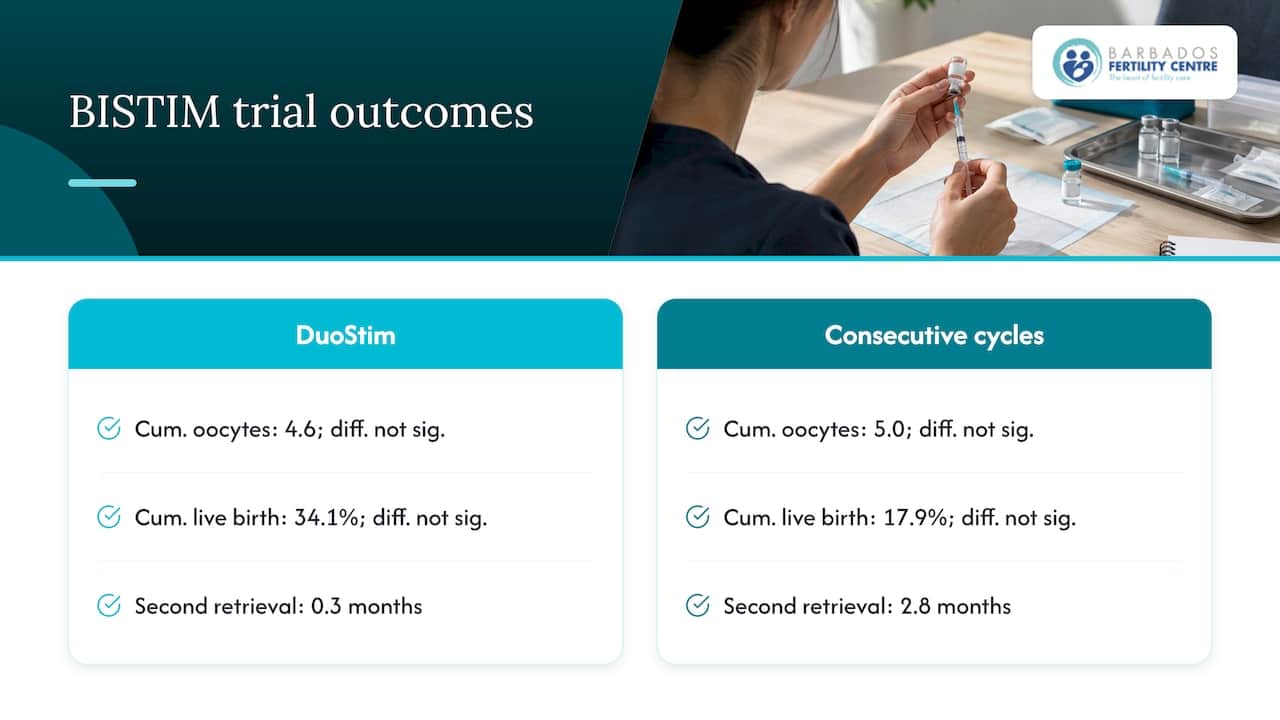
The trial’s authors concluded that the only confirmed benefit in routine practice is shortening the wait for a second retrieval by about two weeks when you need to accumulate eggs or embryos.
DuoStim versus back-to-back egg retrievals
Many people search for “back to back egg retrievals” because they want to know whether doing two retrievals close together is better than spacing them. There are two ways to do it:
| DuoStim | Back-to-back conventional cycles | |
|---|---|---|
| Stimulations | Two in one menstrual cycle | One per cycle, in consecutive cycles |
| Time to second retrieval | About 0.3 months in BISTIM | About 2.8 months in BISTIM |
| Cumulative oocytes | 4.6 in BISTIM | 5.0 in BISTIM |
| Cumulative live birth rate | 34.1% in BISTIM (not significantly different) | 17.9% in BISTIM (not significantly different) |
| Fresh transfer | Not possible after luteal retrieval | Possible after the first cycle, depending on the plan |
| Best fit | Urgent timelines, advanced age, low reserve | Patients who can wait one to two months |
The practical message: if your timeline is flexible, repeating a standard cycle is the simpler route, with a rest between retrievals and a normal medication pattern. If your timeline is not flexible, DuoStim can compress the same work into about two weeks. Whichever you choose, the goal is the same: a bank of eggs or embryos large enough to give you a reasonable chance of at least one chromosomally normal embryo.
Risks, side effects and practical demands
DuoStim uses the same medication families as standard IVF, just in two waves. That means more injections over a short window, extra ultrasound visits, and two sedated retrievals. A few specifics are worth knowing:
- Ovarian hyperstimulation syndrome (OHSS). A review in the Journal of IVF-Worldwide reports OHSS is uncommon, under 1% in poor responders, especially with GnRH-agonist triggers. It notes the risk becomes more relevant in young oncology patients with good reserve. Our page on OHSS prevention covers how clinics lower it.
- Freeze-all. Because luteal-phase stimulation requires embryo cryopreservation, fresh transfers are deferred. Two consecutive freeze-thaw processes mean embryos and eggs need careful handling in the lab.
- Cancellation. The 2018 Frontiers analysis lists higher cancellation rates in the luteal phase and substantial total gonadotropin doses among the protocol’s practical limits.
- Long-term data. The same analysis notes that gynecological, obstetrical and neonatal safety data are still limited, and that cost-effectiveness has not been fully studied.
If you are on hormonal medications with a medical condition such as a history of cancer, clotting problems, or PCOS, your reproductive endocrinologist should tailor the plan. Our IVF medications list explains what each drug does so the schedule feels less overwhelming.
If a DuoStim or standard cycle ends in pregnancy, early planning for the months ahead helps. A second trimester checklist is a helpful way to prepare for the anatomy scan and the weeks after it.
What DuoStim costs in the United States
There is no standard price list for DuoStim in the US. It is billed as two stimulations and two retrievals, so you can expect it to cost more than one conventional cycle, and often more than two spaced cycles once freezing and testing are included. Your total depends on your clinic, your medication doses, and whether you add genetic testing.
For context, a July 2026 Milliman report puts the comprehensive self-pay cost of a single US IVF cycle at $15,000 to $30,000. On top of that, it gives these ranges:
- Fertility medications: $3,000 to $7,000 per cycle
- ICSI: $1,500 to $3,000
- PGT-A: $3,000 to $6,000
- Storage: $600 to over $1,000 per year
If you need two stimulations, medication and monitoring costs multiply, and freezing and storage add up. Our guide to cutting US IVF medication costs explains where the savings are.
Insurance. Coverage depends on your state and plan. As one example, the District of Columbia’s 2026 fertility guide requires covered plans to include at least three complete oocyte retrievals with unlimited embryo transfers, plus standard fertility preservation, though self-insured and short-term plans are exempt. Check your plan documents for your state’s rules.
Federal changes. ReproductiveFacts.org reports that a drug-pricing agreement discounts Gonal-f, Ovidrel and Cetrotide through the TrumpRx.gov portal, with estimated savings of up to $2,200 per cycle on medications. It also notes that employer fertility reimbursement accounts were capped at $2,150 annually for 2025, well below the full cost of a cycle.
Our perspective
At Barbados Fertility Centre, we see the DuoStim question as a question about time and total cost, and we think both deserve a straight conversation.
Compressing two retrievals into one cycle can be valuable when a deadline is real. When it is not, we believe a well-planned course of standard cycles gives you the same goal, a bank of eggs or embryos, with a calmer rhythm. Our approach is to design the plan around you: your ovarian reserve, your age, your history and your schedule.
We have been treating patients since 2002 in a JCI-accredited facility, and we publish our prices so that you can compare options before you travel. A full IVF cycle at our clinic starts from $5,750, which for many US patients changes what is possible, including a second attempt. Taking the stress out of the process matters to us as much as the numbers.
Barbados
Planning your next step
If you are in the position where you are deciding between more eggs fast and a gentler pace, the questions to settle first are these:
- What are your AMH and antral follicle count, and how did you respond to any past stimulation?
- Is there a medical or personal deadline that makes two months matter?
- Do you plan to test embryos genetically, and how many euploid embryos would you like to bank?
- What is your total budget for retrievals, medication, freezing and storage?
At Barbados Fertility Centre, our published prices let you build an answer to the fourth question quickly. IVF starts from $5,750, IVF with ICSI from $6,750, and egg freezing is $4,950. You can see every line on our price list and international price list, and our cost calculator helps you estimate your own plan. We coordinate treatment remotely for international patients, so much of the preparation happens before you travel.
If you are considering egg freezing because of age or a medical timeline, our egg freezing page sets out the process. For an overview of how we work with patients from abroad, see IVF treatment abroad.
FAQ
Is DuoStim better than a standard IVF cycle?
Not for everyone. DuoStim is designed to give two retrievals quickly, and studies in poor responders show a good yield of embryos from the second stimulation. The first randomized trial found no significant difference in cumulative oocytes or live births compared with two consecutive cycles. Its main advantage is timing.
Can I do back-to-back egg retrievals without DuoStim?
Yes. You can do consecutive conventional cycles, with one retrieval each, and bank the eggs or embryos. In the BISTIM trial the second retrieval came about 2.8 months after the first, compared with 0.3 months for DuoStim. Your doctor can advise on the right spacing for you.
Is DuoStim safe?
Published studies report low rates of serious complications. OHSS is uncommon in poor responders, under 1% in one review, and no serious adverse events were reported in the BISTIM trial. Long-term safety data are still limited, so discuss your history with your reproductive endocrinologist before starting.
Does insurance cover DuoStim?
It depends on your state and plan. Some states require coverage of a number of oocyte retrievals, and the District of Columbia requires at least three for covered plans. Self-insured plans are often exempt, so read your plan documents and ask the insurer how two stimulations in one cycle would be counted.
Sources
- Ten years of DuoStim in time-sensitive poor-prognosis IVF (PMC, 2026)
- The BISTIM study: a randomized controlled trial (PMC, 2023)
- DuoStim, a reproducible strategy to obtain more oocytes (PMC, 2020)
- Effectiveness of Controlled Ovarian Stimulation for Oocyte Cryopreservation in oncologic patients (MDPI, 2025)
- Double Stimulation in the Same Ovarian Cycle (Frontiers in Endocrinology, 2018)
- The Shanghai Protocol at Ten (Journal of IVF-Worldwide)
- Fertility benefits: Market landscape and employer considerations (Milliman, July 2026)
- 2026 RX Guide Fertility Treatment (DC Department of Insurance, Banking and Securities)