


Egg retrieval is done under sedation, so you are not meant to feel the procedure itself. The discomfort most people talk about comes afterward: cramping, bloating and soreness that rest, acetaminophen and a heating pad usually manage. This guide covers what happens during the procedure, how sedation works, what recovery feels like, and the symptoms that mean you should call your clinic. If you are weighing treatment abroad, it also explains how we handle the retrieval step at Barbados Fertility Centre.
TL;DR
- Egg retrieval is a short procedure, about 30 to 60 minutes, performed with sedation, so pain during the procedure is not the main concern.
- Afterward, expect cramping, a bloated or full feeling and light spotting. Rest for at least 24 hours, use acetaminophen as directed and apply a heating pad.
- Pain that acetaminophen does not relieve, a fever over 100°F, heavy bleeding or nausea lasting more than 24 hours needs a call to your clinic.
- Sedation plans differ by clinic and by patient. Ask which medicines will be used and who monitors you.
- Plan one quiet day after retrieval with a companion, and do not schedule heavy work or workouts.
Table of Contents
- Is egg retrieval painful?
- How anesthesia and sedation work during egg retrieval
- What pain to expect after egg retrieval
- How to manage pain and recover well
- Warning signs: when to call your clinic
- What affects how painful retrieval feels for you
- Preparing mentally and practically
- We believe comfort and clarity go together
- Egg retrieval at Barbados Fertility Centre
- Frequently asked questions
- Sources
Is egg retrieval painful?
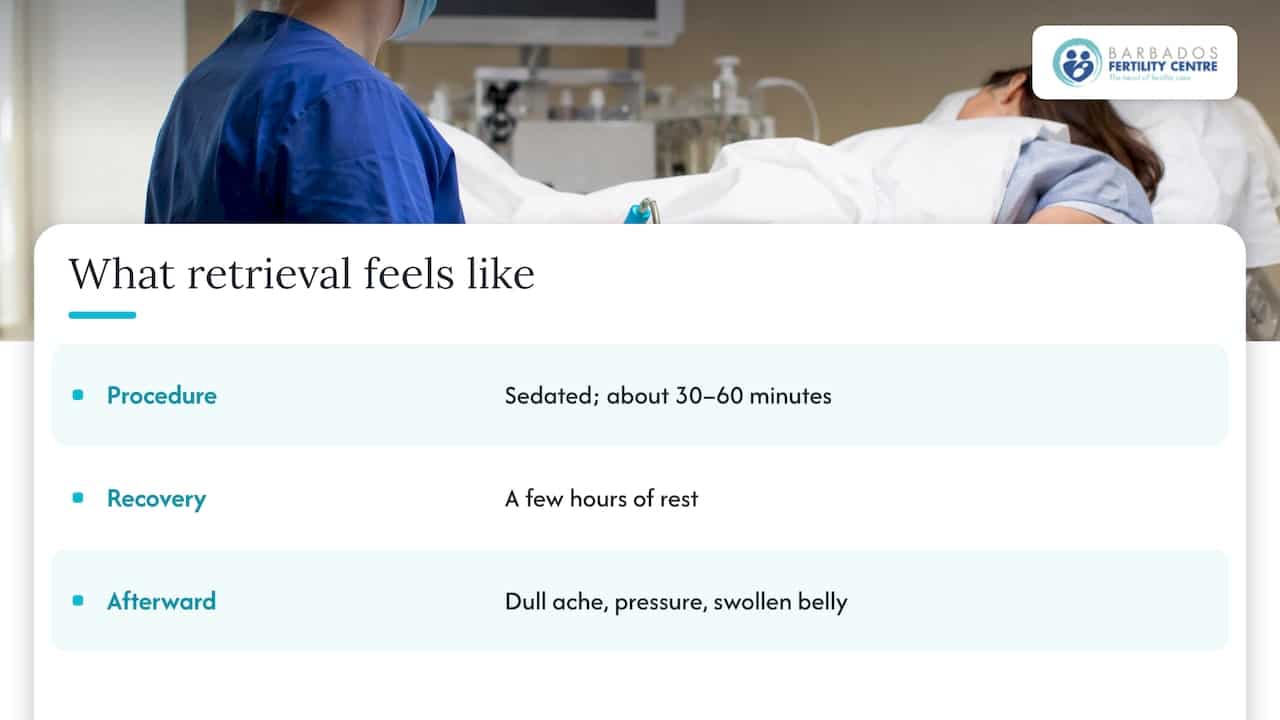
The procedure is designed so that you are comfortable. A doctor guides a thin needle through the vaginal wall, using ultrasound, into each ovarian follicle and collects the fluid containing the eggs. Because that needle passes through sensitive tissue, you are given medication first. At academic centers such as Emory School of Medicine, the retrieval takes about 30 to 60 minutes while the patient is sedated, followed by a few hours of rest in a recovery room.
Most patients describe the experience as drowsy and uneventful. You go to sleep or into a deep, relaxed state, and you wake up in recovery. What you notice later is usually a dull, period-like ache low in the abdomen, pressure from enlarged ovaries and a swollen belly.
Pain is personal. Your number of follicles, your response to stimulation medication, your pain sensitivity and your anxiety about the procedure all shape how it feels. That is why a good clinic plans your comfort in advance rather than treating every retrieval the same.
How anesthesia and sedation work during egg retrieval
There is no single universal protocol. Clinics choose from a small set of approaches, and the choice should fit you.
Conscious sedation is the most common approach
A 2024 review of anesthesia in assisted reproduction reports that conscious sedation is used in 84% of IVF cycles for oocyte retrieval. The same review notes that there is no robust evidence that anesthesia affects fertility outcomes, and that the technique should be tailored to the individual and the procedure.
Conscious sedation usually means an intravenous sedative combined with a pain medicine. You may be very drowsy, may drift in and out, and typically will not remember the procedure well. Other clinics use deeper anesthesia managed by an anesthesia professional. Either way, you are monitored throughout.
Which medicines work best?
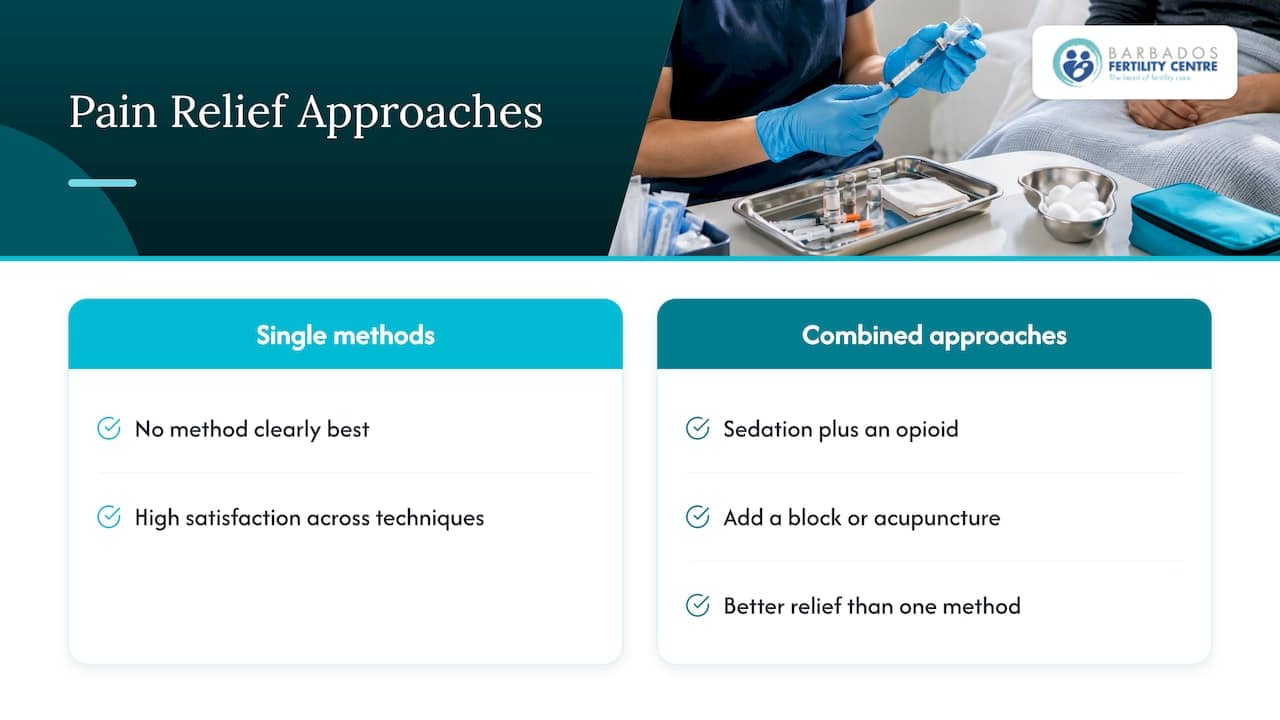
Research gives some useful guidance. A 2018 Cochrane review found that no single method or technique was clearly better than another for pain relief during and after retrieval. It did find that combining sedation with an analgesic such as an opioid, and adding a paracervical block or acupuncture, relieved pain better than any one method alone. All the techniques it reviewed were associated with high patient satisfaction.
A 2020 randomized trial in Hong Kong compared two sedation regimens. It found that fentanyl with midazolam gave better pain relief, sedation and satisfaction than pethidine with diazepam under conscious sedation. You do not need to memorize drug names, but it helps to know the regimen is a deliberate choice, not an afterthought.
Why comfort matters medically, not just emotionally
The same 2024 review points out that keeping a patient comfortable makes the follicular puncture easier and lowers the risk of inadvertent trauma to nearby organs or major vessels. Good sedation is part of a safe procedure, not a luxury.
Questions to ask before your retrieval
- What medicines will I receive, and will I be asleep or drowsy?
- Who monitors my breathing and heart rate during the procedure?
- Do I need to fast beforehand, and for how long?
- Do I need a companion to take me home?
- Which pain medicine should I take afterward, and at what dose?
Write the answers down. If you travel for treatment, ask them well before you book flights.
What pain to expect after egg retrieval
After the sedation wears off, you will probably feel a mix of the following:
- Cramping in the lower abdomen, similar to period cramps.
- Bloating and pressure, because your ovaries are larger than usual after stimulation.
- Light vaginal spotting, from the needle passing through the vaginal wall.
- Fatigue, from sedation and a demanding stimulation cycle.
- Constipation or a sluggish gut, which can add to belly discomfort.
Hormone shifts after retrieval can also affect mood. Patients sometimes report fatigue, irritability or feeling more emotionally sensitive, and these changes are generally temporary. Your clinic can tell you what to expect based on your medication protocol and whether another treatment step is planned, such as an embryo transfer.
If the cramping feels a lot like your usual period pain, that is a good sign that it is within the expected range. If you are also in the transfer phase and trying to tell different sensations apart, our guide on implantation cramps versus period cramps explains how they differ.
Is pain five days after retrieval normal?
Mild soreness, bloating and fullness can linger for several days, and many people are still aware of their ovaries for a while. What matters is the direction. Discomfort that is slowly easing is reassuring. Pain that is getting worse, or that is not relieved by acetaminophen, is the signal to call. The list of warning signs below applies at day five exactly as it does at day one.
How to manage pain and recover well
Emory School of Medicine gives clear, practical aftercare instructions that match what most clinics advise. It recommends that you rest for at least 24 hours, take acetaminophen (Tylenol) for pain, use a heating pad on the abdomen, and avoid heavy lifting and strenuous exercise. Its instructions specify two regular-strength acetaminophen tablets every 6 hours. Follow your own clinic’s dosing, since your doctor knows your health history.
A simple recovery plan
- Arrange a companion. You will not be able to drive after sedation, and having someone with you makes the first evening easier.
- Go home and rest. Lie down, keep your phone within reach and plan on doing very little for the rest of the day.
- Take pain medicine as directed. Taking acetaminophen on schedule is easier than chasing pain once it builds.
- Use gentle heat. A heating pad on the lower abdomen can soothe cramping.
- Eat and drink in small, regular amounts. Light meals and fluids help if you feel bloated or queasy.
- Move gently. Short, slow walks around the house are fine. Skip lifting and workouts until your doctor clears you.
- Keep a symptom note. Jot down your pain level, temperature and bleeding, so you can describe them clearly if you need to call.
If you have questions about the medicines you used during stimulation, our IVF medications list explains what each drug does and what to expect.
Can you travel or take a vacation after retrieval?
Many people want to combine treatment with a trip, and it is a fair question. The answer depends on how you feel, how many follicles were punctured, whether you are planning a fresh transfer and what your doctor advises. Because of bloating and the need for rest, it is sensible to build in recovery time before any long journey or active itinerary, and to confirm your travel timing with your clinic before you book. Plan your flights around your treatment calendar, not the reverse.
Warning signs: when to call your clinic
Most recoveries are uneventful, but a few symptoms need prompt attention. Emory School of Medicine lists these as reasons to call your doctor:
- Vaginal bleeding heavier than a period
- Foul-smelling vaginal discharge
- Pain that is not relieved by Tylenol
- A fever greater than 100°F
- Nausea that lasts more than 24 hours
- Signs of an allergic reaction, such as hives, rash, swelling or difficulty breathing
If you have difficulty breathing or swelling of the face or throat, treat it as an emergency and call 911. For anything else on the list, phone your fertility clinic first. They know your cycle details and can decide whether you need to be seen. Do not wait for your next appointment, and do not assume the symptom will pass.
When you are abroad, know before you leave exactly how to reach the clinic, which phone number to use after hours, and where the nearest emergency department is.
What affects how painful retrieval feels for you
Two patients can have very different experiences. These factors make the most difference:
| Factor | Why it matters |
|---|---|
| Number of follicles | More follicles can mean more punctures and more pelvic fullness afterward |
| Sedation plan | The combination of sedative and pain medicine affects comfort during and after the procedure |
| Anxiety level | Calm patients often report an easier experience, which is why a relaxed setting helps |
| Pain history | If you have endometriosis or sensitive pelvic pain, tell your team in advance |
| Aftercare | Rest, scheduled acetaminophen and heat make the first days easier |
The Cochrane evidence points the same way: pain control works best when several methods are combined rather than relying on one alone. Tell your team about past reactions to anesthesia, allergies and any chronic pain before the day.
Preparing mentally and practically
Fear of the unknown makes the procedure feel worse. A few preparations help:
- Learn the sequence. Check-in, IV placement, sedation, a procedure of roughly half an hour to an hour, then recovery. Knowing the order removes surprises.
- Follow the fasting instructions exactly. This matters for sedation safety, and your clinic will give you the timing.
- Pack comfortable clothes. Loose waistbands are kinder to a bloated belly.
- Stock your recovery kit. Acetaminophen, a heating pad, easy snacks, water and something to watch.
- Clear your calendar. Take the day off and do not plan anything demanding for the day after.
If you want to understand where retrieval sits in the bigger picture, our page on what IVF involves walks through each stage.
We believe comfort and clarity go together
Patients tell us the procedure is not what they fear most. It is the unknown: the cost, the travel, the cycle timing, and whether they will be looked after. We built our approach around reducing that stress.
Barbados Fertility Centre has operated since 2002 and holds JCI accreditation, which means the clinic is held to internationally recognized medical standards. Our aim is for patients to receive care comparable to leading US clinics, in a calm Caribbean setting and at a more affordable price. Treatment is personalized, so the plan for your cycle reflects your history, your goals and your questions.
For international patients, we coordinate treatment remotely before you travel, so the steps of your cycle are clear before you board a plane. We believe that when you know what will happen on retrieval day, who will be with you and what recovery looks like, the experience feels far more manageable.
Ask us about your sedation and recovery plan in your first conversation. It is one of the most useful questions you can bring.
Barbados
Egg retrieval at Barbados Fertility Centre
If you are considering IVF, ICSI or egg freezing and want an accredited, private clinic with transparent pricing, we can help you plan the whole cycle, including retrieval and recovery. Our egg freezing cycle is listed at $4,950 on our international price list, and our CARICOM price list shows IVF from $5,750 and IVF with ICSI from $6,750.

You can see how the process works for overseas patients on our IVF treatment abroad page, read our egg freezing information sheet, or contact us through barbadosivf.com to talk through your plan. If you are not sure where to start, our Fertility Healthcheck is a good first step.
Frequently asked questions
Will I be awake during egg retrieval?
Retrieval is performed under sedation, and the patient is sedated for the roughly 30 to 60 minutes the procedure takes, according to Emory School of Medicine. Depending on the plan, you may be deeply drowsy or fully asleep. Ask your clinic which approach it uses and who monitors you.
How long does pain after egg retrieval last?
Mild cramping, bloating and soreness are common and typically ease over the first days, although the pace varies from person to person. Resting for at least 24 hours, taking acetaminophen and using a heating pad help. If pain is worsening or acetaminophen does not relieve it, call your clinic.
Can I go back to work the next day?
This depends on how you feel and on your doctor’s advice. Emory advises resting for at least 24 hours and avoiding heavy lifting and strenuous exercise. Many people plan a day off and a lighter day after that, especially if their job is physical.
Does the type of anesthesia affect my chances of pregnancy?
A 2024 review found no robust evidence that anesthesia affects fertility outcomes. It also says the technique should be tailored to the individual. Discuss your medical history and preferences with your anesthesia team in advance.
Which symptoms mean I should call right away?
Call your clinic for bleeding heavier than a period, foul-smelling discharge, pain that Tylenol does not relieve, a fever above 100°F, or nausea lasting more than 24 hours. Hives, rash, swelling or difficulty breathing are emergency signs, so call 911.
Sources
- Oocyte (egg) retrieval, Emory School of Medicine
- Pain relief for women undergoing oocyte retrieval, Cochrane (2018)
- Anaesthesia considerations for assisted reproductive technology (2024)
- Randomized trial comparing sedation regimens for oocyte retrieval (2020)
- What Happens After Egg Retrieval?, American Surrogacy
Recommended
- Surgical Sperm Retrieval: Clinician Decisions That Avoid a Wasted Egg
- Egg Freezing Info
- Endometrial Scratch Before IVF: What the Evidence Shows
- Implantation Cramps vs. Period Cramps: How to Tell the Difference