


In the United States, a reciprocal IVF cycle commonly lands between about $15,000 and $35,000 once medications are included, and many couples budget for more than one attempt. The reason is simple: two people receive medical care instead of one. One partner goes through egg retrieval, and the other prepares her uterus for the embryo transfer. Below, we break down what the quoted prices usually include, what pushes the total up, and how to bring it down, including the option of treating abroad.
TL;DR
- Published US estimates put the base reciprocal IVF procedure at $12,000 to $15,000, with medications for both partners adding $3,000 to $8,000 per cycle.
- Donor sperm, embryo testing, frozen transfers, legal parentage work and repeat cycles are the usual extras that raise the final figure.
- Insurance rarely pays for reciprocal IVF without a documented medical reason, so plan on paying out of pocket and ask for an itemized quote.
- Treating at an accredited clinic outside the US can reduce the clinical portion of the bill. Our published IVF prices start at $5,750.
Table of Contents
- What reciprocal IVF is and why it costs more than standard IVF
- What reciprocal IVF costs in the US
- What goes into the total
- A realistic budget range
- Will insurance pay for reciprocal IVF?
- Ways to lower the cost
- Does reciprocal IVF carry extra risks?
- Reciprocal IVF abroad: how Barbados fits in
- Perspective
- Get a plan and price for your situation
- How to compare quotes: a short checklist
- FAQ
- Sources
What reciprocal IVF is and why it costs more than standard IVF
Reciprocal IVF, sometimes called shared motherhood or partner-assisted IVF, lets both partners take part biologically. One partner provides the eggs. They are fertilized with donor sperm, and the resulting embryo is transferred to the other partner, who carries the pregnancy.
That design means two sets of medical steps happen in parallel:
- The egg provider takes stimulation medication, has monitoring ultrasounds and bloodwork, and undergoes egg retrieval.
- The carrying partner takes hormones to prepare the uterine lining, has her own monitoring, and then has the embryo transfer.
- The laboratory fertilizes the eggs, usually with ICSI when donor sperm is limited or frozen, and cultures the embryos.
Because it involves care for two people, reciprocal IVF is inherently more expensive than a standard cycle where one person is both egg provider and carrier. This is the main reason the numbers you see online look higher than a generic “IVF cost” figure.
What reciprocal IVF costs in the US
Published figures vary by source, year and what each one counts. Here is how the most credible ones line up.
| Source | Figure | What it covers |
|---|---|---|
| Family Equality fact sheet (2019) | $12,000 to $15,000 | Baseline reciprocal IVF procedure |
| Same fact sheet | $3,000 to $8,000 per cycle | Medications for both partners |
| UnitedHealthcare family-building resource | $12,000 to $15,000, plus $3,000 to $8,000 | Initial cycle, then medications per cycle |
| American Society for Reproductive Medicine (2025) | $15,000 to $25,000 | A typical US IVF cycle, with many patients needing more than one |
Add the base procedure and the medication range together and you get roughly $15,000 to $23,000 for a single cycle before anything else. Clinic-published estimates tend to sit higher, which is why you will see single-cycle figures of $20,000 and up in marketing material. The ASRM figure is for standard IVF, so reciprocal treatment, with its second set of monitoring and medication, should be expected to sit at or above that range.
Two cautions when you compare quotes:
- Check what “per cycle” means. Some clinics quote only the retrieval and lab work. Others include monitoring, the transfer and the first embryo freeze. Ask for the line items in writing.
- Check the year. The Family Equality sheet dates from 2019, and drug and clinic prices have moved since. Treat it as a floor for planning, not a current quote.
What goes into the total
A reciprocal IVF budget is a stack of separate services. Going through them one by one is the clearest way to avoid surprises.
Monitoring, retrieval and the laboratory
This is the core of the quoted price: ultrasounds, bloodwork, the retrieval procedure with anesthesia, fertilization, embryo culture and the transfer. The laboratory sits at the heart of your treatment, so it is worth asking about accreditation, how embryos are cultured and what the clinic’s published results look like for your age group.
Medications for both partners
The egg provider needs stimulation drugs. The carrying partner needs estrogen and progesterone to prepare and support the uterine lining. The Family Equality fact sheet puts medications for both partners at $3,000 to $8,000 per cycle, and a 2023 Future Family estimate puts medication alone at $7,000 to $10,000. Dose depends on age, ovarian reserve and response, so two couples with the same clinic can pay quite different amounts.
Donor sperm
For most same-sex female couples, donor sperm is a separate purchase. The Family Equality sheet reports anonymous donor sperm at $300 to $1,500 per half-cc vial and notes that more than one vial may be recommended. Shipping and storage fees at the clinic or sperm bank come on top.
Embryo testing and freezing
Preimplantation genetic testing, embryo freezing and annual storage are optional or situational, but they are common. If you plan to freeze embryos and transfer them later, the frozen transfer is usually billed as its own cycle.
Additional transfers and repeat cycles
The ASRM notes that many patients need more than one IVF cycle, and that cumulative cost is a major barrier to access. For reciprocal IVF, a sensible plan is to budget for the first retrieval plus at least one extra transfer, rather than the single best-case cycle.
Legal parentage work
Legal rules for reciprocal IVF vary by state, and it may be wise to seek legal counsel about parentage. In many cases the non-gestational partner is advised to pursue a legal step even when both names are on a birth certificate. Ask a family law attorney in your state what applies to you and add that fee to your plan.
Travel, if you treat away from home
If you cross a border for treatment, flights, accommodation and time away from work belong in the budget. We cover how that works below.
A realistic budget range
The table below is a planning framework built from the sources above. It is not a quote from any clinic.
| Budget item | Low planning figure | High planning figure |
|---|---|---|
| Base reciprocal IVF procedure | $12,000 | $15,000 |
| Medications, both partners | $3,000 | $8,000 |
| Donor sperm (one to three vials) | $300 | $4,500 |
| Single cycle subtotal | $15,300 | $27,500 |
The donor sperm high figure assumes three vials at the top of the reported range. Embryo testing, a second transfer and legal fees are not in this table, which is why couples who need a second attempt often end up well above the subtotal.
Will insurance pay for reciprocal IVF?
Usually not. Coverage varies by insurer and by state, and providers generally do not cover reciprocal IVF without documented medical necessity, such as diagnostic testing for the carrying partner, according to Future Family’s 2023 overview. That same source notes that 17 states mandated infertility coverage as of 2023, though not all of those laws include IVF.
A few practical steps:
- Call your insurer and ask, in these words, whether IVF, medications and monitoring are covered, and how the plan defines infertility for same-sex couples.
- Ask your employer’s benefits team whether a fertility benefit or reimbursement program exists. Some employers offer one separately from the health plan.
- Be careful about assuming recent federal announcements will lower your bill. The ASRM has pointed out that the 2025 federal initiative created no direct federal IVF insurance mandate or subsidy, and that medication discounts address only one component of the cost, because procedural and laboratory expenses remain.
Ways to lower the cost
There are no guaranteed free cycles, but several options can reduce what you pay out of pocket.
- Employer benefits, grants and loans. The UnitedHealthcare resource lists employer benefits, grants and loans as places to look.
- HSA funds. People with a health savings account may be able to use it for certain family-building expenses. Confirm eligibility with your plan administrator or a tax professional before relying on it.
- Package pricing. Ask clinics whether medications, monitoring and the transfer are bundled or billed separately.
- Sequence your spending. Some couples complete retrieval and freeze embryos, then schedule the transfer later, which spreads the cost over time.
- Compare the clinical price abroad. A US clinic’s price includes high overhead. An accredited clinic in another country can charge far less for the same clinical steps.
Does reciprocal IVF carry extra risks?
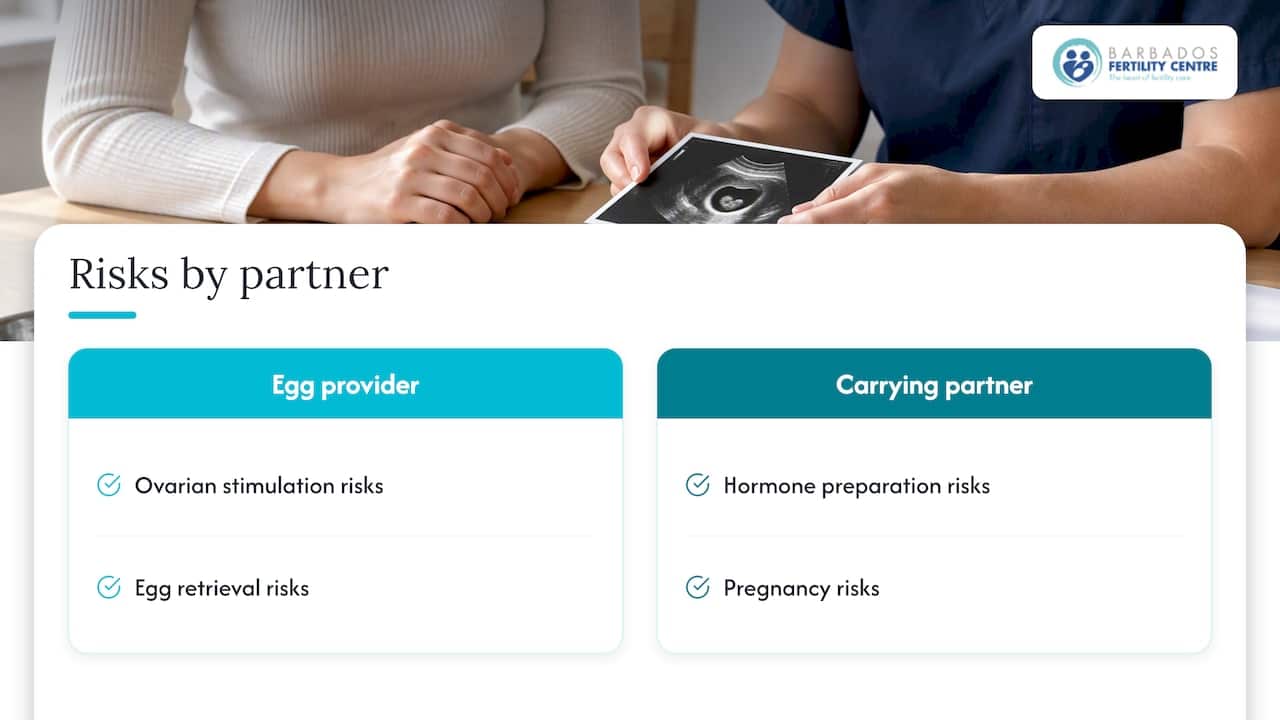
The medical risks are the same ones that come with any IVF cycle, but reciprocal IVF involves two people. The egg provider faces the risks of ovarian stimulation and retrieval, and the carrying partner faces those of hormone preparation and pregnancy. Both partners should have a health screening before you start, and your reproductive endocrinologist should tailor medication doses to each of you. If either of you has a history of ovarian, uterine or hormonal conditions, raise it at the first consultation so the plan accounts for it. A cycle that has to be repeated because it was not tailored well is also a cost risk.
Reciprocal IVF abroad: how Barbados fits in
US prices are driven largely by clinic overhead, and that is where an international option can help. Barbados Fertility Centre has operated since 2002 and works under JCI accreditation, an international standard for healthcare quality. We publish our prices openly, so you can see them before you contact us.
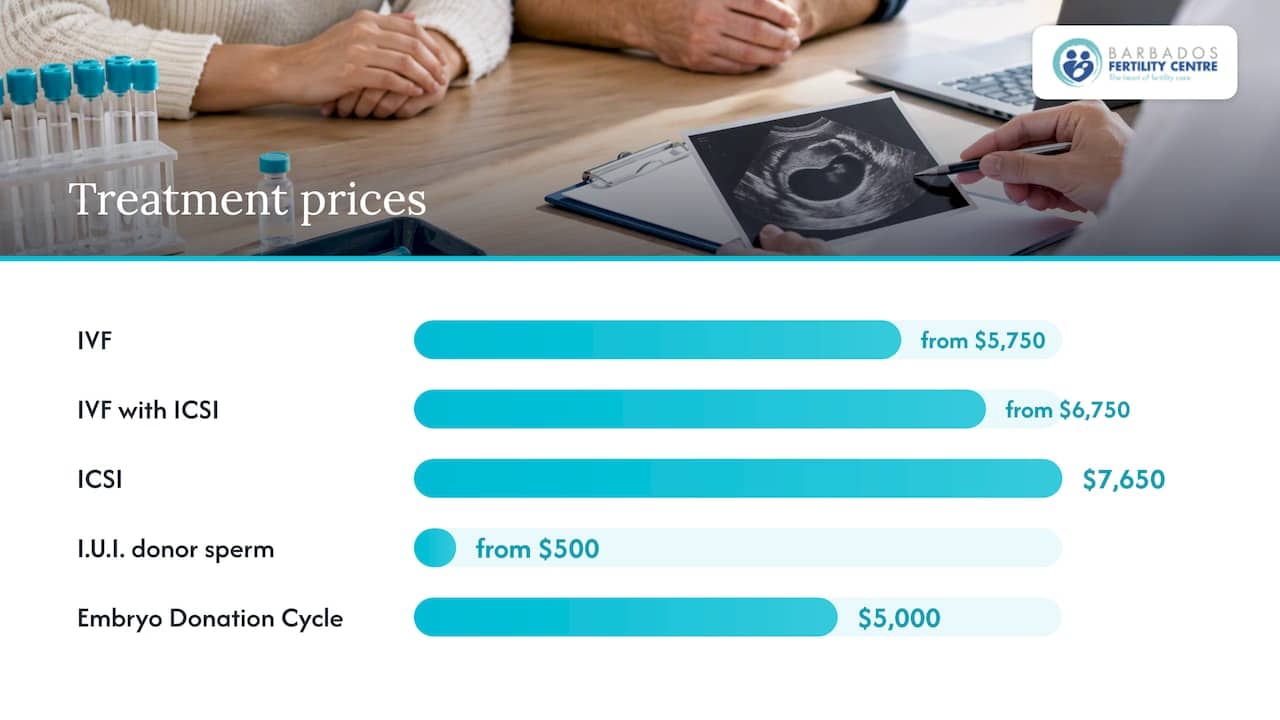
Here are our published treatment prices that are relevant when you build a plan for a female couple:
| Treatment | Published price |
|---|---|
| IVF | from $5,750 |
| IVF with ICSI | from $6,750 |
| ICSI | $7,650 |
| I.U.I. with donor sperm, per cycle, including scans | from $500 |
| Embryo Donation Cycle | $5,000 |
These are the prices of individual treatments, not a packaged reciprocal quote. Medications, donor sperm, travel and any extra services are not part of the figures above. Ask our team how your two-partner plan would be laid out, step by step, and what would be billed separately. Our current prices are on the CARICOM price list and the international price list, and which one applies depends on where you live.
We coordinate treatment remotely before you travel, so much of the early work, including consultations and planning, can happen from home.
Perspective
When couples contact us about reciprocal IVF, the first thing we hear is worry about the total. We understand that. The treatment is emotionally meaningful because both of you take part, and it is financially heavy because both of you are patients.
Our approach is to make the numbers as clear as the medicine. We publish our prices, we explain what each line covers, and we keep the treatment environment calm, because stress is a real part of the experience of IVF. We are an accredited, private clinic, and we designed our service to give you the standards you would expect from a top US clinic without the same cost or complexity.
We would rather you ask every question before you book than discover a charge after you arrive. Bring your medical history, your budget and your timeline, and we will build a plan around them.
Barbados
Get a plan and price for your situation
If you are comparing US quotes with an option abroad, the fastest way to compare like for like is to look at the line items. See our published IVF and ICSI prices and then contact Barbados Fertility Centre to discuss how your plan would work and what it would include.

How to compare quotes: a short checklist
Whether you stay in the US or travel, ask every clinic the same questions:
- What does the cycle price include: monitoring, retrieval, fertilization, culture, transfer?
- Are medications for both partners included, or priced separately?
- Is ICSI included, or billed as an add-on?
- What does embryo freezing cost, and what are the annual storage fees?
- Is a frozen transfer billed as a new cycle?
- What does the clinic’s financial coordinator expect an average couple of your age to spend in total, including a second attempt?
- Is the clinic accredited, and what are its published results for patients of your age?
A clear, itemized answer to each is a good sign. A vague answer is a reason to ask again.
FAQ
How much does reciprocal IVF cost in the US?
Published US sources put the base procedure at $12,000 to $15,000, with medications for both partners adding $3,000 to $8,000 per cycle. Donor sperm, embryo testing, additional transfers and legal fees come on top. Many couples need more than one transfer, so plan for a total above a single cycle.
Does insurance cover reciprocal IVF?
Usually not, unless there is a documented medical necessity. Coverage varies by insurer and state, and not every state mandate includes IVF. Ask your insurer and your employer’s benefits team for written answers before you start.
Is there a free round of IVF for lesbian couples?
We are not aware of any standard program that provides a free cycle. Employer benefits, grants, loans and HSA funds can reduce what you pay yourselves. Check eligibility for each option with the provider or administrator.
Is reciprocal IVF riskier than standard IVF?
The medical risks are those of standard IVF, but two people go through treatment, so each partner takes on her own share. A full health screening for both of you and a plan tailored by your fertility specialist are the best ways to manage that.
Sources
- Average Costs for the LGBTQ+ Community to Achieve Pregnancy, Family Equality (2019)
- LGBTQ+ family building, UnitedHealthcare
- How Much Is Reciprocal IVF and How To Prepare Financially (2023)