


The answer depends on the type of cycle you are in. After a fresh IVF transfer, research finds no significant difference in pregnancy or live birth rates between vaginal progesterone and intramuscular injections, so comfort can reasonably guide the choice. In a programmed frozen embryo transfer (FET), where your body makes no progesterone of its own, a large randomized trial found vaginal-only support did worse, and many clinics now use injections or a combination. Below we explain why, what each route feels like day to day, and how to raise the question with your own physician.
TL;DR
- Fresh IVF cycle: injections (progesterone in oil, or PIO) and vaginal suppositories or inserts perform about equally in pooled trial data, and patients rate the vaginal route as more satisfying.
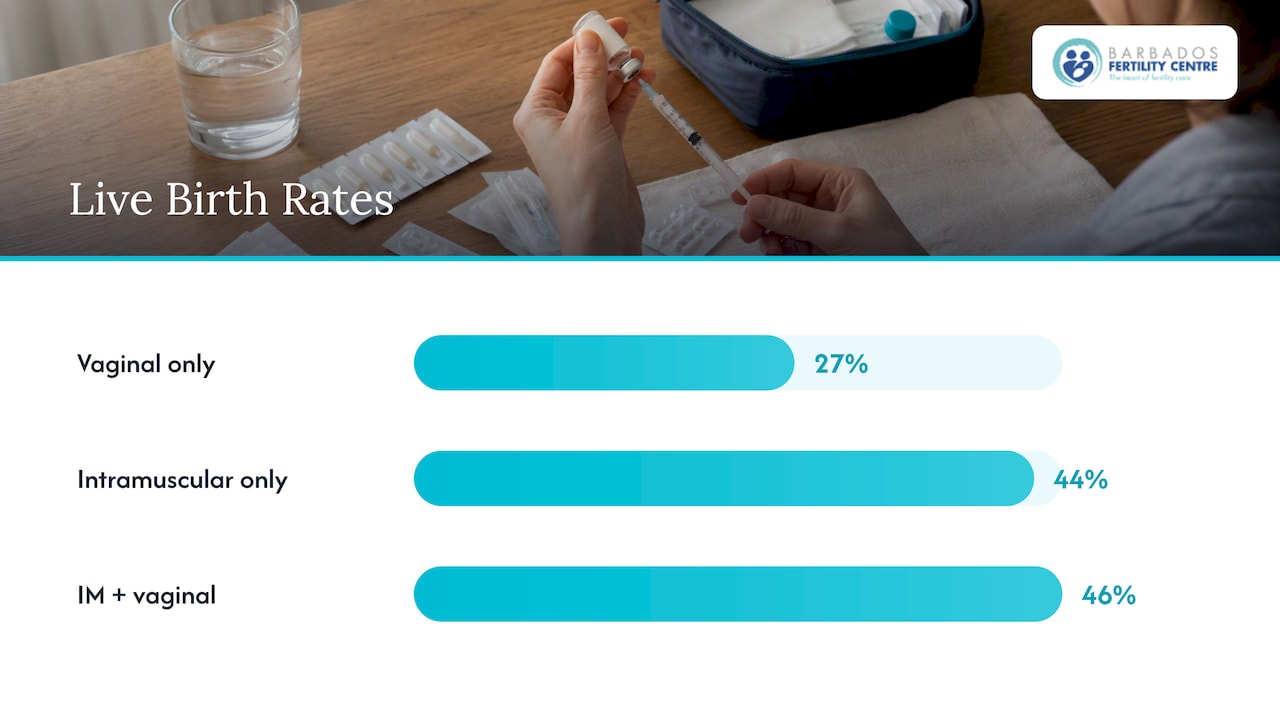
- Programmed frozen transfer: one multicenter trial reported live birth in 27% with vaginal-only progesterone, 44% with IM progesterone and 46% with both.
- Injections are more uncomfortable to give. Vaginal products more often cause discharge, itching and irritation.
- No single route is universally best. Your reproductive endocrinologist chooses based on your cycle type, history and preferences. Never switch or stop on your own.
Table of Contents
- Why progesterone matters after an embryo transfer
- What the evidence says about fresh IVF cycles
- What changes in frozen embryo transfer
- Side effects and daily life: shots vs suppositories
- Side-by-side comparison
- Does progesterone cause weight gain?
- How to choose with your physician
- Our perspective at Barbados Fertility Centre
- Planning around your medication schedule
- Treatment and pricing at our clinic
- FAQ
- Sources
Why progesterone matters after an embryo transfer
Progesterone prepares the uterine lining to accept an embryo and helps maintain early pregnancy. In a natural cycle, the ovary produces it after ovulation. In IVF, that process is disrupted. The American Society for Reproductive Medicine’s educational bulletin notes that some form of luteal phase support is supported by the evidence whenever treatment includes a GnRH analog, which covers most stimulation protocols.
In a programmed FET cycle the situation is more extreme. Medications suppress your own ovulation, so you receive estrogen and then progesterone, and the progesterone you take is the only progesterone your body has. That is why the delivery route has more weight there than in a fresh cycle.
There are three main routes:
- Intramuscular injection. Progesterone dissolved in oil, injected into the upper outer buttock, usually once a day.
- Vaginal insert, suppository or gel. Placed in the vagina, usually two or three times a day depending on the product.
- Oral capsules. Swallowed, and used less often as the main route for support.
The Society for Assisted Reproductive Technology (SART) explains that injection produces the highest blood levels. Higher blood levels are not the same as higher pregnancy rates, though, and that gap is the heart of this debate.
What the evidence says about fresh IVF cycles
A systematic review and meta-analysis of 15 randomized controlled trials covering 5,656 patients found no statistically significant difference between vaginal and intramuscular progesterone for clinical pregnancy, miscarriage or live birth. Satisfaction was significantly higher with the vaginal route (p < 0.00001).
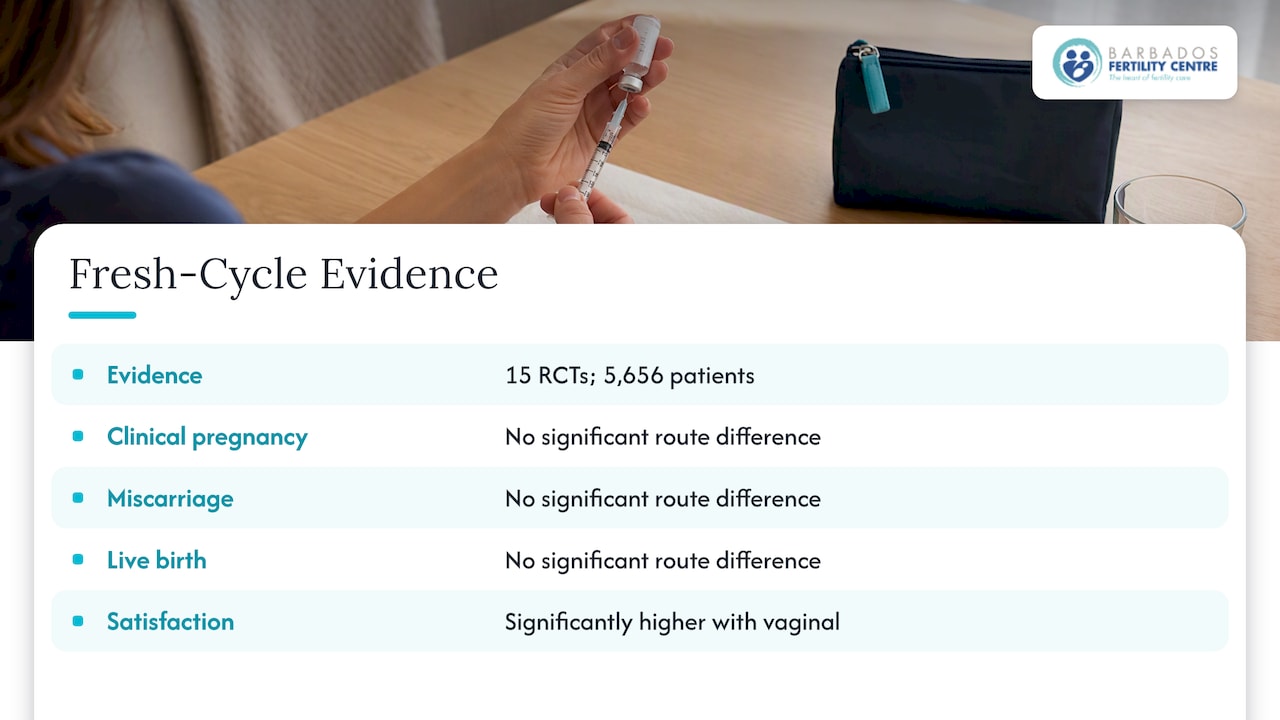
A caution about that finding: it pools many trials with different products, doses and designs. It tells you that, on average, switching route in a fresh cycle does not cost you much. It does not promise that the result is identical for every individual.
For most patients in a fresh cycle, then, the choice often comes down to tolerability. Some people hate needles. Others would rather inject once a day than manage inserts two or three times daily.
What changes in frozen embryo transfer
In 2021, a three-armed randomized trial tested whether vaginal progesterone was as good as IM progesterone for programmed FET. It was not. According to the published trial, live birth rates were:
| Progesterone regimen in programmed FET | Live birth rate |
|---|---|
| Vaginal only | 27% |
| Intramuscular only | 44% |
| Intramuscular plus vaginal | 46% |
The study, which involved more than 1,000 completed FET cycles, also reported that half of the pregnancies in the vaginal-only group ended in miscarriage. The investigators concluded that IM progesterone optimizes live birth in this setting.
Older meta-analyses often combined fresh and frozen cycles, which can hide this difference. A fresh cycle has a corpus luteum (the structure left behind after egg retrieval) that still contributes some hormone. A programmed frozen cycle has none.
The discussion has been active among specialists. In an ASRM journal club debate on luteal support in programmed FET, faculty and fellows weighed these findings against the convenience of vaginal products. The practical result is that some clinics have moved from vaginal-only protocols to IM-only or combined ones for FET.
Two points keep this balanced:
- Not every FET is programmed. In natural or modified natural cycles, your own ovulation produces progesterone, and the need for supplementation differs. Your physician will tell you which type you are in.
- Vaginal products can work well for many patients, and protocols vary across clinics. The optimal route has not been universally established across all treatment types, so a clinic’s protocol differing from one you read about is not a red flag.
Side effects and daily life: shots vs suppositories
Here the picture reverses. The evidence favors injections in programmed FET, but day-to-day tolerability often favors the vaginal route.
Intramuscular progesterone (PIO)
The most common complaints are soreness at the injection site, lumps or knots under the skin, and the anxiety of giving or receiving a daily deep injection. A 2022 clinical review of vaginal versus intramuscular progesterone fits with what patients report: injections tend to be more uncomfortable to administer. Rarely, people react to the oil base, so tell your clinic about any rash, swelling or hives.
Practical points many patients find useful, to confirm with your nurse:
- Rotate sides each day.
- Ask your clinic about technique, needle length and whether warming the vial is appropriate for your product.
- Have your partner or a trained helper give the shot if you are anxious about doing it yourself.
- Call your clinic if you develop spreading redness, fever, severe pain or swelling at a site.
If you are starting injections, our patient injection instruction videos show the steps visually, which helps many people feel steadier before the first dose.
Vaginal suppositories and inserts
SART lists vaginal discharge, itching, burning and local irritation among the bothersome effects of vaginal progesterone. Many people describe it as messy rather than painful. Panty liners are usually enough, and the product itself is generally not a sign that the medicine is “leaking out” and failing. If you are unsure whether discharge is normal or a sign of infection, ask your clinic instead of guessing.
Do not stop doses because of discomfort. Call the clinic first, because there are often ways to change the product or schedule.
Oral progesterone
SART notes that oral progesterone can cause dizziness or sleepiness, which can often be managed by taking the largest dose at bedtime. It is rarely the sole route for support, so ask your physician if it is part of your plan.
Side-by-side comparison
| Injection (PIO) | Vaginal suppository or insert | |
|---|---|---|
| Typical frequency | Once daily | Usually two to three times daily, depending on product |
| Blood progesterone levels | Highest | Lower, with local uterine delivery |
| Fresh IVF cycle outcomes | Similar to vaginal in pooled trials | Similar to IM in pooled trials |
| Programmed FET outcomes | Higher live birth in one large trial | Lower live birth when used alone in that trial |
| Main drawbacks | Pain, soreness, lumps, needle anxiety | Discharge, itching, irritation, mess |
| Patient satisfaction | Lower in pooled data | Higher in pooled data |
Does progesterone cause weight gain?
It is a common worry, and the evidence is thin. The figures people find online usually come from injectable birth control, not IVF. ACOG notes that some women gain weight on that contraceptive shot, with average gain among those who did being under 5 pounds. That is a different drug (depot medroxyprogesterone acetate) used for a different purpose, so it does not directly answer the IVF question. Bloating and fluid retention during stimulation and the luteal phase are common and tied to the overall treatment. If you notice rapid weight gain, severe bloating or shortness of breath during treatment, contact your clinic promptly, since those can signal ovarian hyperstimulation syndrome.
How to choose with your physician
Use these questions to shape the conversation:
- What type of cycle am I in? Fresh transfer, programmed FET, or natural FET. This is the biggest factor.
- What does your clinic’s data show for my protocol? Practice varies, and a good clinic can explain its reasoning.
- Can I combine routes? In the FET trial above, adding vaginal progesterone to injections performed about as well as injections alone, so combined plans exist for a reason.
- What if I cannot tolerate the injections? Ask about alternatives before you skip doses.
- Is blood progesterone testing part of my monitoring? Researchers are still debating how and whether to measure serum progesterone in FET preparation, so ask how your clinic uses it.
Patient preference is a legitimate factor when the clinical outcomes are similar, as in many fresh cycles. When outcomes differ, as in programmed FET, it is worth hearing why your physician recommends one route before you push for another.
Our perspective at Barbados Fertility Centre
We see patients travel for treatment, often feeling overwhelmed by cost and by the number of decisions in front of them. Progesterone is one of those decisions, and it can look like a minor detail until you are managing daily doses far from home.
Our view is simple. The route should match the cycle and the patient, and your physician should explain the reason in plain language. We would not tell you that one route is right for everyone, because the evidence does not say that. For programmed frozen transfers, the 2021 trial is hard to ignore, and we think any patient with a vaginal-only plan can fairly ask her physician how that plan fits the current evidence. For fresh cycles, comfort is a fair consideration.
As a JCI-accredited clinic, we hold ourselves to documented standards, and we aim for personalized plans and a calm patient experience. For international patients, that includes remote coordination so that you understand your medication schedule before you travel, and instruction videos for anyone new to injections. Your own protocol is set by your treating physician after your assessment, and we encourage you to ask us about it directly.
— Barbados
Planning around your medication schedule
Progesterone usually continues through the early weeks of pregnancy if your transfer is successful, so think about logistics early. Pack enough supplies, confirm storage requirements for your product, and ask how to handle a missed dose before it happens. If you are traveling for treatment, our guide to making the most of an IVF abroad timeline covers how to plan around monitoring and transfer dates, and our page on luteal phase support explains how we think about it.
If a transfer works, you will soon be looking at the next stage. A general resource such as this pregnancy and early parenthood planner and blog can help you organize that period, though it is no substitute for your care team’s advice.
Treatment and pricing at our clinic
If you are comparing clinics for IVF or frozen transfer, we publish our pricing openly. IVF is listed from 5,750 USD, and IVF with ICSI from 6,750 USD, on our CARICOM price list. ICSI is 7,650 USD and egg freezing 4,950 USD on our international price list. You can also estimate your own plan with our IVF cost calculator. Medication, including progesterone, is planned with your physician, so ask us what applies to your protocol.
FAQ
Which form of progesterone is most effective?
It depends on the cycle. In fresh IVF, pooled trials show no significant difference between vaginal and intramuscular routes. In programmed frozen transfers, one large trial found intramuscular progesterone, alone or with vaginal, gave higher live birth rates than vaginal alone.
Why would you inject progesterone?
Injections give the highest blood levels and are taken once a day. They are most often chosen in programmed frozen transfer cycles, where the body makes no progesterone of its own. Some patients also choose them because they find vaginal products messy or irritating.
Do progesterone injections make you gain weight?
There is no strong evidence that IVF progesterone itself causes lasting weight gain. Bloating and fluid retention during treatment are common. Contact your clinic if gain is rapid or comes with severe bloating or breathlessness.
Can I switch from shots to suppositories if the injections are too painful?
Talk to your physician before changing anything. In a fresh cycle, a switch may be reasonable. In a programmed frozen cycle, vaginal-only support has performed worse in trials, so your doctor may suggest another approach to make injections easier or a combined plan.
Sources
- Vaginal versus intramuscular progesterone for luteal phase support in ART: systematic review and meta-analysis (PubMed)
- Intramuscular progesterone optimizes live birth from programmed frozen embryo transfer: a randomized clinical trial (PubMed)
- Progesterone supplementation during the luteal phase and in early pregnancy: educational bulletin (Fertility and Sterility)
- ASRM Journal Club Global: luteal support in programmed FET cycles
- SART: Progesterone
- Serum progesterone concentration in frozen embryo transfer preparation (PMC)
- ACOG: Progestin-only hormonal birth control, pill and injection
Recommended
- Injection Instructions
- IVF Patients: Evidence First Luteal Phase Support and JCI Clinic Plan
- What is IVF?