


A single embryo freezing cycle in the United States typically runs $10,000 to $20,000 once you add retrieval, lab fees, and medications, with average cycle costs commonly landing between $10,000 and $15,000 before storage. The three factors that swing your final bill the most: how many retrieval cycles you need, your medication protocol, and whether you add testing like PGT-A or pay for multiple years of storage. Always ask your clinic for a written, itemized quote before you commit.
TL;DR:
- Embryo freezing costs in the US typically range from $10,000 to $15,000 per cycle before storage fees, with major expenses including retrieval, lab work, and medications.
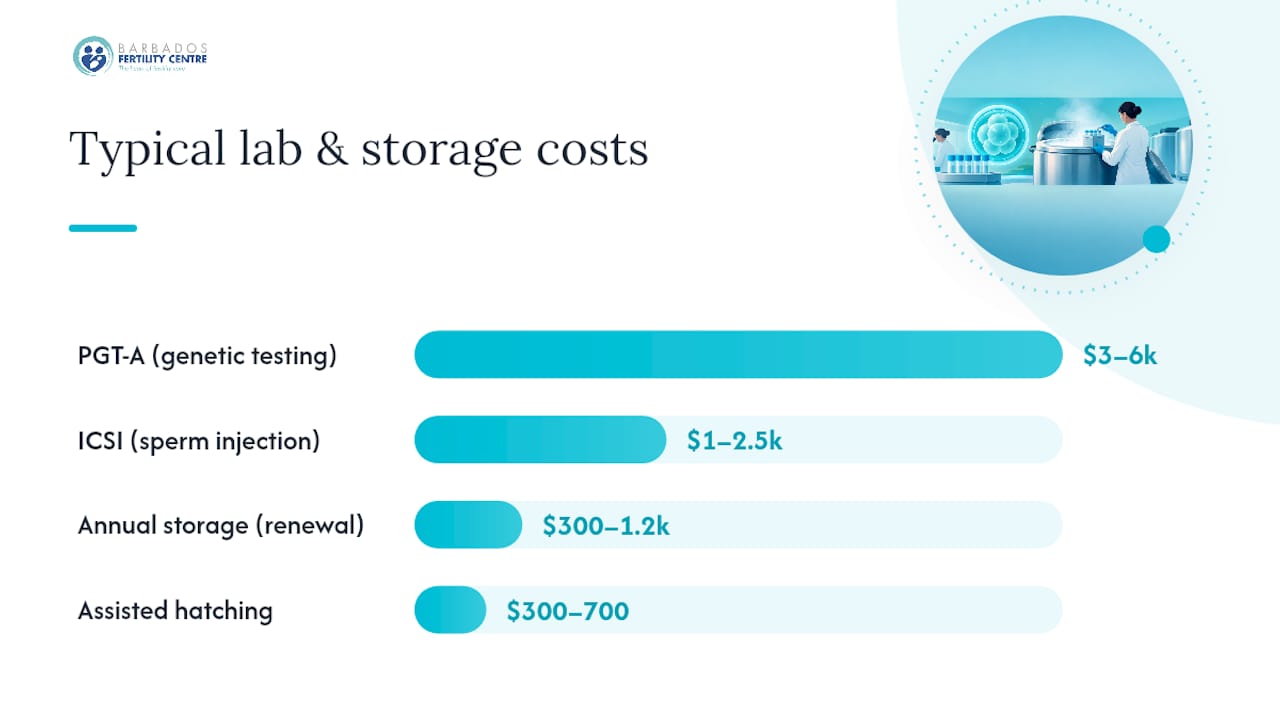
- Costs for additional procedures like PGT-A and ICSI can add $3,000 to $6,000, and storage fees often run between $300 and $1,200 annually, with billing models varying.
- Multiple cycles or genetic testing can substantially raise total costs, sometimes exceeding $35,000 for two full cycles with testing.
- Insurance coverage is often limited and varies by state and medical necessity, making thorough verification with insurers essential beforehand.
- Request detailed, itemized quotes covering all line items to accurately compare clinics and avoid underestimating total expenses.
Table of Contents
- What Does Embryo Freezing Cost, Line by Line?
- Why Do Medication and Lab Add-On Costs Vary So Much?
- What Do Real Embryo Freezing Budgets Look Like?
- Does Insurance Cover Embryo Freezing?
- How Long Can Embryos Stay Frozen, and What Does That Mean for Cost?
- How Can You Lower Your Total Embryo Freezing Cost?
- What Do Clinical Guidelines Say About Fertility Preservation Costs?
- Our Take: Stop Comparing Headline Prices
- Get a Transparent, Itemized Embryo Freezing Quote
- Where to Read More on Coverage and Costs
- Sources
- FAQ
What Does Embryo Freezing Cost, Line by Line?
Every clinic packages fees differently, but the underlying cost centers stay consistent. Understanding each line item helps you compare quotes that look wildly different but actually cover the same ground.
Retrieval and lab work usually make up the largest chunk of your bill. Medications come as a separate expense that many quotes bury in fine print or leave out entirely. Storage, meanwhile, is billed as its own recurring charge, often under CPT code 89342, with clinics typically invoicing it per specimen per year.
| Line item | Typical cost range |
|---|---|
| Initial consultation | $300–$700 |
| Ovarian stimulation monitoring | $1,000–$2,500 |
| Egg retrieval procedure | $5,500 |
| Fertilization/lab fees (including ICSI) | $1,000–$2,500 |
| Cryopreservation (freezing) | $1,000–$2,000 |
| Embryo storage (annual) | $300–$1,200 |
| Thaw and transfer (when you’re ready to use them) | $3,000–$5,000 |
| Medications | $2,000–$6,000 |
A few packaging patterns worth flagging before you sign anything:
- Some clinics bundle the first year of storage into the cryopreservation fee; others bill it separately from day one.
- Medication costs almost never appear in a clinic’s headline “cycle price” and get quoted through a pharmacy instead.
- ICSI is sometimes included in the base lab fee and sometimes tacked on as a $1,000 to $2,500 add-on, so ask directly.
Why Do Medication and Lab Add-On Costs Vary So Much?
Your medication protocol depends on your ovarian reserve, age, and how your body responds to stimulation during monitoring. A patient who needs a higher dose or a longer stimulation window pays more simply because more monitoring visits and more medication units are required. Medication costs commonly add several thousand dollars per cycle and remain one of the most frequently underquoted parts of the process.
Lab add-ons are where a “simple” cycle can quietly become an expensive one. Here’s what typically gets added, and why:
- ICSI (intracytoplasmic sperm injection): injects a single sperm directly into each egg, often used for male-factor infertility, adding roughly $1,000 to $2,500.
- PGT-A (preimplantation genetic testing for aneuploidy): screens embryos for chromosomal abnormalities before freezing, typically adding $3,000 to $6,000 depending on embryo count.
- Assisted hatching: a lab technique that thins the embryo’s outer shell before transfer, usually $300 to $700.
Storage itself follows one of two billing models: annual renewal, where you’re charged yearly at $300 to $1,200, or multi-year prepay, which sometimes comes with a discount. State-level insurance mandates rarely require coverage for storage itself, even in states that mandate coverage for IVF procedures, so don’t assume your annual storage fee is covered just because your retrieval was.
Pro Tip: Ask your clinic whether storage billing is per specimen or per patient. Some clinics charge one flat annual fee no matter how many embryos you have frozen, while others charge per embryo, and that difference compounds significantly over a decade of storage.
What Do Real Embryo Freezing Budgets Look Like?
Numbers on a fee schedule only tell part of the story. Here’s how three common scenarios actually add up once every line item lands on the invoice.
- Single cycle, no genetic testing (lower end): Consultation ($300) + monitoring ($1,800) + retrieval ($5,500) + lab/ICSI ($2,000) + freezing ($1,200) + medications ($2,500) + first-year storage ($400) totals roughly $13,700.
- Single cycle with PGT-A (typical): The same base cycle plus PGT-A testing at $4,000 pushes the total to roughly $17,700, assuming a moderate medication dose.
- Two cycles, no testing (higher end): Two full retrieval cycles rarely double every cost. Consultation and some monitors stay flat, but medications and retrieval repeat, landing the combined total near $24,000 to $28,000.
- Two cycles with PGT-A on both (high end): Stacking testing onto two cycles can push totals past $35,000, particularly if medication doses increase on the second cycle.
Peer-reviewed cost reviews place average cryopreservation cycle costs at $10,000 to $15,000 before storage, and many patients need more than one cycle to bank enough viable embryos.
Adding a second cycle or genetic testing doesn’t just add a fee. It can shift your total cost bracket entirely, which is exactly why an itemized quote matters more than a headline “starting at” price.
Does Insurance Cover Embryo Freezing?
Coverage depends heavily on your state, your employer’s plan, and whether your freezing is classified as medically necessary versus elective. A patient freezing embryos before chemotherapy often has a stronger coverage case than someone freezing electively for career or family-planning reasons, according to RESOLVE’s state-by-state insurance guidance.
Before you assume anything is covered, call your insurer’s member services line and ask these questions directly:
- Does my plan cover embryo freezing when it’s classified as fertility preservation before medical treatment?
- Are medications covered separately, and is there a lifetime dollar cap?
- Is annual storage included, or is it always self-pay?
- Does PGT-A testing require separate preauthorization?
- Is there a cycle limit or lifetime maximum on covered fertility procedures?
Insurance coverage varies by state law, employer plan design, and medical indication. Patients should contact their insurer directly to verify coverage for the procedure, medications, and storage rather than relying on a clinic’s general assumptions.
Recent state mandates have expanded coverage in places like California, but even mandated plans frequently exclude long-term storage or cap it at a set number of years. Don’t assume a “covered” state means everything is covered.
How Long Can Embryos Stay Frozen, and What Does That Mean for Cost?
Frozen embryos can remain viable for many years in storage, with successful pregnancies reported from embryos frozen for over a decade. Storage duration itself isn’t the limiting factor for viability. Cost and logistics are what actually change over time.
Keep these practical points in mind as you plan for long-term storage:
- Storage fees compound annually, so a decade of storage at $600 per year adds up to $6,000 beyond your original cycle cost.
- Moving embryos between facilities requires specialized shipping and contracts, often costing several hundred dollars per shipment.
- Legal shifts around embryo disposition in some states can complicate long-term planning, so confirming your disposition options in writing before you start protects you later.
- Ask any clinic about their tank-failure contingency plan. Storage tank failures have precedent, and a clinic’s disaster protocol matters as much as its freezing technique.
How Can You Lower Your Total Embryo Freezing Cost?
A handful of practical moves can meaningfully reduce what you pay out of pocket, without cutting corners on care.
- Ask for a multi-cycle package price. Many clinics discount a second cycle when bundled upfront.
- Look into medication discount programs through pharmaceutical manufacturers, which can cut medication costs substantially.
- Research fertility grants and nonprofit assistance programs, which award funding based on financial need or diagnosis.
- Check whether your employer offers fertility benefits. More companies now include preservation coverage as a standard benefit.
- Compare payment plans and medical financing options directly against their interest rates before signing anything.
Pro Tip: Always request a fully itemized quote and compare it line by line against a competitor’s bundled price. A “$9,000 package” that excludes medications and PGT-A can end up costing more than a transparent $12,000 quote that includes everything.
Watch for red flags in financing offers: high-interest personal loans marketed specifically for fertility treatment, and bundle pricing so vague you can’t tell what’s actually included.
What Do Clinical Guidelines Say About Fertility Preservation Costs?
Fertility preservation guidance from the American Society for Reproductive Medicine’s Ethics Committee notes that planned embryo freezing is commonly performed within IVF, but when pursued electively it’s typically self-pay, which creates real access disparities for patients without strong insurance coverage.
Embryo cryopreservation is common practice within IVF treatment, but planned fertility preservation done outside a medical indication is often not covered by insurance, which can limit access for patients who would benefit from it.
When evaluating any fertility clinic, look for international accreditation, transparent published pricing, and clear outcome reporting rather than vague success claims. Barbados Fertility Centre, established in 2002, operates under JCI accreditation and publishes its pricing directly, which lets you compare costs before you ever book a consultation. This article provides general cost information, not personalized medical advice. Always discuss your specific protocol and pricing with a licensed fertility specialist.
Our Take: Stop Comparing Headline Prices
The biggest mistake we see readers make is comparing one clinic’s “starting at” price against another’s without checking what’s actually included. A $9,000 quote that excludes medications, storage, and testing isn’t cheaper than a transparent $14,000 quote. It’s just less honest upfront.
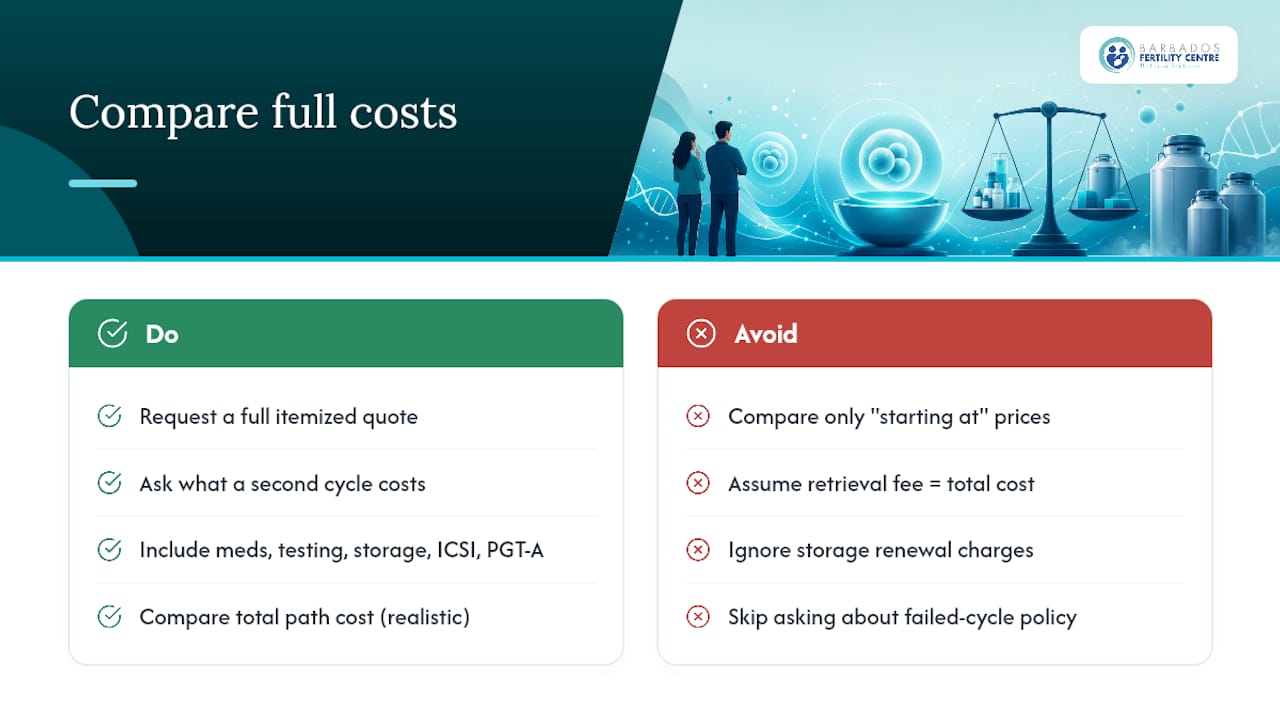
Conventional advice tells people to “shop around,” which is fine as far as it goes, but it skips the harder question: shop around for what, exactly? Two clinics quoting the same retrieval fee can differ by thousands once you factor in how they bill ICSI, whether PGT-A is bundled, and how aggressively they charge for storage renewal. The number that matters isn’t the cycle price. It’s the total cost of the path you’re actually going to take, including a realistic chance you’ll need a second cycle.
If you take one thing from this breakdown, make it this: request a full itemized quote before you compare anything. Ask what happens if your first cycle doesn’t yield enough embryos. That single question exposes more about a clinic’s real pricing than any marketing page will.
— Barbados
Get a Transparent, Itemized Embryo Freezing Quote
Barbados Fertility Centre publishes its embryo freezing pricing directly, so you can see exactly what you’re paying for before you ever schedule a flight. An Egg Freezing Cycle starts from $4,950, a fraction of what many US clinics quote once medications and testing are added, and the clinic coordinates remotely with international patients from the first consultation through travel planning.

Instead of piecing together quotes from separate labs, pharmacies, and storage facilities, you get one itemized breakdown from a JCI-accredited clinic that has recorded thousands of successful pregnancies since 2002. If you’re weighing US pricing against a lower-cost alternative that doesn’t sacrifice medical standards, request a personalized itemized quote and start a remote consultation to map out your timeline, financing options, and travel schedule before you commit to a clinic.
Where to Read More on Coverage and Costs
For deeper reading on the topics covered here, these sources go straight to the primary guidance:
- ASRM’s ethics guidance on planned oocyte cryopreservation, covering clinical standards and access disparities.
- RESOLVE’s insurance coverage summaries by state, useful for checking your specific state’s mandate.
- The peer-reviewed cost review on PMC that anchors the cost figures used throughout this article.
- ASRM’s coding guidance explaining how storage and cryopreservation fees are billed.
This article is general information, not a substitute for advice from a qualified doctor. Consult a qualified healthcare professional about your own circumstances before acting on anything here.
Sources
- Peer-reviewed review on fertility preservation costs — PMC
- Planned oocyte cryopreservation to preserve future reproductive potential: an Ethics Committee opinion — ASRM
- ASRM coding guidance — embryo storage fees for multiple cycles
FAQ
Is Embryo Freezing Covered by Insurance?
Coverage depends on your state’s mandates, your employer’s plan design, and whether your freezing is medically necessary versus elective. RESOLVE’s insurance resources recommend calling your insurer directly to confirm coverage for the procedure, medications, and storage separately, since each is often billed and covered differently.
What Are the Downsides of Freezing Embryos?
The main downsides are financial and logistical: upfront costs commonly reach $10,000 to $20,000 per cycle, storage adds recurring annual fees, and there’s no guarantee a single cycle yields enough viable embryos. Legal questions around disposition can also complicate long-term planning if you don’t confirm terms in writing beforehand.
How Long Will Frozen Embryos Last?
Frozen embryos can remain viable for many years in proper storage conditions, with successful pregnancies reported from embryos frozen well over a decade earlier. The bigger practical concern over time is cumulative storage cost and the clinic’s long-term storage policies, not embryo viability itself.
Is Embryo Freezing Considered IVF?
Embryo freezing is a step within the broader IVF process, following egg retrieval and fertilization in the lab. It can also stand alone as a fertility preservation option when you freeze embryos now to use in a future IVF cycle, such as before medical treatment or to delay childbearing.