


Yes, you can fly with fertility medications, including injectables, needles and syringes. Pack everything in your carry-on, tell the TSA officer at the checkpoint that you have medically necessary liquids or injectables, and keep each medication in its labeled packaging. Most travelers clear security without trouble, and a little preparation makes the checkpoint a two-minute step instead of a worry.
This guide covers what TSA allows, how to pack and keep medications cold, what paperwork helps, and how to plan around delays, whether you are flying across the US or traveling abroad for treatment.
TL;DR
- Carry fertility medications in your carry-on, never in checked luggage, so a lost bag cannot derail a cycle.
- TSA allows medically necessary liquids over 3.4 ounces (100 milliliters). Take them out of your bag and tell the officer at the start of screening.
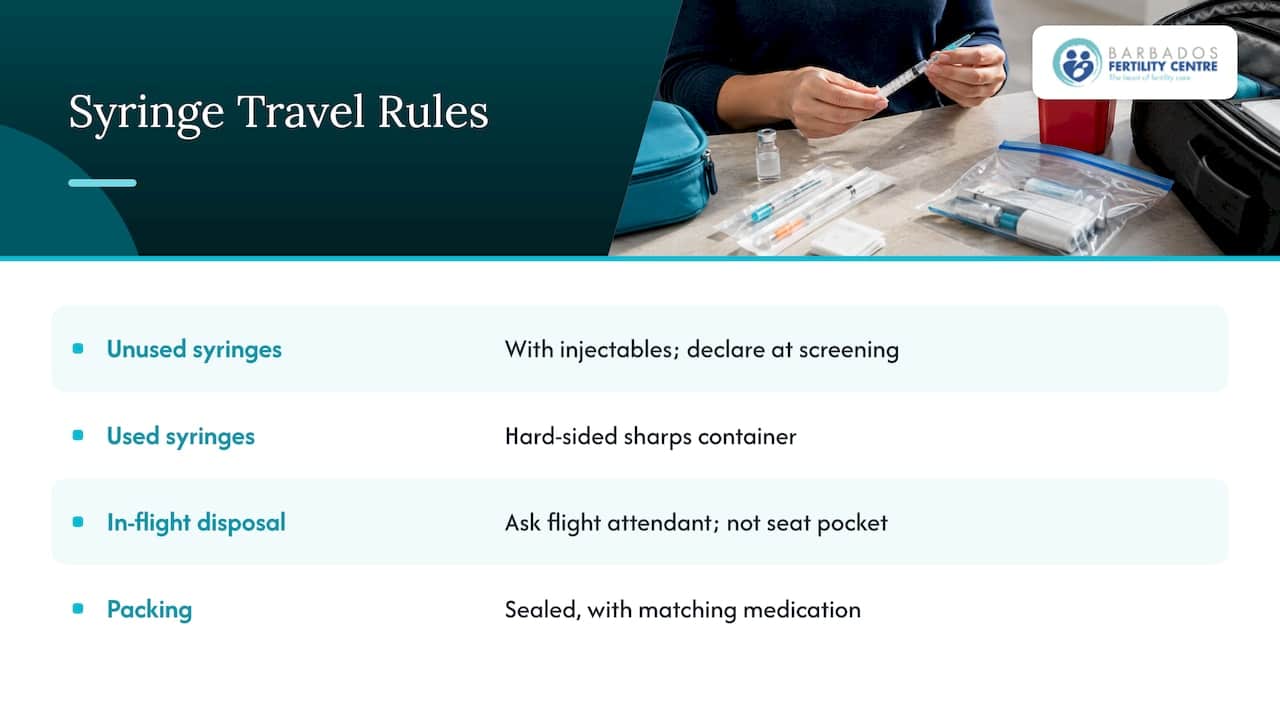
- Unused syringes are allowed when you travel with the injectable medication they go with.
- Gel packs and ice packs are allowed to keep medication cool, even if partly melted.
- Bring a prescription copy or a short note from your clinic, plus a few extra days of medication in case of delays.
Table of Contents
- What TSA allows: the short version
- Syringes and needles at security
- How to move through the checkpoint
- Why carry-on only
- Do fertility medications need to stay cold?
- Packing checklist for an IVF trip
- Prescriptions and a doctor’s letter
- Birth control, pills and oral fertility drugs
- Delays, excursions and a backup plan
- Flying for treatment, and flying after transfer
- Our perspective
- Plan your treatment with us
- FAQ
- Sources
What TSA allows: the short version
TSA’s own guidance says medically necessary liquids, medications and creams over 3.4 ounces or 100 milliliters are allowed in carry-on bags, and that you should remove them for separate screening. The usual 3-1-1 liquid rule does not apply to them. All items still go through screening, and TSA recommends that medication be clearly labeled to make that easier.
For fertility patients this covers most of what you will carry:
- Pre-filled pens and vials of stimulation medication
- Trigger shots
- Progesterone in oil
- Oral medications and patches
- Alcohol wipes, syringes and needles
The principle is the same for all of them: declare, separate, and let the officer screen.
Syringes and needles at security
Seeing a bag of needles in your carry-on can feel alarming, but TSA treats this as routine. TSA permits unused syringes in carry-on and checked bags when they are accompanied by injectable medication, and you should declare them to a security officer at the checkpoint for inspection.
The American Diabetes Association, which publishes guidance for travelers who inject daily, notes that unused syringes are allowed with insulin or other injectable medication, and that used syringes are allowed in a sharps container or another hard-surface container. If you need to inject during a flight, it helps to know that United Airlines asks passengers to ask a flight attendant for help disposing of syringes rather than leaving them in the seat pocket or lavatory.
A practical tip: keep needles and syringes in their original sealed packaging, in the same pouch as the medication they are used with. That makes the link between the two obvious to the officer.
How to move through the checkpoint
A clear routine keeps things calm, especially if you are already tired or anxious about the cycle ahead.
- Pack your medications in one pouch or organizer at the top of your carry-on, so you can pull it out in seconds.
- Tell the officer before screening starts. Say something simple: “I have medically necessary liquids and injectable medication.”
- Take the medication out of your bag and place it in a separate bin. The ADA advises that medical liquids in containers over 3.4 ounces should not go in the quart-sized bag with your other liquids.
- Expect possible extra screening. TSA’s disability and medical conditions page explains that officers may test liquids for explosives. If screening technology cannot clear an item, you may be asked to open the container for vapor analysis, and screening never involves putting anything into the medically necessary liquid.
- Ask about alternatives if you are concerned. If you do not want a vial opened, tell the officer. The same TSA page notes that an item whose alarm cannot be resolved may not be allowed through, so give yourself time rather than arriving at the last minute.
Allow an extra 20 to 30 minutes on top of your usual airport arrival time. That is our own suggestion, not a TSA requirement, but it removes the pressure if you are asked for a second look.
Why carry-on only
The most repeated advice from specialty pharmacies is never to check fertility drugs. A pharmacy that ships these medications notes that a missing bag of specialty medication could compromise an entire treatment cycle. We agree for three reasons:
- Checked bags get delayed or lost, and replacing stimulation medication at short notice is difficult and costly.
- Cargo holds can reach temperatures that medication labels do not allow.
- Timing matters. Many injections are scheduled to the hour, and a trigger shot cannot wait for your suitcase.
For a deeper look at what each drug does and why timing matters, see our guide to IVF medications.
Do fertility medications need to stay cold?
It depends on the drug, the brand and whether the product has been opened. Always follow your own pharmacy label and your clinic’s instructions. Official product information shows how different the requirements can be:
| Medication (example) | Storage per product information | Source |
|---|---|---|
| Gonal-f lyophilized multi-dose vials | Refrigerated or room temperature, 2°-25°C (36°-77°F), protected from light | US product label |
| Gonal-f pen (Canadian monograph) | Patient may store at 2-25°C for up to 3 months; after first use up to 28 days at room temperature; do not freeze | Product monograph |
| Menopur | Room temperature, 15°-25°C, protected from light; use right after reconstitution | Product monograph |
| Ovidrel | 2-8°C, protected from light, not frozen | Healthdirect product information |
Brands, formulations and countries differ, so use this table to understand the range and not as instructions for your own supply. Your prescription label and the leaflet in the box are the final word, and your clinic nurse can confirm anything unclear.
Keeping medication cool in the air
For anything that must stay refrigerated, use a small insulated bag with a frozen gel pack. TSA states that ice packs, freezer packs and gel packs may be presented at the checkpoint frozen, partially frozen or melted to keep medically necessary items cool, so you do not need to worry if the pack softens on the way.
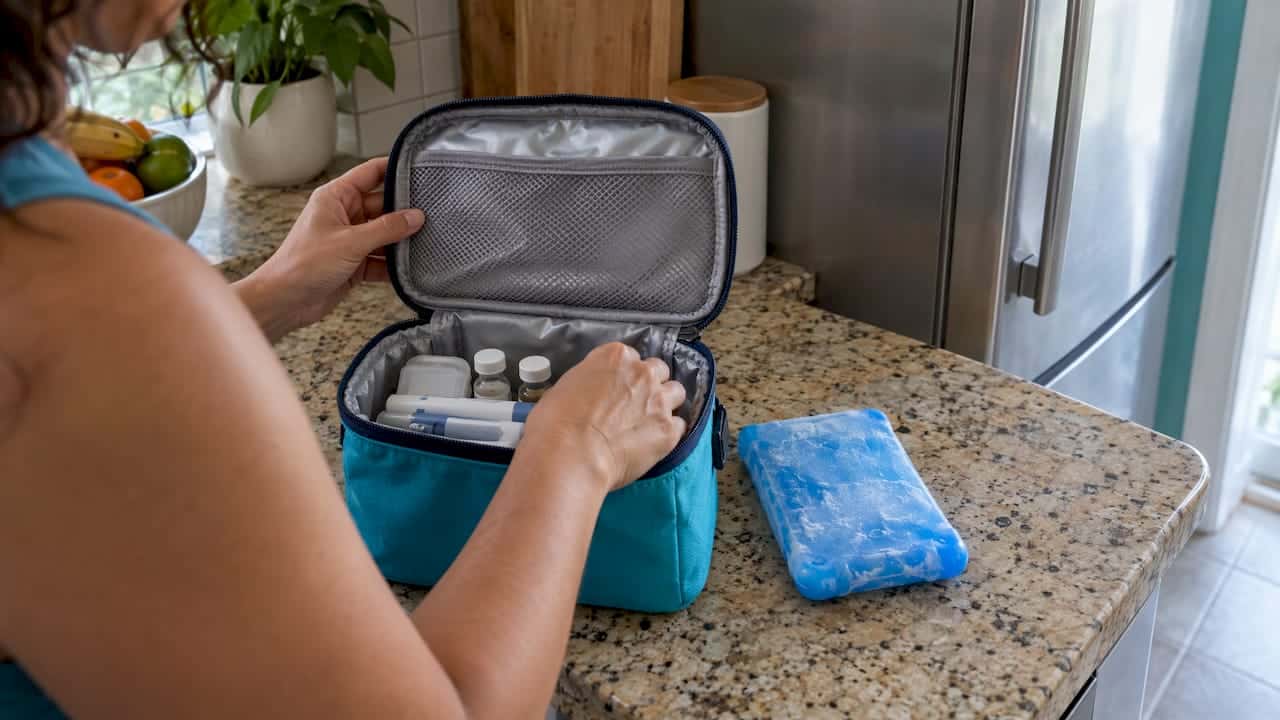
Do not count on the airline to chill your medication. United, for example, says it cannot store medication in its fridges or coolers, so you need to follow TSA’s policy on ice and ice packs and bring your own cooling. Check your airline’s page before you fly, because policies differ.
At your destination, check the hotel mini-fridge. A specialty pharmacy guide warns that some mini-fridges do not cool well while others get cold enough to freeze medication. Put a thermometer inside for the first hour, or ask the front desk for a fridge that can be set to a stable temperature.
Packing checklist for an IVF trip
A specialty pharmacy suggests building an IVF medication organizer in your carry-on, with alcohol wipes, syringes and a few extras, and keeping prescriptions in their original packaging. Here is a fuller list we recommend to patients planning travel:
- Medications, enough for the whole trip plus 2 to 3 extra days
- Syringes and needles, in sealed packaging, with a few spares
- Alcohol wipes, gauze and a small sharps container for used needles
- Insulated bag and gel packs for refrigerated items
- A written schedule with drug names, doses and exact injection times, including time zone changes
- A copy of your prescriptions and your clinic’s contact details
- A thermometer for the hotel fridge
- Travel insurance details, since not all policies cover fertility treatment. See our guide to travel insurance for IVF abroad
Time zones and injection times
If you cross time zones, ask your clinic whether to keep home time or shift gradually. Do not guess with a trigger shot or a timed antagonist dose. Set phone alarms in both time zones and write the plan on paper in case your phone dies.
Prescriptions and a doctor’s letter
TSA does not publish a requirement for a doctor’s letter for domestic flights, but carrying proof is sensible. United recommends bringing proof of prescription in case TSA asks. That can be:
- The pharmacy label on each medication, in your name
- A printout or screenshot of your prescription
- A short letter from your clinic on letterhead listing your medications, stating they are for personal treatment, and mentioning that you carry needles and syringes for injection
A letter is not a pass that overrides screening, but it answers questions quickly. If you are flying internationally, check the rules of the country you are entering for restricted medications, because requirements are set by each country’s authorities, not by TSA. Your clinic or the destination country’s embassy can point you to the right page.
Birth control, pills and oral fertility drugs
Oral medications are simpler than injectables. TSA allows pills in both carry-on and checked bags, which covers birth control used to schedule a cycle, as well as oral ovulation medications. We still advise carrying them in your carry-on, in their labeled packaging, for the same reasons as injectables: a delayed bag should never delay a cycle. A pharmacy resource adds that solid-form fertility drugs can be brought in any quantity if they are screened.
Delays, excursions and a backup plan
Flights get canceled and bags get lost. The same pharmacy guide notes that most medications allow brief excursions from labeled storage conditions, but delays are unpredictable. Before you leave:
- Ask your clinic how long each medication can be outside its labeled temperature range
- Keep your clinic’s after-hours number in your phone and on paper
- Know a pharmacy near your destination that can fill an emergency prescription
- Fly early in the day when possible, so a cancellation leaves time to rebook
Flying for treatment, and flying after transfer
Many of our patients travel from across the US for treatment with us, which means flying with medications at least once. Our team coordinates the plan remotely, so you know which medications you start at home and which you need to bring. Read more about IVF treatment abroad and how to make the most of a treatment timeline abroad.
If you are wondering about the flight home after an embryo transfer, we reviewed our own results in flying after embryo transfer. Medication costs also shape how people plan, and our page on IVF medication costs explains how to reduce them. If your regimen includes progesterone, our comparison of progesterone injections and suppositories may help you decide how to carry and use it.
Our perspective
We see the same worry in almost every patient who travels for treatment: will my medication get through the airport? In our experience, preparation removes most of the stress. A labeled pouch, a short letter from the clinic and a clear injection schedule are what make the journey easy.
Our approach to treatment is designed to reduce stress at every step, and travel is part of that. Barbados Fertility Centre has treated patients since 2002 and operates under JCI accreditation. Our team coordinates remotely with international patients, so you arrive knowing what to bring, what we will provide and when each injection is due.
We also believe care should be affordable and transparent. Treatment in Barbados costs significantly less than at many US clinics, and that includes the planning support that makes a trip like this manageable. If you are unsure about any medication or packing question, ask us before you fly.
Barbados
Plan your treatment with us
If you are comparing options for IVF, IUI or egg freezing and want to know what the journey looks like, we publish our prices openly. IVF starts from 5,750 USD, and egg freezing starts from 4,950 USD, per our price list for CARICOM residents. International patients can see rates on the international price list, and you can estimate your own plan with the IVF cost calculator.

Tell us where you are flying from and which medications you expect to use, and our team will help you plan packing, timing and storage around your cycle.
FAQ
Can I fly with IVF injections?
Yes. TSA allows medically necessary liquids and injectable medication in carry-on bags, even above 3.4 ounces. Declare them at the checkpoint, remove them from your bag for separate screening, and keep syringes with the medication they belong to.
Do IVF injections need to be refrigerated while traveling?
Some do and some do not. Storage ranges differ by drug and brand, from room temperature to 2-8°C, so check your label and ask your clinic. For refrigerated items, use an insulated bag with a frozen gel pack, which TSA allows even if partly melted.
Can I bring birth control on a plane?
Yes. TSA allows pills in carry-on and checked bags. Keep them in your carry-on in labeled packaging so a delayed bag does not interrupt your schedule.
Do I need a doctor’s letter to fly with fertility meds?
No letter is listed as a TSA requirement, but proof of prescription is recommended by airlines such as United. Pharmacy labels and a short clinic letter listing your medications and needles answer most questions quickly. For international trips, check the destination country’s rules.
Sources
- TSA: I am traveling with medication, are there any requirements
- TSA: Unused syringes
- TSA: Disabilities and medical conditions
- TSA: Medications (pills)
- American Diabetes Association: What can I bring with me on the plane
- United Airlines: Traveling with medication and medical equipment
- Traveling with fertility medication (pharmacy guide)
- Traveling with fertility medications (PDF guide)
- Gonal-f product label
- Gonal-f pen product monograph
- Menopur product monograph
- Ovidrel product information (Healthdirect)
Recommended
- Flying After Embryo Transfer: 2,135 Transfers, No Clear Difference
- Travel Insurance for IVF Abroad: What to Check Before You Fly
- Making the Most of a Fertility Treatment Timeline: IVF Abroad
- IVF Medications List: What Each Drug Does and What to Expect