


An endometrial scratch is a short procedure in which a thin plastic catheter is passed through the cervix to gently injure the lining of the uterus, usually in the cycle before IVF or an embryo transfer. The idea is that the lining’s healing response may make it more receptive to an embryo. The research is mixed: large reviews describe the evidence as uncertain, and results for people with previous failed cycles are debated. This guide explains how the procedure works, what it feels like, what the studies say, and how endometrial polyps relate to it.
TL;DR
- An endometrial scratch (also called endometrial injury) is essentially an endometrial biopsy done with a thin pipelle catheter, usually around day 21 of the cycle before treatment.
- Cochrane reviewers say it is unclear whether the procedure changes live birth rates, and the HFEA calls the evidence conflicting for most IVF and ICSI patients.
- Expect cramping and some bleeding. Infection and uterine perforation are possible but extremely rare.
- Polyps are a separate issue: they can interfere with implantation, and removal is often considered after repeated IVF failure.
- Ask your fertility team whether a scratch, a polyp check or another work-up fits your history before you add anything to a cycle.
Table of Contents
- What an endometrial scratch is
- How the procedure is done
- When it is performed
- What it feels like and what to expect afterward
- Does it improve IVF results?
- Checking the uterus first: lining, scars and polyps
- Endometrial polyps and fertility
- Perspective
- What treatment costs at our clinic
- Questions to bring to your appointment
- FAQ
- Sources
What an endometrial scratch is
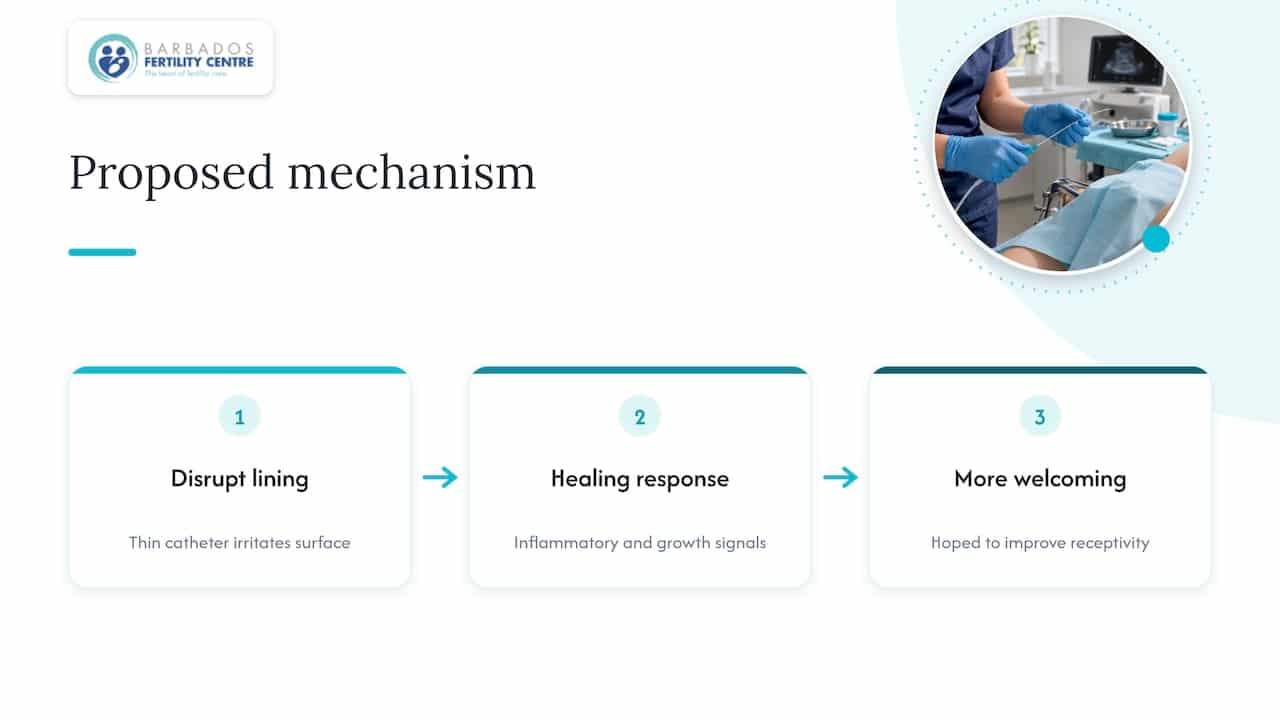
The endometrium is the lining of the uterus. It thickens each cycle so that an embryo can attach and grow. Endometrial scratching, also known as endometrial injury, deliberately disrupts that lining with a thin plastic catheter, in the hope of improving endometrial receptivity for implantation.
The name sounds harsher than the procedure. It is not surgery and it does not involve anesthesia in the usual sense. Clinically it is the same as an endometrial biopsy: a doctor collects a small sample and, in doing so, irritates the surface of the lining. The theory is that the healing response afterward, which may involve inflammatory and growth-related signals, creates a more welcoming environment for an embryo.
It is considered an “add-on” to IVF rather than a core part of treatment. The core steps, ovarian stimulation, egg retrieval, fertilization in the laboratory and embryo transfer, are described on our page on what IVF involves. An add-on is anything extra that is offered with the hope of improving the odds, and each one deserves a clear conversation about what the evidence shows.
How the procedure is done
The steps are short and similar to a routine pelvic exam or cervical screening:
- You lie back as you would for a speculum exam.
- The doctor inserts a speculum to see the cervix.
- A thin plastic pipelle is passed through the cervix into the uterus.
- The pipelle is moved back and forth and rotated to collect a sample and scratch the lining.
- The catheter is withdrawn and the visit ends, often within minutes.
Some providers add a saline rinse afterward, and techniques vary between clinics. You can usually go home right away. If you are nervous about a speculum exam, tell your doctor beforehand so they can pace the procedure and talk you through it.
When it is performed
Timing matters because the lining changes through the cycle. The scratch is usually performed around day 21 of the cycle before IVF or embryo transfer, meaning the cycle that precedes the treatment cycle. In practice, your clinic sets the exact day based on your cycle length and your treatment protocol.
Because timing is tied to your cycle, it helps to avoid assuming you are pregnant if you are trying naturally in a cycle when a scratch is planned. Your doctor will usually ask you to use protection or confirm that you are not pregnant before the procedure. Follow your own clinic’s instructions on this point.
What it feels like and what to expect afterward
Most people describe period-like cramping during the procedure and for a short time afterward. Official guidance describes the procedure as intrusive and potentially painful, so it is reasonable to plan for it:
- Take any pain relief your doctor recommends before you arrive.
- Allow a quiet afternoon rather than a packed schedule.
- Expect light spotting or bleeding afterward, and use a pad rather than a tampon unless your clinic says otherwise.
Spotting after a scratch can be confusing if you are also tracking symptoms. If you want to understand how light bleeding differs from a period or early pregnancy bleeding, this explainer on implantation bleeding versus a period walks through timing and testing. If you had a scratch in a cycle where you are also trying to conceive, ask your clinic before you interpret any bleeding yourself.
Risks
The procedure may cause pain, bleeding or infection, and, extremely rarely, uterine perforation. Contact your clinic promptly if you develop fever, severe or worsening pelvic pain, foul-smelling discharge or heavy bleeding after the procedure. These need medical assessment, not waiting.
On the question many parents-to-be ask, the UK’s fertility regulator reports no evidence that scratching poses additional risks to a child born after fertility treatment.
Does it improve IVF results?
This is the question behind most searches, and the honest answer is that nobody can promise a benefit.
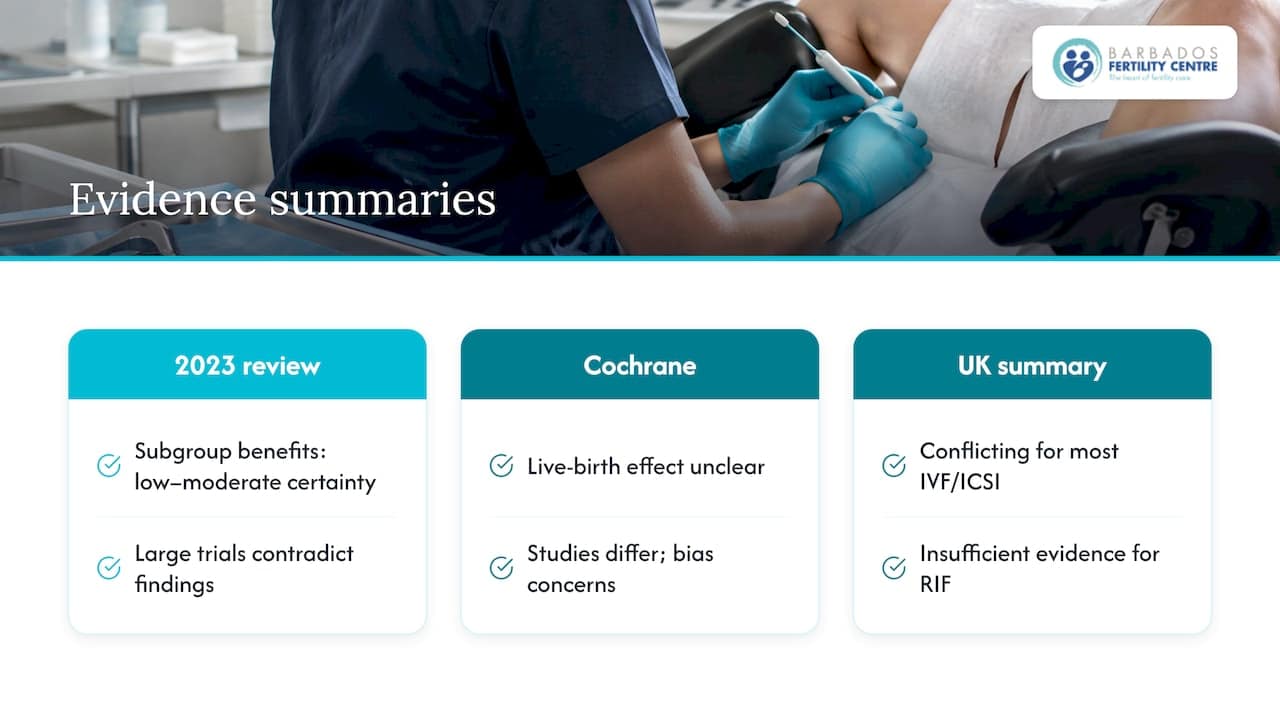
Early small studies suggested promise, especially for women who had several failed transfers. Since then, larger trials have complicated that picture. A 2023 review noted that although some meta-analyses reported potential benefits for sub-groups with prior IVF failures, those findings were of low to moderate certainty and contradicted by other large randomized trials.
The Cochrane review, one of the most rigorous evidence summaries in medicine, states that it is unclear whether endometrial injury affects live birth rates. Reviewers pointed to potential bias in many studies and to the fact that the studies differed from one another. The review’s evidence runs to December 2025.
The UK regulator’s summary is similar. It describes the evidence as conflicting for most IVF or ICSI patients and insufficient to rate effectiveness for patients with recurrent implantation failure.
Why results differ between studies
Part of the confusion comes from how studies are built. They differ in:
- Who is included: first-time IVF patients, people with two or more failed transfers, or women using donor eggs.
- When and how the scratch is done: the cycle day, the device, and whether a rinse follows.
- What is measured: clinical pregnancy, ongoing pregnancy or live birth. Live birth is the outcome that matters most to patients.
A study of scratching in egg donation cycles, for example, asked whether a scratch changed pregnancy and live birth rates when the eggs came from young donors, a setting that separates endometrial factors from egg quality. Different populations answer different questions, which is why a single headline claiming that scratching “boosts pregnancy rates” deserves a careful read of the underlying trial.
What this means for you
If your clinic offers a scratch, ask a few plain questions:
- What does the evidence show for someone with my history?
- Is it done in the cycle before treatment, and what does it cost?
- What discomfort should I plan for?
- What else could explain my previous failed cycles, and has that been checked?
That last question is often the most productive. Repeated implantation problems can have many causes: embryo quality, chromosomal factors, hormonal support, or structural issues in the uterus. A scratch addresses none of those directly, so a good work-up matters more than any single add-on.
Checking the uterus first: lining, scars and polyps
Before considering an add-on, many specialists prefer to look for things that can be identified and treated. A few examples:
- Lining thickness and quality. A thin lining can reduce the chance of implantation. Our guide to a thin uterine lining explains hormonal versus structural causes, and why scars or infection should be ruled out first.
- Cavity shape and tubes. An ultrasound-based test such as SIS or HyCoSy can help assess the uterine cavity and tubes.
- Conditions such as endometriosis. Our page on endometriosis and fertility covers how it can affect treatment planning.
- Hormonal support after transfer. The form of progesterone you use matters for many patients; see our comparison of progesterone injections and suppositories.
Endometrial polyps and fertility
People who search for endometrial scratching often also search for polyps, because both involve the uterine lining and both come up when IVF cycles have not worked.
What polyps are
Endometrial polyps are growths that arise from the uterine lining and project into the cavity. A 2021 review describes them as space-occupying lesions that may interfere with embryo implantation through local inflammation or altered receptivity, including changes in the genes HOXA10 and HOXA11, which help the lining prepare for pregnancy.
How they are found
Polyps are identified by transvaginal ultrasound or hysteroscopy, a procedure in which a thin camera is passed into the uterus. An ultrasound with fluid in the cavity can make them easier to see. Hysteroscopy lets the doctor look directly and, if needed, remove the polyp in the same visit.
Should a polyp be removed?
The answer depends on the person. Management in infertile patients is typically individualized: some small polyps under 10 mm may regress on their own, while removal is often considered in cases of repeated IVF failure.
The evidence on results after removal is mixed. Some studies suggest a benefit for IUI cycles, but there is no strong, consensus-based evidence that routine polyp removal significantly improves live birth rates in IVF. That is why clinicians usually decide case by case, weighing symptoms, polyp size, your age, and your treatment history.
If polyps are found on a scan, ask your doctor:
- How large is it, and is there more than one?
- Do you recommend removal now or monitoring?
- If removed, how long before I can begin or resume treatment?
How polyps and scratching differ
| Endometrial scratch | Polyp assessment and removal | |
|---|---|---|
| What it is | Deliberate injury to the lining with a pipelle | Finding and, if needed, removing a growth in the cavity |
| Purpose | To trigger a healing response that may aid implantation | To clear a possible physical obstacle |
| Typical timing | Around day 21 of the cycle before treatment | After ultrasound or hysteroscopy findings |
| Evidence | Uncertain effect on live birth | Mixed, individualized decision |
| Main discomfort | Cramping and light bleeding | Depends on the method; discussed with your doctor |
Perspective
We meet many patients who arrive after one or more cycles that did not work, and who have been offered a long list of extras. Our view is that the most helpful thing we can do is slow the conversation down and look at the whole picture: your age, your ovarian reserve, your partner’s semen results, the embryos you have produced, and the state of the uterus.
Endometrial scratching is a good example of a topic where honest conversation matters. The research is not settled, so we encourage you to ask what the evidence means for your own history rather than relying on a headline. Our approach is personalized, and we would rather map out the likely reasons for a previous cycle not working than add steps without a clear rationale.
Our clinic has operated since 2002 under JCI accreditation, and we publish our prices so you can plan with confidence. We coordinate treatment remotely for international patients, so you can have your questions answered and your plan in place before you travel. Our setting in Barbados is designed to keep the experience as calm as possible, because stress during treatment is something we take seriously.
Barbados
What treatment costs at our clinic
When a cycle has not worked, cost is often the next worry. Our published prices are transparent. IVF is listed from $5,750, IVF with ICSI from $6,750, and IUI from $500 per cycle including scans, on the CARICOM price list. On the international price list, ICSI is $7,650 and egg freezing is $4,950. Prices can change, so check the price pages for the current figures, and use our IVF cost calculator to estimate your own plan.
If you are comparing options abroad, our page on IVF treatment abroad explains how remote coordination works for international patients. Send us your history and previous results, and our team will talk through a plan built around you.

You can start with our IVF treatment page or the questions to ask before IVF.
Questions to bring to your appointment
Whether or not a scratch is on the table, a focused appointment helps. Consider bringing:
- A summary of previous cycles: medication, number of eggs, fertilization, embryo grades and transfer results.
- Any scan reports that mention the lining, polyps, fibroids or fluid.
- Questions about add-ons: what each one is, what it costs, what the evidence shows, and what the alternatives are.
- Your own priorities, such as budget, time off work and travel.
A scratch, a hysteroscopy, a change in hormone support and a closer look at embryo quality are all separate decisions. Treat each one on its own merits.
FAQ
Does an endometrial scratch hurt?
Most people feel cramping similar to period pain during the procedure, and it usually settles soon afterward. Official guidance describes it as intrusive and potentially painful, so taking pain relief as your doctor advises can help. If you have severe pain, fever or heavy bleeding afterward, call your clinic.
Does endometrial scratching increase the chance of a live birth?
The evidence is uncertain. Cochrane reviewers say it is unclear whether the procedure affects live birth rates, and some earlier benefits seen in people with failed cycles were not confirmed by other large trials. Your doctor can explain what applies to your history.
When is an endometrial scratch done?
It is usually done around day 21 of the cycle before IVF or embryo transfer. Your clinic sets the exact day according to your cycle and treatment plan.
Can endometrial polyps affect fertility?
They can. Polyps may interfere with implantation through local inflammation or changes in the lining’s receptivity. Small polyps sometimes regress on their own, and removal is often considered after repeated IVF failure. The decision is individual, so discuss it with your fertility specialist.
Sources
- Endometrial scratching for IVF, Evidence-based IVF, University of Melbourne
- Endometrial scratching, HFEA
- Does injury to the lining of the womb improve outcomes for women undergoing IVF, Cochrane
- The role of endometrial scratching prior to in vitro fertilization, Reproductive Biology and Endocrinology, 2023
- Management of endometrial polyps in infertile women, Clinical and Experimental Reproductive Medicine, 2021
Recommended