


Ovarian reserve testing estimates how many eggs remain in your ovaries and, more usefully, how your ovaries are likely to respond to fertility medication. It uses a blood test (AMH, sometimes FSH and estradiol) and a transvaginal ultrasound that counts antral follicles. It does not measure egg quality, and it cannot tell you whether you will get pregnant. This guide covers each test, when it is done, how to read the results and what to do with them.
TL;DR
- The main tests are AMH (a blood test that can be drawn on any day), FSH and estradiol (blood tests early in the cycle) and antral follicle count (an ultrasound).
- Results estimate egg quantity and likely response to stimulation. They do not measure egg quality or predict natural pregnancy.
- A low result is a reason to talk to a fertility specialist soon. It is never, on its own, a reason to be refused IVF.
- A single AMH blood test is often listed online from about $89. A full workup with ultrasound and a specialist consultation costs more.
- Age remains the strongest guide to egg quality, so results are best read together with your age and your plans.
Table of Contents
- What ovarian reserve means
- The main ovarian reserve tests
- How to prepare and what to expect
- What results mean
- What AMH can and cannot predict
- Using your results in treatment and egg freezing
- How much ovarian reserve testing costs in the US
- Our perspective
- Start with a fertility assessment
- FAQ
- Sources
What ovarian reserve means
Ovarian reserve is the number of eggs (oocytes) left in your ovaries. You are born with all the eggs you will ever have, and the number declines with age. The American Society for Reproductive Medicine (ASRM) says testing is mainly useful for estimating how the ovaries will respond to stimulation and for counseling about treatment. It describes the tests as poor standalone measures of reproductive potential, natural fertility or short-term chances of conceiving.
That framing matters. Think of ovarian reserve testing as a map of your options and your likely medication needs, not a verdict on your fertility.
The main ovarian reserve tests
ASRM lists two families of tests: biochemical tests (blood hormones) and ovarian ultrasound. Here is how they compare.
| Test | What it measures | When it is done | Notes |
|---|---|---|---|
| AMH (anti-Müllerian hormone) | A hormone made by small developing follicles | Any day of the cycle | Cycle-independent and more sensitive than early-cycle hormone levels |
| FSH | Pituitary hormone that rises when the ovaries respond less | Cycle day 2, 3 or 4 | Elevated values are specific but not sensitive, and results vary between cycles |
| Estradiol | Estrogen, read alongside FSH | Early in the cycle | Not interpreted alone |
| Antral follicle count (AFC) | Number of small follicles (2 to 10 mm) in both ovaries | Ultrasound, usually early in the cycle | Depends on equipment and the sonographer |
ASRM also notes that ovarian volume is rarely used because of variability and lack of sensitivity, and that clomiphene challenge testing should be abandoned.
AMH
AMH is the test most people start with, because the blood draw does not have to be timed to your period. ASRM calls AMH and AFC the sensitive markers of ovarian reserve that help counsel patients about response and the number of eggs retrieved.
Two cautions apply. The European Society of Human Reproduction and Embryology (ESHRE) warns in its 2025 patient leaflet that AMH may give false readings in people using oral contraceptives and in people with polycystic ovary syndrome (PCOS). If you have PCOS, our pages on managing PCOS explain how it can affect results and treatment.
FSH and estradiol
Basal FSH is typically measured on cycle day 2, 3 or 4. A high value points to reduced reserve, but a normal value does not rule it out, and one reading can mislead because levels vary within and between cycles. The ASRM patient fact sheet adds that reference ranges differ between laboratories, so always compare your number with the range printed on your own report.
Antral follicle count
AFC is done with a transvaginal ultrasound in the early part of your cycle. The sonographer counts the small follicles visible in both ovaries. It is the one test that lets a clinician see your ovaries, and it can also reveal conditions such as cysts or fibroids that affect fertility. Because it relies on skill and equipment, a clinic that does these scans every day gives the most consistent count.
How to prepare and what to expect
- Choose your tests. Most clinics combine AMH with an AFC scan. FSH and estradiol are added when a fuller picture is needed.
- Time them. AMH can be drawn any day. Schedule FSH, estradiol and the ultrasound for the first days of your period.
- Tell the clinician what you take. Hormonal contraception and PCOS can change how AMH is read.
- Bring your history. Cycle length, past surgery, endometriosis and family history of early menopause help put numbers in context.
- Review results with a specialist. A number on a lab report means little without your age and goals.
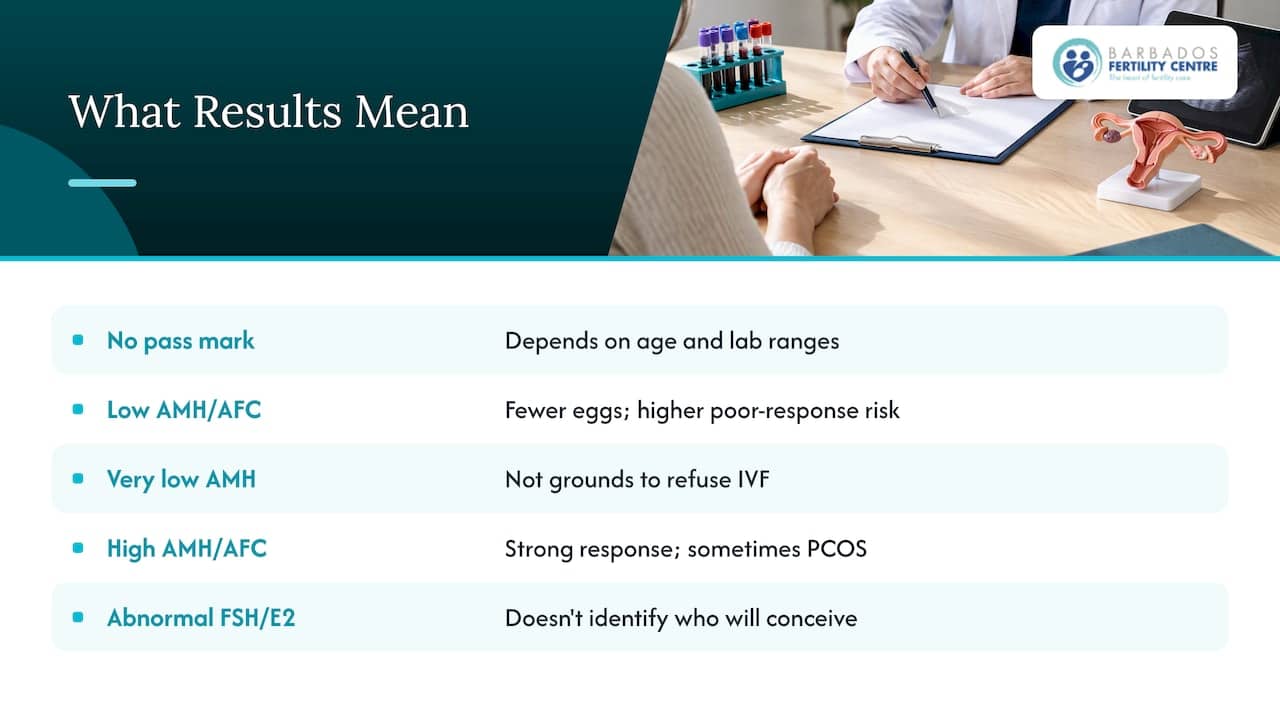
What results mean
There is no single pass mark. Labs report AMH in different units and ranges, and what counts as “low” depends on your age. As a rough illustration of how steeply AMH falls with age, see our AMH levels by age nomogram.
A low AMH or low AFC suggests a smaller number of eggs and a higher chance of a poor response to stimulation. ASRM says extremely low AMH should not be used to refuse IVF treatment. If you have been told your count is low, read can I still do IVF with a low egg count.
A high AMH or high AFC can signal a strong response, and sometimes PCOS. Clinicians use it to avoid overstimulation, which is why dosing is individualized.
Abnormal FSH or estradiol generally indicates reduced fertility potential, but the ASRM fact sheet is clear that it does not identify who will or will not conceive.
What AMH can and cannot predict
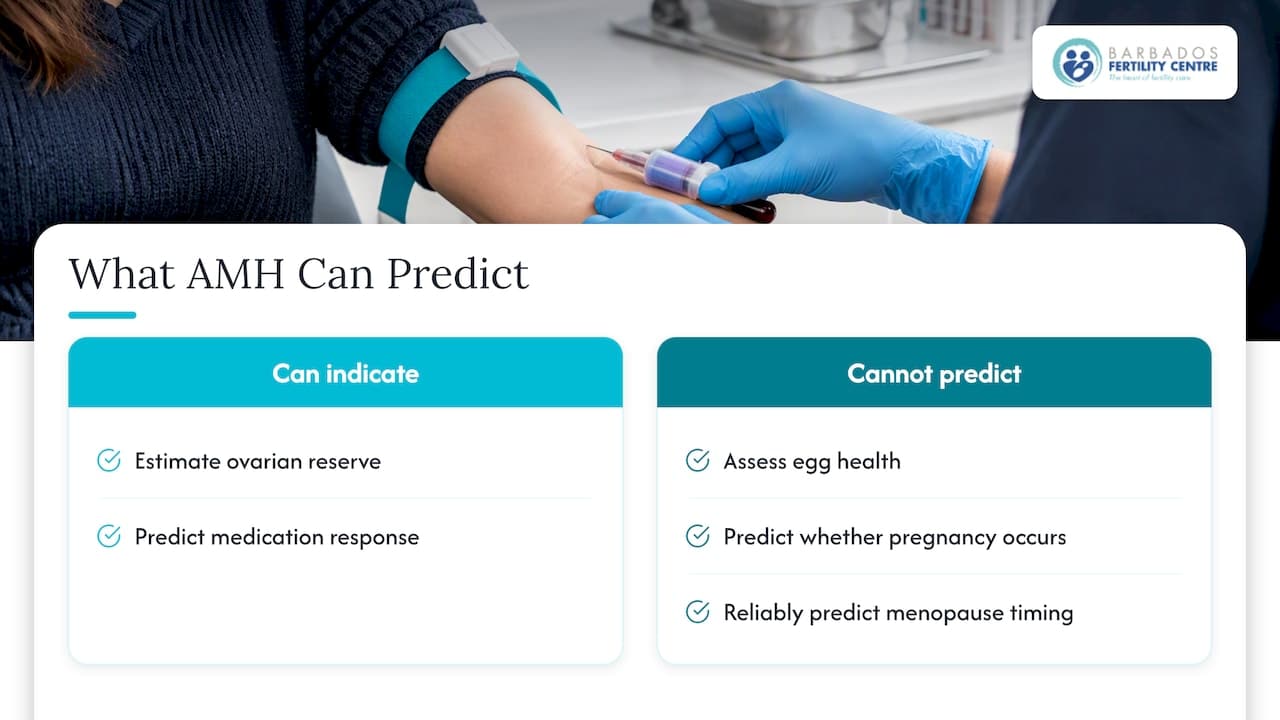
The most common misunderstanding is that AMH measures egg quality or the odds of pregnancy. It does not. MedlinePlus says AMH can estimate ovarian reserve and help predict response to fertility medicines, but it cannot assess egg health or predict whether pregnancy will occur.
ESHRE goes further: pregnancy can occur with low AMH, and women of the same age have, on average, similar monthly chances of pregnancy regardless of AMH level. The same leaflet says AMH cannot reliably predict when an individual will reach menopause. If you are noticing cycle changes and wonder whether they are hormonal, this overview of perimenopause symptoms and timeline explains what that transition looks like.
In practice: your age is the best guide to egg quality, and AMH is the best guide to how much medication you may need.
Using your results in treatment and egg freezing
For IVF. MedlinePlus explains that AMH helps clinicians select a stimulation dose: higher AMH generally suggests a response to a smaller dose, while low AMH may call for a higher one. This is the most practical use of the test. It makes a cycle safer and more efficient. See what IVF involves for the full process.
For IUI. If your reserve looks reasonable and your other findings are favorable, a simpler treatment may be considered first. Our page on intrauterine insemination explains when that fits.
For egg freezing. ASRM advises that egg-freezing decisions should rest on your reproductive plans and age, with AMH informing the expected yield, not whether to proceed. Our guide on how many eggs you should freeze shows how AMH and age shape that number.
How much ovarian reserve testing costs in the US
Prices vary by where you test. Online lab-ordering sites list a stand-alone AMH blood test from about $89, and the ceiling among the sites compared there was about $129. Home collection kits are typically priced higher, and a few states restrict direct-to-consumer lab ordering.
A clinic workup costs more because it adds an ultrasound and a physician’s interpretation. Insurance coverage for fertility diagnostics differs by plan and by state, so ask your insurer before booking. A cheap blood test is only useful if someone qualified explains what it means for you.
Our perspective
We see many patients who arrive with a single AMH number and a great deal of worry. Our message is the same each time: the number is information, not a sentence.
At Barbados Fertility Centre, we read ovarian reserve results together with your age, your history and your goals. A low count changes the plan: it may mean a different medication protocol or a faster timeline, and sometimes the use of donor eggs. It does not mean you are out of options.
We designed our care to remove the barriers that make fertility testing and treatment feel overwhelming: clear pricing, a calm setting and remote coordination before you travel. Established in 2002 and operating under JCI accreditation, we aim to give international patients standards they would expect at a leading US clinic, at a more affordable cost.
If you are unsure what your results mean, get them to a specialist early. Time is the one factor you cannot buy back.
Barbados
Start with a fertility assessment
If you want your reserve tested and explained in one place, our Female Fertility Healthcheck is the place to begin, and partners can see the Male Fertility Healthcheck. Our published prices begin at $5,750 for IVF, $4,950 for an egg freezing cycle and $500 per cycle for IUI including scans, as listed on our price list and international price list. You can estimate your own plan with the IVF cost calculator.

Overseas patients can read how treatment abroad works, including coordination before you travel.
FAQ
Is there a test for egg quality?
No. AMH, FSH and AFC estimate how many eggs you have and how you may respond to medication, not their genetic or developmental quality. MedlinePlus states that AMH cannot assess egg health. Age is the more informative guide to quality.
Is IVF possible with a very low AMH?
Often, yes. ASRM states that extremely low AMH should not be used to refuse IVF. The likely number of eggs is lower and the stimulation plan may differ, so a specialist should set expectations for your age and situation.
Can I get pregnant naturally with low AMH?
Yes, it can happen. ESHRE notes that pregnancy occurs at low AMH and that women of the same age have similar average monthly chances regardless of AMH. If you have been trying for some time, especially over 35, consider seeing a fertility specialist.
When in my cycle should I test?
AMH can be drawn on any day. FSH and estradiol are usually measured on cycle days 2 to 4, and the antral follicle count ultrasound is also done early in the cycle. Tell your clinician if you use hormonal contraception, because it can affect AMH readings.
Sources
- ASRM: Testing and interpreting measures of ovarian reserve (2020)
- ASRM: Ovarian reserve patient fact sheet
- ESHRE: Is the AMH test a reliable test of fertility? (2025)
- MedlinePlus: Anti-Müllerian Hormone Test
- Find Lab Test: AMH test price comparison
- Perimenopause: symptoms, timeline and care
Recommended
- Donor Information
- Surgical Sperm Retrieval: Clinician Decisions That Avoid a Wasted Egg
- Recurrent Miscarriage Testing: What to Expect, Step by Step
- Under 7 mm Thin Uterine Lining? IVF Patients: Rule Out Scars or Infection First