

Smoking lowers your chances of success with IVF, and so does nicotine in other forms. The American Society for Reproductive Medicine (ASRM) links tobacco use to impaired fertility, a higher risk of miscarriage and poorer outcomes from assisted reproduction, and notes that much of the lost fertility may be regained within a year of quitting. If you are planning a cycle, stopping before you start is one of the few factors fully in your own hands. Here is what the evidence says for women and men, what to do about vaping and alcohol, and how to plan your timeline.
TL;DR
- Smokers may need nearly twice as many IVF cycles to conceive as nonsmokers, according to the ASRM practice committee.
- Vaping does not avoid nicotine exposure, and human evidence on its reproductive effects is limited, so it is not a safe swap.
- Much of smoking’s effect on fertility may be reversed within a year of quitting, so the earlier you stop, the better.
- Alcohol is linked to poorer IVF outcomes in women, and ACOG advises no safe level during pregnancy.
- Your partner’s habits count too. We can review your whole picture in a fertility assessment.
Table of Contents
- How smoking affects fertility and IVF in women
- What about men who smoke?
- Nicotine, vaping and other products
- When to quit: how long before IVF
- Practical steps for quitting before treatment
- Alcohol, egg quality and fertility
- Perspective: what we see at Barbados Fertility Centre
- Planning treatment once you have quit
- Treatment at Barbados Fertility Centre
- What to ask your fertility clinic about lifestyle
- FAQ
- Sources
How smoking affects fertility and IVF in women
Cigarette smoke carries thousands of chemicals, and several of them reach the ovaries, the eggs and the lining of the uterus. The ASRM’s committee opinion on tobacco and marijuana use states that tobacco use in women is strongly linked to impaired fecundity, meaning the ability to conceive, and to higher risks of miscarriage and ectopic pregnancy (ASRM, 2024). The same document reports that smokers may need almost twice as many IVF cycles to conceive as women who do not smoke.
In practical terms, this shows up at several points in a cycle:
- Ovarian response. Smoking is associated with a lower response to stimulation medication, which can mean fewer eggs retrieved.
- Egg and embryo quality. Smoking is associated with reduced embryo quality, which affects how many embryos are suitable for transfer or freezing.
- Implantation. Lower implantation rates are reported among smokers, so a good embryo has a smaller chance of settling.
- Early pregnancy loss. Miscarriage risk rises, which can turn a positive result into a heartbreaking setback.
The risks do not end at a positive pregnancy test. The Centers for Disease Control and Prevention (CDC) reports that smoking doubles the risk of abnormal bleeding during pregnancy and delivery, which creates serious dangers for both the mother and the baby. The CDC also notes that smoking can damage fetal development in ways that persist through childhood and into the teen years.
If you have already had a cycle that did not work and you smoke, that does not mean smoking was the only cause. IVF outcomes depend on age, ovarian reserve, sperm quality, uterine factors and more. Our page on why an IVF cycle may fail walks through the common reasons and what can be changed next time.
What about men who smoke?
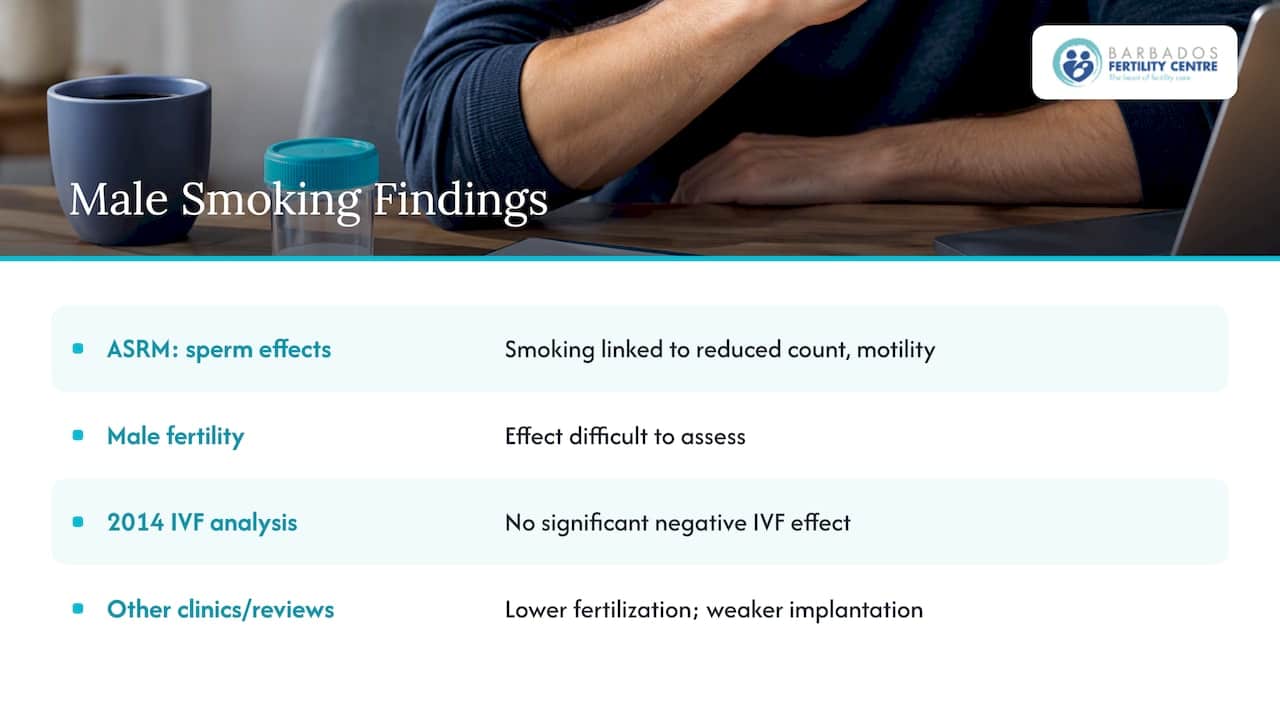
Male smoking is harder to measure than female smoking, and the research is mixed. The ASRM says that smoking is associated with reduced sperm parameters, such as count and motility, but that its effect on male fertility is difficult to assess. One widely cited analysis of IVF cycles by Cinar and colleagues, published in 2014, found that cigarette smoking among men did not have a significant negative effect on IVF outcomes. Other clinics and reviews report lower fertilization rates and weaker implantation when sperm comes from smokers.
How should you read that? Smoking is not good for sperm, and the effect may be modest in some couples and larger in others. When sperm quality is a concern, techniques such as ICSI, where a single sperm is injected directly into an egg, can help overcome some barriers. Our page on ICSI and male infertility treatment explains when it is recommended.
Secondhand smoke is a separate issue. If your partner smokes at home, quitting together is easier and removes an exposure for you as well.
Nicotine, vaping and other products
A common question is whether vaping, patches or nicotine gum are a safer way to cut down while trying to conceive. Here is what is known:
- Vapes and e-cigarettes. The ASRM notes that electronic nicotine delivery systems contain nicotine and other toxic substances, so nicotine exposure is not avoided by using them. Human evidence on their reproductive effects is scarce, though there is a theoretical basis for harm, and they are not recommended during pregnancy (ASRM, 2024).
- Nicotine replacement. Patches, gum and lozenges are sometimes used to quit cigarettes. Ask your physician or fertility specialist which product and dose make sense for you, especially if you are already pregnant or about to start stimulation medication.
- Marijuana. The same ASRM document covers marijuana use alongside tobacco. We recommend discussing any cannabis use openly with your care team before treatment.
The honest takeaway: because evidence on newer products is limited, the cautious plan is to aim for no tobacco and no vaping before and during treatment, with medical support if you need it.
When to quit: how long before IVF
The best time to quit is before you try to conceive. The ASRM states that much of the reduced fecundity linked to smoking may be reversed within a year of stopping. Older CDC-published evidence from the Surgeon General’s report shows that women who stop before pregnancy, or in the first three to four months, reduce their risk of a low-birth-weight baby to that of women who never smoked.
That gives you a rough planning guide:
| When you quit | What it means for you |
|---|---|
| A year or more before treatment | Gives the body the longest window to recover fertility |
| Several months before stimulation | Still worthwhile, and egg development during a cycle takes months |
| Right before a cycle | Better than continuing, and every smoke-free week counts |
| After a positive test | Still protective for the pregnancy, and you should ask your doctor for support |
There is no point waiting for a perfect timeline. If you are in your late thirties or older and time matters, speak with a specialist about balancing the clinical clock against the quit date. Age is a major factor for IVF, and our guide on age limits and success rates explains how it plays in.
Practical steps for quitting before treatment
Quitting is hard, and relapse is common. A plan helps more than willpower alone.
- Set a quit date and tell your partner and your care team. Support improves your odds.
- Talk to your doctor about medication. Prescription and over-the-counter options exist, and your doctor can advise on what suits your situation.
- Use free quit-line support. In the US, the national quitline at 1-800-QUIT-NOW connects you to your state’s program.
- Remove triggers. Clear lighters, ashtrays and vape pods from home and car.
- Replace the ritual. A walk, a stretching routine or a gentle class can fill the same slot.
- Plan for stress. Stress is a top relapse trigger, and fertility treatment can bring plenty of it.
On stress, there is useful background in this overview of stress and women’s health, which explains how stress affects the body and why managing it matters. Some people also find that mind-body practices help them through a quit attempt, and there is a good primer on yoga for fertility if you want to try one.
A healthy vitamin D level is another useful part of preparation, and our article on vitamin D and fertility covers it in detail.
Alcohol, egg quality and fertility
Many people who give up cigarettes ask about alcohol next. The picture is less clear-cut than for smoking, but the direction is consistent.
- Women. The American College of Obstetricians and Gynecologists (ACOG) notes that alcohol consumption in women is associated with menstrual disorders and altered fertility.
- IVF outcomes. A review of lifestyle factors found that studies generally show maternal alcohol consumption is negatively associated with successful pregnancy after IVF, and that paternal drinking may be linked to lower live birth rates too. It concludes that cutting down or abstaining before treatment may improve outcomes.
- Embryo quality. A separate review of couples undergoing assisted reproduction describes six epidemiologic studies on alcohol in women having ART, with some showing negative effects on outcomes such as fertilization and embryo quality.
- Pregnancy. ACOG advises that there is no safe level or type of alcohol use during pregnancy, and notes that brief counseling can reduce the risk of alcohol-exposed pregnancies.
Does the amount matter? Heavier drinking is generally associated with larger effects, but research has not established a threshold that is safe for everyone going through IVF. During a cycle you cannot know the exact day of conception or implantation, so the simplest guidance most clinics give is to avoid alcohol once you begin treatment. Before that, reducing is better than not reducing.
Perspective: what we see at Barbados Fertility Centre
We have been helping couples and individuals build families since 2002, and lifestyle questions come up in nearly every first consultation. Smoking is one of the most common, and often it comes with guilt. We do not want guilt to stop anyone from asking for help.
Our view is simple. IVF is a medical process, and the best results come from combining good laboratory work with a body that is as ready as it can be. Quitting smoking does not require perfection, and it does not need to delay you for years. We help you build a plan that fits your age, your history and your timeline.
We also know that treatment can feel overwhelming, which is why our approach focuses on minimizing stress. A calm environment, clear pricing and personal care help patients keep focused on healthy habits, including staying smoke-free. Because we are JCI-accredited, you can expect high medical standards without the complexity or the cost of many US clinics.
Tell us honestly about your habits and your partner’s. That information helps us tailor your protocol, and it is never a reason for judgment.
Barbados
Planning treatment once you have quit
Once you have a smoke-free routine, the next step is to understand your own fertility. A baseline assessment looks at ovarian reserve, uterine health and sperm quality, so any treatment recommendation fits you. Our fertility healthcheck is designed for this stage, including for international patients who coordinate remotely before traveling.
If you are not ready for IVF, there are other routes depending on your situation:
- Intrauterine insemination (IUI) is a less intensive first step for some couples.
- Egg freezing lets you protect your eggs now, and quitting smoking before retrieval is also advisable.
- IVF for single women and same-sex IVF are available with the same care.
If you have a condition such as endometriosis alongside lifestyle factors, read our overview of endometriosis and fertility to see how treatment is adapted.
Treatment at Barbados Fertility Centre
We offer IVF, ICSI, IUI, egg freezing, egg and embryo donation and fertility assessments in a private, internationally accredited facility in Barbados. Cost is a real concern for many patients, so we publish our prices.

Our published prices include IVF from $5,750, IVF with ICSI from $6,750 and egg freezing cycles from $4,950 on the CARICOM price list. On the international price list, ICSI is $7,650 and egg freezing is $4,950. IUI starts from $500 per cycle including scans. Prices differ by treatment plan, so check the CARICOM price list or the international price list for your situation, or use our IVF cost calculator. You can also learn how IVF abroad works, and see our success rates.
What to ask your fertility clinic about lifestyle
Whichever clinic you choose, you should feel free to ask these questions at the first visit:
- How will my smoking history, or my partner’s, change the protocol or the expected number of cycles?
- Is there a smoke-free period you recommend before stimulation?
- Do you test sperm before the cycle, and when might ICSI be advised?
- Which medications are safe if I am using nicotine replacement?
- What should I avoid during the two-week wait?
We also have a guide on what you should be asking about IVF, and a plain-language explanation of what IVF involves.
FAQ
Does smoking reduce IVF success rates?
Yes. The ASRM links tobacco use to poorer outcomes from assisted reproduction, and smokers may need nearly twice as many IVF cycles to conceive as nonsmokers. Smoking is also linked to a higher risk of miscarriage. The effect varies from person to person, and quitting can reverse much of it.
Can I vape or use nicotine gum instead while doing IVF?
Vaping does not avoid nicotine, and it adds other toxic substances. Human data on reproductive effects is limited, and the ASRM does not recommend these products during pregnancy. Ask your doctor about nicotine replacement before using it during treatment.
How long should I stop smoking before IVF?
The earlier, the better. The ASRM says much of smoking’s effect on fecundity may be reversed within a year of quitting. If you cannot wait that long, quitting several months before stimulation is still worth it, and so is quitting at any point after.
Does my partner’s smoking matter?
It can. Smoking is associated with reduced sperm parameters, although studies disagree on how strongly it affects IVF outcomes. Secondhand smoke also exposes you, so quitting together is the best approach.
Does alcohol affect egg quality and IVF?
Research links alcohol to menstrual disorders, altered fertility and poorer IVF outcomes in women, and ACOG says no amount is safe in pregnancy. Most clinics advise avoiding alcohol during treatment. Reducing or stopping beforehand may improve your chances.
Sources
- Health Effects of Cigarettes: Reproductive Health, CDC
- The Surgeon General’s 1990 Report on the Health Benefits of Smoking Cessation, CDC MMWR
- Prepregnancy Counseling, ACOG
- Alcohol and Women, ACOG
- Beyond body mass index: lifestyle factors that may influence IVF outcomes
- Caffeine, alcohol, smoking, and reproductive outcomes among couples undergoing ART
- Stress and Women’s Health
- Yoga for fertility
Recommended
- IVF – What You Should Be Asking
- Why did my IVF fail?
- Making the Most of a Fertility Treatment Timeline: IVF Abroad
- How Old Is Too Old for IVF? Age Limits, Success Rates & What Doctors Say