

For IVF, the trigger shot is usually taken 34 to 36 hours before egg retrieval. For IUI or timed intercourse, ovulation is expected roughly a day and a half after the shot, so insemination or intercourse is planned around that window. The exact hour is set by your clinic from your scans and bloodwork, and it is the one number in your cycle you should never round. This guide explains how the timing works, how to turn it into a clock time, and what to do if the plan goes wrong.
TL;DR
- IVF and egg freezing: the trigger is typically given 34 to 36 hours before retrieval. Your clinic picks the exact clock time and counts backward from the procedure.
- IUI and timed intercourse: the shot is timed so ovulation follows roughly 36 to 40 hours later, and your team sets the insemination or intercourse window around that.
- The medication matters: hCG, a GnRH agonist and a dual trigger do not behave identically, so the interval your clinic uses is specific to your prescription.
- Missed or late dose: call your clinic immediately. Do not double up or guess.
Table of Contents
- What the trigger shot does
- Trigger shot timing for IVF and egg freezing
- Timing for IUI and timed intercourse
- How clinicians decide the right moment
- What happens after the trigger
- Practical steps for a smooth trigger night
- What if you take it late, early or not at all?
- Our view at Barbados Fertility Centre
- Planning an IVF or egg freezing cycle with us
- FAQ
- Sources
What the trigger shot does
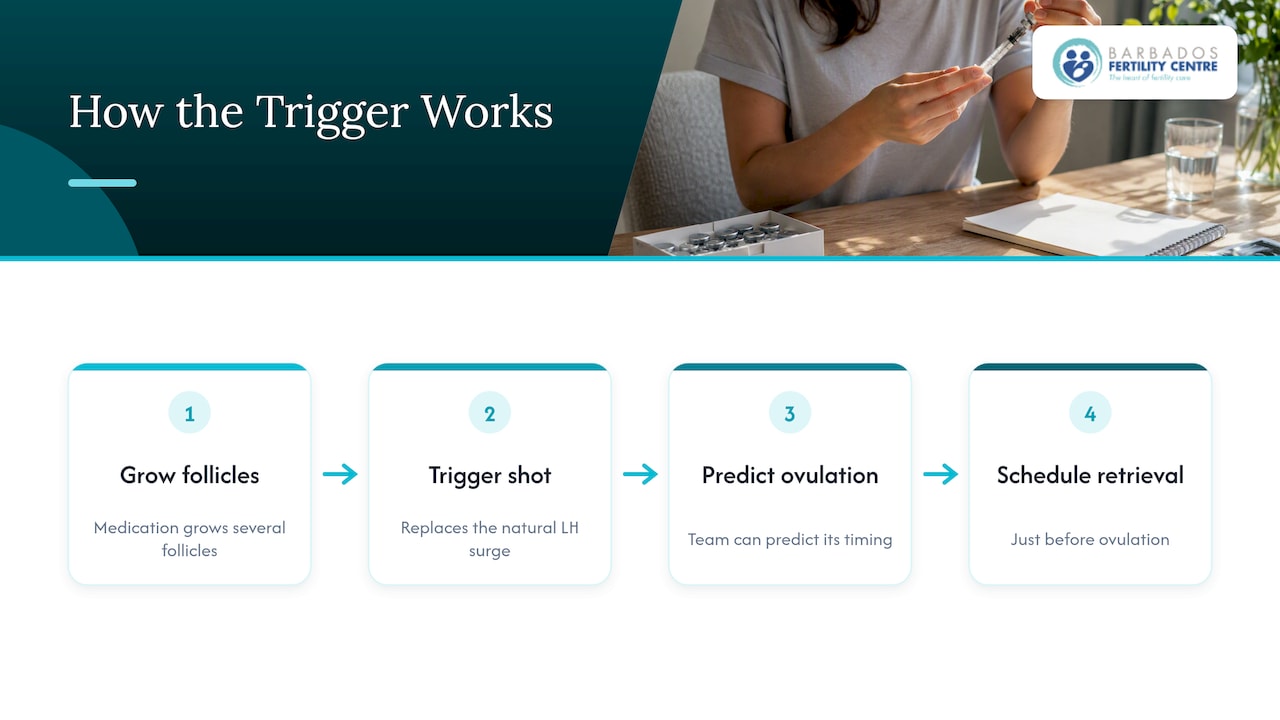
During stimulation, medication grows several follicles at once. The eggs inside are not ready to fertilize until they complete their final stage of maturation. In a natural cycle, a surge of luteinizing hormone (LH) handles this. In a stimulated cycle, the trigger shot replaces that surge, so your team can predict when ovulation would occur and schedule retrieval just before it.
That is why timing matters so much. The trigger starts a clock. Retrieval too early can mean immature eggs. Retrieval too late risks the follicles releasing the eggs before they can be collected. For an IUI cycle, the same logic applies in reverse: the shot tells you when ovulation is coming, so insemination meets the egg.
Trigger shot timing for IVF and egg freezing
The standard answer is 34 to 36 hours between the injection and the retrieval. A 2025 retrospective study of 59,206 cycles found that the optimal interval varies by trigger medication, with hCG generally needing a shorter interval than a GnRH agonist to maximize mature (MII) eggs. Another clinic guide describes a 36-hour gap before egg freezing retrieval, which falls at the upper end of the same range. Egg freezing follows the same stimulation and trigger logic as an IVF cycle, because in both cases the goal is to collect mature eggs.
Turning 36 hours into a clock time
Your retrieval is booked first, and the trigger time is calculated from it. Here is how that looks in practice:
| Retrieval scheduled for | Trigger window at 34 hours | Trigger at 36 hours |
|---|---|---|
| 8:00 a.m. Thursday | 10:00 p.m. Tuesday | 8:00 p.m. Tuesday |
| 9:30 a.m. Friday | 11:30 p.m. Wednesday | 9:30 p.m. Wednesday |
| 7:30 a.m. Monday | 9:30 p.m. Saturday | 7:30 p.m. Saturday |
These are arithmetic examples only. Your clinic will give you one specific time, sometimes with a few minutes of leeway, and that is the time to use. Set two phone alarms, and set one a few minutes early to give yourself time to prepare the injection.
Why your evening may look so exact
Most retrievals are scheduled in the morning, so most triggers land in the evening, often between 8 and 11 p.m. If you are traveling for treatment, plan where you will be at that hour. Check that your medication is stored correctly and that you have all the supplies in your room or home before the evening arrives. Our guide to making the most of a fertility treatment timeline abroad walks through how the pieces fit together for international patients.
Two-part and dual triggers
Some protocols use two medications. A dual trigger combines hCG with a GnRH agonist such as leuprolide, and a randomized trial in antagonist IVF cycles compared that approach with hCG alone. If your instructions list two injections, they may be spaced apart, for example an hour apart. Follow the order and spacing written on your plan rather than what you read in a forum, because those details differ between clinics.
Timing for IUI and timed intercourse
With IUI, the trigger is used to pinpoint ovulation. Your team monitors your follicles by ultrasound, and Healthline’s overview notes that specialists typically wait until follicles reach roughly 15 to 20 mm and the uterine lining is at least 7 to 8 mm thick, with protocols varying between clinics. Once those markers line up, you take the shot as directed.
The same source says ovulation generally happens about 36 to 40 hours after the shot. IUI is commonly performed around 24 to 36 hours after the trigger, and clinics that advise timed intercourse usually point you to a similar span. Because the window between shot and insemination is shorter than the window for IVF, ask exactly which day and hour the procedure will happen when you receive your trigger instructions.
IUI is a lower-intensity treatment than IVF, and cycles at our clinic start from 500 USD per cycle including scans, whether with a partner’s or donor sperm. Medication is a separate consideration, which we explain on our IUI cost page and IUI treatment page.
How clinicians decide the right moment
No one picks a trigger date from the calendar. The decision comes from three streams of information:
- Follicle size on ultrasound. Your team tracks the leading follicles and looks for a group that has reached the target size for your protocol.
- Hormone levels. Estradiol and other blood markers show how the follicles are responding and help flag any risk.
- Your risk profile. Patients with many follicles or a high response may be at higher risk of ovarian hyperstimulation syndrome (OHSS).
That third point affects the medication choice. A randomized trial in women with PCOS examined using a GnRH agonist trigger in place of hCG in an OHSS-prevention setting, which is why some clinics switch higher-risk patients to an agonist. The change can alter the hormonal pattern, and the interval your team uses may shift with it.
Male factor can also shape the plan, since sperm quality influences whether your team recommends ICSI rather than conventional insemination. If you are researching that side of the picture, this comparison of enclomiphene and clomiphene for men’s fertility explains two medications men sometimes ask about. A male assessment with a reproductive specialist is the right place to decide what, if anything, applies to you.
What happens after the trigger
The trigger is the start of a short sequence, not the end of one:
- Fasting and arrival. You will be told when to stop eating and drinking before retrieval, and when to arrive.
- Retrieval. The eggs are collected in a brief procedure under sedation.
- Fertilization. In ICSI, a single sperm is injected into each mature egg. A randomized controlled trial in good-prognosis couples found no difference in fertilization or blastulation rates when ICSI was done at 36.5 versus 39 hours after the trigger (2.5 versus 5 hours after retrieval). The laboratory therefore has some flexibility once the eggs are collected, but the flexibility on your side, before retrieval, is much smaller.
The lab sits at the heart of your treatment, and it plans its day around your trigger time. That is one more reason to keep to the clock.
Practical steps for a smooth trigger night
- Confirm the time in writing. Ask for it as a clock time with the date, not as “about 36 hours.”
- Set up early. Lay out the vial, syringe, needle, alcohol swabs and a sharps container before the day arrives.
- Watch the instruction video. Our injection instructions show each step, so you are not learning on the night.
- Take it on time. A few minutes either way is usually fine if your clinic says so. An hour is not the same thing.
- Log it. Note the time you injected and tell your team at your next contact.
- Keep your phone on. Clinics sometimes adjust arrival times on the day.
If you are mixing a powder, injecting two medications, or the pen jams, call the clinic’s emergency line before improvising. If you feel severe abdominal pain, rapid weight gain, trouble breathing or very reduced urination after stimulation, contact your clinic or seek urgent care right away, since these can be signs of OHSS.
What if you take it late, early or not at all?
The honest answer is that it depends on how far off you are and which medication you took, so the right step is a phone call, not a search. Your team can look at your follicle scans and decide whether to shift the retrieval time, repeat part of the plan or, in rare cases, change the cycle.
Do not take a second dose to make up for a problem. Do not move your retrieval time yourself. If you used the wrong vial or injected only part of a dose, keep the packaging and tell your team exactly what happened.
Our view at Barbados Fertility Centre
We see the same anxiety again and again: patients worry that one injection on one evening can decide the whole cycle. The injection matters, but it is one step in a plan that your team has built around your scans. Our job is to make that plan simple to follow and to make it feel manageable rather than frightening.
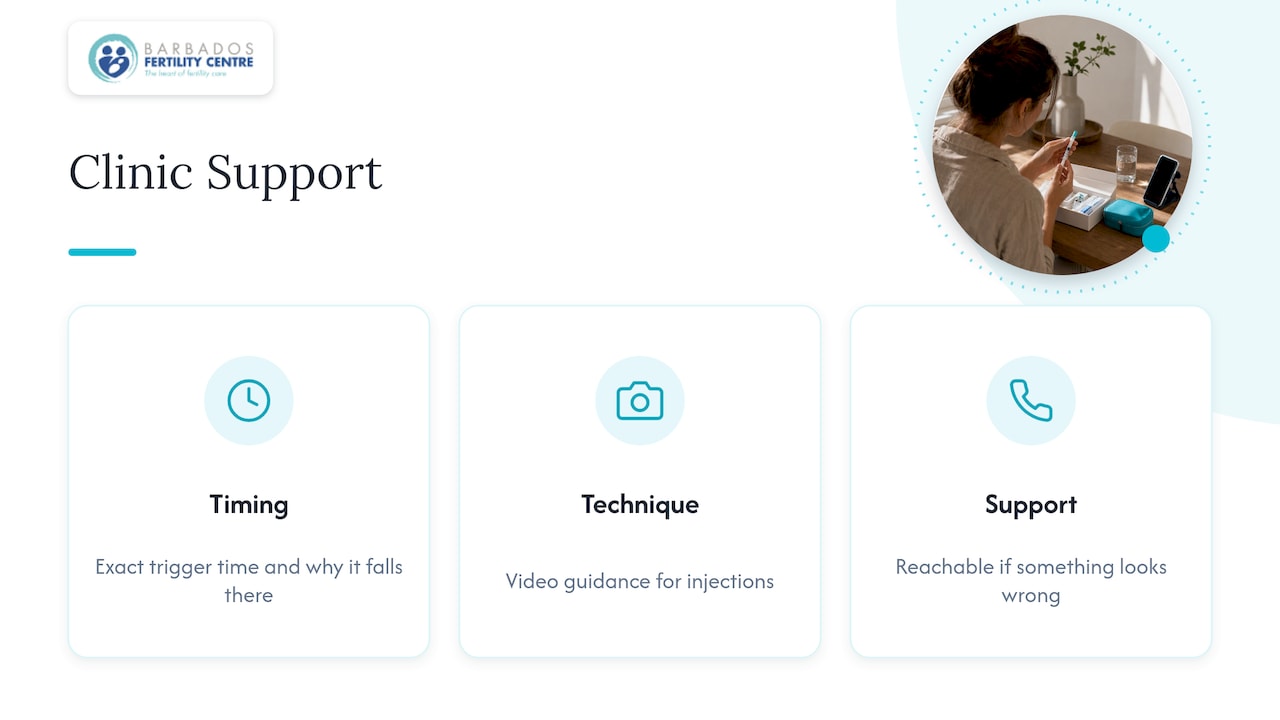
In practice, that means three things. First, we give you the trigger time as an exact instruction, and we explain why it falls where it does. Second, we make the technique easy to learn ahead of time, with video guidance for the injections. Third, we are reachable if something looks wrong, because we would always rather you ask than guess.
We also think timing is easier to handle when the rest of your trip is not adding stress. Our patients come to Barbados from many countries, and since 2002 our focus has been on pairing internationally accredited care (we hold JCI accreditation) with a calm setting and clear pricing. A trigger shot taken at 9 p.m. is not dramatic when everything around it is organized. You can read more about how a cycle fits together on our IVF treatment page and in what to ask any clinic before you start.
Our advice is simple. Ask for the time in writing, rehearse the injection and never be embarrassed to double-check.
— Barbados
Planning an IVF or egg freezing cycle with us
If you are comparing options, our published prices are a good place to start. IVF starts from 5,750 USD and IVF with ICSI from 6,750 USD on our price list. On our international price list, ICSI is 7,650 USD and egg freezing is 4,950 USD. Medications and travel are separate considerations, so to see a fuller picture for your situation, try our IVF cost calculator. If you would like to talk through your protocol, contact us through our website and our team will guide you.
FAQ
When is the trigger shot given in IVF?
It is usually given 34 to 36 hours before egg retrieval, once your follicles have reached the size your team is aiming for. Your clinic will work backward from your retrieval time and give you an exact clock time for the injection. The best interval can differ depending on whether you use hCG or a GnRH agonist.
When should I take the trigger shot if I am doing IUI?
You take it when your scans show mature follicles, as directed by your doctor. Insemination is then usually scheduled about 24 to 36 hours later, although protocols vary. Ask your clinic for the date and hour of the IUI at the same time you receive the trigger instructions.
Does a few minutes’ difference matter?
Clinics generally build in a small margin, but you should not treat it as a given. If your instructions say 9:00 p.m., aim for 9:00 p.m. If you are going to be more than a few minutes off, phone your clinic first rather than deciding yourself.
Is the trigger shot timing different for egg freezing?
The principle is the same as for IVF, because mature eggs are collected before they are released. One clinic guide describes the shot being given about 36 hours before an egg freezing retrieval. Your own instructions are what count, since your team sets the exact interval.
Can I take the trigger shot earlier to fit my schedule?
No. Moving the injection without moving the retrieval changes the interval your team planned, and that can affect how many eggs are mature. If your schedule makes the time impossible, tell your clinic as early as you can so they can adjust the whole plan.
Sources
- Optimal timing for triggering oocyte maturation during IVF cycles varies between GnRH agonist and hCG use (PubMed, 2025)
- Trigger Shot: What It Is, How It Works, Side Effects (Healthline)
- Do’s and Don’ts with the Egg Freezing Trigger Shot (Amilis)
- Optimal timing of ICSI after egg retrieval: a randomized controlled trial (PMC)
- Dual trigger (hCG + leuprolide) versus hCG trigger in antagonist non-donor IVF: a randomized controlled trial (PMC)
- GnRH agonist trigger versus hCG in PCOS undergoing IVF for an OHSS-free clinic: a randomized controlled trial (PMC)
Recommended
- 36–48 Hours After the Trigger: Ovulation Induction Meds in Practice
- IVF – What You Should Be Asking
- Intrauterine Insemination (IUI) at Barbados Fertility Centre
- Injection Instructions