


A 2025 retrospective study of 2,135 embryo transfers found no significant difference in pregnancy or implantation between patients who flew afterward and those who did not. For most people, a flight is not a barrier to implantation. The study was retrospective, though, so talk with your clinic about your own risk factors before you book.
TL;DR:
- The 2025 study was retrospective and came from one clinic; it did not assess very long flights, tight connections, or patients with clotting histories.
- Postpone travel and contact your clinic for ovarian hyperstimulation symptoms, recent blood clots, active bleeding, clinician restrictions, or another condition that makes flying unsafe.
- Pregnancy raises deep vein thrombosis risk at least fivefold, so long flight travelers should hydrate, walk often, exercise their calves, and consider compression stockings.
- For flights across time zones, confirm medication timing with your clinic, carry prescriptions and supplies aboard, and arrange required blood tests before departure.
- Seek urgent care for shortness of breath, chest pain, or sudden pain or swelling in one calf, and notify your clinic after emergency treatment.
Table of Contents
- What do the research and medical guidance say about flying after transfer?
- What medical risks should you consider before flying?
- When is the best time to fly, and when should you delay?
- How do you manage medications and logistics while traveling?
- What should you do on the day of travel?
- Which symptoms mean you should call your clinic or seek care?
- How do we advise patients who want to fly?
- FAQ
- Sources
What do the research and medical guidance say about flying after transfer?
The most direct evidence is a 2025 retrospective analysis of 2,135 embryo transfers. Researchers compared patients who flew after their transfer with those who stayed on the ground. About 17.94% of patients traveled by plane, so the comparison group was large enough to be meaningful.
The results were close to identical. Implantation rates were 34.58% and 38.65%.](https://pubmed.ncbi.nlm.nih.gov/40440475/) Miscarriage rates also showed no significant difference. The p-values for pregnancy, implantation and miscarriage were 0.94, 0.28 and 0.32, none of which approaches statistical significance.
Pregnancy rates were 61.99% in non-travelers and 62.14% in travelers, which means the flight itself did not measurably change the outcome in this group.
Official guidance for pregnant travelers points the same way. The CDC Yellow Book explains that airplane cabins are pressurized to the equivalent of roughly 6,000 to 8,000 feet. The lower oxygen tension at that altitude is unlikely to cause fetal problems in a normal pregnancy. The same chapter lists the real travel concerns: sitting still for long periods, exposure to infection and abdominal bloating. It suggests practical fixes such as an aisle seat and loose clothing.
ACOG’s travel guidance says occasional air travel is generally safe in a healthy pregnancy. It advises avoiding travel when a pregnancy is complicated and recommends checking airline policies. Many airlines ask for physician documentation after certain gestational ages, which rarely matters in the first weeks after a transfer but becomes relevant later.
Here is what to keep in mind when you read this evidence:
- The study was retrospective, so patients were not randomly assigned to fly or stay home. People who chose to travel may differ from those who did not in ways the data cannot capture.
- The data come from a single clinical setting, so results may not carry over to every population or travel pattern.
- Prospective data are limited, which means no trial has yet tested flying versus not flying head to head.
- The study looked at flying in general, not at very long flights, tight connections or patients with a clotting history.
Because of these gaps, we encourage shared decision-making. The evidence is reassuring, and your own medical history still shapes the final call. A patient with a prior clot, for example, needs a different conversation than a patient with an uncomplicated cycle.
What medical risks should you consider before flying?
Embryo position is not the concern. The more realistic issue is blood clotting. Pregnancy raises the risk of deep vein thrombosis (DVT), and so do the hormone medications used in treatment. Long periods of sitting add to that.
The CDC Yellow Book puts the first part in numbers: pregnancy increases DVT risk by at least five times compared with non-pregnant women. It is equally clear that the absolute risk stays low for occasional travelers. A several-fold increase on a very small baseline is still a small number, which is why precautions are sensible rather than alarming.
Simple steps that lower clot risk
For long-distance travel, the CDC recommends staying hydrated, stretching often and wearing graduated compression stockings. In practice, we suggest:
- Drink water steadily before and during the flight, and go easy on alcohol and heavy caffeine.
- Walk the aisle regularly and do calf pumps in your seat between walks.
- Choose an aisle seat so getting up never feels like an imposition.
- Wear graduated below-knee compression stockings on long flights, fitted before you travel.
- Dress in loose, comfortable layers that do not squeeze your abdomen.
Pro Tip: Put on compression stockings before you leave for the airport, since they are much harder to fit once your ankles swell from sitting.
Medication for clot prevention
Blood-thinning injections or tablets, such as low-molecular-weight heparin or direct oral anticoagulants, are not routine for most travelers. Whether they make sense depends on your personal history, so they are an individualized decision for your clinician. Never start or stop anticoagulants on your own because of a flight.
Other risks worth a quick look
Infection exposure is a fair concern in crowded airports and cabins, so wash your hands often and keep sanitizer within reach. Cabin pressure is not a worry for a healthy early pregnancy, as described above. Cosmic radiation exposure on an occasional flight is minimal and not a reason to cancel a trip.
When is the best time to fly, and when should you delay?
Many clinics allow short flights during the two-week wait. If your schedule gives you any flexibility, we suggest allowing some time after transfer. That is not because a flight would dislodge the embryo. It simply keeps you from rushing through an airport on the same day as a procedure, which is stressful for most people.
There is also no benefit to staying flat. Large-sample evidence summarized in a study on bed rest after transfer shows strict bed rest does not improve outcomes, and gentle movement is recommended. We cover the same ground in our article on bed rest after embryo transfer.
Reasons to postpone travel
Delay your flight and call your clinic if any of these apply:
- You have symptoms of ovarian hyperstimulation syndrome (OHSS), such as rapid weight gain, a swollen abdomen or severe bloating.
- You have had a recent venous thromboembolism (a clot in a vein).
- You have active vaginal bleeding.
- Your clinician has told you not to travel.
- You have another significant medical condition that makes a flight unwise.
Long-haul and international flights
Longer flights call for more planning. You sit still for hours, your clot risk rises with duration, and time zones can scramble your medication schedule. If you are flying across several zones, work out your dosing plan with your clinic before you leave. A transfer followed immediately by a red-eye with a tight connection is the scenario most worth rethinking.
How do you manage medications and logistics while traveling?
Continuing your luteal support on time matters more than where you are when you take it. Planning ahead keeps you on schedule. Our guide to luteal phase support explains what these medications do and why timing counts.
Follow these steps:
- Pack every medication and supply in your carry-on bag, never in checked luggage, so a delayed bag cannot interrupt your treatment.
- Ask your clinic for a dated letter listing your prescriptions and any injection instructions, and carry a copy with the medications.
- Keep medications in their original packaging with the pharmacy labels visible.
- Convert your dosing times to the destination time zone before you leave, then confirm the plan with your clinic rather than guessing.
- Ask whether your clinic needs a pregnancy test or blood work while you are away, and arrange a local lab in advance if so.
- Plan for refrigerated medications and syringes by carrying a small insulated pouch, and tell security staff about them at the checkpoint.
Pro Tip: Set phone alarms in both your home time and your destination time, and ask your clinic which dose to anchor to if your schedule has to shift.
For airport security, the original packaging and the clinic letter do most of the work. Medical supplies are normally allowed through screening when declared. If you need a refresher on giving injections, our injection instruction videos are a good thing to review before you go.
Coordination with your clinic is part of the plan too. Confirm whether you must stay nearby for early monitoring or can test locally. Our patient journey page shows how appointments and communication are organized, which helps you decide what to arrange before departure.
What should you do on the day of travel?
Travel day goes better when you remove as many sources of pressure as you can. Aim for a calm, unhurried day rather than a perfectly optimized one.
- Pick an aisle seat when possible so you can stand and walk without climbing over anyone.
- Get up and walk regularly, and do calf pumps and ankle circles while seated.
- Keep a water bottle with you and sip regularly. Fill it after security.
- Pack your carry-on with medications, your clinic letter, your clinic’s contact number, snacks, and compression stockings if you use them.
- Arrive early. Extra time at check-in and security keeps you from sprinting to a gate.
- Wear loose, comfortable clothing and shoes that still fit if your feet swell.
If your itinerary has a long layover or a tight connection, add buffer time or consider moving the trip. A missed connection and a scramble across a terminal can add stress without adding any benefit. Nothing in the evidence says stress alone causes failed implantation, but there is little reason to invite it when a calmer route exists.
On the plane, keep it simple. Stay hydrated, move when the seatbelt sign allows, and keep your medications within reach. If you feel unwell, tell the cabin crew early rather than waiting.
Which symptoms mean you should call your clinic or seek care?
Most travelers have an uneventful trip. Still, know which symptoms need action so you are not deciding under pressure.
Contact your clinic or seek care promptly for any of the following:
- Heavy vaginal bleeding, soaking a pad quickly.
- Severe or cramping abdominal pain.
- Sudden swelling, warmth or pain in one calf, which can signal a clot.
- Shortness of breath or chest pain.
- Fever or feeling seriously unwell.
Seek immediate emergency care for severe or sudden symptoms, especially breathing trouble or calf pain. Then let your clinic know what treatment you received.
Before you leave, arrange a local contact for follow-up and blood tests if you will be away for a while. Keep your travel insurance details and emergency contacts somewhere easy to reach, such as your phone’s lock screen and a printed copy in your carry-on. The CDC’s page on blood clots and travel is useful background on recognizing clot symptoms.
How do we advise patients who want to fly?
Many of our patients ask us this, and our answer is usually reassuring. We focus on lowering risk rather than forbidding travel. That means a clear medication schedule, clot precautions on longer trips, and a written plan for what to do if something feels wrong.
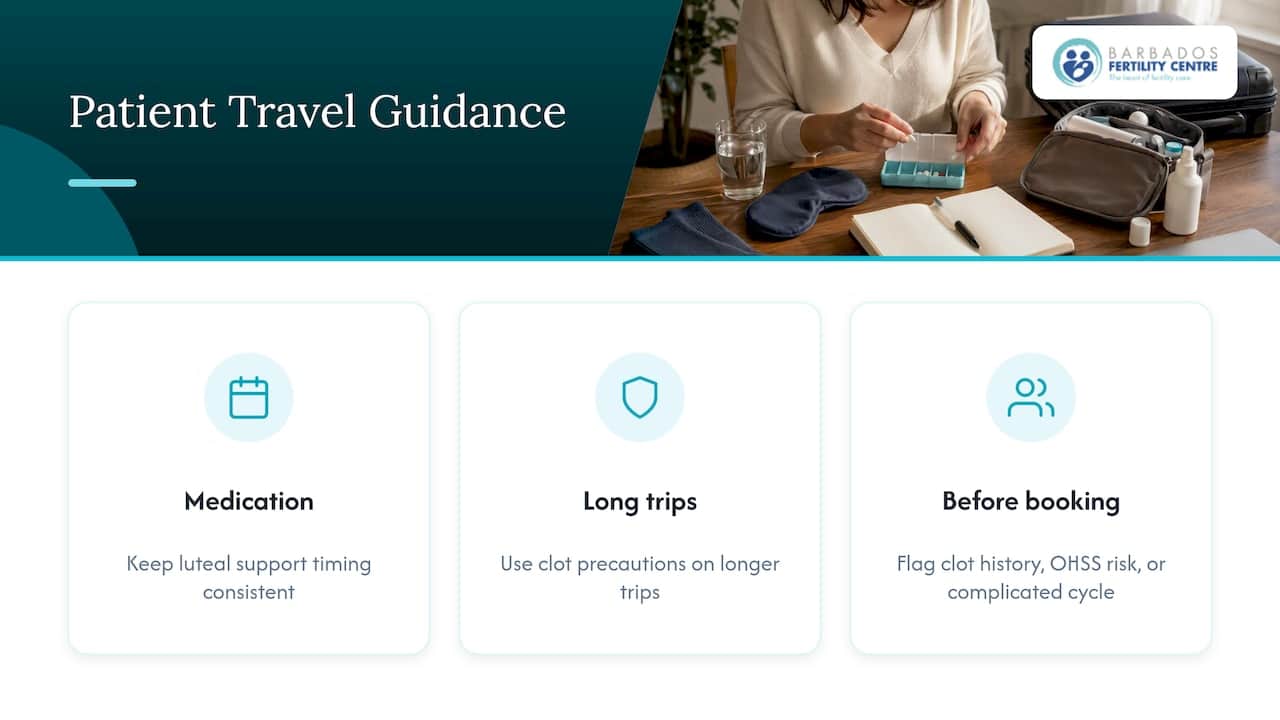
Our approach rests on evidence rather than habit. We do not ask patients to stay still after transfer. The same thinking applies to luteal-phase support, where timing and consistency matter more than location. Both topics have their own pages if you want the detail.
What I would underline is that the decision belongs to you and your care team together. A flight that is routine for one patient may call for more caution in another. If you have a history of clots, an OHSS risk or a complicated cycle, tell us before you book anything. Planning ahead is far easier than solving a problem from an airport gate, and we would rather help you arrange the trip well than have you cancel out of worry.
— Barbados
This article is general information, not a substitute for advice from a qualified doctor. Consult a qualified healthcare professional about your own circumstances before acting on anything here.
FAQ
Can I fly during the two-week wait?
For most healthy patients, yes. A 2025 retrospective study found no significant difference in pregnancy rates between those who flew after transfer and those who did not. Check with your clinic first, especially for long flights.
Can I fly at 4 weeks pregnant?
Occasional air travel is generally considered safe in a healthy pregnancy, according to ACOG. Airlines usually set restrictions much later in pregnancy. If your pregnancy is complicated, ask your clinician before flying.
Can a bumpy car ride affect implantation?
There is no scientific evidence that routine movement, turbulence or bumpy rides affect implantation, because the embryo is securely placed in the uterus. Gentle activity is encouraged rather than strict rest, as our article on bed rest after embryo transfer explains.
What should you avoid right after embryo transfer?
Avoid anything your clinic has told you to skip, and skip strenuous exercise, heavy lifting and long periods of sitting still. Normal gentle activity is fine. For background on the early days, this partner guide on implantation bleeding versus a period explains what to expect during the wait.
Sources
- Does flying after embryo transfer impact implantation?
- Deep Vein Thrombosis and Pulmonary Embolism | Yellow Book | CDC
- Pregnant Travelers – CDC Yellow Book, 2026 edition – NCBI Bookshelf
- Travel During Pregnancy | ACOG
Recommended
- Clinic Triage for Spotting After Embryo Transfer: Red Flags, Evidence
- IVF Cycles Per Year: How Many Is Safe? Expert Fertility Guide