


An IVF cycle itself usually takes about two to six weeks, but the whole journey starts earlier, with testing and planning in the month before. The professional society SART describes each cycle as steps spread over two to six weeks, with preparation beginning the month before. At Barbados Fertility Centre, we coordinate much of the early work remotely for international patients, so the time you spend away from home is shorter than the full timeline suggests.
This guide walks through each stage in order, what happens, how long it takes and what can move the dates.
TL;DR
- Plan for roughly 4 to 6 weeks from the start of medication to a pregnancy test, with testing and planning in the month before.
- Ovarian stimulation usually takes 8 to 14 days, and eggs are retrieved 34 to 36 hours after the trigger injection.
- The pregnancy blood test comes about 8 to 14 days after the embryo transfer.
- A frozen embryo transfer follows a separate, shorter schedule and can happen in a later month.
- Your own response to medication sets the exact dates, so every calendar is an estimate until monitoring confirms it.
Table of Contents
- The IVF timeline at a glance
- Step 1: Consultation and fertility testing
- Step 2: Planning the cycle and starting medication
- Step 3: Ovarian stimulation (8 to 14 days)
- Step 4: The trigger injection and egg retrieval
- Step 5: Fertilization and embryo development (about 3 to 6 days)
- Step 6: Embryo transfer
- Step 7: The two-week wait and the pregnancy test
- A sample timeline for a fresh cycle
- What can change your IVF timeline
- Planning travel around the timeline
- Our perspective
- Starting your cycle with us
- FAQ
- Sources
The IVF timeline at a glance
| Stage | Typical duration | What happens |
|---|---|---|
| Consultation and testing | Several weeks before the cycle | Medical history, hormone tests, scans, semen analysis |
| Cycle planning | Days to a few weeks | Medication plan, start date, travel dates |
| Ovarian stimulation | 8 to 14 days | Daily injections, scans and blood tests |
| Trigger and retrieval | Trigger, then retrieval 34 to 36 hours later | Final egg maturation, short procedure |
| Fertilization and embryo growth | About 3 to 6 days | Lab fertilization and monitoring |
| Embryo transfer | Day 3 to day 6 after retrieval, or in a later cycle | Embryo placed in the uterus |
| Pregnancy test | 8 to 14 days after transfer | Blood test for hCG |
The stimulation range and the retrieval window come from the American Society for Reproductive Medicine’s patient booklet on assisted reproductive technology. The pregnancy test window comes from SART’s step-by-step guide linked above.
Step 1: Consultation and fertility testing
Every cycle starts with a picture of your fertility. For women this usually means a medical history, blood tests for ovarian reserve (how many eggs remain), and an ultrasound. For a partner with sperm, it means a semen analysis. Some patients also need an assessment of the uterine cavity or tubes.
This stage can take a few weeks, mostly because tests are timed to your menstrual cycle and results must be reviewed before a plan is written. It is also the stage that can be done from home. Our clinic offers remote treatment coordination for international patients, so your questions, results and plan can be settled before you book flights. If you are comparing options abroad, our page on IVF treatment abroad explains how this works.
Where it goes wrong: missing results, repeat tests or a start date that does not line up with your period can add weeks. Sending complete records early keeps the calendar tight.
Step 2: Planning the cycle and starting medication
IVF calendars count from day 1, the first day of full menstrual bleeding. Most clinics have patients start stimulation medication within the first days of the cycle, often day 2 or 3, though the exact day depends on the protocol your doctor chooses. Some protocols begin with a period of preparation medication, which lengthens the timeline by one to several weeks.
Before the start date, you receive a written schedule and your drug list. Knowing what each drug does makes the injections far less intimidating, and our IVF medications guide covers that in plain terms.
Step 3: Ovarian stimulation (8 to 14 days)
In a natural cycle, the body usually matures a single egg. IVF uses injectable hormones to help several follicles (the fluid-filled sacs that hold eggs) develop together. The ASRM booklet states that generally 8 to 14 days of stimulation are required.
During these days you attend monitoring visits, typically a transvaginal ultrasound plus blood tests, every few days. These visits decide when to adjust doses and when the follicles are ready. Timing is crucial here, which is why your date for retrieval is only confirmed late in the stimulation phase.
For international patients, the monitoring phase is the part that needs you on site, or in contact with a local clinic that can follow your protocol. Ask your coordinator which arrangement applies to you before you book travel.
Where it goes wrong: some patients respond more slowly or more strongly than expected. A slow response extends stimulation. A strong response may lead the doctor to change the plan to protect your safety. The ASRM notes that up to 20% of cycles may be cancelled before egg retrieval, usually because follicles do not develop as hoped. Your doctor will explain the options if this happens.
Step 4: The trigger injection and egg retrieval
When scans and blood tests show the follicles are mature, you take a trigger injection. It replaces your body’s natural surge of luteinizing hormone (LH) and completes final egg maturation. Retrieval is then scheduled 34 to 36 hours after the hCG trigger, which is why the injection is given at a precise time, often late in the evening.
That window is tight. Taking the injection too early or too late can affect the eggs collected, so follow your nurse’s clock time exactly. Our guide to trigger shot timing explains how the timing is set for IVF and egg freezing, and what to do on trigger night is a practical checklist.
Ovulation predictor kits are a different tool: they detect the natural LH surge in an unmedicated cycle, which is useful background for understanding why ovulation tests are not used to time an IVF retrieval. In IVF, the trigger and the scans set the clock.
Retrieval itself is a short procedure done under sedation. Most patients go home the same day and rest for the remainder of it. For egg freezing, the timeline ends here, after the eggs are vitrified (rapidly frozen) and stored. See our egg freezing information for that path.
Step 5: Fertilization and embryo development (about 3 to 6 days)
On retrieval day the embryology team combines eggs and sperm. There are two ways:
- Conventional insemination: eggs and sperm are placed together in a dish.
- ICSI: a single sperm is injected into each mature egg. The ASRM booklet notes that ICSI is used in roughly 60% of US cycles, and it is especially helpful with male-factor infertility. Learn more about ICSI at our clinic.
Usually 65% to 75% of mature eggs fertilize, according to the same booklet. Not every egg is mature, and not every fertilized egg becomes a usable embryo, so numbers fall at each stage. The next morning you typically receive a fertilization report. Embryos are then grown in the laboratory for several days, and many clinics transfer or freeze them at the blastocyst stage, around day 5 or 6.
This lab phase is where your treatment is decided quietly. It is the heart of your cycle, and a good lab is why the waiting days feel long.
Step 6: Embryo transfer
There are two routes, and they change your timeline.
Fresh transfer. An embryo is transferred a few days after retrieval, while you are still on hormone support. The total cycle from first injection to transfer is often about three to four weeks.
Frozen embryo transfer (FET). Embryos are frozen and transferred in a later cycle. This gives your body time to recover from stimulation and allows genetic testing or travel planning where relevant. In a natural-cycle FET, no additional medications are used and monitoring relies on blood tests or urine tests; the ASRM’s Journal Club Global notes that blastocyst transfer is typically performed six days after the LH surge is detected. The same source explains that monitoring schedules are very clinic-specific, so your calendar will follow your own clinic’s protocol. Our page on the frozen embryo transfer timeline and aftercare walks through both medicated and natural versions.
The transfer itself is quick, similar to a pap smear, and generally does not need anesthesia.
Step 7: The two-week wait and the pregnancy test
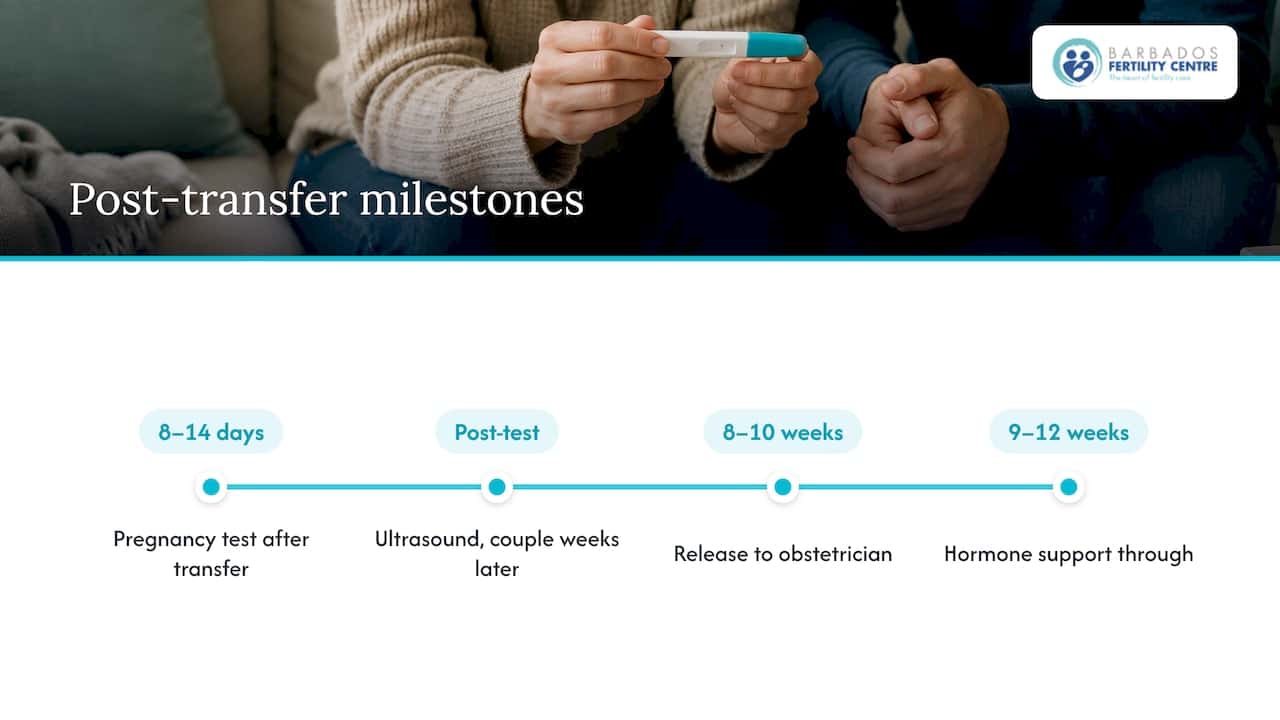
After transfer you take progesterone and other support medication as prescribed. SART says the pregnancy test is typically done 8 to 14 days after transfer. A blood test measuring hCG is more reliable than a home test, and testing too early can give a misleading answer.
If the result is positive, hormone support typically continues until 9 to 12 weeks of gestation, and patients are generally released to their obstetrician at 8 to 10 weeks, again per SART. A first ultrasound a couple of weeks after the positive test confirms the pregnancy is developing.
A sample timeline for a fresh cycle
The following is an illustration, not a prescription. Your doctor will set your actual days.
- Weeks before: consultation, tests, plan, travel booking.
- Cycle day 1: period starts, you notify your clinic.
- Days 2 to 3: stimulation injections begin.
- Days 5 to 14: monitoring scans and blood tests every few days.
- Around day 10 to 14: trigger injection, then retrieval about 36 hours later.
- The next day: fertilization report.
- Days 3 to 6 after retrieval: embryo transfer, or freezing for a later transfer.
- 8 to 14 days after transfer: pregnancy blood test.
What can change your IVF timeline
- Your response to medication. More or fewer days of stimulation, or a changed protocol.
- Cycle cancellation. If follicles do not develop as hoped, the cycle may be stopped and restarted later.
- Planned freezing. Choosing a frozen transfer moves the pregnancy test to a later month.
- Additional procedures. Tests of the uterus or tubes, such as an SIS or HyCoSy scan, are best done before the cycle begins.
- Donor eggs or embryos. Matching and preparing a recipient cycle adds planning time. See our egg donation page.
Planning travel around the timeline
If you are travelling for treatment, the cleanest plan splits the work. Testing, consultation and the medication plan happen first, often remotely. Stimulation and monitoring need you near the clinic. Retrieval and transfer are fixed events. Your coordinator can map those dates to flights so you are not waiting around or rushing. Our IVF cost calculator also helps you budget the whole plan before you commit.
Our perspective
Most patients arrive worried about two things: the calendar and the cost. A clear schedule answers the first, and transparent pricing answers the second.
We built our approach around reducing stress during treatment. Our team has been treating patients since 2002, and we operate under JCI accreditation. For us, a good timeline is one you understand before day 1: what each visit is for, which dates are fixed and which depend on your response.
We keep the process personal. Your plan follows your tests, not a template, and we coordinate remotely with international patients so that time away from home is spent on the steps that need you in the room.
Barbados
Starting your cycle with us
Barbados Fertility Centre offers IVF from $5,750 and IVF with ICSI from $6,750, as published on our CARICOM price list. International patients can see ICSI at $7,650 and egg freezing at $4,950 on the international price list. Our IVF treatment page describes the programme, and our team can build a personal calendar around your tests and travel.

If you would like to prepare questions for your first consultation, start with what you should be asking about IVF.
FAQ
How many weeks does the IVF process take?
The cycle itself usually takes about two to six weeks, according to SART, with preparation starting the month before. From the start of medication to the pregnancy test, many patients see roughly four to six weeks. A frozen transfer adds time because it happens in a later cycle.
How long after egg retrieval is the embryo transfer?
In a fresh cycle, transfer is commonly a few days after retrieval, often at day 3 or at the blastocyst stage on day 5 or 6. In a frozen cycle, transfer happens in a later month, once your uterus is prepared. Your doctor decides based on how your embryos develop.
When do I take a pregnancy test after IVF?
SART says the test is typically done 8 to 14 days after embryo transfer. Your clinic gives you the exact day for a blood test. Follow it rather than testing at home early, since early results can mislead.
Can the timeline change once I have started?
Yes. Dates depend on how your follicles grow, which is why monitoring scans and blood tests happen every few days. Your doctor may extend stimulation, adjust doses or choose to freeze embryos for a later transfer. Your clinic will give you updated dates after each visit.
Sources
Recommended
- Patient Journey
- IVF – What You Should Be Asking
- IVF Cost Calculator – Find Out How Much IVF Treatment Will Cost
- Making the Most of a Fertility Treatment Timeline: IVF Abroad