


A time-lapse incubator is an embryo incubator with a built-in camera. It photographs your embryos every few minutes so embryologists can watch development without taking the embryos out of the incubator. That is the technology. The practical question for you is how much it should weigh in choosing a clinic, and the research gives a clear answer: it is a useful laboratory tool, but the quality of the whole lab, the accreditation behind it and the total price of your cycle matter just as much to your result. This guide explains how the technology works, what the large trials found, and how to compare clinics sensibly.
TL;DR
- A time-lapse incubator takes images of embryos at set intervals (commonly every 5 to 15 minutes) and compiles them into a video, so embryos stay undisturbed in stable conditions.
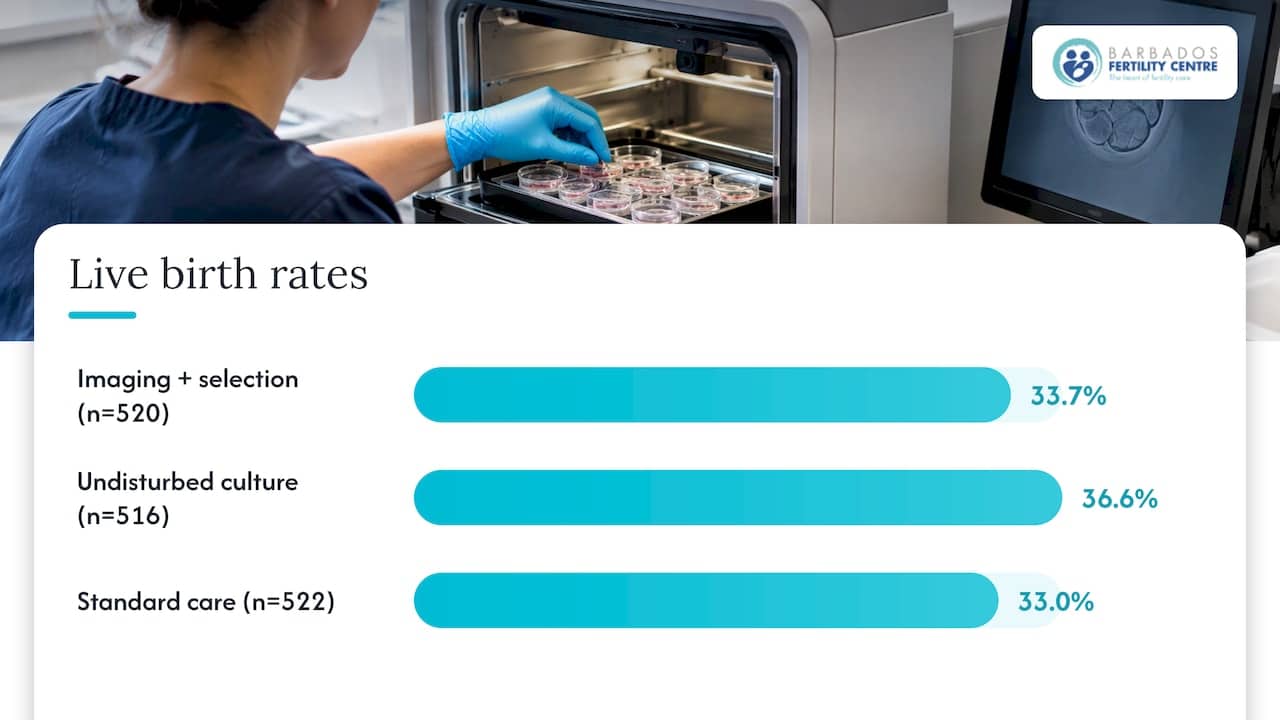
- The largest trial to date, TILT (The Lancet, 2024), found live birth rates of 33.7% with time-lapse imaging versus 33.0% with standard care, not a significant difference.
- AI embryo grading builds on time-lapse video, but the American Society for Reproductive Medicine (ASRM) says trials have largely failed to show benefit over standard morphology grading.
- When comparing clinics, look at accreditation, embryo grading practice, transparent all-in pricing and personal guidance, not one piece of equipment.
Table of Contents
- What a time-lapse incubator is
- Why continuous imaging appeals
- What the trials say about pregnancy and live birth
- AI embryo grading: where it stands
- Embryo grading you can understand today
- What to compare when choosing a clinic
- What treatment costs at Barbados Fertility Centre
- Making an informed choice
- Start with a conversation about your plan
- Our perspective
- FAQ
- Sources
What a time-lapse incubator is
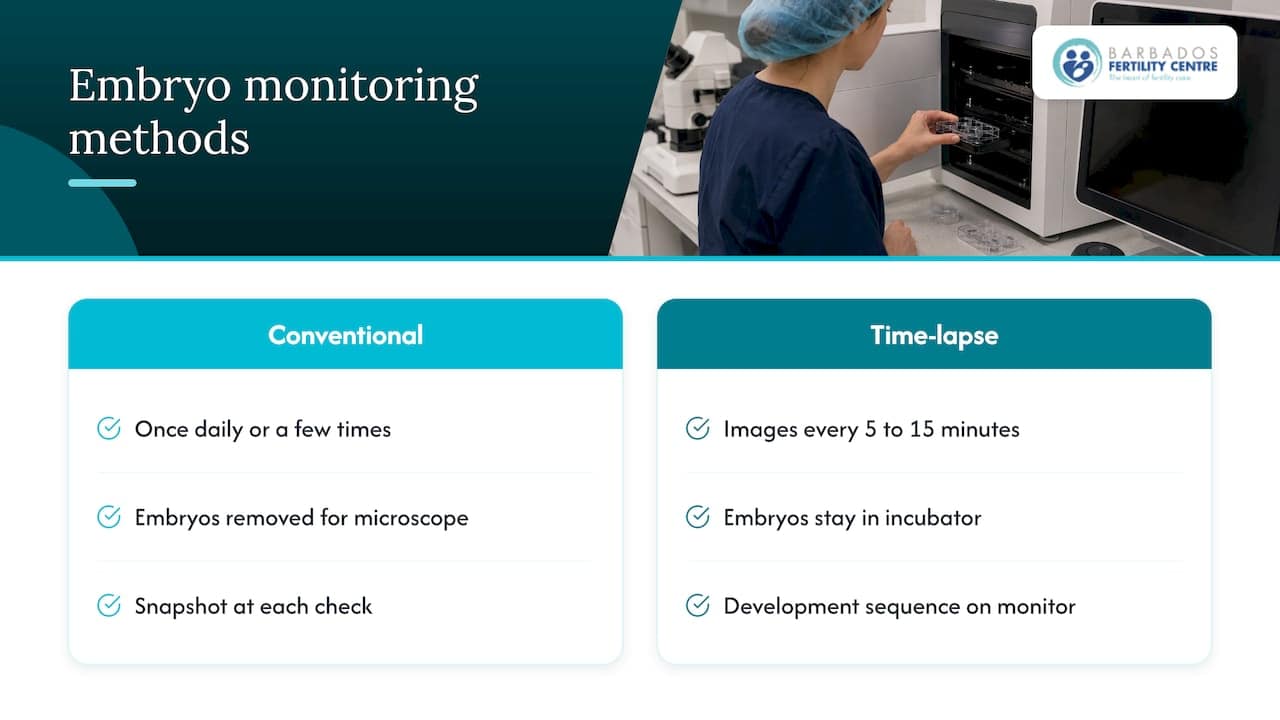
In conventional IVF, embryos sit in an incubator and an embryologist takes them out once a day, or a few times, to look at them under a microscope. Each check is a snapshot.
A time-lapse system changes the rhythm. According to the Cochrane review of time-lapse systems, it is a device that takes digital images of embryos at set intervals, for example every 5 to 15 minutes. The images are compiled by specialist software into a sequence shown on an external monitor. Embryologists can then assess how an embryo develops without removing it from the incubator. Some systems also add computer-assisted scoring of morphokinetic parameters.
Morphokinetics simply means the timing of an embryo’s development: when it first divides, how long each cell cycle lasts, and how evenly the cells split. The ASRM notes that time-lapse imaging lets embryologists track multinucleation, fragmentation, direct and asymmetric divisions, and cell-cycle lengths, which are hard to catch with once-a-day checks.
Not one technology
The term covers more than one design. Lundin and Park (2020) describe an open type, where culture dishes and a camera sit inside a regular box incubator, and a closed bench-top type that integrates microscope, camera and stable culture conditions. Different systems also use differently built scoring algorithms, so results from one brand do not automatically carry over to another. You may see the best-known branded system, the EmbryoScope, used as a general name for all of them.
Why continuous imaging appeals
The logic is easy to follow. A 2025 review by Sciorio and colleagues points out that conventional assessment gives only a snapshot at specific time points, depends on the individual embryologist’s judgment, and needs embryos to leave the incubator, exposing them to changes in pH, temperature and gas. Continuous monitoring tracks development from fertilization to blastocyst (the stage reached around day five or six) while conditions stay stable.
The benefits with the clearest support are practical:
- Undisturbed culture. Embryos are not moved for daily checks.
- More information. The ESHRE (European Society of Human Reproduction and Embryology) good-practice recommendations say time-lapse technology increases observations and allows dynamic assessment of embryo development.
- Lab workflow. The ASRM opinion cites a randomized trial in which AI cut blastocyst evaluation time almost tenfold, the clearest demonstrated benefit of AI grading so far.
- A record you can discuss. Video of development gives your care team more to talk through with you.
What the trials say about pregnancy and live birth
Patients usually want to know whether the technology raises the chance of a baby. The research is detailed, so here is the summary and one worked example.
The TILT trial
The TILT trial (Bhide et al., The Lancet, 2024) is a double-blind randomized trial of 1,575 participants at seven IVF centers in the UK and Hong Kong. Live birth rates were:
| Group | Live birth rate |
|---|---|
| Time-lapse imaging with embryo selection | 33.7% (175 of 520) |
| Undisturbed culture alone | 36.6% (189 of 516) |
| Standard care | 33.0% (172 of 522) |
The authors concluded that time-lapse systems do not significantly increase the odds of live birth compared with standard care. Clinical pregnancy and pregnancy loss did not differ significantly either.
What this means for you: if a clinic in your price range does not use time-lapse, a good embryology team using careful standard methods is working with comparable odds in this trial.
Earlier reviews
The findings line up with earlier pooled analyses:
- The Cochrane review of eight trials (2,303 women) found no evidence of a difference in live birth or clinical pregnancy between time-lapse systems and conventional incubation.
- A 2023 meta-analysis of 14 trials found a small increase in implantation rate with time-lapse incubators, but no improvement in live birth, ongoing pregnancy, clinical pregnancy or miscarriage rates.
- ESHRE’s 2023 add-on recommendations say time-lapse imaging is not recommended as a tool to improve live birth rates.
In plain terms, time-lapse gives embryologists a richer view, and research is still working out how best to turn that view into better outcomes. For a patient, the sensible reading is that it is a refinement of the lab rather than the thing that decides whether a cycle works.
AI embryo grading: where it stands
Many of the searches around this topic concern AI embryo grading. These tools analyze time-lapse images or video to score or rank embryos. According to the ASRM, some systems use manually annotated features such as division timing as inputs, while deep learning models can analyze raw video and estimate the chance of pregnancy.
The same committee opinion lists the open issues: annotation can be subjective, the algorithms are often trained on one clinic’s embryos and may not generalize, and trials have largely failed to show benefit over standard morphology grading. A 2026 appraisal in Frontiers in Endocrinology adds that performance differs by platform. One tool met its non-inferiority target (442 participants) while another did not (1,066 participants), so each product should be judged on its own evidence. The authors place routine AI embryo selection on a five to ten year horizon.
If a clinic offers an AI score, treat it as one input alongside the embryologist’s grade, not a verdict on an embryo.
Embryo grading you can understand today
Whatever equipment a lab uses, embryos are graded, and you are entitled to understand what the grade means. A blastocyst grade typically describes how expanded the embryo is, and the quality of its inner cell mass and outer layer. Our guide to reading your embryo grades walks through the numbers and letters, and what you should be asking during IVF lists questions worth bringing to any consultation.
A grade is a prediction, not a promise. Embryos with modest grades result in healthy babies, and top-graded ones sometimes do not implant. That is one reason the trials above find limited gains from fancier selection.
What to compare when choosing a clinic
If you are weighing options, especially across borders, these are the factors with the most bearing on your experience:
- Accreditation. Joint Commission International (JCI) accreditation is an independent review of a facility’s medical standards. Barbados Fertility Centre operates under JCI accreditation.
- Lab and embryology team. Ask how embryos are cultured, how they are graded and how decisions about transfer or freezing are made. Ask for the clinic’s own results, reported by age group.
- Which add-ons are offered, and why. Ask what each add-on is intended to do, what the evidence says, and what it adds to the bill.
- Total, itemized pricing. Medication, monitoring, freezing and storage can change the total.
- Personal guidance. Your age, ovarian reserve (the number of eggs remaining) and diagnosis shape the right protocol more than any single piece of equipment.
Cost is where add-ons bite. The Journal of IVF Worldwide cites a median U.S. IVF cost of $19,200 with medications and notes that routine use of time-lapse imaging, genetic testing and AI tools has enriched that figure. Availability and fees for time-lapse vary by clinic in the U.S., so ask for a written breakdown before you commit.
Testing before you book
Before any lab technology comes into play, treatment starts with understanding your own fertility. If you are comparing at-home fertility testing with clinic testing, remember that a full workup of hormone levels, ovarian reserve and semen quality is what lets a specialist plan your cycle. We offer both female and male fertility assessments.
What treatment costs at Barbados Fertility Centre
Many of our patients come from the United States because the published prices are a fraction of typical U.S. totals. Our published prices include:
| Treatment | Price |
|---|---|
| IVF | from $5,750 |
| IVF with ICSI | from $6,750 |
| ICSI (international price list) | $7,650 |
| Egg freezing (international price list) | $4,950 |
| IUI, per cycle, including scans | from $500 |
| ICSI with known donor eggs | from $9,500 |
| Embryo donation cycle | $5,000 |
The full lists are on our CARICOM price list and international price list, and the IVF cost calculator helps you estimate a plan for your situation. ICSI means a single sperm is injected directly into an egg, often used for male-factor infertility.
Making an informed choice
Put the evidence in order. First, your diagnosis and age. Second, the experience and standards of the clinic. Third, a clear budget. Equipment such as time-lapse incubators comes after those, as one of several tools that a good laboratory may or may not use. A clinic that explains its choices openly, and does not pressure you into extras, is worth more than any single feature.
Start with a conversation about your plan
We have been treating patients since 2002, with IVF, ICSI, IUI, egg freezing and donor programs in a calm, private setting, and we coordinate treatment remotely for international patients before you travel. If you want to understand your options and costs, our IVF abroad page explains how the process works, and our IVF treatment page covers the cycle itself.

You can review current pricing on our price lists and contact the team through barbadosivf.com to talk through a plan built around you.
Our perspective
Patients often arrive having read about the newest laboratory technology and wondering whether they must have it. We understand why. Fertility treatment is emotional, and any tool that promises more certainty is appealing.
Our view is that the strongest foundation is a high-standard, accredited facility, an experienced team and a plan matched to you. That is what we have built since 2002, with thousands of successful pregnancies and JCI accreditation that holds us to the standards expected of top clinics in the United States.
We also believe cost should never be a mystery. We publish our prices, so you can plan before you travel, and our approach is designed to keep stress low through personalized care in a quiet Caribbean setting. We would rather you arrive informed, with your embryo grades explained and your questions answered.
Barbados
FAQ
Does a time-lapse incubator increase my chance of a baby?
The largest trial, TILT, found live birth rates of 33.7% with time-lapse imaging and 33.0% with standard care, a difference that was not statistically significant. Earlier pooled reviews reached similar conclusions on live birth. Your age and diagnosis remain the biggest drivers of success.
Is the EmbryoScope the same as a time-lapse incubator?
The EmbryoScope is a well-known brand of time-lapse incubator, and the name is often used for the whole category. Other systems exist, with different designs and scoring software, so comparisons between them should be made product by product.
Is AI embryo grading better than an embryologist’s grading?
Not yet shown. The ASRM reports that trials of AI-assisted selection have largely not demonstrated benefit over standard morphology assessment, though AI can speed up the evaluation work. Your embryologist’s judgment remains central.
Does time-lapse imaging harm embryos?
The TILT trial reported no significant differences in pregnancy loss between groups, so no added safety concern appeared. Systems are designed to keep embryos in stable conditions while images are taken.
What should I ask a clinic about add-ons?
Ask what each add-on is meant to do, what research supports it for someone with your profile, and exactly what it adds to the cost. Ask for the answers in writing so you can compare clinics fairly.
Sources
- Time-lapse systems for embryo incubation and assessment in assisted reproduction (Cochrane review, 2018)
- Time-lapse technology for embryo culture and selection (2020)
- Use of time-lapse technology and artificial intelligence in IVF (2025)
- ESHRE good practice recommendations for the use of time-lapse technology (2020)
- Frontiers in Endocrinology: Implementation readiness of artificial intelligence in embryo assessment (2026)
- TILT trial, The Lancet (2024)
- Effect of embryo selection using time-lapse monitoring: systematic review and meta-analysis (2023)
- ESHRE good practice recommendations on add-ons in reproductive medicine (2023)
- Paying more for no better outcome: the add-on crisis in modern medicine
Recommended