


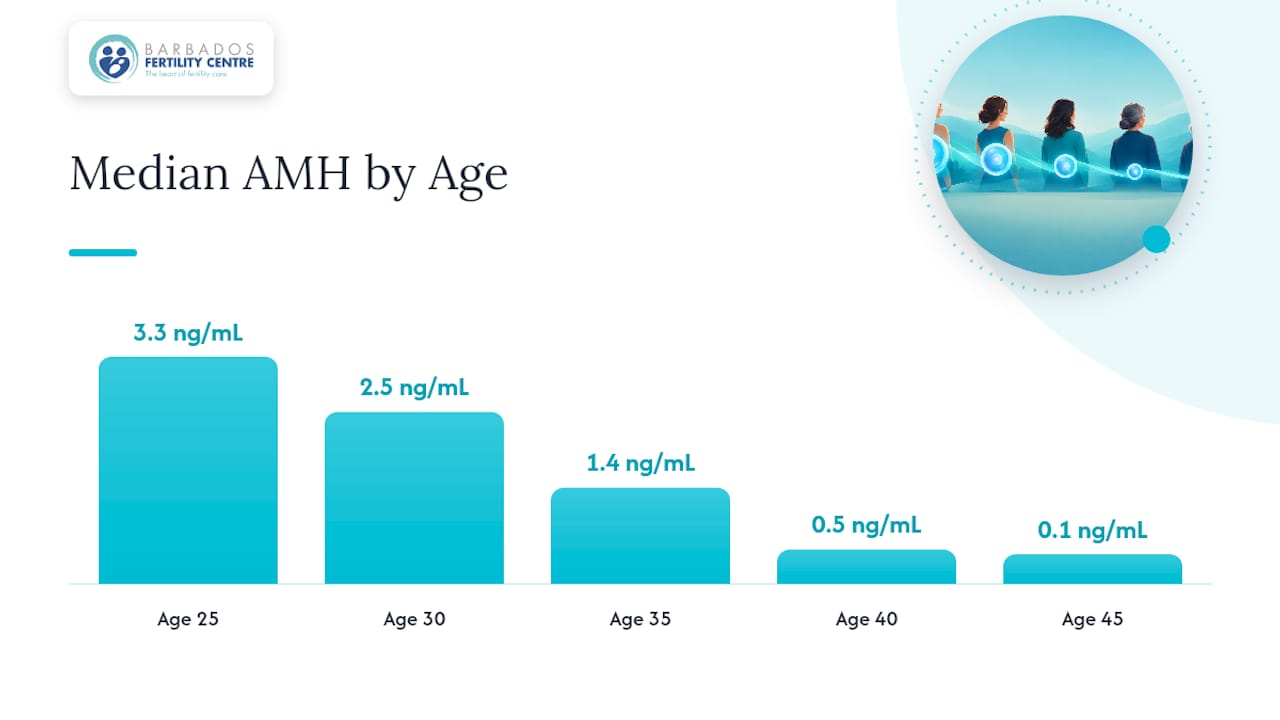
Median AMH runs about 3.3 ng/mL at 25, 2.5 ng/mL at 30, 1.4 ng/mL at 35, 0.5 ng/mL at 40, and 0.1 ng/mL at 45, according to a large 2025 cohort study. AMH tells you about egg quantity, not egg quality, and it does not predict whether you will conceive naturally or through treatment. If your result sits well outside the typical range for your age, that is the moment to talk it through with your OB/GYN or a reproductive endocrinologist.
TL;DR:
- AMH levels decline gradually with age, making small year-to-year differences normal and not necessarily concerning if within the typical age-specific range.
- An AMH below 0.7 to 1.0 ng/mL generally indicates a lower ovarian reserve, but studies show similar pregnancy rates over multiple cycles for women with such low values.
- Factors like hormonal contraceptive use, PCOS, endometriosis, previous ovarian surgery, and lab assay differences can temporarily or permanently alter AMH results without reflecting true ovarian reserve.
- In fertility treatments, AMH mainly helps plan stimulation protocols rather than predict natural conception success, as it has limited predictive power for pregnancy odds.
- A comprehensive assessment combining AMH, antral follicle count, cycle history, and personal goals provides a more accurate picture than relying on a single number for decision-making.
Table of Contents
- Age-stratified AMH values and how to read the chart
- What AMH measures, and what it can’t tell you
- Factors that change your AMH results
- How clinicians use AMH in fertility care
- When to test and how to prepare for an accurate result
- Interpreting your result by age: what counts as low
- Limitations of AMH and when to see a specialist
- A clinical perspective on individualized AMH interpretation
- Sources
- FAQ
Age-stratified AMH values and how to read the chart
Anti-Müllerian hormone declines steadily across the reproductive years, and a 2025 cohort of 22,920 women gives the clearest picture yet of what “typical” looks like at each age. The nomogram data show a smooth downward curve rather than a cliff edge, which matters because it means small year-to-year differences in your own number are expected and rarely alarming on their own.
| Age | Median AMH (ng/mL) |
|---|---|
| 25 | 3.3 |
| 30 | 2.5 |
| 35 | 1.4 |
| 40 | 0.5 |
| 45 | 0.1 |
These are median values, meaning half of women at that age test higher and half test lower. AMH is usually reported in nanograms per milliliter (ng/mL), though some labs use picomoles per liter (pmol/L), so it helps to confirm which unit your report uses before comparing it to any chart.
The decline is not linear. Earlier cohort work suggests AMH drops by roughly 0.2 to 0.3 ng/mL per year through the mid-30s, then slows somewhat after that point. By the mid-40s, many women test near the lower detection limit of the assay, which is expected as ovarian reserve approaches its natural endpoint.
What a chart cannot tell you is where you personally should sit within that range. Two 32-year-olds can have AMH values a full point apart and both be within normal biological variation. The number becomes useful when a clinician places it alongside your cycle history, antral follicle count, and family planning timeline rather than reading it in isolation.
What AMH measures, and what it can’t tell you
AMH is produced by granulosa cells surrounding small, developing follicles in the ovaries. The more early-stage follicles you have, the higher your AMH tends to read, which is why it works as a proxy for ovarian reserve, the pool of eggs remaining at any given time.
Where confusion creeps in is assuming that number also predicts your chances of getting pregnant. It does not, at least not reliably on its own.
- AMH reflects how many follicles are present, not how genetically or chromosomally sound the eggs inside them are.
- The ASRM committee opinion describes AMH as a marker of oocyte quantity, not oocyte quality, and notes that prospective trials found limited predictive power for natural conception.
- Referenced trials in that same guidance found that women with low AMH, generally below 0.7 to 1.0 ng/mL, showed cumulative pregnancy rates over 6 to 12 cycles similar to women with normal AMH.
- MedlinePlus reinforces this, describing AMH as a reflection of ovarian reserve that should be read alongside other clinical information rather than as a standalone predictor.
For someone weighing whether to try to conceive now or wait, this distinction changes the conversation. A lower-than-average AMH does not close the door on natural conception, but it can shift the urgency of decisions around fertility preservation or when to seek treatment. AMH is one input into that decision, not the verdict.
Factors that change your AMH results
A single AMH number can be misleading if you do not account for what might be shifting it that day. Several common factors push results up or down independent of your actual ovarian reserve.
- Hormonal contraceptives can lower measured AMH by roughly 30% within a couple of cycles of starting the pill, patch, or ring, so a low reading while on birth control deserves a second look before you draw conclusions.
- PCOS typically raises AMH because of the higher number of small antral follicles associated with the condition.
- Endometriosis, prior ovarian surgery, and certain autoimmune or medical conditions can lower AMH independent of age.
- Assay platform matters: Gen II, Elecsys, and Ansh Labs kits can produce different absolute values for the same blood sample, so comparing results across labs without knowing the assay used can be misleading.
- Biological variation within the same person from one cycle to the next can be substantial enough to affect clinical decisions, which is one reason some clinicians prefer trends over a single cutoff.
If you are on hormonal contraception and need a clear baseline, ask your clinician whether pausing it before testing makes sense for your situation, and disclose any relevant diagnoses before you test rather than after.
Pro Tip: Bring a list of current medications and any diagnosed reproductive conditions to your AMH blood draw, since a few details can change how your result should be read.
When a result looks unexpectedly low or high, or doesn’t match your antral follicle count on ultrasound, a repeat test or a complementary FSH measurement can help clarify whether the number reflects your actual reserve or a temporary influence.
How clinicians use AMH in fertility care
In an IVF setting, AMH earns its keep mainly as a planning tool rather than a prediction of pregnancy odds. Reproductive endocrinologists use it to anticipate how your ovaries are likely to respond to stimulation medication.
- A higher AMH often signals a stronger response to stimulation, which can prompt a lower starting medication dose to reduce the risk of ovarian hyperstimulation.
- A lower AMH can lead to a higher or adjusted stimulation protocol aimed at recruiting as many follicles as the ovaries can produce.
- AMH results can also influence timing conversations around egg freezing, particularly for someone considering delaying childbearing.
Prospective cohort data cited in ASRM’s guidance found limited predictive value of AMH for natural conception odds, which is why clinics pair AMH with other markers like antral follicle count and FSH before making treatment decisions. None of these numbers works well in isolation. A stimulation plan built on AMH alone, without imaging or a full history, risks over- or under-treating a patient whose actual response differs from what the blood test implied.
When to test and how to prepare for an accurate result
AMH does not fluctuate meaningfully across the menstrual cycle the way FSH or estradiol do, which gives you flexibility in scheduling.
- Book the test on any day of your cycle. Unlike day-3 FSH, AMH testing does not require cycle-day precision.
- Disclose hormonal contraceptive use. Tell your clinician if you are currently on the pill, patch, ring, or hormonal IUD, since this can lower your reading.
- Mention recent pregnancy or breastfeeding. Both can temporarily affect ovarian hormone levels and should factor into how your result is interpreted.
- List relevant conditions and medications. PCOS, endometriosis, prior ovarian surgery, and certain treatments can shift your number in either direction.
- Ask about a repeat test or AFC ultrasound. If your result is borderline or inconsistent with your history, a follow-up antral follicle count adds useful context.
A single blood draw is usually enough for a baseline. What matters more is making sure your clinician has the full picture before interpreting what that baseline means for you.
Interpreting your result by age: what counts as low
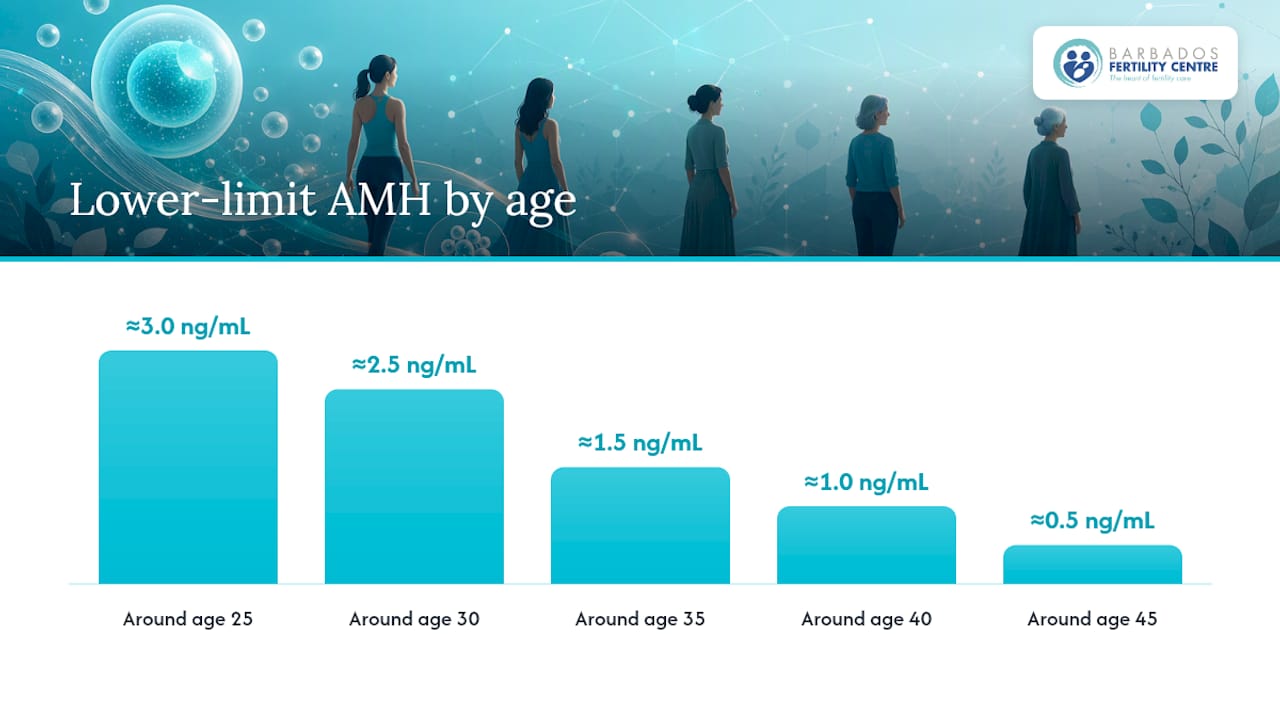
Clinical guidance offers rough, age-specific reference points to flag when a result warrants a closer look, though these are context markers rather than firm cutoffs. AJOG’s guide to ovarian reserve testing cites conservative lower-limit values used in fertility-clinic settings to identify when a number sits notably below what’s typical for age.
- Around age 25, values below roughly 3.0 ng/mL may prompt closer attention.
- Around age 30, the comparable lower-limit reference is roughly 2.5 ng/mL.
- Around age 35, it drops to roughly 1.5 ng/mL.
- Around age 40, roughly 1.0 ng/mL.
- Around age 45, roughly 0.5 ng/mL.
These age-specific lower-limit references, drawn from fertility-clinic populations, are used to flag results worth discussing rather than to diagnose infertility outright, a distinction ASRM’s own guidance reinforces by cautioning against treating any single AMH value as a pass or fail marker.
What actually changes based on where you land: a result meaningfully below the reference for your age might move up the timeline on a conversation about egg freezing, or prompt a referral to a reproductive endocrinologist sooner rather than later. A result within range, even if not high, does not remove the value of tracking family planning goals against your age and personal circumstances. The practical next step is the same at almost every age: bring the number to your OB/GYN or a fertility specialist, ask what it means combined with your cycle history and any imaging, and let that fuller picture, not the number alone, guide your timeline.
Limitations of AMH and when to see a specialist
AMH is a useful screening tool, but it has real limits worth keeping in mind before you treat one result as definitive. Assay differences between labs, natural biological fluctuation from one test to the next, and the absence of a single universal reference range all mean that context matters as much as the number itself. Guidance on premature ovarian insufficiency also cautions against using AMH alone to diagnose that condition, since FSH remains the primary marker in that specific scenario.
A few situations call for a specialist conversation rather than watching and waiting:
- Your AMH is notably lower than typical for your age, especially alongside irregular cycles.
- You have a family history of early menopause or premature ovarian insufficiency.
- You’ve been trying to conceive for six months to a year without success despite a normal-range AMH.
A reproductive endocrinologist will typically pair your AMH with an antral follicle count ultrasound and FSH testing, then walk through what the combined picture means for your specific timeline and goals, rather than relying on any single test.
A clinical perspective on individualized AMH interpretation
We read every AMH result as one piece of a larger picture, not a verdict. Two patients with nearly identical numbers can need very different plans depending on age, cycle history, and personal goals. An effective approach involves personalized interpretation, pairing AMH with antral follicle counts and a full medical history before recommending a path forward. Whether someone is exploring IVF, ICSI, or egg freezing, the number is treated as a starting point for a conversation, not the end of one.
— Barbados
This article is general information, not a substitute for advice from a qualified doctor. Consult a qualified healthcare professional about your own circumstances before acting on anything here.
Sources
- Age-stratified anti-Müllerian hormone (AMH) nomogram: a comprehensive cohort study including 22.920 women
- Testing and interpreting measures of ovarian reserve: a committee opinion (2020) – ASRM
- Effect of combined hormonal contraceptives on AMH levels (PMC)
- Anti-mullerian hormone (AMH) test – MedlinePlus
FAQ
What is a good AMH level to get pregnant?
There is no single AMH threshold that guarantees pregnancy, since AMH reflects egg quantity rather than the chance of conceiving. A result within the typical range for your age is reassuring for ovarian reserve, but the ASRM committee opinion notes that even low AMH does not necessarily lower cumulative pregnancy rates over several cycles.
What should your AMH be at 35?
Median AMH at 35 is about 1.4 ng/mL based on a large 2025 cohort study, though individual results vary widely and still fall within normal biological range on either side of that figure. A result notably below this level is worth discussing with a clinician, but it is not a diagnosis on its own.
Can I improve my AMH level naturally?
There is no established treatment or supplement proven to reliably raise AMH, since it reflects the follicles you already have rather than a hormone level you can boost. Some temporary changes in measured AMH relate to factors like hormonal contraceptive use rather than an actual change in ovarian reserve, which is why testing conditions matter more than lifestyle claims.
How many follicles should a woman have at age 37?
Antral follicle count varies by individual and is typically assessed by ultrasound alongside AMH rather than compared to a single universal number. A reproductive endocrinologist can interpret your specific count together with your AMH and cycle history to give you a picture that’s meaningful for your age and goals.